July 31, 2026
The Minerals That Western Defence Cannot Afford to Ignore
The global critical minerals conversation has shifted from academic policy discussion to genuine supply chain emergency. At the centre of that emergency sits a specific subset of rare earth elements: the heavy rare earths, particularly dysprosium, terbium, and yttrium. These are not interchangeable commodities with multiple sourcing options. They are precision inputs with no commercially viable substitutes in their primary applications, and the countries that control them increasingly understand exactly what that means for everyone else.
That geopolitical reality is the lens through which the Sovereign Metals Kasiya rare earth opportunity deserves to be examined. Not as a standalone rare earth development, but as a potentially transformative layer of upside sitting beneath a project that already passed its most rigorous financial scrutiny without any rare earth contribution included. Furthermore, understanding rare earth supply chains at a macro level is essential context before assessing any individual project's strategic position.
When big ASX news breaks, our subscribers know first
What the Kasiya DFS Already Established, Without Rare Earths
Before examining the rare earth angle, it is important to understand the foundation underneath it. Kasiya is not a speculative early-stage project in need of a narrative. The definitive feasibility study confirmed a 25-year operation processing 536 million tonnes of ore, producing two commodities with established markets and non-binding offtake arrangements already in place with Mitsui and Traxys.
| Metric | DFS-Confirmed Figure |
|---|---|
| Pre-tax NPV (8% discount rate) | US$2.2 billion |
| Internal Rate of Return | 23% |
| Steady-state rutile output (annual) | 222,000 tonnes |
| Steady-state graphite output (annual) | 275,000 tonnes |
| Steady-state EBITDA (annual) | US$476 million |
| Total revenue over mine life | US$16.2 billion |
| Capital expenditure to first production | US$727 million |
| NPV-to-capex ratio | 3.0x |
| Mine life | 25 years |
Kasiya holds DFS-confirmed status as the world's largest known natural rutile deposit and the second-largest known flake graphite deposit globally. The rutile market is structurally constrained, with natural rutile increasingly preferred over synthetic alternatives in titanium pigment and titanium metal production due to lower energy intensity and superior purity. The graphite market carries its own structural dynamics as battery anode demand continues to grow.
Why the Absence of Rare Earths From the DFS Is the Most Important Framing Detail
Every figure in the table above was calculated with zero contribution from heavy rare earths. That is the critical analytical point. The Sovereign Metals Kasiya rare earth opportunity, as it is now emerging, represents potential value layered on top of a project that has already been assessed, costed, and structured for financing. This is categorically different from a company with a rare earth project that needs to justify its economics from scratch.
Heavy Rare Earths: Why This Category Commands a Different Conversation
The rare earth sector is routinely misunderstood, partly because the phrase covers a chemically diverse group of 17 elements with vastly different market dynamics, supply profiles, and end-use applications.
The Light Versus Heavy Distinction That Most Investors Miss
Light rare earth elements (LREEs) such as cerium, lanthanum, and neodymium are more abundant in nature and processed at higher volumes globally. Heavy rare earth elements (HREEs) including dysprosium, terbium, and yttrium are rarer, more geologically concentrated in fewer deposit types, and carry significantly higher per-kilogram value. The conventional rare earth industry, including most Western producers and processors, is heavily skewed toward light rare earths. The heavy fraction of a typical rare earth basket is often small in percentage terms but disproportionate in commercial value.
Heavy rare earth elements are not simply more expensive versions of lighter counterparts. They occupy entirely different positions in critical technology supply chains, and their absence cannot be engineered around in high-performance permanent magnet applications.
Dysprosium and Terbium: The Magnet Materials Underpinning Modern Defence
Dysprosium and terbium serve a specific and irreplaceable function in NdFeB (neodymium-iron-boron) permanent magnets: they maintain coercivity, meaning the magnet's ability to resist demagnetisation, at elevated operating temperatures. Without dysprosium and terbium additions, NdFeB magnets lose performance under the thermal conditions encountered in electric vehicle drivetrains, precision-guided munitions, submarine propulsion systems, and aircraft actuators. No substitute has been commercialised. The demand for both elements is structurally tied to the growth of electric mobility and advanced defence platforms simultaneously.
Yttrium: The Heavy Rare Earth With the Broadest Technology Footprint
Yttrium is less discussed than dysprosium and terbium but arguably has the most diverse set of critical applications. It is used in yttria-stabilised zirconia thermal barrier coatings that protect aircraft turbine blades at extreme temperatures, in yttrium-aluminium garnet (YAG) lasers used across medical, industrial, and military settings, in phosphors for displays and LED lighting, and in semiconductor manufacturing processes. Critically, the United States imports essentially 100% of its yttrium consumption and has no domestic production. MP Materials, the most prominent rare earth producer in the US, reports no measurable yttrium, dysprosium, or terbium in its Mountain Pass operation, which is dominated by light rare earth mineralogy.
China's Control of the Heavy Rare Earth Supply Chain
China controls approximately 95% of global heavy rare earth output, a concentration that has moved from a long-noted vulnerability to an active policy flashpoint. China's export restrictions imposed in April 2025 specifically targeted dysprosium, terbium, and yttrium. In January 2026, those controls were extended to cover dual-use items affecting exports to Japan. On February 24, 2026, US Assistant Secretary for Industrial Base Policy Michael P. Cadenazzi Jr. testified before the Senate Armed Services Committee that the United States imports nearly 100% of its heavy rare earth consumption, with approximately 90% of that sourced from China. His assessment of that dependency, characterising it as a direct threat to national security, set the policy backdrop against which recent capital market transactions have been priced.
Kasiya's Monazite Chemistry: What the Pit-by-Pit Data Actually Shows
Monazite is a phosphate mineral that concentrates rare earth elements, often with a particular affinity for the heavy fraction when geological conditions are favourable. At Kasiya, monazite has been identified in the non-conductor tailings stream of the rutile processing circuit, meaning it concentrates in material that would otherwise be discarded under the current DFS flowsheet.
Four Pits, One Consistent Pattern
Testwork was conducted across four pits already embedded in the approved DFS mine plan: Babbler, Kingfisher, Sparrow, and Mousebird. The geographic and geological diversity across these pits is an important detail. A result from a single pit could reflect a localised anomaly. A consistent pattern across four separate pits within the same deposit provides a stronger basis for inference about deposit-wide characteristics, though formal resource quantification remains subject to the forthcoming mineral resource estimate.
| TREO Basket Component | Kasiya Average (All Depths) | Near-Surface Average (0-6m) | Below 6m Average | Global Top-5 Producers Average |
|---|---|---|---|---|
| Dysprosium + Terbium combined | 2.5% | 2.9% | 2.3% | 0.4% |
| Yttrium | 11.8% | 15.4% | 10.3% | 1.7% |
| Relative enrichment ratio (Dy+Tb) | ~6x | Higher | Lower | Baseline |
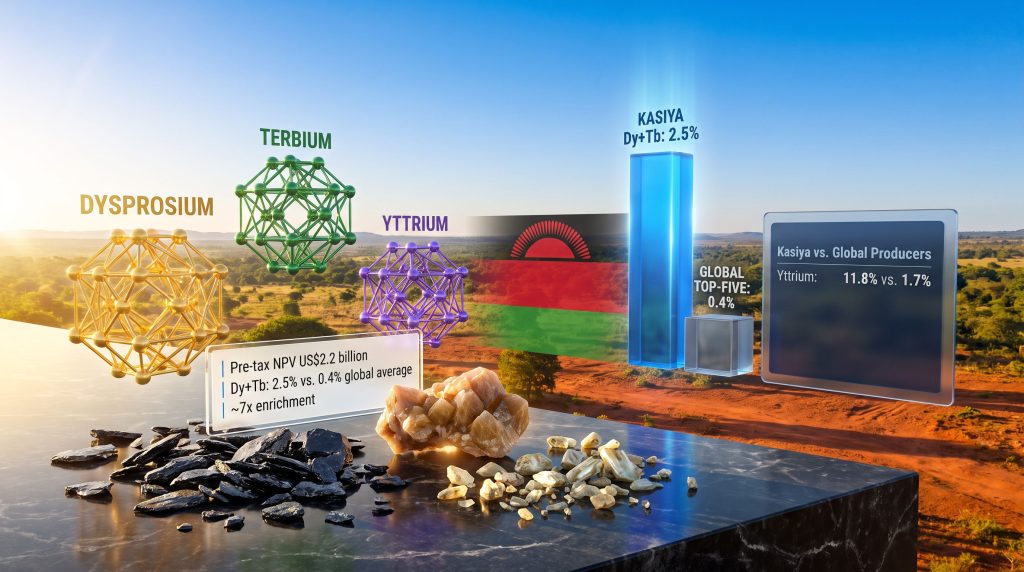
The comparison with the world's five largest rare earth producers is striking. A combined dysprosium and terbium proportion of 2.5% of the TREO basket versus a peer average of 0.4% represents approximately a sixfold to sevenfold enrichment. For yttrium, the differential is even more pronounced: 11.8% at Kasiya versus 1.7% across the peer group. These are not marginal differences in chemistry. They represent a fundamentally different deposit profile in terms of heavy rare earth concentration. For further background on Kasiya's rare earth potential, independent analysis has noted how this enrichment profile broadens its strategic financing appeal.
The Near-Surface Enrichment Detail That Matters for Production Scheduling
The grade variation with depth carries operational significance beyond its geological interest. Near-surface material, from zero to six metres depth, recorded 2.9% dysprosium and terbium combined and 15.4% yttrium. Below six metres, those figures fall to 2.3% and 10.3% respectively. Because the Kasiya mine plan sequences early production through these same four pits, the heaviest concentration of high-value rare earth elements would theoretically be accessible in the earliest production periods. This near-surface enrichment pattern, if confirmed by the mineral resource estimate and technical-economic study, could mean that any monazite revenue stream begins at its highest-grade point.
The By-Product Economics: Where the Opportunity Sits in the Flowsheet
Understanding the commercial case requires understanding where monazite sits in relation to the existing processing infrastructure, rather than treating it as a separate mining proposition.
How Monazite Reports Through the DFS Processing Circuit
- Ore is mined and fed into the DFS-specified rutile and graphite processing circuit.
- Through the electrostatic separation stage, minerals are divided into conductor and non-conductor fractions.
- Monazite, a non-conductor, reports to the tailings stream alongside other non-economic non-conductor minerals.
- Under the current DFS plan, this non-conductor tailings stream is directed to the tailings storage facility.
- Sovereign's proposition is that a recovery step could be inserted to concentrate the monazite before the tailings stream is stored, producing a saleable concentrate.
- The company's position is that this recovery step would require no new primary mining circuit, no additional ore processing, and minimal additional reagent consumption.
- The actual capital and operating cost of this step will be determined by the forthcoming technical-economic study.
What Remains Unverified and Why It Matters
The low incremental cost characterisation is a company estimate based on processing logic, not a costed engineering outcome. Several elements require independent technical assessment before the economics can be treated as confirmed:
- Full mineralogical characterisation of the monazite, including liberation behaviour and deportment through the circuit
- Assessment of thorium and uranium content, both naturally occurring in monazite, and the regulatory and handling requirements this creates
- Capital requirements for any downstream processing, separation, or refining capability to meet concentrate specifications
- Concentrate purity and specification requirements for potential offtake buyers, which will determine the extent of downstream processing required
The monazite by-product thesis is internally coherent and technically plausible based on what is publicly known about the processing flowsheet. However, the distance between plausible and costed is exactly where the technical-economic study needs to travel.
Comparable Transactions and What They Reveal About Market Pricing
Two transactions completed in early 2026 provide the most relevant benchmarks for understanding how Western capital is currently valuing non-Chinese heavy rare earth supply.
| Transaction | Date | Value | Key Terms |
|---|---|---|---|
| USA Rare Earth acquires Serra Verde Group (Brazil) | April 20, 2026 | ~US$2.8 billion | 15-year offtake, 100% US Government guarantee; Dy floor US$575/kg; Tb floor US$2,050/kg |
| Energy Fuels acquires Australian Strategic Materials (ASX) | January 20, 2026 | US$299 million | Strategic heavy rare earth supply acquisition |
The Serra Verde transaction is particularly instructive. A US government-backed price floor of US$575 per kilogram for dysprosium and US$2,050 per kilogram for terbium, underwritten over 15 years, reflects a willingness to commit public capital to securing heavy rare earth supply chains at valuations substantially above recent spot market pricing. The Energy Fuels acquisition of Australian Strategic Materials confirms that this is not a single transaction anomaly. In addition, the rare earth geopolitical impact of these deals signals a broader structural shift in how Western governments are approaching supply chain security.
Monazite Concentrate Pricing: The Ex-China Premium in Context
Independent forecasting from Project Blue shows a meaningful gap between Chinese benchmark pricing and what ex-China buyers are currently prepared to pay for monazite concentrate with a HREE-enriched chemistry.
| Price Scenario | Forecast (60% TREO Monazite Concentrate) |
|---|---|
| Project Blue 2026 Base Case | US$16,000 per tonne |
| Project Blue 2026 High Case | US$19,000 per tonne |
| April 2026 Shanghai Metals Market Benchmark (54-55% TREO) | ~US$6,142 per tonne |
The divergence between approximately US$6,142 per tonne on the Shanghai Metals Market and Project Blue's base case of US$16,000 per tonne for a HREE-rich concentrate reflects a structural bifurcation in the monazite market. Buyers outside China, particularly those seeking supply chain independence, are paying a premium that reflects scarcity, security of supply considerations, and the cost of building alternative processing capacity. It is important to note that Sovereign has not signed any offtake or sales agreement for monazite concentrate, and realised prices will ultimately depend on negotiated terms and market conditions at the time of production.
The next major ASX story will hit our subscribers first
Key Milestones That Will Determine Whether This Thesis Converts Into Disclosed Value
The Sovereign Metals Kasiya rare earth opportunity currently sits at an early evaluation stage relative to the DFS-confirmed rutile and graphite business. Converting the opportunity into quantified, contracted value requires a specific sequence of milestones.
Milestone 1: Technical-Economic Study and Maiden Rare Earth Mineral Resource Estimate
This is the single most important near-term catalyst. The maiden rare earth MRE converts testwork chemistry into a reportable resource under JORC or equivalent standards, providing the tonnage and grade basis required for any economic assessment. Simultaneously, the technical-economic study will produce the first engineering cost estimate for monazite recovery, confirming or revising the low incremental cost thesis. Until both are published, the rare earth opportunity remains a favourable grade comparison rather than a costed revenue stream.
Milestone 2: Binding Offtake Agreements for Rutile and Graphite
Progress from non-binding arrangements with Mitsui and Traxys toward executed binding offtake agreements would de-risk the base-case DFS economics independently of any rare earth contribution. A rare earth offtake agreement of this nature is typically a prerequisite for project debt financing and significantly reduces the execution risk profile.
Milestone 3: Mining Licence Grant and IFC Financing Progress
The underlying project's advancement depends on Malawi's Mining and Minerals Regulatory Authority granting the mining licence and on continued engagement with the International Finance Corporation on project financing. These are the structural gating items for the project as a whole.
Investor checklist for monitoring progress:
- Publication of the maiden rare earth mineral resource estimate under reporting standards
- Technical-economic study confirming or revising the incremental cost thesis for monazite recovery
- Binding offtake agreement execution with Mitsui and Traxys for rutile and graphite
- Mining licence grant from Malawi's Mining and Minerals Regulatory Authority
- International Finance Corporation financing engagement and outcome
How the Rare Earth Layer Changes the Investment Case Structure
The structural position of the Sovereign Metals Kasiya rare earth opportunity within the broader project economics deserves careful analytical framing.
| Scenario | Revenue Drivers | NPV Basis |
|---|---|---|
| Base Case (DFS Only) | Rutile and graphite | US$2.2B pre-tax NPV8% |
| Upside Case (DFS + Monazite) | Rutile, graphite, and monazite by-product | Unquantified, pending technical-economic study |
The key structural insight is that because the monazite opportunity sits entirely outside the DFS, any positive outcome from the technical-economic study and MRE represents genuine incremental value rather than a reallocation from within an existing estimate. Unlike a standalone rare earth company that must justify its entire capital structure against rare earth pricing assumptions, Kasiya's rare earth potential is assessed against a project that already achieves a 23% IRR and a 3.0x NPV-to-capex ratio without it.
This structural position reduces the sensitivity of the overall investment thesis to rare earth pricing uncertainty. If the monazite economics prove commercially viable, the impact is additive. If the technical-economic study reveals unfavourable cost or regulatory outcomes, the base-case project economics remain intact. That asymmetry is the most analytically relevant feature of the rare earth opportunity as it currently stands.
Three conditions would need to be satisfied for the monazite opportunity to materially shift Kasiya's disclosed valuation:
- The maiden MRE must confirm sufficient tonnage and grade to support commercial-scale recovery.
- The technical-economic study must confirm that incremental capital and operating costs are low enough to justify recovery relative to prevailing monazite concentrate prices.
- An offtake agreement, or at minimum a non-binding heads of agreement, must be established with a buyer willing to pay an ex-China premium for HREE-enriched monazite concentrate.
Frequently Asked Questions: Sovereign Metals Kasiya Rare Earth Opportunity
What rare earth elements have been confirmed at Kasiya?
Testwork conducted across four planned pits, Babbler, Kingfisher, Sparrow, and Mousebird, has identified monazite concentrate containing dysprosium, terbium, and yttrium. These are classified as heavy rare earth elements and carry significant strategic and commercial value given current supply chain constraints driven by Chinese export controls.
Are the Kasiya rare earths included in the project's DFS valuation of US$2.2 billion?
No. The DFS was constructed entirely on rutile and graphite economics. Any rare earth contribution represents potential upside that sits entirely outside the existing project valuation and has not been included in any financial modelling published to date.
How does Kasiya's rare earth chemistry compare to major global producers?
The combined dysprosium and terbium proportion within the total rare earth oxide basket averages approximately 2.5% across the four tested pits, compared to roughly 0.4% across the world's five largest rare earth producers. Yttrium averages 11.8% versus 1.7% for the same peer group, representing an enrichment factor of approximately seven times.
What processing infrastructure would be required to recover monazite at Kasiya?
Sovereign indicates the monazite concentrate reports from the non-conductor tailings stream of the existing DFS-specified processing circuit. The company's position is that recovery may not require a new primary mining circuit or significant additional reagent consumption, though this remains subject to confirmation by the forthcoming technical-economic study and regulatory assessment of monazite handling requirements.
What is the current status of the Kasiya rare earth opportunity?
The opportunity is at an early evaluation stage. A dedicated technical-economic study and maiden rare earth mineral resource estimate are underway. No rare earth resource has been formally declared under reporting standards, no production plan exists, and no monazite offtake agreement has been signed. For the latest details directly from the company, the Kasiya project page on Sovereign Metals' website provides current updates on progress and milestones.
What are the biggest risks to the Kasiya monazite opportunity?
Key risks include:
- The technical-economic study returning unfavourable cost or engineering outcomes
- Regulatory complexity associated with thorium and uranium content in monazite concentrate
- The absence of a declared mineral resource under formal reporting standards
- No confirmed offtake pricing or commercial arrangement for monazite concentrate
- Dependency of the entire project on the underlying mining licence grant in Malawi
- Market pricing uncertainty for monazite concentrate if ex-China premiums narrow
Who are the strategic partners involved in the Kasiya project?
Sovereign Metals (ASX: SVM | AIM: SVML | OTCQX: SVMLF) has non-binding offtake arrangements with Mitsui and Traxys for its rutile and graphite production, and is engaged with the International Finance Corporation on project financing. No strategic partner or offtake counterparty has been announced for the rare earth stream.
The Honest Assessment: Where Opportunity Ends and Uncertainty Begins
The Sovereign Metals Kasiya rare earth opportunity is genuinely distinctive in several ways. The HREE enrichment profile of the monazite is materially superior to most comparable producers. The by-product recovery logic is technically coherent. The macro environment, shaped by Chinese export controls, US Senate testimony on supply chain vulnerability, and multi-billion dollar transactions securing non-Chinese heavy rare earth supply, has rarely been more favourable. Critically, the rare earth opportunity sits on top of a project with already-confirmed scale and economics, not underneath one that needs rare earths to justify its existence.
However, the gap between a favourable chemistry comparison and a contracted revenue stream is real and measurable. It will close, or not, through the technical-economic study, the mineral resource estimate, and the regulatory pathway for monazite handling. Those are the documents and approvals that will determine whether the Sovereign Metals Kasiya rare earth opportunity transitions from compelling geological evidence into a quantifiable third revenue stream.
Until that transition is confirmed, the most accurate analytical framing is this: Kasiya's base case stands on its own merits at a US$2.2 billion pre-tax NPV. Everything in the monazite story represents potential upside that the market has not yet been asked to price.
This article is intended for informational purposes only and does not constitute financial advice. All forecasts, price projections, and economic estimates referenced are subject to material uncertainty. Readers should conduct independent due diligence before making any investment decisions. Past performance and preliminary study outcomes are not indicative of future results.
Want to Track the Next Major Critical Minerals Discovery the Moment It Hits the ASX?
Discovery Alert's proprietary Discovery IQ model scans ASX announcements in real time, instantly identifying significant mineral discoveries across rare earths, rutile, graphite, and more than 30 other commodities — turning complex data into actionable insights before the broader market reacts. Explore how historic discoveries have generated substantial returns on Discovery Alert's dedicated discoveries page, and begin your 14-day free trial today to position yourself ahead of the next major find.