July 31, 2026
The Invisible Bottleneck Reshaping the Global Rare Earth Industry
The permanent magnet supply chain has a structural problem that most investors still underestimate. More than 90% of the world's heavy rare earth processing capacity sits within a single country's borders, and the deposits that feed that capacity are geographically clustered in regions carrying escalating geopolitical risk. Dysprosium and terbium, the two elements that determine whether a permanent magnet can withstand high operating temperatures inside an electric vehicle drivetrain or a wind turbine generator, flow almost entirely from ionic clay deposits in southern China and, increasingly, from Myanmar, a jurisdiction with significant supply chain reliability concerns.
This concentration isn't a new phenomenon. It developed over decades as Western manufacturers optimised for cost rather than supply security. The consequence is a permanent magnet supply chain with virtually no redundancy at the heavy rare earth end, and a growing scramble by downstream manufacturers, governments, and resource developers to identify credible alternative sources before demand curves for EV motors and grid-scale wind installations make the problem acute. Furthermore, understanding the rare earth supply chain reveals just how fragile the current structure has become.
That structural backdrop is precisely the lens through which the Cobra Resources Wudinna rare earth project in South Australia needs to be evaluated. Not as a standalone junior mining story, but as a potential contributor to one of the most pressing materials supply problems facing the energy transition.
When big ASX news breaks, our subscribers know first
What Makes Ionic Adsorption Clay Deposits Fundamentally Different
To understand why Wudinna is attracting attention, it helps to understand what ionic adsorption clay mineralisation actually is, and why it behaves so differently from conventional rare earth rock.
In most hard rock rare earth deposits, the target elements are locked within the crystal lattice of resistant minerals like bastnäsite or monazite. Liberating those elements requires crushing, high-temperature roasting, and aggressive chemical processing. The result is a capital-intensive flowsheet with significant tailings management requirements and environmental complexity.
Ionic adsorption clays work on an entirely different principle. Rare earth elements are held on the surface of clay mineral particles in an exchangeable ionic state, a product of chemical weathering acting on granitic or volcanic parent rock over geological timescales. Because the elements aren't structurally locked, they can be displaced from the clay surface by introducing a competing cation, typically ammonium sulphate, in solution. The rare earths detach, move into solution, and can be recovered downstream without any physical excavation or grinding of rock.
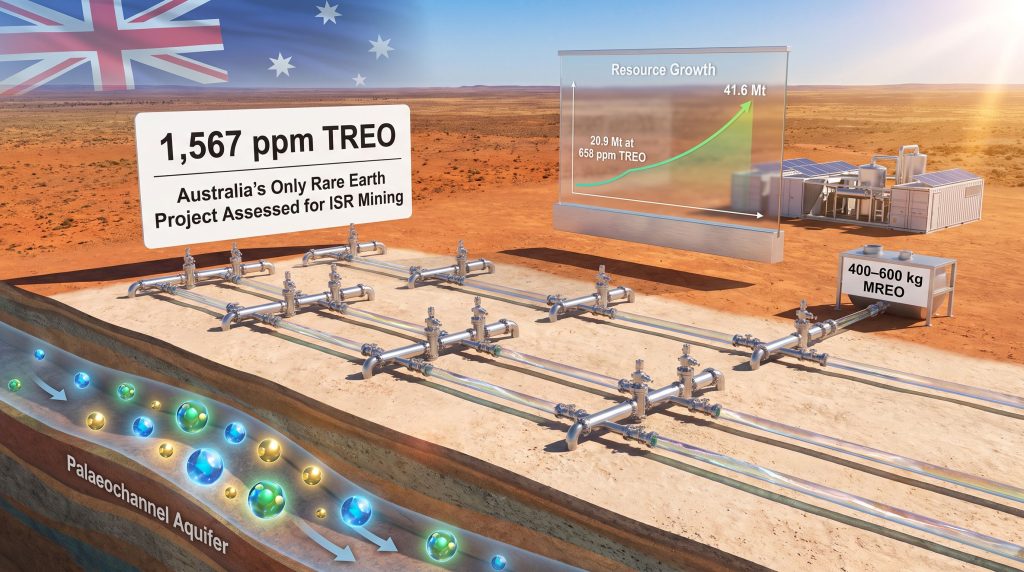
Key distinction: The ionic adsorption mechanism is what makes in situ recovery (ISR) technically viable for these deposits. The same chemistry that occurs in a heap leach can, under the right hydrogeological conditions, be replicated underground by circulating lixiviant through the ore-bearing aquifer via a wellfield network, recovering dissolved rare earths from solution at surface.
This has several profound implications for project economics. There are no open pits, no underground workings, no blasting, no crushing circuits, and no tailings storage facilities. The surface footprint of an ISR operation is a fraction of that of a conventional mine, which carries significant advantages for environmental approvals and community acceptance. In addition, the in-situ leaching benefits extend well beyond cost savings, offering meaningful reductions in land disturbance and rehabilitation obligations.
The critical technical variable that determines whether ISR is viable is aquifer permeability. The lixiviant solution must be able to move through the ore-bearing material at sufficient rates to achieve economic recovery. If permeability is too low, the process stalls. This is why permeability data is among the most consequential technical information a company developing an ionic rare earth ISR project can publish.
Wudinna's Geological Architecture and Why Palaeochannels Matter
The Cobra Resources Wudinna rare earth project sits within the Gawler Craton in South Australia, one of Australia's most ancient geological provinces. The rare earth mineralisation is hosted within palaeochannel systems, ancient buried river valleys that operated during periods when the Australian landscape was dramatically wetter than today.
These palaeochannels are significant for two reasons. First, the fluvial processes that carved and filled them concentrated fine-grained clay-rich sediments that are particularly effective at adsorbing ionic rare earths. Second, the buried nature of the channels means the mineralisation is sealed from modern weathering and erosion, preserving the ionic character of the rare earth content.
The Wudinna project encompasses multiple prospects, with the Boland and Head Prospects forming the current core of resource definition activity. An existing wellfield at Boland provides a functioning operational baseline against which other prospects can be benchmarked technically.
Earlier JORC-compliant disclosures established a resource of 20.9 million tonnes at 658 ppm TREO at the Clarke and Baggy Green prospects, with a broader figure of 41.6 million tonnes cited in relation to the wider Wudinna project footprint. The 74-hole Sonic core drilling programme completed across Boland and Head is designed to generate the dataset required to consolidate these areas into a single, updated Mineral Resource Estimate.
Drilling Results and What the Grade Profile Signals to the Market
The completed 74-hole Sonic core programme across approximately 3,200 metres of drilling has confirmed mineralisation continuity across the Head Prospect, with high-grade zones identified on both the eastern and western margins of the palaeochannel system. All assay results have been received.
Head Prospect Assay Results: Key Intersections
| Intersection | TREO Grade | Interval | Depth From Surface |
|---|---|---|---|
| Best result | 1,567 ppm TREO | 2.35 m | 11 m |
| Second result | 916 ppm TREO | 2.75 m | 38.3 m |
| Third result | 710 ppm TREO | 4.4 m | 27.1 m |
| Fourth result | 504 ppm TREO | 2.8 m | 36.1 m |
The best intersection carries particular significance beyond its headline grade. At 505 ppm neodymium-praseodymium and 17 ppm dysprosium-terbium, it confirms that the heavy rare earth enrichment characteristic of ionic clay deposits elsewhere in the world is present at Wudinna. Dysprosium and terbium are the elements that command the highest unit values among the rare earth group and are the most supply-constrained relative to projected permanent magnet demand.
The shallow depth of the best intersection, beginning at just 11 metres below surface, is also technically meaningful. Shallower mineralisation requires less wellfield infrastructure per unit area of ore body and reduces the energy required to circulate lixiviant through the system, both of which benefit the operating cost profile of an ISR operation.
Permeability Testing: The Technical Proof Point Investors Should Focus On
Of all the technical data Cobra has published on the Cobra Resources Wudinna rare earth project, the permeability results arguably carry the most weight in assessing ISR viability.
Particle-size distribution analysis was conducted on 50 samples drawn from across both the Boland and Head Prospects. The result: 70% of tested samples demonstrated permeability equal to or exceeding that of the existing Boland wellfield, which is already operational.
This benchmark matters because it isn't a theoretical laboratory comparison. The Boland wellfield represents a real-world operating system. Demonstrating that the majority of material from the wider drilled footprint matches or betters its hydraulic characteristics means the case for ISR applicability across the expanded resource area is grounded in operational data rather than modelling assumptions.
Technical risk context: In ISR development globally, permeability failures have been among the most common reasons projects do not proceed from feasibility to construction. A dataset showing 70% of samples meeting an operational benchmark represents a meaningful reduction in what is typically the dominant technical risk variable for this extraction method.
Cobra has also confirmed completion of baseline hydrological assessment requirements, satisfying a key regulatory prerequisite for production permitting in South Australia. This places the permitting pathway on a concurrent track with the resource estimate and scoping study workstreams rather than lagging behind them.
Metallurgical Recovery: What the Testwork Programme Is Targeting
Metallurgical testing of 43 samples from both the Head and Boland Prospects is ongoing to establish recovery parameters across the wider resource area. Two bulk composite samples of approximately 100 kg each have been prepared for detailed testwork that will define production parameters for the small-scale study.
Three specific areas of metallurgical investigation are worth understanding in depth:
-
Ammonium sulphate reduction trials: The Boland site hosts naturally occurring saline groundwater. Testwork is evaluating whether this groundwater can partially substitute for ammonium nitrate as the lixiviant, reducing reagent costs. If validated, this would represent a site-specific cost advantage with no analogue at most competing ionic rare earth projects globally.
-
pH management protocols: ISR processing of ionic clays generates natural acid conditions as a by-product of ion exchange reactions. Managing pH is essential both for controlling which elements dissolve and for preventing the mobilisation of contaminant species that would complicate downstream processing.
-
Crude product precipitation: The testwork is establishing specifications for an intermediate product that can be transported to external processing facilities, avoiding the need for a standalone separation plant on site.
Published benchmarks from earlier testwork reported recoveries of up to 58% Mixed Rare Earth Oxide (MREO) and 65% Heavy Rare Earth Oxide (HREO) at pH 3. The heavy rare earth recovery figure is particularly relevant: at above 60%, it is technically competitive with the recovery rates achieved at established ionic clay operations in southern China. Replicating that performance under field ISR conditions, rather than in a laboratory setting, is the purpose of the small-scale production demonstration planned for 2027.
The next major ASX story will hit our subscribers first
The Small-Scale Production Plan: Why This Is a Bankability Exercise, Not a Commercial Launch
Preliminary engineering and process modelling for a small-scale production facility at the existing Boland wellfield are complete. The design is structured around an integration between ISR field operations and the processing infrastructure at the Australian Nuclear Science and Technology Organisation (ANSTO) pilot plant.
Small-Scale Production Study Parameters
| Parameter | Detail |
|---|---|
| Target output | 400 to 600 kg Mixed Rare Earth Oxides |
| Field trial duration | Approximately 60 days |
| Number of wellfields | Up to four |
| Processing partner | ANSTO pilot facility |
| ANSTO scope | Dissolution, impurity removal, cerium suppression, precipitation |
| Target commencement | First half of 2027 |
The four-wellfield design allows simultaneous testing of natural acid generation, pH management, sequential element recovery, and site remediation within a single field trial. This is significant because it means the demonstration generates data across the full operational cycle of an ISR mine, not just the extraction phase.
The output of 400 to 600 kg of mixed rare earth oxides is not positioned as a commercial milestone. It is a techno-economic data generation exercise. The recovery rates, reagent consumption figures, solution chemistry profiles, and remediation performance generated during the 60-day field component will feed directly into the economic modelling assumptions of a future bankable feasibility study. Demonstrating production of a saleable intermediate product also strengthens the company's credibility in early-stage offtake discussions with downstream processors.
South Australia's ISR Regulatory Familiarity: An Underappreciated Jurisdictional Advantage
The regulatory environment for ISR mining varies enormously between jurisdictions. In states or countries where ISR is a novel extraction method, regulators lack the institutional knowledge to assess environmental management plans efficiently, creating permitting delays that can add years to development timelines.
South Australia occupies a structurally advantaged position in this regard. The state has an established ISR regulatory history through the uranium sector, particularly in the Olympic Dam region, where fluid-based extraction methods have been assessed and permitted for decades. Regulators understand the hydrogeological monitoring requirements, the remediation obligations, and the environmental management frameworks applicable to ISR operations.
For the Cobra Resources Wudinna rare earth project, this means permitting discussions proceed from a baseline of mutual technical understanding rather than regulatory first principles. Environmental consultants JBS&G Environmental Consultants and Rendement Consulting have been engaged to advance the permitting programme, with approvals for the small-scale production demonstration being pursued in parallel with the resource estimate and scoping study.
Development Roadmap: Key Milestones and Sequencing
| Milestone | Status | Timing |
|---|---|---|
| 74-hole Sonic drilling programme | Complete | Completed 2026 |
| All assay results received | Complete | Completed 2026 |
| Maiden Mineral Resource Estimate (ERM engaged) | In progress | Weeks from July 2026 |
| Scoping study | Pending MRE | Following MRE |
| Small-scale production permitting | In progress | Ongoing |
| Small-scale production demonstration | Engineering complete | H1 2027 |
| Manna Hill Copper Project advancement | Concurrent | Ongoing |
The pace of development from initial ionic rare earth discovery in 2023 to completed drilling, pending maiden resource estimate, and fully engineered small-scale production plan in 2026 is notable by junior mining standards. Most ionic rare earth projects outside of China have spent considerably longer at the equivalent development stage, partly because the deposit type is less well understood by Western technical consultants and partly because ISR permitting is genuinely complex in less experienced regulatory jurisdictions.
The concurrent advancement of the Manna Hill Copper Project in the Nackara Arc, optioned in 2025, provides a second value catalyst that is independent of rare earth market conditions. However, the rare earth processing challenges facing the broader sector make Wudinna's ISR-focused approach a compelling point of differentiation. This concurrent development is a useful risk distribution mechanism for investors monitoring the company's broader portfolio.
Comparing Wudinna to the Rare Earth Project Landscape
| Attribute | Wudinna (Cobra Resources) | Conventional Hard Rock REE Project | Established Ionic Clay (China/Myanmar) |
|---|---|---|---|
| Extraction method | ISR, no excavation | Open cut or underground | ISR or heap leach |
| Heavy REE enrichment | Confirmed (Dy, Tb) | Generally light REE dominant | Present |
| Surface disturbance | Minimal | High | Moderate |
| Capital intensity | Lower | High | Low to moderate |
| Jurisdiction risk | South Australia (tier-one) | Variable | Elevated geopolitical risk |
| Processing partner | ANSTO pilot facility | Independent | State-owned enterprises |
The competitive positioning of the Cobra Resources Wudinna rare earth project relative to conventional alternatives is strongest at two points: the environmental and capital cost profile of ISR versus open-cut mining, and the heavy rare earth enrichment profile relative to the light rare earth-dominant hard rock projects that represent most of Australia's rare earth pipeline.
Dysprosium and terbium are not interchangeable with lanthanum or cerium in permanent magnet applications. Consequently, a project that can demonstrate credible recovery of heavy rare earths at commercially relevant grades addresses a different and more acutely supply-constrained market segment than the majority of Australian rare earth development activity. The broader critical minerals demand picture reinforces the strategic urgency of developing credible non-Chinese sources of heavy rare earth supply.
Key Risks Investors Should Monitor
While the technical and strategic case for Wudinna is substantive, several variables will materially influence the project's trajectory. The rare earth geopolitics shaping global supply decisions add further weight to the importance of resolving these risks efficiently. Key considerations include:
-
Maiden MRE outcomes: The grade and tonnage of the consolidated resource estimate will determine whether the project's scale supports commercially viable production. Earlier resource figures provide directional context but the new estimate incorporating Head and Boland is the operative dataset.
-
Field versus laboratory recovery rates: Metallurgical benchmarks of 58% MREO and 65% HREO were established under controlled conditions. Replicating these under field ISR conditions is the central technical question the 2027 production demonstration will answer.
-
Permitting timeline: Regulatory approvals for the small-scale demonstration remain in progress. Delays at this stage would push back the data generation required for bankable feasibility.
-
Rare earth oxide pricing: Dysprosium and terbium prices are subject to significant volatility. Project economics at scoping study stage will be sensitive to prevailing and forecast price assumptions for these elements.
-
Lixiviant cost validation: The potential to use saline Boland groundwater as a partial ammonium sulphate substitute is a meaningful operating cost variable that remains subject to testwork confirmation. Further detail on Cobra's mineral resources provides broader context for evaluating the company's overall asset base.
Disclaimer: This article contains forward-looking statements and analysis based on information available at the time of writing. Mineral resource estimates, production targets, metallurgical recovery rates, and timelines are subject to material change. This content does not constitute financial or investment advice. Readers should conduct independent research and consult a licensed financial adviser before making investment decisions.
Want to Position Yourself Ahead of the Next Major Mineral Discovery?
Discovery Alert's proprietary Discovery IQ model delivers real-time alerts on significant ASX mineral discoveries — including critical and rare earth metals shaping the energy transition — instantly converting complex data into actionable insights for investors at every experience level. Explore how historic discoveries have generated substantial returns on Discovery Alert's dedicated discoveries page, and begin your 14-day free trial today to ensure you're never behind the market on the next major find.