July 31, 2026
The Industrial Chain That Took China Decades to Build Is Being Reconstructed in North America in Just a Few Years
Rare earth supply chains do not fail suddenly. They erode gradually, through decades of outsourcing decisions that each seemed rational in isolation but collectively hollowed out an entire industrial capability. By the time Western governments recognised the strategic consequences, China controlled not just the mining of rare earth elements but the separation, metallization, and magnet manufacturing stages that transform raw ore into the high-performance components powering modern defence systems, electric vehicles, wind turbines, and industrial robotics.
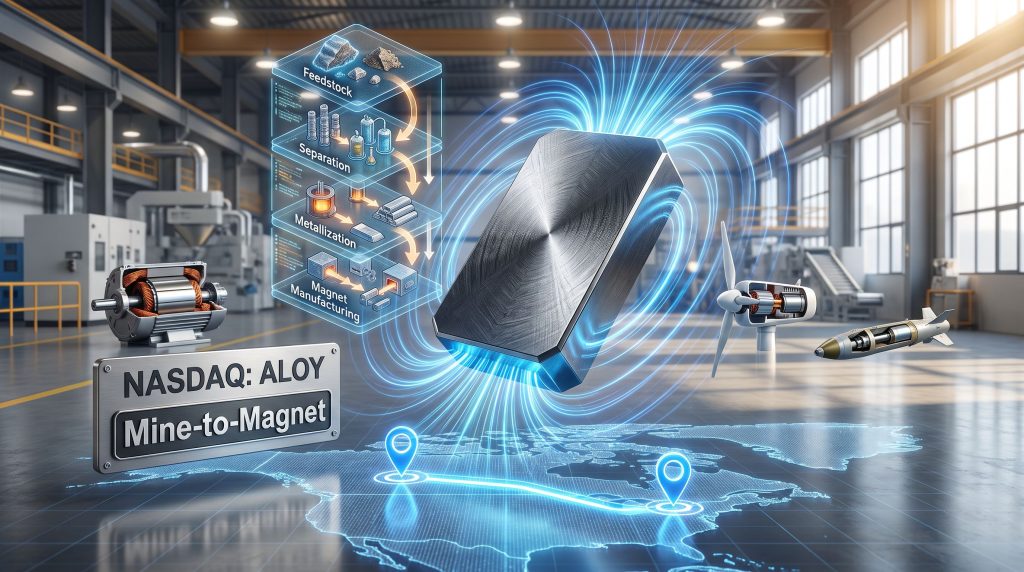
That structural vulnerability is now generating one of the most compressed industrial rebuilding efforts in modern history. REalloys rare earth magnet manufacturing in North America represents a central piece of that effort, with the company assembling a fully integrated supply chain across feedstock sourcing, rare earth processing, heavy rare earth metallization, and finished neodymium-iron-boron (NdFeB) permanent magnet production, spanning facilities in Saskatchewan and Euclid, Ohio.
Understanding why this matters requires understanding how the magnet supply chain actually works, and why partial solutions have repeatedly failed to close the gap.
When big ASX news breaks, our subscribers know first
Why NdFeB Magnets Sit at the Centre of Every Critical Technology Sector
Neodymium-iron-boron permanent magnets are not a niche industrial material. They are the highest-energy-density commercial magnets available and are embedded in systems across virtually every technology sector classified as strategically important by Western governments.
Each electric vehicle traction motor requires between 1 and 2 kilograms of NdFeB magnet material, with premium performance motors requiring more. Large offshore wind turbines using direct-drive permanent magnet generators require up to 600 kilograms of rare earth magnet material per unit. Industrial servo motors, defence guidance systems, submarine propulsion, radar arrays, drone propulsion, satellite attitude control systems, and AI data centre hard disk drives all rely on rare earth permanent magnets of varying specification grades.
What makes NdFeB magnets particularly difficult to substitute is the combination of magnetic strength, temperature stability, and physical compactness they offer. No commercially available alternative delivers equivalent performance at scale. This is why multiple Western governments, including the United States, have formally classified rare earth magnets and their constituent materials as critical minerals. Surging critical minerals demand across defence, energy, and technology sectors is intensifying the urgency of this classification.
The concentration of this production inside a single country creates a systemic vulnerability that no amount of stockpiling or diplomatic engagement can fully resolve. China currently accounts for the overwhelming majority of global NdFeB permanent magnet production, with some estimates placing its share at roughly 90% of global output. That figure encompasses not just magnet manufacturing but the upstream separation and midstream metallization steps without which no magnet manufacturing is possible.
The Four-Stage Supply Chain and Why Each Stage Matters Independently
One of the least understood dynamics in rare earth supply chain analysis is that the chain is not a single market. It is a sequence of technically distinct industrial processes, each requiring separate infrastructure, expertise, and investment:
| Stage | Description | Strategic Significance |
|---|---|---|
| Feedstock / Mining | Raw rare earth ore extraction | Determines supply security and geopolitical exposure |
| Separation | Converting ore into separated rare earth oxides | Historically dominated by Chinese processing infrastructure |
| Metallization | Converting oxides into high-purity metals and alloys | The most technically demanding midstream step |
| Magnet Manufacturing | Sintering and finishing NdFeB permanent magnets | The final value-added stage closest to end-use markets |
The metallization stage deserves particular attention because it is the step most systematically absent from Western rebuilding efforts. Converting separated dysprosium and terbium oxides into high-purity metals requires specialised furnace technology, precise atmosphere control, and significant process expertise. It is not simply a scaling problem. It is a capability gap that accumulated over decades as Western metallurgical expertise migrated to Chinese industrial clusters.
Dysprosium and terbium are heavy rare earth elements that serve a specific and non-negotiable function in high-performance NdFeB magnets: they increase the coercivity of the magnet, meaning its resistance to demagnetisation at elevated temperatures. Defence applications and electric vehicle traction motors routinely operate at temperatures where standard NdFeB magnets would lose significant performance without heavy rare earth additions. This is why heavy rare earth metallization capability is not optional for anyone building a defence-qualified magnet manufacturing platform.
Furthermore, understanding rare earth supply chains reveals just how many interdependent stages must function in concert before a finished magnet reaches a defence contractor or vehicle manufacturer.
Companies that control multiple stages simultaneously hold a structural advantage that cannot easily be replicated by those operating at only one point in the chain. The rare earth supply chain is not a single market. It is a sequence of technically distinct industrial processes.
How REalloys Is Assembling the Integrated Platform
The Saskatchewan Processing and Metallization Hub
The centrepiece of REalloys' supply chain buildout is its approximately $20.6 million capital commitment to expand the Saskatchewan Research Council's rare earth processing facility. This investment secures preferred access rights to up to 80% of the facility's expanded output, covering neodymium-praseodymium (NdPr) metal and separated dysprosium and terbium oxides, with commercial production targeted to begin in early 2027.
Crucially, REalloys is also funding a dedicated heavy rare earth metallization facility at the same Saskatchewan site. Upon completion, this is expected to represent the largest heavy rare earth metallization operation outside China. The first qualification-scale materials, covering dysprosium, terbium, and NdPr, are targeted for delivery in Q4 2026, positioning them in customers' hands for evaluation ahead of the Department of Defense's January 1, 2027, procurement deadline under DFARS 252.225-7052.
The significance of co-locating the metallization facility with the separation infrastructure should not be underestimated. Transporting heavy rare earth oxides across jurisdictions introduces logistical complexity, chain-of-custody documentation requirements for defence qualification, and additional processing delays. Co-location removes one of the most operationally fragile links in the intermediate processing chain.
The Ohio Magnet Manufacturing Anchor
Downstream from the Saskatchewan hub, REalloys operates magnet manufacturing in Euclid, Ohio, producing 100% U.S.-manufactured NdFeB permanent magnets. The initial facility is designed for approximately 3,000 tonnes per year, with a stated expansion pathway toward 10,000 tonnes per year as demand scales and the integrated upstream supply comes online.
The JS Link partnership, currently formalised as a non-binding letter of intent, extends this downstream capability by incorporating an established permanent magnet manufacturer with prior activity in allied markets. JS Link previously signed a deal with Lynas Rare Earths related to a magnet facility in Malaysia, demonstrating existing credentials in the permanent magnet manufacturing space. The progression from this non-binding agreement to a binding commercial framework represents one of the key near-term milestones that market participants will be watching closely.
Feedstock Architecture: Multi-Source Supply Security
| Supply Source | Location | Agreement Type | Key Materials |
|---|---|---|---|
| Critical Metals' Tanbreez Project | Greenland | Definitive long-term offtake (15% of Phase 1) | Rare earth concentrate |
| Sheep Creek Deposit | Montana, USA | Strategic alliance and offtake commitment | Rare earth ore |
| Ramaco Resources Brook Mine | Wyoming, USA | MOU supply framework | Coal-hosted rare earth material |
The Tanbreez rare earth project in Greenland is particularly noteworthy. Greenland's rare earth deposits are among the largest and most mineralogically diverse in the world, and securing offtake from an allied jurisdiction before processing infrastructure is fully commissioned reflects disciplined supply chain sequencing rather than reactive procurement.
Coal-hosted rare earth extraction from the Wyoming Brook Mine platform represents an emerging domestic supply pathway that carries a dimension rarely discussed in mainstream coverage. Coal seams in the Powder River Basin and adjacent Wyoming geology have been found to host rare earth concentrations in the associated clays and ash byproducts of coal processing. This is a materials pathway that could convert existing coal infrastructure and communities into critical mineral supply nodes, aligning economic transition goals in energy-producing regions with strategic mineral security objectives.
The Regulatory Trigger Forcing Industrial Timelines to Compress
The U.S. Department of Defense's DFARS 252.225-7052 regulation establishes a hard statutory cutoff of January 1, 2027, after which Chinese-origin rare earth magnets may not be used in defence procurement. This is not a soft guideline or a policy aspiration. It is a binding procurement rule that forces every defence prime contractor and their tier-two suppliers to qualify alternative magnet sources before that date.
The compliance challenge is significant. Qualifying a new magnet source for defence applications requires extensive materials characterisation, testing against military performance specifications, and often multi-year supplier approval processes. The compression of that timeline into roughly twelve to eighteen months from the point when non-Chinese production is first available creates extraordinary urgency for any platform capable of delivering qualification-scale materials before commercial ramp.
This is precisely the function of REalloys' Q4 2026 qualification-scale delivery milestone. Placing defence-grade dysprosium, terbium, and NdPr materials into customer evaluation programmes before the statutory deadline allows qualification testing to proceed in parallel with commercial production ramp, rather than sequentially after it.
China's Extraterritorial Controls and the Escalating Risk Calculus
Beijing's export control framework has evolved beyond restricting what leaves Chinese territory. China has extended controls to target the movement of Chinese-origin materials held by third-party entities globally, and has placed U.S. rare earth firms on export control lists that instruct organisations and individuals worldwide to suspend existing transactions involving designated dual-use materials destined for those companies. The practical effect is that supply chains built around Chinese-processed intermediate materials remain exposed to Beijing's leverage even after those materials have physically left China.
This extraterritorial enforcement model represents a qualitative escalation from conventional export controls. It means that a Western company sourcing Chinese-processed rare earth oxides through a third-country intermediary cannot confidently assume that supply arrangement is insulated from Chinese policy decisions. The material's origin follows it through the supply chain.
The restrictions follow the material itself rather than the exporter, an approach that gives Beijing a layer of influence over global supply chains built around Chinese processing infrastructure that extends well beyond China's own borders.
For context, Mountain Pass in California was once the world's dominant rare earth mine. Its closure in the 1990s and the subsequent concentration of Western rare earth processing in China unfolded across roughly three decades. Rebuilding equivalent capability outside China within a few years represents an unprecedented industrial policy ambition, one that requires sustained procurement commitments alongside private capital investment to justify the capital intensity involved. The broader dimensions of rare earth geopolitics make it clear that these decisions carry consequences far beyond commodity markets.
The next major ASX story will hit our subscribers first
How the REalloys Platform Compares to Other Western Initiatives
| Initiative | Geography | Stage | Key Differentiator |
|---|---|---|---|
| REalloys (NASDAQ: ALOY) | Canada + USA | Processing + metallization + magnets | Fully integrated mine-to-magnet platform |
| MP Materials | California, USA | Mining + partial processing | Upstream-focused; magnet manufacturing still developing |
| Lynas Rare Earths | Australia + Malaysia + USA | Mining + separation | No North American magnet manufacturing |
| USA Rare Earth | Texas, USA | Separation + magnets | Downstream focus; feedstock dependency remains |
The competitive distinction that emerges from this comparison is not simply about scale or geography. It is about which companies have closed the metallization gap. Separation and magnet manufacturing are both technically challenging, but the conversion of separated heavy rare earth oxides into defence-qualified metals is the step that remains most comprehensively absent from Western industrial infrastructure. A platform that closes this specific gap occupies a structurally different position from those that do not.
However, America's rare earth supply chain faces broader structural challenges that no single company can resolve alone, underscoring the importance of coordinated policy alongside private investment.
Defence End-Markets and the Industrial Users with the Most at Stake
The defence sector is the primary driver of policy urgency, but the end-market exposure extends across multiple programme types:
- Unmanned aerial systems: Electric propulsion motors and precision guidance electronics in tactical drones depend on high-performance NdFeB magnets that currently have no domestically manufactured equivalent at scale.
- Advanced combat aircraft: Actuation systems, flight control surfaces, and radar components in next-generation platforms require rare earth magnetic components that must meet exacting military specifications.
- Missile defence and electronic warfare: Radar arrays, directed energy systems, and missile seeker heads embed rare earth-intensive components at multiple points in their design.
- Satellite and space systems: Reaction wheels, attitude control systems, and communication payloads rely on rare earth magnetic components where weight and performance density are critical design parameters.
Defence manufacturers including Kratos Defense and Security Solutions, Boeing, Northrop Grumman, and AeroVironment all maintain significant exposure to rare earth magnet supply through their respective programmes in drones, military aircraft, missile defence, radar, and precision electronics. A domestic mine-to-magnet platform capable of supplying defence-qualified materials resolves the DFARS compliance problem at the production source rather than through complex supply chain auditing and exemption procedures.
Industry analysts covering REalloys rare earth magnet manufacturing in North America have highlighted this defence sector alignment as a core strategic differentiator for the company's commercial positioning ahead of the 2027 procurement deadline.
Key Milestones Tracking the Path to Commercial Scale
Near-Term (H2 2026)
- Delivery of first qualification-scale dysprosium, terbium, and NdPr materials from the Saskatchewan metallization facility, targeted Q4 2026.
- Initiation of customer qualification evaluation programmes for defence-grade heavy rare earth metals ahead of the January 1, 2027 DFARS deadline.
- Progression of the JS Link partnership from non-binding letter of intent toward a binding commercial agreement.
Medium-Term (2027 and Beyond)
- Commercial production commencement at the Saskatchewan processing and metallization facility, early 2027 target.
- Scaling of the Euclid, Ohio magnet manufacturing operations from 3,000 tonnes per year toward the 10,000 tonnes per year expansion pathway.
- Transition of feedstock agreements from Greenland, Montana, and Wyoming into active delivery schedules supporting processing operations.
Investors and industry observers should note that the milestones described above involve forward-looking projections that carry execution, permitting, capital, and technical risks. Actual outcomes may differ materially from current targets. This article does not constitute investment advice. Readers should conduct independent due diligence and consult a registered financial adviser before making any investment decisions.
The Geopolitical Stakes That Extend Beyond the Rare Earth Sector
The reconstruction of North American rare earth magnet manufacturing capability carries strategic implications that reach well beyond any single company or commodity. The parallel to semiconductor reshoring is instructive. Just as the CHIPS Act acknowledged that advanced semiconductor fabrication had become a foundational national security asset, rare earth magnet manufacturing is increasingly recognised as a determinant of military readiness and defence industrial base resilience rather than simply an industrial competitiveness question.
The speed at which this industrial base is being rebuilt across North America, compressing what took China roughly three decades of industrial policy into a targeted multi-year buildout, is itself an experiment in the limits and capabilities of policy-accelerated industrial reconstruction. The outcome will have implications not only for the rare earth sector but for how Western governments approach every other critical material category where equivalent dependencies have accumulated over the same period.
REalloys rare earth magnet manufacturing in North America, anchored by the Saskatchewan processing and metallization hub and the Ohio magnet manufacturing facility, represents one of the most structurally complete attempts yet to build that capability from the ground up, across all four stages of the supply chain, on a timeline dictated not by market forces alone but by the hard statutory deadlines of defence procurement law. OilPrice.com has also noted the broader significance of North America adding major new rare earth supply sources as this buildout accelerates.
This article contains forward-looking statements and projections that involve uncertainty. Past performance and announced plans do not guarantee future results. The information presented is for educational purposes only and should not be construed as investment advice.
Want to Track the Next Major Critical Minerals Discovery Before the Market Does?
Discovery Alert's proprietary Discovery IQ model delivers real-time alerts on significant ASX mineral discoveries — including critical minerals driving the rare earth supply chain rebuild — turning complex geological data into actionable investment insights the moment they hit the exchange. Explore historic discoveries and their returns to understand the opportunity, then begin your 14-day free trial to position yourself ahead of the broader market.