July 31, 2026
The Geological Anomaly Rewriting the Rare Earth Supply Map
Roughly 85% of the world's ionic clay rare earth production originates from a single country. That concentration, built over decades of deliberate industrial policy, has created a supply vulnerability that Western governments, defence contractors, and electric vehicle manufacturers are now scrambling to address. The search for deposits that can replicate China's ionic clay advantage elsewhere on the planet has been long, expensive, and largely unsuccessful — until a project in the Brazilian highlands began delivering results that changed the conversation entirely.
The Meteoric Resources Caldeira DFS, released in July 2026, represents the most detailed technical and financial validation yet of what may be the most strategically significant rare earth deposit identified outside Chinese territory. Understanding what that study actually confirms — and what it does not yet resolve — requires stepping back from the headline numbers and examining the geological, commercial, and market dynamics that give this project its unusual weight.
When big ASX news breaks, our subscribers know first
Why Ionic Clay Deposits Are Not Like Other Rare Earth Projects
Most people who follow commodity markets are familiar with hard-rock rare earth deposits — the carbonatite-hosted systems like Mountain Pass in California or the monazite-bearing placers that dot coastlines across the Indo-Pacific. These deposits require crushing, grinding, flotation, and energy-intensive hydrometallurgical processing to liberate rare earth elements from their host minerals. Capital costs are high, processing complexity is significant, and the path from discovery to production is measured in decades.
Ionic clay deposits work on an entirely different principle. In these systems, rare earth elements are not locked into crystalline mineral structures. Instead, they are electrostatically adsorbed onto the surface of clay minerals — typically kaolinite and halloysite — in lateritic weathering profiles. Because the rare earths are not chemically bound, they can be recovered using a simple leaching process, typically with ammonium sulphate solution, without the need for blasting, crushing, or complex mineral processing.
This distinction drives several important operational advantages:
- Lower mining capital costs: Free-digging, shallow ore eliminates the need for drill-and-blast operations and heavy hard-rock mining equipment
- Simpler processing infrastructure: Heap leach or vat leach systems replace complex flotation and cracking circuits
- Lower reagent costs: Ammonium sulphate leaching is significantly cheaper than the acid baking and high-temperature cracking used for hard-rock concentrate processing
- Faster ramp-up potential: Simpler processing flowsheets reduce commissioning risk and the time required to reach nameplate capacity
These are the structural reasons why China's ionic clay operations in Jiangxi Province have historically produced rare earths at costs that hard-rock producers struggle to match. They are also the reasons why discovering a large, high-grade ionic clay deposit outside China matters so profoundly to those managing rare earth supply chains.
What the Meteoric Resources Caldeira DFS Actually Confirms
Breaking Down the Reserve, Cost, and Financial Parameters
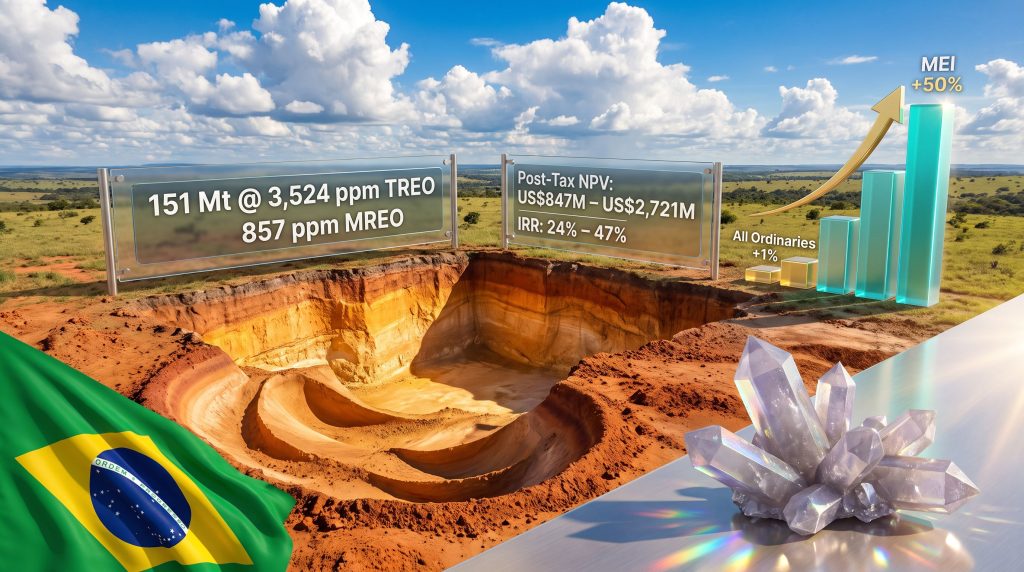
The Meteoric Resources Caldeira DFS is built on a resource base of exceptional scale for an ionic clay deposit. The confirmed ore reserve of 151 million tonnes grading 3,524 parts per million total rare earth oxides (TREO) supports a mine life exceeding 20 years at the proposed processing rate of 6 million tonnes per year. Within that TREO grade, 857 ppm is attributable to Magnet Rare Earth Oxides (MREO), the commercially critical fraction used in high-performance permanent magnets.
The financial model was presented under two pricing scenarios, a standard practice for rare earth projects given the volatility of the market:
| DFS Parameter | Spot Price Scenario | Forecast Price Scenario |
|---|---|---|
| Ore Reserve | 151 Mt @ 3,524 ppm TREO | 151 Mt @ 3,524 ppm TREO |
| Post-Tax NPV | US$847 million | US$2,721 million |
| IRR | 24% | 47% |
| Total Project Revenue | US$9.4 billion | US$17.4 billion |
| Initial Capex (incl. 10% contingency) | US$498 million | US$498 million |
| Average Operating Cost | US$11.68/kg TREO | US$11.68/kg TREO |
| Payback Period | 4 years | Not specified |
| Mine Life | >20 years | >20 years |
The 24% IRR at spot prices is a particularly important figure for project finance purposes. Many critical mineral development projects require a significant price recovery from current depressed levels to achieve acceptable returns. Caldeira clears the typical lender threshold of 15% IRR without requiring any price uplift, which materially reduces the financing risk profile. Furthermore, this outcome directly reflects broader critical minerals demand dynamics reshaping the global energy transition.
The Engineering and Metallurgical Foundation
The study is underpinned by more than 90,000 metres of drilling across the three deposits incorporated into the DFS — a programme of sufficient scale to support a high-confidence resource classification. Critically, the DFS also draws on more than six months of operation from a pilot plant located in Brazil, a level of metallurgical validation that goes well beyond desktop assumptions or laboratory bottle-roll tests.
Technical Note: Pilot plant data is qualitatively different from bench-scale testwork. Operating a continuous processing circuit for six months exposes variables that laboratory tests cannot replicate, including reagent consumption fluctuations, clay mineralogy variability, solution chemistry management, and solid-liquid separation performance. The sustained pilot plant operation at Caldeira substantially reduces the metallurgical execution risk embedded in the capital and operating cost estimates.
The recovery rate for magnet rare earths through the leaching process was confirmed at 71%, a commercially viable figure that reflects the deposit's amenable clay mineralogy. Recovery rates for ionic clay deposits vary considerably depending on the proportion of clay-adsorbed versus mineral-locked rare earths, and the Caldeira result suggests a high proportion of readily accessible, adsorbed rare earth content.
Perhaps the most significant de-risking milestone embedded in the DFS is the resource reclassification achievement. The project converted its resource category from Indicated to Measured across three deposits, lifting Measured Resource tonnage from approximately 11 million tonnes to 102 million tonnes. Under international reporting standards (JORC and CRIRSCO), Measured Resources carry the highest level of geological confidence and are required to support the highest confidence ore reserve category. This reclassification signals to lenders and offtake counterparties that the geological model is sufficiently robust to support binding financial commitments.
Deconstructing the US$11.68/kg TREO Operating Cost
What Drives Ionic Clay Cost Competitiveness
Operating cost per kilogram of TREO is the primary competitiveness metric for rare earth projects targeting permanent magnet supply chains. At US$11.68/kg TREO, Caldeira's estimated operating cost reflects the inherent advantages of ionic clay mineralogy combined with the project's Brazilian operating environment. However, understanding the rare earth processing challenges that other projects face helps contextualise why this figure is so competitively significant.
The cost structure of an ionic clay operation breaks down into several components, each benefiting from the deposit type's characteristics:
- Mining costs: Shallow ore excavated with scrapers or small front-end loaders, eliminating drill-and-blast costs entirely. The free-digging nature of lateritic profiles keeps mining strip ratios low and equipment capital requirements modest.
- Reagent costs: Ammonium sulphate consumption is the dominant reagent cost driver. Unlike hard-rock processing, ionic clay leaching operates at ambient temperature and low reagent concentrations.
- Processing infrastructure: Leach pad or agitated tank infrastructure is significantly cheaper to build and operate than a full hydrometallurgical plant with crushing, milling, flotation, and cracking circuits.
- Logistics: Brazil's existing agricultural and mineral export infrastructure, combined with Caldeira's location in the state of Minas Gerais, provides established road and rail connectivity.
- Administration and overhead: Fixed cost allocation across a high-throughput operation of 6 million tonnes per year keeps unit overhead costs low.
Capital Efficiency in Context
The US$498 million initial capital estimate (inclusive of a 10% contingency buffer) is a meaningful data point for assessing project risk at the DFS stage. The inclusion of a contingency at this level reflects the maturity of the engineering work. DFS-stage estimates typically carry accuracy ranges of plus or minus 10 to 15 percent, and the contingency provision sits within that band.
For a project producing an average of approximately 6 million tonnes of ore per year with associated leaching and rare earth recovery infrastructure, a sub-US$500 million capital estimate reflects the processing simplicity advantage of ionic clay mineralogy relative to hard-rock equivalents of comparable scale. In addition, Ausenco's appointment as engineering partner to advance the FEED programme adds further credibility to the capital cost framework.
The MREO Premium: Why Grade Composition Matters More Than Total Grade
One of the most frequently misunderstood aspects of rare earth project evaluation is the distinction between TREO and MREO. Total rare earth oxide grade captures all 17 rare earth elements present in the ore, including those with minimal commercial value in current markets — such as cerium and lanthanum — which face chronic oversupply and low pricing.
MREO captures the subset that actually commands premium pricing: primarily neodymium (Nd), praseodymium (Pr), dysprosium (Dy), and terbium (Tb). These four elements are the critical inputs to neodymium-iron-boron (NdFeB) permanent magnets — the technology underpinning electric vehicle traction motors, wind turbine generators, and a wide range of defence and aerospace systems.
Market Context: The permanent magnet rare earth market is structurally different from the broader rare earth market. While cerium and lanthanum together constitute approximately 50–60% of TREO in many deposits and trade at very low prices, NdPr oxide has historically traded at 5 to 20 times the price per kilogram. Dysprosium and terbium can trade at substantially higher prices still.
Caldeira's 857 ppm MREO within a 3,524 ppm TREO profile gives an MREO/TREO ratio of approximately 24%, which is a commercially meaningful proportion for a deposit of this scale. The 71% recovery rate for magnet rare earths through the leaching process means the project delivers recoverable MREO into the product stream at a level that supports offtake interest from permanent magnet manufacturers.
Offtake Geography and Market Positioning
Who Is Buying and Why Location Matters
The non-binding offtake agreements signed with counterparties in South Korea, Canada, and North America are geographically deliberate. South Korea hosts a significant permanent magnet manufacturing industry and is a major consumer of separated rare earth oxides. North American demand is driven by the growing domestic EV manufacturing base and the policy imperative to reduce dependence on Chinese rare earth processing.
It is important to note that non-binding agreements at DFS stage are standard practice in the rare earth sector and should not be interpreted as equivalent to binding offtake contracts. Their commercial significance lies in what they signal: identified demand from credible counterparties who have conducted sufficient technical due diligence to express a commercial interest.
Downstream Value-Adding Optionality
Meteoric is also progressing feasibility studies assessing the potential for downstream processing within Brazil — moving beyond a mixed rare earth carbonate toward separated rare earth oxides. In-country value-adding, if proven feasible, would capture a larger proportion of the margin between raw ore and final product, and would align with Brazilian government interest in maximising domestic value creation from its critical mineral endowment.
The pricing differential between a mixed rare earth precipitate and separated NdPr oxide can be substantial. However, rare earth separation requires solvent extraction circuits of considerable complexity, and the capital and operating cost implications of downstream processing would need to be reflected in an updated financial model. Consequently, this remains an important area for investors to monitor as the project advances.
The next major ASX story will hit our subscribers first
Brazil as a Mining Jurisdiction: What Investors Need to Understand
Regulatory Framework and Permitting Progress
Brazil is a mature mining jurisdiction with an established regulatory framework administered at both federal and state levels. The country has substantial experience with large-scale mining operations, including the world's largest iron ore and niobium industries, and possesses the infrastructure, technical workforce, and regulatory institutions to support a project of Caldeira's scale.
Caldeira has already secured its Preliminary Environmental Licence, a significant milestone confirming the project has passed initial environmental screening. The next critical regulatory step is the Installation Licence (LI), which authorises construction commencement and is targeted for receipt by the end of 2026. Brazilian environmental licensing typically proceeds in three stages: Preliminary Licence, Installation Licence, and Operating Licence.
The project has also been incorporated into Brazilian government frameworks relating to critical minerals and the country's decarbonisation agenda. This inclusion reflects policy recognition of rare earths as strategically important materials, though it should not be interpreted as constituting project-specific financial support or accelerated permitting approval from any level of government.
From DFS to Construction: The Remaining Milestones
A Sequential Pathway to First Production
Completing a definitive feasibility study is a major project milestone, but it is not the final step before construction. The pathway from the Caldeira DFS to first production involves several sequential milestones, each carrying execution risk:
- Installation Licence receipt targeted by end of 2026
- Front-end engineering and design (FEED) completion, currently underway with engineering partner Ausenco
- Finalisation of project financing structure, including resolution of discussions with government credit agencies
- Conversion of non-binding offtake agreements to binding commercial contracts
- Final Investment Decision (FID) by the board
- Construction commencement, previously targeted for 2026
- First production, previously targeted for 2028
Each of these steps involves third-party dependencies, regulatory processes, and market conditions that are outside the company's direct control.
Key Risks That the DFS Does Not Resolve
A DFS is the highest-confidence pre-construction study, but it does not eliminate project risk. The material uncertainties remaining for Caldeira include:
- Financing risk: Discussions with government credit agencies are described as advanced but have not produced binding debt commitments. The gap between indicative interest and executed term sheets is significant.
- Rare earth price sensitivity: The wide NPV spread between spot (US$847 million) and forecast (US$2,721 million) scenarios illustrates the project's exposure to rare earth price movements.
- Permitting timeline: Brazilian environmental licensing, while procedurally well-defined, is subject to delays from community consultation, regulatory capacity, and political considerations.
- Downstream processing optionality: The feasibility of in-country value-adding remains unresolved and an updated financial model incorporating a separation circuit has not yet been published.
The Growth Option Hidden in the Tenement Boundaries
One of the less-discussed but potentially significant aspects of the Caldeira project is the extent of exploration upside beyond the current DFS footprint. The three deposits incorporated into the study cover less than 20% of the broader tenement area. More than 80% of the tenement has not been drill-tested at sufficient density to contribute to the current ore reserve.
This means the 151 million tonne, 20-plus-year reserve base is almost certainly not the ceiling for the project's ultimate scale. Furthermore, for broader context on deposit-hunting across the sector, rare earth exploration insights highlight how few projects at this stage can point to such a substantial unexplored tenement area as a genuine growth option.
Investor Framework: Reading the DFS Numbers Correctly
The Dual-Scenario NPV and What It Implies
The decision to present NPV under both spot and forecast price assumptions is standard practice for rare earth development projects and is often misread by investors. The two scenarios do not represent a range of expected outcomes — they represent financial performance under two distinct sets of pricing assumptions, each of which may or may not reflect actual market conditions at the time production commences.
The more analytically useful observation is the IRR of 24% at spot prices. Internal rate of return is a price-agnostic measure of capital efficiency, and a 24% IRR using current depressed rare earth prices indicates that the project generates acceptable returns without requiring a market recovery. Combined with a four-year payback period at spot, this positions Caldeira in the upper tier of critical mineral development projects on a risk-adjusted return basis.
| Metric | Caldeira (Spot) | Caldeira (Forecast) | Typical Viable Range |
|---|---|---|---|
| Post-Tax NPV | US$847M | US$2,721M | Project-specific |
| IRR | 24% | 47% | 15–25% threshold |
| Initial Capex | US$498M | US$498M | Project-specific |
| Operating Cost | US$11.68/kg TREO | US$11.68/kg TREO | Competitive benchmark |
| Mine Life | >20 years | >20 years | 10–30 years typical |
| Payback Period | 4 years | Not specified | 3–7 years typical |
Share Price Performance and Re-Rating Dynamics
Meteoric Resources (ASX: MEI) shares appreciated approximately 50% over the 12 months preceding the DFS release, compared to approximately 1% for the broader All Ordinaries Index over the same period. This substantial outperformance reflects the market's progressive re-rating of the project as drilling results, pilot plant data, and resource upgrades accumulated ahead of the DFS completion.
The DFS release itself creates a classic investor psychology inflection point. The relevant question for investors evaluating Caldeira post-DFS is whether the project's next set of catalysts — primarily the Installation Licence receipt and financing announcements — carry sufficient new information to sustain the current premium. For further detail on the full suite of project announcements, the Meteoric Resources project page provides a comprehensive overview of the Caldeira development timeline and technical documentation.
Disclaimer: This article contains general information only and does not constitute financial advice. Past share price performance is not indicative of future returns. Rare earth prices are volatile and actual project economics may differ materially from DFS estimates. Investors should conduct their own due diligence and consider seeking independent financial advice before making investment decisions.
Frequently Asked Questions: Meteoric Resources Caldeira DFS
What is a Definitive Feasibility Study and why does it matter?
A DFS is the highest-confidence pre-construction study conducted for a mining project. It converts exploration resources into ore reserves using detailed engineering and cost inputs, produces capital and operating cost estimates with accuracy ranges of approximately plus or minus 10 to 15 percent, and generates the financial model used to support a Final Investment Decision. Lenders, offtake counterparties, and equity investors typically require a completed DFS before committing capital to project construction.
What makes MREO more commercially important than TREO?
TREO measures the aggregate of all rare earth elements present in the ore, including low-value elements like cerium and lanthanum that face structural oversupply. MREO isolates the neodymium, praseodymium, dysprosium, and terbium fraction that commands premium pricing due to its role in permanent magnet production. Because permanent magnets are the primary growth driver for rare earth demand through EV motors and wind turbine generators, MREO grade and recovery rates are the principal commercial value determinants for projects targeting this market.
How much of the Caldeira tenement is captured in the current DFS?
The current DFS incorporates three deposits covering less than 20% of the broader tenement area held by Meteoric Resources. More than 80% of the tenement has not yet been included in the study, representing a substantial runway for future resource growth, mine life extension, and potential production scale-up in future project iterations.
What are the critical remaining milestones before construction can begin?
The key sequential milestones are: receipt of the Brazilian Installation Licence (targeted by end of 2026), completion of front-end engineering and design, finalisation of project financing, conversion of non-binding offtake agreements to binding contracts, and a formal Final Investment Decision. Construction was previously targeted to commence in 2026, with first production targeted for 2028. The latest ASX announcement provides the most current guidance on these milestones.
Why does the DFS present two different NPV figures?
The spot price NPV of US$847 million and the forecast price NPV of US$2,721 million reflect two different rare earth pricing assumptions rather than a range of expected outcomes. The spot scenario uses current market prices, while the forecast scenario incorporates analyst consensus price projections for future periods. Neither figure constitutes a prediction of actual project returns. The IRR of 24% at spot prices is arguably the more robust measure of project viability, as it demonstrates acceptable returns without requiring any price recovery.
Want to Know When the Next Major Rare Earth Discovery Hits the ASX?
Discovery Alert's proprietary Discovery IQ model scans ASX announcements in real time, instantly identifying significant mineral discoveries — including rare earths — and delivering actionable insights to subscribers before the broader market reacts. Start your 14-day free trial today, or explore Discovery Alert's discoveries page to see how historic finds have generated extraordinary returns for early investors.