July 30, 2026
The Quiet Transformation of Global Rare Earth Supply Chains
The rare earth supply chain has never been broken in the conventional sense. It simply grew in one direction for three decades, concentrating extraction, separation, and magnet manufacturing within a single geography. Today, the cost of that concentration is being measured not in dollars but in strategic vulnerability. Automotive manufacturers, defence contractors, and technology firms across East Asia, Europe, and North America are confronting the same structural problem: their access to the materials that make electrification and advanced computing physically possible runs through a narrow corridor they do not control.
This pressure is not producing panic. It is producing architecture. Industrial conglomerates, export credit agencies, and sovereign mining bodies are collaborating to construct parallel rare earth supply chains from the ground up, identifying deposit types that can deliver volume, deposit chemistries that can reduce processing complexity, and geopolitical partners who can offer stability alongside scale.
The Meteoric POSCO rare earths partnership in Brazil is one of the clearest expressions of this structural realignment to emerge in 2026. Its significance is not reducible to a single offtake agreement. It is the convergence of a project with genuinely uncommon metallurgical characteristics, a buyer with a clearly defined mine-to-magnet strategy, and a bilateral diplomatic environment that provides institutional scaffolding for long-term commercial commitments.
When big ASX news breaks, our subscribers know first
Brazil's Rare Earth Position: Large Resource, Modest Output
Brazil's geological endowment in rare earths is substantial by any measure. The country holds significant ionic clay-hosted rare earth deposits, a deposit type that has attracted disproportionate attention from project developers and industrial buyers alike. Unlike carbonatite-hosted rare earth systems, which require energy-intensive cracking and acid dissolution at elevated temperatures, ionic clay deposits allow rare earth recovery through a relatively low-temperature leach process.
Strip ratios tend to be lower, capital intensity is reduced, and the naturally adsorbed rare earth ions can be mobilised with comparatively mild reagents. Furthermore, understanding the processing challenges associated with different deposit types is essential context for evaluating why ionic clay projects attract premium industrial interest.
Despite this geological advantage, Brazil has historically contributed a marginal share of global rare earth supply. The gap between resource endowment and commercial production reflects a combination of factors: infrastructure constraints in the relevant regions, the historical absence of downstream processing facilities, and the difficulty of competing commercially with Chinese production during periods of suppressed rare earth pricing.
That calculus is shifting. Western and Korean industrial buyers are now explicitly willing to accept a cost premium for supply chain security. The relevant question for Brazilian projects is no longer whether the economics can beat China, but whether they are robust enough to satisfy anchor industrial partners who will pay a reliability premium and potentially co-invest in development.
The Caldeira Project: Scale and Metallurgical Differentiation
Resource Scale and Deposit Characteristics
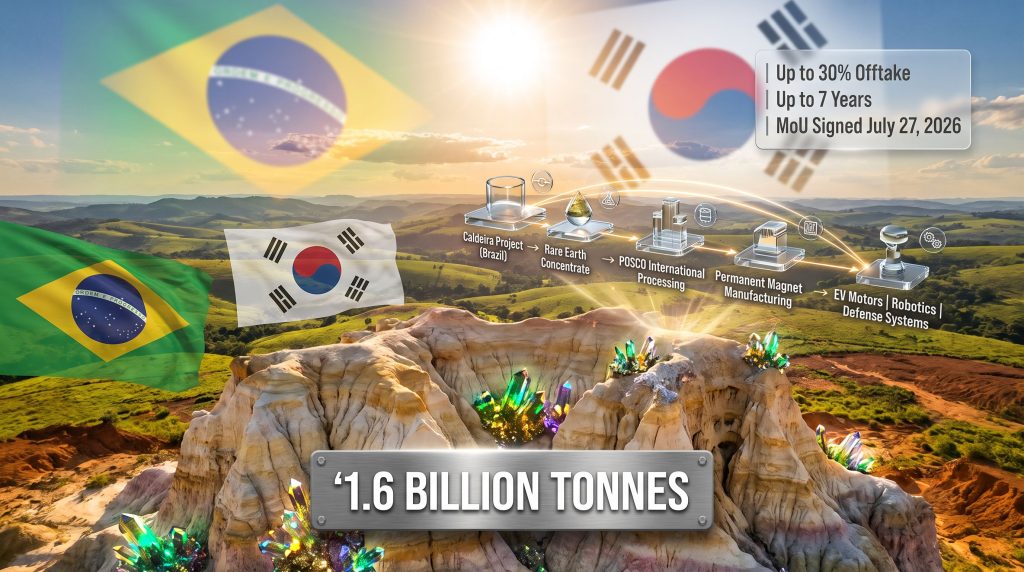
The Caldeira Project, situated in Caldas, Minas Gerais, represents one of the larger ionic clay rare earth resources identified outside of Southeast Asia. Meteoric Resources upgraded the global resource estimate to 1.6 billion tonnes in July 2026, establishing Caldeira among the most significant ionic clay rare earth deposits on record globally.
Minas Gerais has long been the nucleus of Brazilian mining activity. Its geological setting, infrastructure connectivity, and regulatory familiarity make it a comparatively lower-risk location for large-scale mining development compared to frontier regions. For an international industrial partner conducting due diligence, the state's established mining culture is a meaningful risk-reduction factor.
The Metallurgical Factor That Defines Commercial Viability
Perhaps the most consequential technical detail embedded in the Meteoric POSCO rare earths partnership is not the resource size but the concentrate chemistry. Metallurgical test work completed by Meteoric confirmed that the rare earth concentrate produced at Caldeira contains low impurity levels, meaning it can be fed directly into POSCO International's downstream processing facilities in South Korea without requiring additional refining or intermediate purification steps.
This characteristic is less common than it might appear. Many rare earth concentrates carry penalty elements, including thorium, uranium, phosphorus, or fluorine, that complicate downstream processing, trigger regulatory requirements in receiving countries, and increase the cost of oxide separation. A concentrate that arrives clean enough for direct processing eliminates an entire processing stage from the value chain, compressing costs and improving margin for both the seller and the buyer.
The ability to deliver a direct-process-ready concentrate to an industrial buyer of POSCO's scale is a commercial differentiator that no resource estimate, however large, can replicate. Concentrate chemistry is arguably the most underappreciated variable in rare earth project evaluation.
Development Timeline and Remaining Milestones
Caldeira is currently advancing through feasibility study preparation, environmental licensing, and project financing processes. The company has indicated a Final Investment Decision pathway following mid-2026 milestones, with a targeted production commencement of 2028, subject to regulatory approvals, financing execution, and construction progress. Key remaining milestones include:
- Completion of a definitive feasibility study
- Environmental licensing approval from relevant Brazilian authorities
- Execution of binding offtake and financing agreements
- Securing project-level debt financing, potentially with export credit agency participation
- Construction and commissioning of processing infrastructure
Structural Breakdown of the MoU: What Was Actually Agreed
Core Commercial Parameters
The agreement signed on July 27, 2026, is a non-binding Memorandum of Understanding. It does not create legally enforceable obligations on either party at this stage. Its commercial function is to establish a shared framework for negotiating binding agreements, while signalling commitment to third parties including lenders, regulators, and competing offtake candidates.
| Deal Parameter | Detail |
|---|---|
| Agreement Type | Non-binding Memorandum of Understanding |
| Offtake Volume | Up to 30% of Caldeira Project output |
| Supply Duration | Up to 7 years |
| Potential Equity Investment | Under consideration by POSCO International |
| Financing Institutions | KEXIM and K-SURE engagement possible |
| Key Technical Driver | Low-impurity concentrate, direct POSCO processing compatible |
| Signing Date | July 27, 2026 |
Beyond Offtake: The Financial Architecture
The MoU extends meaningfully beyond a simple volume commitment. POSCO International has indicated it is considering an equity stake in the Caldeira Project itself, which would align its interests with project success across the full development and production cycle. Equity co-investment by an industrial anchor partner fundamentally changes the risk profile of a project from a debt financing perspective.
The MoU also references engagement with South Korean policy-backed lending institutions, specifically KEXIM (the Export-Import Bank of Korea) and K-SURE (the Korea Trade Insurance Corporation). These entities provide concessional financing, loan guarantees, and credit insurance instruments specifically designed to support South Korean industrial investment in overseas strategic mineral assets. Their involvement, if confirmed in binding agreements, would substantially improve Caldeira's debt financing terms and reduce the blended cost of capital. This structure is comparable in approach to the rare earth offtake deal structures emerging elsewhere in the sector.
POSCO International's Strategic Logic: Building End-to-End Supply
The Mine-to-Magnet Imperative
POSCO International functions as the resource development and trading arm of the broader POSCO Group, one of South Korea's largest industrial conglomerates. The group has articulated an explicit objective to construct a fully integrated rare earth supply chain spanning from mine-level extraction through to permanent magnet production. This strategy targets the supply inputs for electric vehicle drivetrains, industrial robotics, artificial intelligence server infrastructure, and defence-grade component manufacturing.
The four magnetic rare earth elements most critical to this objective are neodymium, praseodymium, dysprosium, and terbium. Neodymium and praseodymium are the primary components of NdPr oxide, the input material for sintered NdFeB magnets used in EV traction motors. Dysprosium and terbium serve as heavy rare earth additives that enhance high-temperature coercivity, a property critical for magnets operating in demanding thermal environments such as automotive powertrains and industrial motors.
South Korea's Supply Chain Exposure
South Korea's manufacturing economy carries concentrated exposure to rare earth supply risk. Its automotive sector, anchored by Hyundai and Kia, is accelerating EV platform deployment. Its semiconductor equipment manufacturing relies on rare earth-containing polishing compounds and speciality alloys. Its defence industrial base requires rare earth-containing guidance systems and propulsion components.
The South Korean government has moved to address this vulnerability through mandated supply chain diversification requirements for strategic minerals, mirroring approaches taken by Japan through JOGMEC and by the European Union under the Critical Raw Materials Act. Furthermore, the broader critical minerals demand surge is intensifying this policy urgency across multiple allied economies simultaneously. POSCO's engagement with Caldeira reflects this policy orientation at the corporate level.
How Caldeira Fits POSCO's Portfolio Requirements
For POSCO International, the Caldeira partnership offers three specific advantages that differentiate it from alternative supply options:
- Geographic diversification away from Chinese production and existing Southeast Asian sources, reducing single-region concentration risk
- Concentrate chemistry compatibility, eliminating the need for intermediate processing and reducing supply chain handling costs
- Scale and duration, with a resource of 1.6 billion tonnes providing the potential for a multi-decade supply relationship that justifies equity co-investment
The Bilateral Diplomatic Dimension
Presidential-Level Engagement and Its Commercial Significance
The timing of the MoU signing carries diplomatic weight beyond its commercial terms. During the same week, Brazilian President Luiz Inácio Lula da Silva and South Korean President Lee Jae-myung jointly reaffirmed their countries' commitment to deepening strategic cooperation across critical minerals, clean energy, and technological innovation. Presidential-level alignment of this kind functions as a sovereign risk signal to private sector investors and lenders, indicating that the broader political environment is supportive of the commercial relationship.
This matters in project finance. Lenders assessing sovereign risk in cross-border resource transactions incorporate bilateral diplomatic signals into country risk assessments. A deal that sits within an active diplomatic cooperation framework is structurally less exposed to sudden regulatory reversal than one that exists purely as a private commercial arrangement. The influence of rare earth geopolitics on these bilateral frameworks is increasingly a primary driver of investment decisions in the sector.
The ANM-KOMIR Technical Cooperation Agreement
Simultaneously, Brazil's Agência Nacional de Mineração (ANM) and South Korea's Korea Mine Rehabilitation and Mineral Resources Corporation (KOMIR) formalised a technical cooperation agreement covering knowledge exchange, regulatory capacity building, and bilateral mineral sector coordination. This institutional layer creates a durable framework that outlasts individual project agreements and provides a channel for resolving technical and regulatory issues at the government level.
The convergence of a commercial MoU, a joint presidential statement, and an inter-agency technical agreement within a single week is not coincidental. It reflects a coordinated, multi-level effort to institutionalise the Brazil-South Korea critical minerals relationship as a structural feature of both countries' industrial strategies.
The next major ASX story will hit our subscribers first
Competitive Positioning: Where Caldeira Sits in the Global Landscape
| Project | Country | Deposit Type | Stage | Key Industrial Partner |
|---|---|---|---|---|
| Caldeira (Meteoric) | Brazil | Ionic Clay | Feasibility | POSCO International |
| Mount Weld (Lynas) | Australia | Carbonatite | Production | Multiple |
| Nolans (Arafura) | Australia | Phosphate | Development | Hyundai, Siemens |
| Songwe Hill (Mkango) | Malawi | Carbonatite | Development | Shenghe Resources |
| Wicheeda (Defense Metals) | Canada | Carbonatite | Feasibility | None confirmed |
Ionic clay deposits remain a comparatively niche segment of the rare earth development pipeline outside of China and a small number of projects in Southeast Asia and Latin America. Caldeira's combination of resource scale, deposit type, and confirmed concentrate chemistry places it in a select category of projects capable of attracting industrial-anchor partnerships of this nature. According to the U.S. Geological Survey, global rare earth production remains heavily concentrated, reinforcing the strategic value of projects like Caldeira.
The Mine-to-Magnet Value Chain in Practice
The commercial logic of the partnership can be understood as a sequential flow:
- Rare earth-bearing ionic clay ore is extracted at Caldeira, Minas Gerais
- On-site or nearby hydrometallurgical processing produces a rare earth concentrate with low impurity levels
- The concentrate is shipped to POSCO International's processing facilities in South Korea
- POSCO separates the concentrate into individual rare earth oxides and alloys, bypassing intermediate refining steps
- Separated materials feed into permanent magnet manufacturing
- Finished magnets are supplied to EV drivetrain assemblers, robotics manufacturers, and defence system integrators
Each step in this chain represents value that has historically been captured inside China. The structural objective of partnerships like this one is to replicate that chain outside Chinese territory, with industrial anchors like POSCO providing the downstream absorption capacity that justifies upstream capital investment.
Risks and Conditions That Will Determine the Outcome
Non-Binding Status and Due Diligence Requirements
An MoU of this nature carries no binding commercial obligation. Before definitive agreements are executed, POSCO International will undertake technical due diligence covering resource validation, metallurgical confirmation at scale, environmental compliance status, and capital cost benchmarking. Financial due diligence will assess project economics against internal hurdle rates and commodity price scenarios. Either party retains the right to withdraw if due diligence surfaces material concerns.
Project-Level Development Risks
Several execution risks remain material at this stage of Caldeira's development:
- Environmental licensing in Minas Gerais carries timeline uncertainty, particularly for large-scale projects with significant land footprint
- Rare earth oxide price volatility can significantly affect project IRR assumptions, particularly for NdPr oxide, which has experienced substantial price cycles in recent years
- Capital requirements for a project of Caldeira's scale will be substantial, and financing package assembly involves multiple institutional counterparties whose approval timelines are not fully within the company's control
- Competing offers from European, American, or other Asian buyers could alter the offtake allocation structure before binding agreements are signed
Geopolitical Tail Risks
The Brazil-South Korea rare earth corridor is exposed to broader geopolitical dynamics. Trade policy shifts in either country, changes in bilateral diplomatic relations, or evolving Chinese export policy on rare earths could all affect the commercial environment within which binding agreements must be executed. These are low-probability but high-impact risks that sophisticated project finance lenders will price into their terms.
Brazil's Broader Critical Minerals Trajectory
The Meteoric POSCO rare earths partnership in Brazil is one expression of a broader repositioning underway in Brazilian mining strategy. The country's rare earth endowment, its stable bilateral relationships with South Korea, the United States, Japan, and key EU member states, and the improving regulatory framework for critical minerals investment are collectively creating conditions for Brazil to capture a meaningfully larger share of global rare earth supply over the coming decade.
The critical unresolved question is whether Brazil will develop the downstream processing infrastructure necessary to capture separation and alloying value domestically, or whether it will remain primarily a concentrate exporter. The Caldeira-POSCO structure, as currently framed, routes processing through South Korea. Future iterations of Brazil's critical minerals strategy will need to grapple with whether this represents an acceptable trade-off for near-term project development or a structural concession that limits long-term value capture. The European Commission's Critical Raw Materials Act offers a useful parallel framework for how governments are responding to these pressures.
The Meteoric-POSCO agreement's long-term significance will ultimately be measured by three outcomes: whether Caldeira reaches commercial production on schedule, whether POSCO converts its equity consideration into committed capital, and whether Brazil uses this partnership as a template for capturing downstream value rather than simply a precedent for exporting concentrate.
Frequently Asked Questions
What is the Meteoric POSCO rare earths partnership in Brazil?
It is a non-binding Memorandum of Understanding signed on July 27, 2026, under which POSCO International may acquire up to 30% of rare earth output from Meteoric Resources' Caldeira Project in Minas Gerais, Brazil, for a period of up to seven years. The MoU also contemplates potential equity investment by POSCO and engagement with South Korean export credit agencies KEXIM and K-SURE for project financing support.
What makes the Caldeira rare earth concentrate commercially attractive?
Metallurgical test work has confirmed that Caldeira's concentrate carries low impurity levels and can be processed directly by POSCO International without additional intermediate refining. This characteristic reduces downstream processing costs and represents a meaningful commercial differentiator relative to many competing rare earth projects globally.
Is the agreement legally binding?
No. The MoU is non-binding and remains subject to technical and financial due diligence, internal corporate approvals at both companies, and the execution of definitive binding commercial agreements before any obligations are established.
When is Caldeira expected to begin production?
Based on current development timelines, Meteoric Resources is targeting a Final Investment Decision following the completion of mid-2026 development milestones, with potential first production in 2028, contingent on financing, licensing, and construction execution.
What role do KEXIM and K-SURE play in this transaction?
KEXIM (Export-Import Bank of Korea) and K-SURE (Korea Trade Insurance Corporation) are South Korean government-backed financial institutions that provide concessional loans, credit insurance, and financing guarantees to support Korean industrial investment in strategic overseas assets. Their potential involvement in the Caldeira financing structure, if confirmed, would likely improve debt terms and reduce the overall cost of capital for the project.
How does this partnership fit into South Korea's critical minerals strategy?
South Korea has implemented policy frameworks requiring diversification of strategic mineral supply chains to reduce dependency on single-source suppliers. POSCO International's engagement with Caldeira reflects this broader industrial policy objective, seeking to anchor a durable supply relationship for magnetic rare earths outside of existing concentrated supply corridors.
Want to Track the Next Major Rare Earth Discovery Before the Market Does?
Discovery Alert's proprietary Discovery IQ model scans ASX announcements in real time, instantly identifying significant mineral discoveries across rare earths and more than 30 other commodities — turning complex geological data into actionable investment insights. Start your 14-day free trial today and visit Discovery Alert's discoveries page to see how historic mineral discoveries have delivered substantial market returns.