July 30, 2026
The Hidden Geology Behind the World's Most Contested Minerals
There is a geological reality that underpins one of the most consequential supply chain battles of the 21st century. Not all rare earth deposits are equal. The distinction between light and heavy rare earth elements is not merely academic; it is the fault line separating manageable supply risk from genuine industrial vulnerability. The JOGMEC rare earth venture in Namibia sits at the centre of this strategic tension.
Heavy rare earth elements, particularly dysprosium (Dy) and terbium (Tb), are the functional backbone of the high-performance neodymium-iron-boron (NdFeB) permanent magnets that power electric vehicle traction motors and wind turbine generators. Without dysprosium additions, NdFeB magnets lose their thermal stability, meaning they demagnetise at the operating temperatures reached inside an EV motor. There is no commercially viable substitute at scale. This is not a transitional problem; it is a structural one.
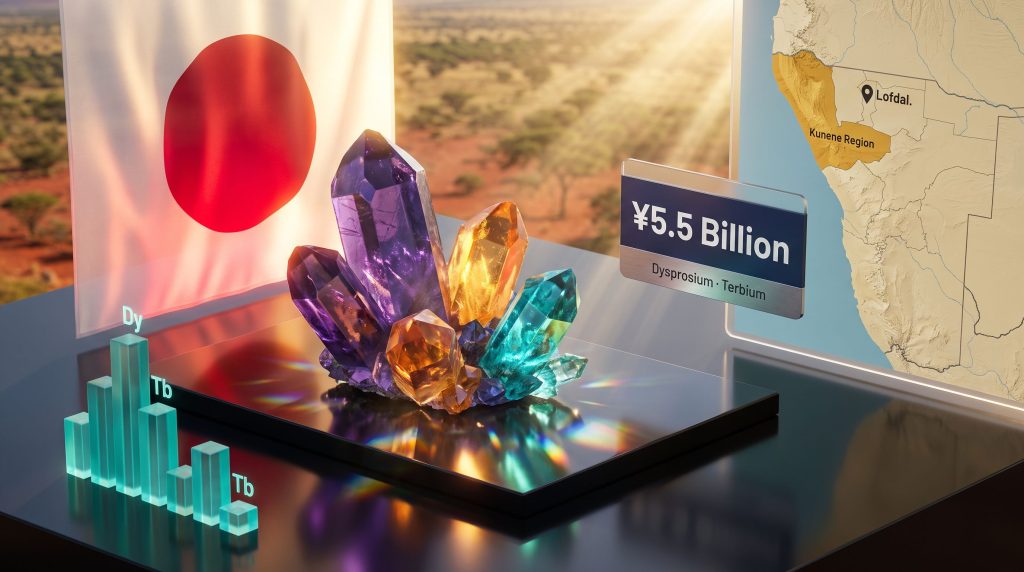
Yet the geological distribution of heavy rare earth-enriched deposits is extraordinarily narrow. Outside of ionic clay deposits concentrated in southern China's Jiangxi Province and neighbouring regions, carbonatite-hosted HREE mineralisation of commercial significance is exceptionally rare globally. This geological scarcity is precisely why Japan's commitment of up to ¥5.5 billion (approximately US$34 million) to a heavy rare earth venture in Namibia, through its state resources agency JOGMEC, deserves far more analytical attention than it typically receives.
When big ASX news breaks, our subscribers know first
Why the HREE Supply Problem Is More Severe Than Commonly Understood
The Dysprosium and Terbium Bottleneck
The rare earth sector is frequently discussed as a single supply chain issue, but this framing obscures a critical distinction. Light rare earths such as neodymium and praseodymium are produced in meaningful quantities from deposits across Australia, the United States, and Canada. Heavy rare earths are categorically different. Understanding rare earth supply chains therefore requires separating light and heavy elements as distinct strategic problems.
China controls an estimated 85 to 90 percent of global rare earth processing capacity, but its dominance over heavy rare earth supply is even more pronounced. Ionic clay deposits, which are the primary non-carbonatite source of dysprosium and terbium, are geographically confined to southern China. These deposits are mined through an in-situ leaching process where ammonium sulfate solution is injected into weathered granite profiles to dissolve rare earth ions. The technique is highly effective but environmentally disruptive, and China has progressively tightened domestic production quotas in response to ecological damage.
This quota constraint, combined with China's rare earth export restrictions that it has demonstrated willingness to deploy, creates a supply ceiling that importing nations cannot resolve through market mechanisms alone. Japan learned this lesson at significant economic cost during the 2010 Sino-Japanese rare earth embargo, when Chinese export restrictions caused dysprosium prices to spike by more than 2,000 percent over an approximately 18-month period, severely disrupting the Japanese automotive and electronics sectors.
The scale of Japan's downstream exposure adds further urgency:
- Japan produced approximately 7.8 million vehicles in 2023, a substantial proportion of which incorporate HREE-dependent permanent magnet motors
- The country has zero domestic rare earth production, making it structurally dependent on import supply chains
- Japanese magnet manufacturers, including Shin-Etsu Chemical and TDK, are among the largest producers of NdFeB magnets outside China, creating a dual vulnerability at both the raw material and processed material stages
The 2010 embargo remains the defining case study in rare earth supply chain risk. It demonstrated that price signals alone cannot protect industrial supply chains when a single nation controls processing infrastructure. Japan's subsequent diversification strategy has been shaped entirely by that experience.
Why Carbonatite-Hosted HREEs Matter Geologically
Most investors and analysts focus on deposit size and grade when evaluating rare earth projects. However, for heavy rare earth supply specifically, the distribution of elements within the total rare earth oxide (TREO) basket is a far more important metric than headline grade alone.
This is where the Lofdal Heavy Rare Earths Project in Namibia's Kunene Region becomes geologically significant in ways that go beyond its absolute resource scale. The deposit's carbonatite-hosted mineralisation yields a rare earth basket with an unusually high proportion of heavy rare earth elements. In most carbonatite deposits globally, light rare earths such as cerium and lanthanum dominate the basket, often representing 60 to 80 percent of total rare earth content by weight.
At Lofdal, the HREE fraction, particularly dysprosium and terbium, represents a significantly elevated share of the total basket. This geological characteristic transforms the project's economic profile because dysprosium and terbium trade at price multiples of 10 to 20 times those of cerium or lanthanum on a per-kilogram basis. A smaller total resource with an HREE-enriched basket can therefore generate substantially greater revenue per tonne of ore processed than a larger light rare earth deposit.
The mineralisation style at Lofdal is hosted within xenotime and fergusonite, both yttrium-bearing phosphate and niobate minerals respectively. This mineralogical composition is notably different from the bastnäsite and monazite that host light rare earths in deposits such as Mountain Pass in California or Mount Weld in Australia. Furthermore, the rare earth processing challenges required to extract and separate HREEs from xenotime and fergusonite are more technically demanding, which partially explains why HREE-enriched carbonatites have historically been underdeveloped relative to their strategic value.
What the JOGMEC Rare Earth Venture in Namibia Actually Involves
Structure and Participants of TJ Namibia Rare Earths
The JOGMEC rare earth venture in Namibia is structured around a newly constituted project entity called TJ Namibia Rare Earths, which brings together three parties with complementary roles. Understanding how each participant contributes is essential to evaluating the venture's commercial and strategic logic.
| Party | Role | Strategic Contribution |
|---|---|---|
| JOGMEC | State capital provider and technical mandate | Funds pre-commercial development; carries resource security mandate |
| Toyota Tsusho | Commercial partner (acquired via competitive bid) | Connects HREE output to Toyota's EV supply chain |
| Namibia Critical Metals | Project tenure holder and operator | Holds the 25-year mining licence; provides operational history |
JOGMEC's commitment of up to ¥5.5 billion funds the feasibility study and advances the project toward what the venture is targeting as a final commercialisation decision in fiscal year 2027. The agency's earn-in interest is structured at up to 40 to 50 percent, subject to spending thresholds, making this a genuine equity partnership rather than a simple offtake or loan arrangement.
Toyota Tsusho's entry through a competitive bidding process is a detail worth examining carefully. JOGMEC structured the venture to attract partners with both financial capacity and downstream connectivity. Toyota Tsusho, as the trading and investment arm of the Toyota Group, provides a direct conduit from African mine production to Japanese EV motor manufacturing. This vertical integration logic is not incidental; it reflects a deliberate architecture designed to ensure that HREE supply flows to end-use industries rather than simply onto commodity markets.
The Lofdal Project: Key Parameters
| Project Attribute | Detail |
|---|---|
| Location | Kunene Region, northwestern Namibia |
| Licence Status | 25-year mining licence, fully granted |
| Primary Target Elements | Dysprosium (Dy), Terbium (Tb) |
| Mineralisation Style | Carbonatite-hosted; xenotime and fergusonite mineralogy |
| JOGMEC Initial Agreement | January 2020 |
| Current Stage | Feasibility study (advancing from 2026) |
| Commercialisation Decision Target | Fiscal year 2027 |
The fact that Namibia Critical Metals holds a fully granted 25-year mining licence removes one of the highest-risk variables in early-stage resource development. Permitting timelines for rare earth projects in many jurisdictions now extend to a decade or longer, given community consultation requirements, environmental assessments, and regulatory complexity. At Lofdal, this risk has already been resolved.
How the JOGMEC–Namibia Partnership Evolved Over Six Years
A Methodical State-Backed Approach: 2020 to 2026
The progression from initial agreement to joint venture formation follows a timeline that reflects JOGMEC's characteristic operating style: deliberate, multi-stage, and oriented toward long-cycle supply security rather than short-term capital efficiency.
- January 2020 – JOGMEC executed a foundational joint exploration, development, exploitation, refining, and distribution agreement with Namibia Critical Metals, covering the Lofdal project
- 2022 – JOGMEC and the Government of Namibia formalised a Memorandum of Understanding covering supply chain research, exploration training programmes, and feasibility studies for Namibia as a potential regional rare earth processing hub
- August 2023 – JOGMEC signed a Statement of Work for research with Namibia's Ministry of Mines and Energy, advancing technical and regulatory groundwork
- 2025 to 2026 – Toyota Tsusho entered via competitive bidding; TJ Namibia Rare Earths was formally constituted
- Fiscal 2027 – Targeted date for feasibility study completion and final commercialisation decision
This six-year development arc is itself instructive. Private capital markets typically demand faster decision cycles and clearer near-term returns. State-backed entities like JOGMEC can absorb the extended timelines and high technical uncertainty associated with pre-feasibility and feasibility work on complex HREE deposits, funding stages that would otherwise remain uninvestable.
What Makes Namibia a Credible Development Jurisdiction
Governance, Infrastructure, and Geopolitical Positioning
Namibia's credibility as a rare earth development jurisdiction rests on several intersecting factors that go beyond the frequently cited narrative of political stability. In addition, the broader landscape of critical minerals geopolitics is reshaping how nations assess frontier jurisdictions like Namibia.
Governance and regulatory track record:
- Namibia's Ministry of Mines and Energy administers a transparent licensing regime with established precedent for large-scale foreign investment
- The country hosts the Rössing uranium mine, one of the world's largest open-pit uranium operations, and the Husab uranium mine, both of which demonstrate that Namibia can accommodate technically complex, large-scale extraction operations
- Namibia has existing hydrometallurgical processing infrastructure associated with its uranium sector, a capability that is technically adjacent to rare earth processing
Why regional processing capacity is achievable:
The 2022 JOGMEC-Namibia MOU explicitly included feasibility work on establishing Namibia as a regional rare earth processing hub. This ambition is grounded in more than aspiration. Namibia already has precedent for uranium conversion processing, grid-connected industrial power, and port infrastructure through Walvis Bay capable of handling processed mineral exports.
If Namibia successfully develops rare earth separation capacity, it could become a non-Chinese HREE processing node for allied nations, comparable in strategic function to what Lynas Rare Earths' Malaysian facility represents for light rare earth processing. The difference is that Namibia's potential hub would address the heavy rare earth gap, which is the more acute and less-solved supply chain problem.
Multi-partner geopolitical positioning:
Namibia has engaged simultaneously with Japan (JOGMEC), the European Union through the EU-Namibia Strategic Partnership on Raw Materials, and the United States. This multi-alignment strategy strengthens Namibia's negotiating position in offtake discussions and reduces dependency on any single buyer nation. For Japan, this also means the competitive environment for Lofdal's output could intensify, adding urgency to securing supply arrangements well ahead of first production.
Metallurgical Complexity: The Risk That Determines Everything
Why Processing Is the Critical Path for HREE Carbonatites
Among the risk categories facing the Lofdal project, metallurgical processing complexity deserves the most detailed examination because it is the variable most likely to determine commercial viability, yet it receives the least public attention. Consequently, the critical minerals demand driven by the energy transition only intensifies the pressure to solve these processing challenges quickly.
HREE extraction from carbonatite-hosted xenotime and fergusonite presents a fundamentally different set of processing challenges compared to either ionic clay HREE deposits or light rare earth carbonatites. The key technical challenges include:
- Mineralogical liberation: Xenotime and fergusonite have different physical and chemical properties from bastnäsite, requiring modified crushing, grinding, and flotation circuits to achieve acceptable liberation at commercially viable particle sizes
- Acid bake or pressure oxidation requirements: The phosphate matrix of xenotime typically requires aggressive chemical treatment, often sulfuric acid bake at elevated temperatures, to break down the mineral lattice and make rare earth ions accessible for leaching
- Separation selectivity: Separating individual HREE elements from one another through solvent extraction is technically demanding because the ionic radii of dysprosium, terbium, holmium, and erbium are very similar, requiring multiple extraction stages and precise control of aqueous chemistry
- Radioactive co-elements: Xenotime frequently contains elevated uranium and thorium concentrations as naturally occurring impurities, which introduces radiation management requirements and potentially increases regulatory complexity for processing operations
The feasibility study currently advancing at Lofdal will need to demonstrate that a metallurgical flowsheet exists that can achieve commercially acceptable rare earth recoveries at a capital and operating cost profile competitive against alternative supply sources. This is not a foregone conclusion, and it represents the most significant technical risk in the project's development pathway.
The next major ASX story will hit our subscribers first
Comparing National Approaches to Rare Earth Supply Security
How Japan's Strategy Fits the Global Competitive Landscape
| Nation / Bloc | Primary Strategy | African HREE Engagement |
|---|---|---|
| Japan (JOGMEC) | State equity + feasibility funding | Namibia: Lofdal HREE project |
| United States (DFC / DoD) | Loan guarantees + offtake support | Limited direct HREE exposure in Africa |
| European Union (CRMA) | Strategic partnerships + processing agreements | Namibia, Zimbabwe, South Africa |
| South Korea (KORES) | State equity + processing deals | Limited African HREE focus |
| China | Vertically integrated SOE ownership | Widespread across DRC, Zimbabwe, Zambia |
Japan's approach is distinctive in several respects. Unlike the US model, which relies heavily on loan guarantees and private sector offtake agreements, JOGMEC takes direct equity positions in projects. Unlike China's model, which prioritises vertically integrated ownership from mine to magnet, JOGMEC structures partnerships with commercial partners like Toyota Tsusho to handle downstream integration. This hybrid model attempts to combine state capital with private sector supply chain connectivity.
Japan's rare earth diversification portfolio now spans Australia (Northern Minerals' Browns Range heavy rare earth project), Canada, Kazakhstan, and now Africa, representing a deliberate geographic spread across politically stable, non-Chinese jurisdictions. The ¥5.5 billion Namibia commitment is consistent with JOGMEC's function as a risk absorber for pre-commercial development stages that private capital markets cannot efficiently price.
Key Risks Facing the Lofdal Development Path
A Structured Risk Assessment
Technical:
- Metallurgical flowsheet not yet proven at commercial scale for Lofdal's specific mineralogy
- Uranium and thorium co-extraction management adds processing and regulatory complexity
- Capital cost estimates remain subject to feasibility-level uncertainty until detailed engineering is completed
Commercial:
- Dysprosium and terbium pricing is historically volatile, with prices subject to rapid shifts driven by Chinese export policy, domestic quota adjustments, and demand fluctuations from the EV sector
- The fiscal 2027 commercialisation decision timeline means the project must demonstrate bankability within a pricing environment that cannot be predicted with confidence
Sovereign and geopolitical:
- Resource nationalism trends across southern Africa introduce long-term policy risk, including potential changes to royalty structures, local content requirements, and export restrictions
- Multi-partner competition for Namibia's mineral resources could evolve in ways that complicate exclusive supply arrangements
Disclaimer: This article contains forward-looking statements, projections, and analysis based on publicly available information. It does not constitute financial or investment advice. Rare earth project development involves substantial technical, commercial, and regulatory risks. Readers should conduct independent research and seek professional advice before making investment decisions.
Frequently Asked Questions About the JOGMEC Rare Earth Venture in Namibia
What is JOGMEC and why does it invest in overseas mining projects?
JOGMEC, the Japan Organization for Metals and Energy Security, is a Japanese government agency mandated to secure stable supplies of minerals and energy resources for Japan's industrial economy. It provides equity capital, loan guarantees, and technical expertise to resource projects internationally, focusing on materials that Japan cannot produce domestically.
Why are dysprosium and terbium so strategically important?
Both elements are essential additions to the NdFeB permanent magnets used in EV motors and wind turbine generators. Without dysprosium, these magnets lose thermal stability at motor operating temperatures. Neither element has a commercially viable substitute at the scale required by the energy transition.
What is the total investment committed by JOGMEC to the Namibia project?
JOGMEC has committed up to ¥5.5 billion (approximately US$34 million) to the TJ Namibia Rare Earths joint venture to fund feasibility work and advance the project toward a commercialisation decision.
When is a final investment decision expected?
The current development plan targets a final commercialisation decision during fiscal year 2027, contingent on feasibility study outcomes.
Is the Lofdal project already permitted for mining?
Yes. Namibia Critical Metals holds a fully granted 25-year mining licence over the Lofdal project, which significantly de-risks the development pathway relative to projects still navigating permitting processes.
Why did Toyota Tsusho participate through competitive bidding?
JOGMEC structured the venture to attract commercially oriented partners with downstream supply chain relevance. Toyota Tsusho's selection through a competitive process reflects its ability to connect Lofdal's HREE output directly to Toyota's EV manufacturing ecosystem, providing both commercial offtake rationale and supply chain integration.
What the Lofdal Venture Signals for Africa's Place in the Critical Minerals Economy
A Structural Shift in How Supply Chain Risk Is Being Managed
The deeper significance of the JOGMEC rare earth venture in Namibia lies not in the ¥5.5 billion figure itself but in the model it represents. For decades, resource-importing nations managed critical mineral risk primarily through spot market purchasing and short-term supply contracts. The 2010 rare earth crisis, the COVID-19 supply chain disruptions, and the accelerating geopolitical decoupling between Western industrial economies and China have collectively discredited that approach.
What is emerging in its place is a model of equity-backed, long-cycle project development in frontier jurisdictions, funded by state capital willing to absorb pre-commercial risk that private markets cannot efficiently price. The JOGMEC-Lofdal structure exemplifies this transition.
For Africa, the implications are substantial. State-backed capital from Japan, the EU, and potentially the United States is increasingly willing to fund feasibility and pre-feasibility work on African critical mineral projects, stages that have historically been orphaned by capital markets due to their risk-return profiles. The explicit inclusion of regional processing hub feasibility in Japan's framework with Namibia suggests that future deals may incorporate in-country value addition as a structural expectation rather than an aspirational afterthought.
As the EU's Critical Raw Materials Act and the US Inflation Reduction Act both create financial incentives for non-Chinese rare earth sourcing, competition for equity positions in projects like Lofdal is likely to intensify significantly ahead of the 2027 commercialisation decision. Nations and industrial groups that have not yet secured HREE supply arrangements face a narrowing window in which genuinely strategic assets remain accessible.
The Lofdal project's ultimate significance may therefore extend well beyond its own production profile. If it successfully demonstrates a commercial pathway for carbonatite-hosted heavy rare earth development in Africa, it will serve as a proof-of-concept that reshapes how subsequent investors from Europe, South Korea, and the United States approach the continent's rare earth endowment. That is a consequential outcome regardless of which precise tonnage figures the feasibility study ultimately delivers.
Want to Know When the Next Major Mineral Discovery Hits the ASX?
Discovery Alert's proprietary Discovery IQ model delivers real-time alerts the moment significant ASX mineral discoveries are announced — turning complex geological and commodity data into actionable insights for investors at every level. Explore why historic discoveries have generated extraordinary returns and begin your 14-day free trial today to position yourself ahead of the broader market.