July 30, 2026
The Invisible Chokepoint Western Manufacturers Cannot Afford to Ignore
Permanent magnets are everywhere. They spin the motors inside electric vehicles, power the pitch-control systems of offshore wind turbines, and enable the precision guidance systems embedded in modern defence platforms. Yet the materials that make these magnets function at high temperatures and under mechanical stress are produced at commercial scale in only one country at meaningful volumes. That country is China, and the two elements most critical to high-performance magnet performance are terbium and dysprosium.
This is not a supply risk in the abstract sense. It is an engineering dependency baked into the design of virtually every next-generation propulsion and power system being manufactured today. Terbium and dysprosium are added to neodymium-iron-boron (NdFeB) magnets specifically to raise their coercivity, meaning their resistance to demagnetisation at elevated temperatures. Without these heavy rare earth element (HREE) additions, EV motors lose performance reliability, wind turbine generators become thermally constrained, and defence applications requiring compact, powerful magnets face material substitution with no equivalent alternative.
The problem for Western industrial planners is not simply that China dominates HREE mining. It is that China controls the separation of these elements from ore into usable oxide form. This processing chokepoint means that even if ore is extracted from non-Chinese deposits, it must typically be shipped to China for refining before it can re-enter Western supply chains as a usable input. Energy Fuels heavy rare earth plant construction in Utah is one of the first credible industrial-scale efforts to close that gap, and it arrives at a moment when rare earth supply chains have never been more scrutinised by governments and manufacturers alike.
When big ASX news breaks, our subscribers know first
Why Terbium and Dysprosium Are So Difficult to Replace
The Chemistry Behind High-Performance Magnets
The rare earth elements most commonly discussed in clean energy and defence contexts are the light rare earths, particularly neodymium and praseodymium (collectively NdPr). These are the primary constituents of NdFeB magnets. However, the heavy rare earths, specifically dysprosium (Dy) and terbium (Tb), serve a functionally distinct and irreplaceable role.
When NdFeB magnets operate above approximately 80 degrees Celsius, their magnetic coercivity degrades rapidly. Dy and Tb, when added in relatively small but precise amounts, dramatically extend the usable temperature range of these magnets. A high-performance EV traction motor, for example, may contain magnets with dysprosium additions of 2 to 5 percent by weight. That small percentage is the difference between a motor that functions reliably across the full operating envelope and one that does not.
What makes this especially significant from a supply chain perspective is that Tb and Dy are not abundant in most rare earth deposits. They concentrate disproportionately in ionic clay deposits found primarily in southern China, specifically in provinces like Jiangxi, Fujian, and Guangdong. These deposits are also where the bulk of the world's HREE separation capacity is located. Outside of China, only a handful of projects globally carry meaningful Tb and Dy grades, and fewer still are at an advanced processing stage.
Furthermore, China rare earth restrictions introduced in recent years have added an urgent policy dimension to what was already a structural supply vulnerability for Western manufacturers.
The separation of heavy rare earth oxides from mixed concentrate is chemically complex and capital-intensive. The solvent extraction circuits required for HREE separation involve hundreds of sequential mixer-settler stages, demanding both deep process engineering expertise and significant upfront infrastructure investment. This creates a natural barrier to entry that has allowed Chinese processors to maintain dominance for decades.
What Makes the White Mesa Mill Strategically Unique
America's Only Fully Licensed Conventional Uranium Processing Facility
The White Mesa Mill in San Juan County, Utah, holds a regulatory status that no other facility in the United States can replicate quickly. It is the only fully licensed and operating conventional uranium processing facility in the country, a distinction that took decades of permitting, environmental approvals, and operational history to establish. That regulatory moat is arguably as valuable as the physical infrastructure itself.
The mill already produces uranium oxide concentrate and has demonstrated the capability to separate light rare earth oxides, specifically NdPr, from monazite feedstocks. Vanadium oxide has also been recovered at the facility when market conditions supported it. This multi-commodity processing profile is not common in the Western world, and it reflects the breadth of chemical processing expertise embedded in the mill's operating team.
The addition of a mixed rare earth carbonate (MREC) circuit as part of the current expansion is particularly noteworthy from a technical standpoint. An MREC circuit functions as a feedstock pre-processing stage that can accept a wider variety of heavy rare earth-rich inputs, including monazite concentrates and mixed carbonate intermediates from third-party sources, and convert them into a standardised intermediate product. This intermediate then feeds the downstream HREE separation circuits.
The practical effect is that the mill gains flexibility to process diverse feedstocks without requiring each source material to meet a single rigid specification, which broadens the potential supplier base considerably. In addition, the MREC circuit enables simultaneous production of rare earth oxides and uranium oxide concentrate. This co-processing capability means the mill does not need to choose between its uranium revenue stream and its rare earth expansion, which has meaningful implications for unit economics and capital recovery.
How Does the Energy Fuels Strategy Fit Into the Broader Picture?
The Energy Fuels strategy is explicitly designed to address the full value chain, from feedstock sourcing through to oxide separation, rather than targeting a single node in the supply chain. This integrated approach sets it apart from many of the single-stage processing projects that have struggled to achieve commercial viability in past cycles.
Breaking Down the $104 Million Expansion: Capacity, Timeline, and Capital
Phase 1 Production Targets
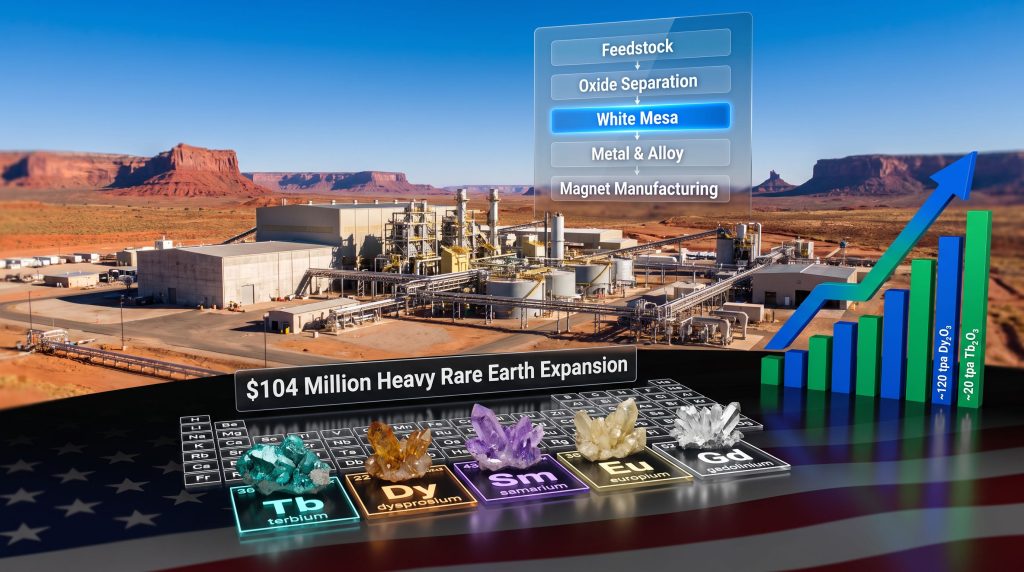
According to Energy Fuels, the Energy Fuels heavy rare earth plant construction in Utah is designed to add the following annual separation capacity at the White Mesa Mill:
| Rare Earth Oxide | Planned Annual Capacity |
|---|---|
| Terbium Oxide (Tb₂O₃) | ~20 tonnes |
| Dysprosium Oxide (Dy₂O₃) | ~120 tonnes |
| Samarium Oxide (Sm₂O₃) | ~140 tonnes |
| Europium Oxide (Eu₂O₃) | ~20 tonnes |
| Gadolinium Oxide (Gd₂O₃) | ~140 tonnes |
The commissioning timeline is structured in two stages. The terbium and dysprosium circuits, the strategically highest-value components of the expansion given global supply scarcity, are targeted for commissioning by Q4 2027. The samarium, europium, and gadolinium circuits follow, with completion targeted by the end of 2028.
This sequencing reflects rational capital prioritisation. Tb and Dy command the highest market premiums among the heavy rare earth oxides and are the most strategically sensitive materials for permanent magnet manufacturers. Bringing these circuits online first generates earlier revenue and validates the facility's technical capabilities before the broader suite of HREE circuits is completed.
Capital Structure and Financial Resilience
The total capital expenditure is estimated at approximately $104 million. The funding architecture is structured across three components:
- Debt financing: The debt component is targeted to be covered by a conditional US government loan commitment previously announced by the company.
- Equity contribution: Drawn from existing working capital, reported at approximately $0.96 billion as of March 31, 2026.
- Grant funding: Applications have been submitted to additional US government agencies for supplementary grant funding.
With working capital of approximately $0.96 billion against a total project cost of $104 million, the equity contribution required represents roughly 10 to 11 percent of available liquidity. Even without the government loan or grant funding, the company holds sufficient capital reserves to fund the expansion independently, suggesting a conservative and well-cushioned financial position heading into construction.
The Integrated Supply Chain: From Monazite to Magnets
Four Nodes, One Vertically Integrated Platform
Understanding the White Mesa expansion in isolation understates its strategic significance. The facility is one node in a four-stage vertical integration architecture that, if fully executed, would span from raw feedstock sourcing to finished magnet production. The structure operates as follows:
- Feedstock sourcing: Monazite concentrate from the Donald Project joint venture in Australia (up to 49% interest alongside Astron Limited), complemented by contracted third-party monazite and MREC sources.
- Oxide separation: White Mesa Mill in Utah, processing monazite and MREC feedstocks into individual rare earth oxides including NdPr, Tb, Dy, Sm, Eu, and Gd.
- Metal and alloy production: Australian Strategic Materials Limited (ASX: ASM) facilities in South Korea, pending completion of the planned ASM acquisition. These facilities convert rare earth oxides into the metallic alloys required for magnet production.
- Magnet manufacturing: Downstream integration via the planned acquisition of Vacuumschmelze, a German permanent magnet manufacturer, completing the mine-to-magnet chain.
Each node addresses a specific gap that has historically prevented Western industrial players from constructing a fully independent rare earth magnet supply chain. The separation stage at White Mesa is arguably the most technically complex and the most difficult to replicate, which is why it serves as the strategic anchor of the entire platform.
The Donald Project as the Primary Feedstock Source
The White Mesa expansion is specifically sized around the anticipated monazite output from the Donald Project in Victoria, Australia. Subject to a positive Final Investment Decision targeted for Q3 2026, Donald is expected to produce approximately 8,500 to 9,500 tonnes of monazite concentrate per annum beginning in 2028.
This volume, combined with third-party feedstock already under contract and in negotiation, is designed to fully utilise both the existing NdPr oxide separation capacity at White Mesa and the new Tb and Dy circuits being added under the current expansion. The feedstock-to-capacity alignment is tight, suggesting the expansion was designed around known supply rather than speculative future contracts.
The Donald Project FID is contingent on completing debt financing negotiations with Export Finance Australia and other lenders, targeting approximately A$220 million in project debt. The outcome of these negotiations represents a near-term catalyst that underpins the entire feedstock supply chain for the White Mesa expansion.
The ASM Acquisition and Downstream Demand Visibility
One of the less widely understood aspects of this expansion is that the rare earth oxides produced at White Mesa already have a targeted downstream buyer built into the corporate structure. Under the planned ASM acquisition, White Mesa's oxide output is targeted to supply approximately 70% of the feedstock required for ASM's existing and planned metal and alloy capacity in South Korea.
This internal offtake arrangement is a significant de-risking mechanism. Rather than relying entirely on spot market sales or external long-term offtake negotiations, the integrated structure creates a captive demand pathway for a substantial portion of the White Mesa expansion's output. For investors, this reduces the revenue uncertainty typically associated with greenfield processing capacity coming online in a market still developing outside of China.
Phase 2: Modelling the 2029 Scale-Up Scenario
Comparative Capacity Targets
The Phase 1 expansion represents the foundation. Phase 2, targeted for 2029, is designed to substantially increase separation throughput across the highest-demand oxide categories:
| Oxide | Phase 1 Capacity (tpa) | Phase 2 Target Capacity (tpa) |
|---|---|---|
| NdPr Oxide | Existing capacity | 6,294 |
| Terbium Oxide | ~20 | ~80 |
| Dysprosium Oxide | ~120 | ~288 |
The Phase 2 expansion draws on a broader feedstock base, incorporating:
- All phases of the Donald Project in Australia
- The Vara Mada Project in Madagascar (100%-owned)
- The Bahia Project in Brazil (100%-owned)
- Third-party monazite concentrates and MRECs from contracted sources
If the Phase 2 targets are achieved, the White Mesa Mill would represent one of the largest HREE oxide separation platforms outside of China, operating at commercial scale with a diversified multi-country feedstock base. The dysprosium target of 288 tonnes per annum alone would represent a meaningful contribution to non-Chinese global supply, given that total annual global Dy oxide production has historically been concentrated almost entirely within Chinese facilities.
Execution Risk and Interdependencies
Several execution risks deserve attention when assessing the probability-weighted scenario for Phase 2:
- Donald FID timing: A delay beyond Q3 2026 would push back the monazite production start date of 2028, potentially leaving Phase 1 circuits operating below designed throughput during the initial commissioning period.
- ASM acquisition completion: The downstream demand pathway is contingent on successfully closing the ASM transaction. Any regulatory or financing complications could affect the captive offtake arrangement.
- Export Finance Australia negotiations: The A$220 million Donald Project debt financing remains under negotiation. Completion is a prerequisite for FID confirmation.
- Phase 2 regulatory approvals: Any expansion beyond Phase 1 capacity at White Mesa will require regulatory review. The mill's existing licensed status provides a meaningful procedural advantage, but timeline risk remains.
The next major ASX story will hit our subscribers first
Western HREE Separation: A Landscape of One
Why This Project Has No Direct Peer
When examined against the global landscape of non-Chinese HREE separation projects, the White Mesa expansion stands largely alone in terms of three simultaneous attributes: a defined commissioning timeline, a funded capital structure, and an existing licensed operating facility as the base. Most Western HREE separation initiatives remain at pre-feasibility or pilot scale, with commercial-scale oxide production years away from realisation.
The combination of a fully permitted facility, demonstrated processing experience across uranium and light rare earth oxides, and a connected feedstock pipeline from an advanced Australian heavy mineral sands project creates a convergence of enabling factors that is genuinely rare in this sector. Building a comparable greenfield separation facility from scratch would require navigating environmental permitting processes that, in the United States, have historically taken ten to fifteen years for complex hydrometallurgical facilities.
Consequently, the growing critical minerals demand driven by the energy transition places an even higher premium on facilities that already hold the requisite licences and operational track records needed to scale rapidly.
For Western permanent magnet supply chains serving defence procurement, EV manufacturing, and clean energy infrastructure, the ability to source terbium and dysprosium oxides from a domestic US facility removes a dependency that has been present since the last major non-Chinese HREE processing capacity closed decades ago. This is not merely an industrial development milestone. It is a structural correction to a supply chain architecture that has accumulated strategic risk over an extended period.
Key Milestones: A Forward-Looking Decision Timeline
Investors and industry observers should track the following sequence of critical milestones and their interdependencies:
| Target Date | Milestone |
|---|---|
| Q3 2026 | Donald Project Final Investment Decision |
| Q4 2027 | Terbium and Dysprosium oxide circuits commissioned at White Mesa |
| End of 2028 | Sm, Eu, and Gd circuits completed; Donald monazite production begins |
| 2029 | Phase 2 White Mesa expansion targeted |
The Donald FID in Q3 2026 is the single most important near-term validation point. A positive decision confirms the primary feedstock supply pipeline, aligns the A$220 million debt financing structure, and provides the operational certainty required for Phase 2 planning. A delay would not halt Phase 1 construction, as third-party contracted feedstock provides a supplementary input source, but it would affect the timeline for full capacity utilisation of the new circuits.
Frequently Asked Questions: Energy Fuels Heavy Rare Earth Plant Construction in Utah
What rare earth oxides will the White Mesa Mill expansion produce?
The Phase 1 expansion targets annual production of approximately 20 tonnes of terbium oxide (Tb₂O₃), 120 tonnes of dysprosium oxide (Dy₂O₃), 140 tonnes of samarium oxide (Sm₂O₃), 20 tonnes of europium oxide (Eu₂O₃), and 140 tonnes of gadolinium oxide (Gd₂O₃). These are produced in addition to the existing NdPr oxide separation capability already operating at the mill.
How much will the expansion cost and how is it funded?
Total capex is estimated at approximately $104 million, funded through a combination of a conditional US government loan commitment, existing working capital of approximately $0.96 billion as of March 31, 2026, and grant funding applications submitted to additional US government agencies.
When will commercial terbium and dysprosium production begin?
The terbium and dysprosium oxide circuits are targeted for commissioning by Q4 2027. The samarium, europium, and gadolinium circuits follow, targeted for completion by the end of 2028.
What is the Donald Project and why does it matter?
The Donald Project is a heavy mineral sands joint venture in Victoria, Australia, in which Energy Fuels holds the right to earn up to a 49% interest alongside Astron Limited. It is the primary feedstock anchor for the White Mesa expansion, targeting approximately 8,500 to 9,500 tonnes of monazite concentrate per annum beginning in 2028. Its Final Investment Decision is targeted for Q3 2026, contingent on finalising approximately A$220 million in project debt financing.
What is the MREC circuit?
The mixed rare earth carbonate circuit is a feedstock processing stage that allows the mill to accept a broader range of heavy rare earth-rich input materials, including monazite concentrates and carbonate intermediates from multiple sources. It standardises these varied inputs into a consistent intermediate product that feeds the downstream HREE separation circuits, all while enabling simultaneous uranium oxide concentrate production.
What is Phase 2 of the expansion?
Phase 2 is targeted for 2029 and would significantly scale separation capacity, reaching targets of 6,294 tonnes per annum of NdPr oxide, approximately 80 tonnes per annum of terbium oxide, and approximately 288 tonnes per annum of dysprosium oxide. It draws on feedstock from the Donald Project, the Vara Mada Project in Madagascar, the Bahia Project in Brazil, and third-party sources.
From Construction Start to Structural Shift
The commencement of Energy Fuels heavy rare earth plant construction in Utah is best understood not as a single corporate milestone but as a visible inflection point in a decade-long structural transition within Western critical minerals supply chains. Three layers of significance compound the importance of this development.
First, the creation of domestic HREE oxide separation capacity at commercial scale in the United States addresses a processing gap that has persisted since the early 2000s. No other facility in the Western world currently operates Tb and Dy oxide separation at the scale being targeted here, with a defined commissioning date.
Second, the vertically integrated architecture connecting Australian monazite, Utah oxide separation, South Korean metal and alloy production, and European magnet manufacturing represents a genuinely novel attempt to construct a fully Western permanent magnet supply chain from the ground up. Furthermore, considerations around energy security in minerals have made domestic processing infrastructure a geopolitical priority, not merely a commercial one.
Third, the financial structure underpinning the expansion, with working capital nearly ten times the project cost and a conditional government loan commitment in place, provides a degree of balance sheet resilience that distinguishes this project from many earlier rare earth initiatives that stalled at the funding stage.
The critical path now runs through the Donald Project FID in Q3 2026. Confirmation of that decision would validate the feedstock pipeline, unlock A$220 million in project debt, and set the clock running toward a 2028 production start that feeds directly into the newly constructed White Mesa circuits. If that sequence executes as planned, the Western permanent magnet supply chain may look materially different by 2030 than it does today.
This article contains forward-looking statements and projections based on publicly announced company targets and timelines. Actual outcomes may differ materially from those described. Readers should conduct independent due diligence before making any investment decisions.
Further Exploration: Readers seeking additional context on Energy Fuels' rare earth strategy and the White Mesa Mill's development trajectory can explore related reporting and analysis available at Crux Investor, which covers critical minerals companies and project developments across global markets. Industry observers can also visit the Energy Fuels corporate site for the latest operational updates on their rare earths and mineral sands programmes.
Want to Track the Next Major Critical Minerals Discovery Before the Market Does?
Discovery Alert's proprietary Discovery IQ model scans ASX announcements in real time, instantly identifying significant mineral discoveries across rare earths and critical minerals — turning complex data into actionable investment insights the moment they are announced. Explore how historic discoveries have generated substantial returns for early movers, and begin your 14-day free trial at Discovery Alert to position yourself ahead of the broader market.