July 30, 2026
The Geopolitics of Heavy Rare Earths: Why Dysprosium and Terbium Are Rewriting Industrial Strategy
The global race to secure heavy rare earth elements has moved well beyond boardroom discussions and policy white papers. It is now playing out in some of the world's most remote geological formations, with state-backed resource organisations and major trading houses committing serious capital to projects that would have been considered too early-stage or too geographically complex just a decade ago. The JOGMEC Toyota Tsusho rare earth venture in Namibia represents exactly this kind of structural shift, where industrial necessity and geopolitical urgency have converged into a single investment thesis.
When big ASX news breaks, our subscribers know first
What Makes Heavy Rare Earths Fundamentally Different from Light Rare Earths?
To understand why the Lofdal project in Namibia's Kunene region commands such attention, it helps to understand what separates heavy rare earth elements (HREEs) from their lighter counterparts at a technical level.
Neodymium-iron-boron (NdFeB) permanent magnets are the dominant magnet type used in electric vehicle traction motors and wind turbine generators. These magnets rely on neodymium and praseodymium, both light rare earths, for their core magnetic properties. However, high-performance applications, particularly EV motors that must operate reliably at elevated temperatures, require small additions of dysprosium and terbium to maintain coercivity, which is the magnet's resistance to demagnetisation under thermal stress.
Without dysprosium and terbium, NdFeB magnets lose their functional integrity at operating temperatures typical of automotive drivetrains. There is currently no commercially deployed substitute for these additions in high-performance motor applications, a constraint that makes HREEs qualitatively different from many other critical minerals where material substitution remains a viable medium-term hedge. Furthermore, critical minerals demand continues to intensify as the global energy transition accelerates, placing even greater pressure on already strained supply chains.
Heavy rare earth elements like dysprosium and terbium are not simply inputs into the clean energy transition. They are non-negotiable preconditions for high-performance permanent magnet motors, and the absence of commercially viable substitutes places the entire EV supply chain in a structurally exposed position relative to the countries that control their supply.
The Ionic Clay Deposit Advantage and Why Lofdal's Geology Matters
Globally, the dominant source of dysprosium and terbium is ionic clay deposits concentrated in southern China. These deposits are prized not only for their grade but for their relatively straightforward processing characteristics. Ionic clay rare earths are adsorbed onto clay minerals and can often be extracted through in-situ leaching or heap leaching processes, avoiding some of the more energy-intensive steps associated with hard-rock rare earth processing.
The Lofdal deposit differs geologically. It is a carbonatite-hosted deposit, which presents distinct rare earth processing challenges compared to ionic clay sources, but also offers important advantages in terms of deposit scale, resource continuity, and geographic accessibility from a sovereign risk perspective. Understanding this distinction matters for investors assessing the project's cost profile and processing pathway as the definitive feasibility study progresses.
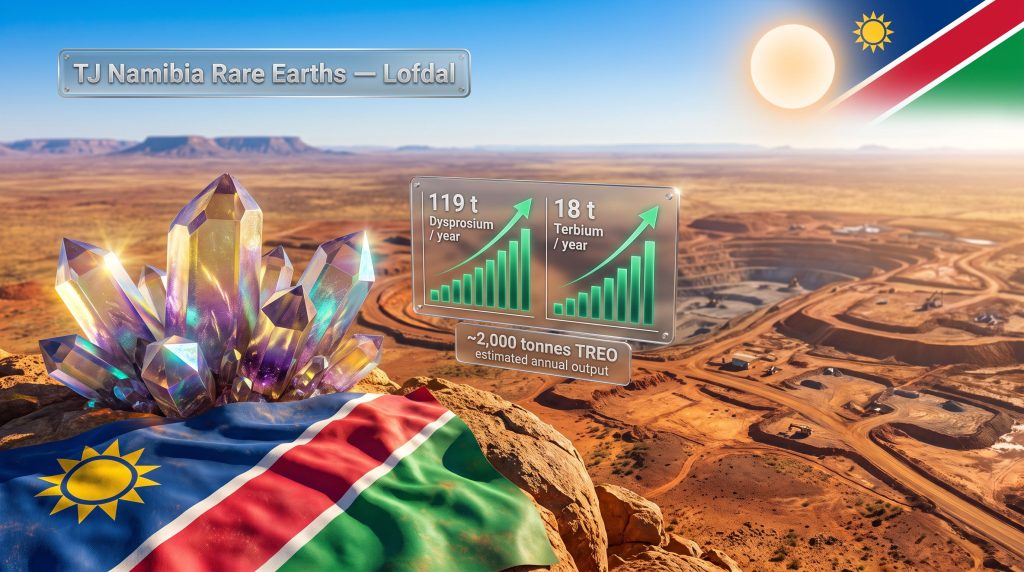
The deposit's estimated annual production profile tells a compelling story:
| Output Metric | Estimated Annual Volume |
|---|---|
| Total Rare Earth Oxides (TREO) | ~2,000 tonnes |
| Dysprosium oxide | ~119 tonnes |
| Terbium oxide | ~18 tonnes |
These volumes, while modest relative to Chinese production, represent a meaningful contribution to non-Chinese HREE supply, particularly given the near-total dominance China exercises over global dysprosium and terbium markets.
China's Export Control Escalation: The Trigger Behind Japan's Urgency
Beijing's decision to impose export restrictions on select heavy rare earth elements and magnet-related products beginning in April 2025 marked a qualitative shift in how critical minerals are being used as instruments of geopolitical leverage. China's rare earth export restrictions had a compressive and sequential impact on Japan specifically, with restrictions tightened again in January 2026 and then twice more in February 2026.
Japan's exposure to this dynamic is particularly acute for several reasons:
- Japan is among the world's most advanced manufacturers of NdFeB permanent magnets and the equipment that depends on them
- The country's automotive sector, anchored by Toyota Group companies, is in the midst of a large-scale pivot to electric vehicle production that will progressively increase HREE demand
- Japan's defence and robotics manufacturing sectors also rely on high-coercivity magnets, amplifying the strategic sensitivity of supply disruption
- Unlike the United States or Australia, Japan has limited domestic mineral resources, making upstream diversification an existential industrial policy priority rather than simply a commercial preference
China accounts for an estimated 90% or more of global dysprosium and terbium supply. At those concentration levels, even a partial disruption creates cascading effects through downstream manufacturing supply chains within weeks, not months.
How the JOGMEC Toyota Tsusho Joint Venture Was Structured
The formation of TJ Namibia Rare Earths as a special-purpose company (SPC) is a structurally elegant solution to a complex multi-stakeholder problem. By creating a dedicated vehicle, Toyota Tsusho and JOGMEC have ring-fenced project risk, established a transparent governance framework between public and private capital, and created a structure that can accommodate future financing arrangements, including potential offtake-linked debt or additional equity participants.
The timeline of how this partnership evolved reveals a disciplined, staged approach to de-risking a frontier project:
- 2020: JOGMEC enters a joint exploration programme at Lofdal alongside Canada-based Namibia Critical Metals, providing early-stage risk capital when private-sector appetite was limited
- Pre-2026: A pre-feasibility study is completed, establishing the technical and economic basis for advancing to definitive feasibility
- March 2026: Toyota Tsusho enters the project through a competitive public tender process, acquiring a portion of JOGMEC's option interest in the deposit
- July 23, 2026: JOGMEC makes its inaugural capital contribution into TJ Namibia Rare Earths
- July 30, 2026: Both partners publicly confirm the joint venture structure and the investment commitment of up to C$47.7 million (approximately USD $33.9 million)
- Target FID: Final commercialisation decision expected during the fiscal year ending March 2027
The fact that Toyota Tsusho entered through a competitive bidding process rather than a negotiated side arrangement is a detail worth noting. It signals that multiple parties evaluated the project and that Toyota Tsusho's participation reflects a considered judgement about Lofdal's commercial fundamentals, not merely a relationship-driven transaction.
JOGMEC's Role as Patient State Capital
JOGMEC operates at the intersection of Japan's industrial policy and resource diplomacy, providing the kind of long-duration, risk-tolerant capital that enables early-stage critical mineral projects to reach the technical and commercial thresholds required to attract private-sector co-investors.
Its six-year involvement at Lofdal prior to Toyota Tsusho's entry is a textbook example of how state-backed resource organisations can de-risk frontier projects in a way that ultimately catalyses private capital. Without JOGMEC's sustained exploration investment from 2020 onward, it is unlikely the project would have reached a pre-feasibility standard capable of attracting a competitive tender process by early 2026.
This patient capital model stands in deliberate contrast to short-cycle private investment logic and represents a model that Japan, South Korea, and increasingly the United States and European Union are seeking to replicate across multiple critical mineral categories and geographies. In addition, the rare earth supply chains that underpin these strategies are becoming a central pillar of national industrial policy worldwide.
Namibia's Position in the African Critical Minerals Competition
Namibia brings a combination of attributes that make it an attractive destination for this kind of investment. Its governance environment is considered among the most stable on the continent, its mining regulatory framework has a track record of predictability, and its geological endowment extends well beyond the rare earth sector into uranium, lithium, and base metals.
The Lofdal project would, if successfully developed, represent Japan's first rare earth mine development on the African continent. That milestone carries significance beyond the project's own economics, establishing a precedent and a relationship between Japanese resource capital and Namibian mining jurisdiction that could underpin future investments. Consequently, African mining finance trends are increasingly reflecting this growing appetite from Asian state-backed and private capital alike.
The broader African critical minerals landscape is also intensifying competitively:
- The United States has been pursuing upstream mineral partnerships across Africa, including rare earth projects in Madagascar
- The European Union's Critical Raw Materials Act is driving European capital toward African mineral projects to satisfy domestic content requirements
- Chinese-backed entities have established significant presence across African lithium, cobalt, and manganese sectors
- Japan's Lofdal commitment places it in direct competition with these dynamics at the project-development level
Key Risks and Decision Gates Before March 2027
The path from current investment commitment to operating mine involves multiple high-stakes decision points. Understanding these gates is essential for anyone seeking to assess the probability of Lofdal reaching production.
| Milestone | Status | Risk Level |
|---|---|---|
| Definitive Feasibility Study | In progress via TJ Namibia Rare Earths | Medium, remote location cost uncertainty |
| Final Investment Decision | Targeted FY ending March 2027 | High, contingent on DFS outcomes |
| Offtake Agreement Execution | Not yet confirmed publicly | High, essential for project financing |
| Namibian Regulatory Approvals | Ongoing | Medium, stable regulatory environment |
| Rare Earth Price Environment | Volatile, China-influenced | High, directly affects project economics |
Scenario Analysis: Accelerants and Headwinds
Several scenarios could materially shift the project's trajectory over the next 18 months:
- Further Chinese export restriction escalation would intensify upstream sourcing urgency across Japanese industry and potentially accelerate the final investment decision timeline
- A sustained rare earth price rally, particularly for dysprosium and terbium, would significantly improve the project's modelled internal rate of return and ease offtake negotiations
- Processing cost surprises uncovered during the DFS, particularly around the carbonatite ore processing pathway, represent the most technically grounded downside risk
- Secured offtake arrangements with Toyota Group magnet manufacturers or third-party Japanese magnet producers would be a major positive catalyst, providing the revenue certainty required for project debt financing
- Geopolitical stabilisation between China and major Western economies, while unlikely in the near term based on current trajectory, could reduce pricing urgency and complicate the commercial case
Disclaimer: The scenario analysis presented here reflects publicly available information and structural industry dynamics. It does not constitute financial advice. Investors should conduct independent due diligence before making investment decisions related to any company or project discussed in this article.
The next major ASX story will hit our subscribers first
Why the Lofdal Project Is a Structural Bellwether for Non-Chinese HREE Supply
The JOGMEC Toyota Tsusho rare earth venture in Namibia is significant not primarily because of its size, which is modest relative to the capital involved in major mining projects, but because of what it represents structurally. It is one of the most technically advanced heavy rare earth development projects outside China currently progressing through definitive feasibility, in a jurisdiction with credible governance, backed by the combined resources of a Japanese state organisation and one of the world's largest automotive-adjacent trading houses.
The question the project ultimately poses is whether the non-Chinese rare earth development pipeline can move fast enough and at sufficient scale to provide industrial consumers with real supply optionality before the next escalatory episode in Beijing's export control playbook. Lofdal cannot answer that question alone, but its progress over the next twelve months will serve as a meaningful data point in that broader assessment.
For Japan's industrial base, for Namibia's economic development ambitions, and for the global supply chain architects trying to build resilience into the clean energy transition, the JOGMEC Toyota Tsusho rare earth venture in Namibia and its journey from exploration to feasibility to potential production is a story worth watching with close attention.
Want To Stay Ahead of the Next Major Mineral Discovery?
Discovery Alert's proprietary Discovery IQ model scans ASX announcements in real time, instantly identifying significant mineral discoveries across critical commodities — including rare earths — and delivering actionable insights directly to subscribers. Explore historic examples of major discoveries and their returns, then start your 14-day free trial at Discovery Alert to position yourself ahead of the broader market.