July 30, 2026
The Hidden Vulnerability Shaping India's Industrial Future
Every major economy that has attempted to build a clean energy and defence manufacturing base without securing its upstream material inputs has eventually encountered the same structural ceiling. The technology works. The factories get built. Then the magnets don't arrive, or they arrive at prices that make domestic production uneconomical, and the entire industrial strategy quietly unravels.
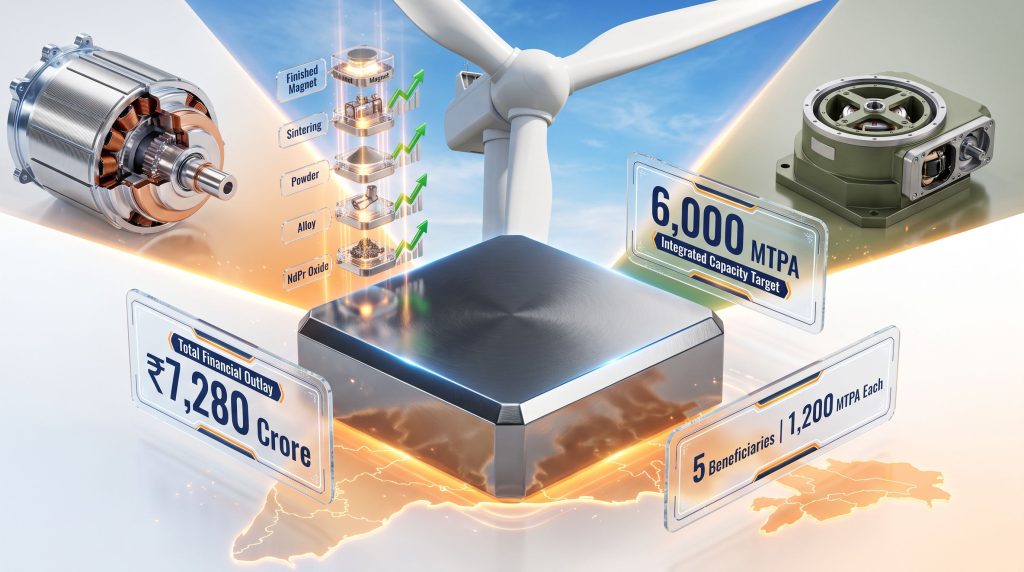
This is the precise vulnerability that India's ₹7,280 crore Scheme to Promote Manufacturing of Sintered Rare Earth Permanent Magnets (REPM) is designed to permanently close. Approved by the Union Cabinet in November 2025 and administered by the Ministry of Heavy Industries (MHI), the scheme is not a peripheral subsidy programme. It is a foundational intervention in one of the most consequential material supply chains of the 21st century, targeting 6,000 metric tonnes per annum (MTPA) of fully integrated rare earth permanent magnet manufacturing capacity across five selected facilities.
Understanding why India launched this India rare earth magnet manufacturing scheme now, how it is structured, what it demands of prospective manufacturers, and where its execution risks lie requires moving well beyond the headline budget figure.
When big ASX news breaks, our subscribers know first
Why Sintered NdFeB Magnets Are the Pressure Point
Not all rare earth magnets are created equal. The sintered neodymium-iron-boron (NdFeB) class sits at the apex of permanent magnet performance, delivering the highest energy density of any commercially available magnet material. This makes sintered NdFeB the only practical choice for applications demanding compact, powerful, and thermally stable magnetic performance, including:
- Permanent magnet synchronous motors (PMSMs) in electric vehicles, which dominate EV drivetrain architecture globally
- Direct-drive wind turbine generators, where magnet mass and field strength directly determine power output per unit weight
- Precision guidance and actuation systems in guided munitions and advanced avionics
- Hard disk drive read/write heads, industrial servo motors, and medical imaging equipment
What makes this material category strategically singular is that China accounts for an estimated 85 to 92 percent of global sintered NdFeB magnet production, according to widely cited industry assessments, with Chinese producers also controlling the majority of upstream neodymium-praseodymium (NdPr) oxide separation and metal alloy output. The concentration is not merely at one point in the chain. It runs through nearly every stage from mine to finished magnet.
Furthermore, China's rare earth strategy has demonstrated precisely how this concentration can be operationalised as an instrument of supply chain leverage, sending procurement uncertainty across EV manufacturers, wind turbine OEMs, and defence contractors simultaneously. Export licensing requirements introduced on rare earth processing technologies and materials in recent years have made this abundantly clear.
Scheme Architecture: How the ₹7,280 Crore Is Deployed
The financial design of the REPM scheme reflects a deliberate effort to balance investment incentivisation with output accountability. Rather than concentrating disbursements at the construction phase, the scheme ties the majority of its financial support to verified commercial production.
| Parameter | Detail |
|---|---|
| Total Financial Outlay | ₹7,280 crore |
| Sales-Linked Incentives | |
| Capital Subsidy Component | ~₹750 crore |
| Implementation Duration | 7 years total |
| Setup Period | 2 years |
| Incentive Disbursement Period | 5 years |
| Target Capacity | 6,000 MTPA (integrated) |
| Implementing Ministry | Ministry of Heavy Industries (MHI) |
| Cabinet Approval | November 2025 |
The logic embedded in this structure is significant. By allocating approximately ₹6,450 crore to sales-linked incentives and only ₹750 crore to capital subsidy, the scheme creates a strong performance signal: disbursements flow from demonstrated output, not from facility construction milestones alone. This mirrors the broader Production Linked Incentive (PLI) philosophy that India has applied across semiconductors, pharmaceuticals, and advanced chemistry cells.
The two-year setup period followed by a five-year incentive window gives selected manufacturers a defined planning horizon while maintaining accountability for genuine commercial operation. The Cabinet's approval of this scheme reflects India's broader ambition to reduce dependency on imported strategic materials.
Global Tender Timeline and Beneficiary Selection
The global competitive tender, formally issued on March 20, 2026 through the Central Public Procurement (CPP) Portal, is designed to attract both domestic Indian manufacturers and international technology and capital partners. Following an addendum published on the CPP Portal, the bid submission deadline was extended from July 29, 2026 to August 12, 2026, with technical bid opening rescheduled to August 13, 2026.
The extension provides prospective manufacturers additional time to complete the technical documentation and partnership structuring that integrated magnet facility proposals require.
Key structural parameters of the selection process:
- Five beneficiaries will be selected through competitive global bidding
- Each facility is expected to target up to 1,200 MTPA of integrated rare earth permanent magnet capacity
- Combined output across five facilities would achieve the scheme's headline 6,000 MTPA national target
- The global bidding structure intentionally broadens the technology and capital pool, recognising that India's domestic incumbent base in sintered magnet manufacturing is currently limited
The inclusion of international participants is a pragmatic acknowledgment of technological reality. High-volume sintered NdFeB manufacturing requires sophisticated process control across powder preparation, magnetic field alignment during pressing, sintering atmosphere management, and post-sintering machining. In these areas, Japan's TDK, Shin-Etsu Chemical, and TDK-owned Magequench, along with European and South Korean producers, hold significant intellectual property depth.
What Full Integration Actually Demands
The word integrated carries considerable weight in this scheme's design. It distinguishes the programme from partial downstream operations that would still leave India structurally dependent on imported upstream materials.
The complete production chain the scheme targets proceeds as follows:
- NdPr oxide sourcing from domestic rare earth deposits or strategic bilateral supply arrangements
- Alloy production converting oxide into neodymium-praseodymium metal alloy through reduction processes
- Powder preparation using hydrogen decrepitation followed by jet milling to produce fine-grained magnetic powder, with particle size control being critical to final magnet coercivity and remanence
- Strip casting and rapid solidification at the alloy stage, a process refinement that significantly improves microstructural homogeneity in the finished magnet
- Magnetic field alignment and pressing where powder is compacted under a strong magnetic field to orient crystallographic axes before sintering
- High-temperature sintering in vacuum or inert atmosphere to achieve full density without oxidation
- Post-sinter heat treatment to optimise coercivity through grain boundary diffusion, an increasingly important technique for reducing heavy rare earth (dysprosium/terbium) content without sacrificing thermal performance
- Precision machining, surface treatment, and coating to specification for the target application
Why Grain Boundary Diffusion Matters
Grain boundary diffusion processing (GBDP) represents one of the more consequential recent advances in NdFeB magnet production. By introducing dysprosium or terbium at the grain boundaries rather than distributing them throughout the magnet bulk, manufacturers can achieve equivalent coercivity with significantly lower heavy rare earth input.
Given that dysprosium and terbium are far scarcer and more expensive than NdPr, GBDP adoption meaningfully reduces both input cost and supply chain exposure for heavy rare earth elements. This makes it a critical capability for any facility seeking long-term cost competitiveness.
Upstream Dependency: India's NdPr Oxide Challenge
One of the less frequently examined dimensions of the REPM scheme is the upstream question it leaves partially unresolved. India possesses substantial rare earth mineral reserves, concentrated in monazite-bearing coastal sand deposits, with the Indian Rare Earths Limited (IREL) having operated processing operations for decades.
However, India's separation and processing infrastructure for light rare earth oxides, particularly the NdPr fraction required for magnet production, remains underdeveloped relative to the volumes the 6,000 MTPA scheme would demand. Consequently, closing this gap requires parallel investment in:
- Rare earth separation plant expansion, particularly solvent extraction capacity optimised for NdPr fractionation
- Domestic alloy reduction facilities using processes such as molten salt electrolysis or metallothermic reduction
- Strategic bilateral supply arrangements with rare earth producing nations, including Australia, where several advanced NdPr projects are targeting production in the late 2020s
The broader context of rare earth supply chains makes this upstream challenge all the more urgent. Without a credible upstream supply solution, the integrated ambition of the REPM scheme risks being partially hollow, with facilities reliant on imported NdPr oxide rather than a genuinely domestic chain from ore to magnet.
The next major ASX story will hit our subscribers first
Sector-by-Sector Demand: Where the Magnets Will Go
Electric Vehicles
India's EV adoption trajectory, particularly across two-wheelers and three-wheelers where penetration is already meaningful, creates a growing domestic demand base for PMSMs. Every permanent magnet synchronous motor in a passenger EV contains approximately 1 to 3 kilograms of sintered NdFeB magnet material, while commercial EV traction motors can require significantly more.
At scale, India's EV production ambitions translate directly into substantial magnet demand that domestic supply could serve at competitive cost and shorter lead times.
Wind Energy
Direct-drive wind turbines, which eliminate the gearbox through the use of large-diameter permanent magnet generators, use substantially more rare earth magnet material per megawatt than geared alternatives. Estimates place magnet consumption at roughly 600 kilograms per megawatt for direct-drive configurations.
India's offshore wind ambitions, still in early development, would disproportionately favour direct-drive architectures where reliability in marine environments is paramount. In addition, rising critical minerals demand from the broader energy transition will only intensify competition for these materials globally.
Defence and Aerospace
This is perhaps the most strategically sensitive demand category. Guided munitions, radar transmit/receive modules, electric actuation in flight control surfaces, and submarine propulsion systems all incorporate high-performance permanent magnets.
The defence indigenisation agenda explicitly requires that critical components sourced through domestic procurement frameworks come from domestically manufactured supply chains, creating a captive demand segment for REPM scheme beneficiaries.
India's Position in the Global Realignment
| Country/Region | Strategic Magnet Initiative | Key Mechanism |
|---|---|---|
| India | REPM Scheme (MHI), ₹7,280 crore | Sales-linked incentives + capital subsidy |
| United States | IRA, Defence Production Act investments | Tax credits, DoD procurement mandates |
| European Union | Critical Raw Materials Act | Strategic project designation, 10% domestic processing target by 2030 |
| Japan | JOGMEC bilateral agreements, domestic recycling | Long-established base with NdFeB recycling infrastructure |
| South Korea | National critical mineral strategy | R&D investment, bilateral mineral diplomacy |
India's 6,000 MTPA target, if achieved, would represent a meaningful new source of non-Chinese magnet manufacturing capacity within the Indo-Pacific region. It could furthermore position India as a supplier to regional partners seeking supply chain diversification.
Japan's established magnet industry and South Korea's growing EV sector both represent plausible export market relationships for Indian producers operating at competitive quality and cost. This aligns closely with the emerging critical minerals coalition taking shape across like-minded nations seeking to reduce exposure to concentrated supply chains.
Execution Risks That Deserve Serious Attention
Technology Transfer and IP Complexity
International technology partners entering joint ventures with Indian manufacturers will face complex intellectual property negotiations. Sintered NdFeB production processes involve numerous patents held by Japanese, Chinese, and European producers. Navigating this IP landscape without exposing Indian facilities to licensing disputes or technology transfer limitations will require sophisticated legal and commercial structuring.
Timeline Ambition vs. Industrial Reality
Greenfield integrated rare earth magnet facilities typically require three to five years from groundbreaking to commercial-scale production. The scheme's two-year setup period is therefore aspirational for fully integrated operations. Initial output from selected facilities is more likely to represent pilot or early-phase production rather than full 1,200 MTPA commercial capacity.
Demand Aggregation
Five facilities collectively targeting 6,000 MTPA will require high utilisation rates to remain financially viable. Without coordinated offtake commitments from EV manufacturers, wind OEMs, and defence procurement agencies timed to commissioning, individual facilities could face early-stage revenue shortfalls that undermine scheme viability even where production targets are technically met.
Heavy Rare Earth Sourcing
High-performance NdFeB grades for EV and defence applications typically require additions of dysprosium or terbium to maintain coercivity at elevated operating temperatures. Global dysprosium and terbium supply is even more geographically concentrated than NdPr. This creates a secondary upstream dependency that the scheme's architecture does not fully address, and one that mirrors challenges seen in other nations with rare earth expansion plans at a similar scale.
Investor Note: This article contains forward-looking assessments based on publicly available policy documents and industry data. Capacity targets, timelines, and financial projections referenced here are subject to revision based on tender outcomes, manufacturer performance, and upstream supply chain developments. Nothing in this article constitutes financial or investment advice.
A Structural Bet on Domestic Sovereignty
The India rare earth magnet manufacturing scheme is ultimately a structural wager that the cost of building domestic capacity today is lower than the cost of import dependency tomorrow. That calculation is informed by what global supply disruptions in rare earth materials have already demonstrated: that concentrated supply chains fail at the worst possible moments, and that the industrial strategies built on top of them are only as resilient as their most vulnerable input.
By targeting the full production chain from NdPr oxide to finished sintered magnet, deploying a predominantly performance-linked incentive structure across seven years, and opening participation to global technology partners, the REPM scheme is designed with a sophistication that reflects genuine engagement with the material complexity of what it is attempting to build.
Whether execution matches design will depend on upstream supply resolution, technology partner quality, demand aggregation coordination, and the practical timelines of greenfield industrial construction. However, the strategic logic is sound, and the geopolitical tailwinds pushing nations toward rare earth supply chain independence show no sign of reversing. The India rare earth magnet manufacturing scheme, consequently, represents one of the most consequential industrial policy commitments of this decade.
Want to Track ASX Discoveries in the Rare Earth and Critical Minerals Space?
Discovery Alert's proprietary Discovery IQ model delivers real-time alerts the moment significant mineral discoveries — including rare earth elements critical to magnet supply chains — are announced on the ASX, turning complex data into actionable insights for traders and investors alike. Explore how historic discoveries have generated substantial returns on Discovery Alert's dedicated discoveries page, and begin your 14-day free trial today to position yourself ahead of the market.