July 30, 2026
Why Feedstock Architecture Is the Hidden Foundation of Rare Earth Refinery Economics
The global rare earth processing industry has long understood a counterintuitive truth: the most expensive asset in the value chain is not the refinery itself, but the guaranteed supply of concentrate flowing into it. History is littered with processing facilities that were technically sound yet commercially unviable, starved of consistent feedstock because upstream supply chains were fragmented, uncommitted, or simply unavailable. This structural vulnerability sits at the core of why long-term concentrate agreements are not peripheral commercial arrangements in rare earth refining — they are the foundational prerequisite upon which every other investment decision depends.
Understanding this dynamic reframes how the Iluka VHM rare earths feedstock deal should be read. Rather than a straightforward supply contract between two Australian mining companies, it represents a carefully engineered attempt to solve one of the hardest problems in building a sovereign rare earth processing industry: locking in the upstream before the downstream opens its doors. Furthermore, rare earth supply chains globally continue to demonstrate just how fragile upstream linkages can be when left to market forces alone.
When big ASX news breaks, our subscribers know first
The Feedstock Security Problem in Rare Earth Refining
Rare earth refineries are capital-intensive, technically complex facilities that require continuous, chemically consistent concentrate inputs to operate efficiently. Unlike commodity smelters that can absorb variable ore grades with relatively modest circuit adjustments, rare earth separation plants are highly sensitive to the mineralogical profile of their feedstock. The solvent extraction circuits used to isolate individual rare earth elements depend on carefully calibrated chemical conditions that can be disrupted if the input chemistry shifts materially between batches.
This technical reality has driven rare earth processors historically toward one of two solutions:
- Vertical integration — owning the mines that feed the refinery, eliminating concentrate competition risk entirely
- Long-term offtake agreements — securing contractual supply from third-party producers across timelines long enough to justify refinery capital expenditure and provide operational planning certainty
China's rare earth industry, which controls approximately 85-90% of global separation capacity, solved this problem through decades of state-coordinated vertical integration, where mining quotas, processing licences, and export controls were managed as an integrated system rather than independent market mechanisms. Western nations attempting to build competing processing capacity face a structurally different challenge: they must construct these supply chain linkages through commercial negotiation rather than administrative directive.
The rare earth processing challenges inherent to solvent extraction circuits further compound this difficulty, as even minor fluctuations in feedstock chemistry can cascade into significant operational disruptions.
"Industry Insight: In the rare earth sector, the pricing of separated oxides at the refinery gate is only commercially meaningful if the cost and availability of concentrate inputs are sufficiently stable. Without feedstock certainty, refinery economics cannot be modelled with enough confidence to attract downstream offtake customers — creating a classic chicken-and-egg problem that long-term supply agreements are specifically designed to break."
The Iluka VHM Rare Earths Feedstock Deal: Structure and Parameters
Breaking Down the Agreement at a Glance
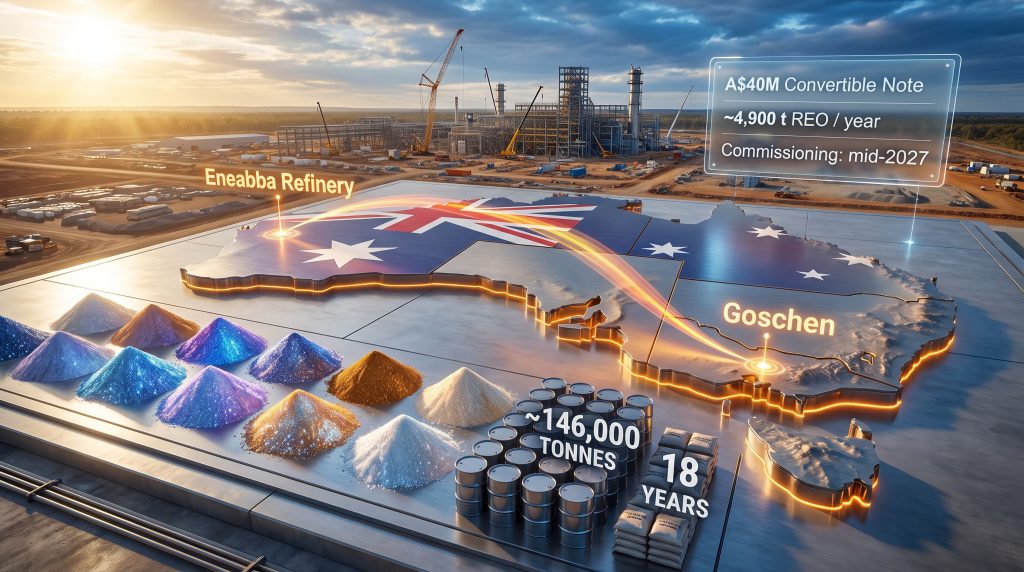
The Iluka VHM rare earths feedstock deal, announced in July 2026, represents one of the most structurally comprehensive concentrate supply agreements to emerge from Australia's developing rare earth sector. Its key parameters are summarised below:
| Parameter | Detail |
|---|---|
| Agreement Duration | 18 years |
| Total Concentrate Volume | ~146,000 tonnes |
| Total Rare Earth Oxide Content | ~86,000 tonnes |
| Annual Concentrate Supply | ~8,320 tonnes per year |
| Annual REO Equivalent | ~4,900 tonnes per year |
| Feedstock Source | Goschen Project, western Victoria |
| Destination Refinery | Eneabba, Western Australia |
| Capital Support Provided | A$40 million (convertible note) |
| Initial Tranche | A$10 million |
| Post-FID Tranche | A$30 million |
| Additional Rights Secured | Right of first refusal — Cannie and Nowie projects |
Why Full-Output Capture Matters More Than Partial Offtake
The agreement covers 100% of Goschen's planned concentrate output, a distinction that carries significantly more strategic weight than a partial allocation would. In the rare earth concentrate market, partial offtake arrangements leave residual volumes available to competing buyers, creating a persistent risk that other purchasers could disrupt a refinery's preferred blend by drawing down shared supply pools.
By securing the entirety of Goschen's planned production, Iluka eliminates concentrate competition risk from this source entirely. This is categorically different from spot purchasing, where concentrate is acquired on an opportunistic basis at prevailing market prices, or partial offtake structures that guarantee a proportion of output but leave the remainder exposed to open market dynamics.
Goschen's Geological Profile: Heavy Rare Earths as a Strategic Differentiator
Western Victoria has emerged as a rare earth province of genuine strategic interest, and Goschen's geological characteristics help explain why. The deposit's mineralogy is notably weighted toward heavy rare earth elements (HREEs), a group that includes dysprosium, terbium, holmium, and erbium, among others.
This matters enormously in the context of current global supply dynamics. Heavy rare earths are significantly scarcer than light rare earth elements (LREEs) such as cerium and lanthanum, which are abundant globally and face periodic oversupply pressure. Dysprosium and terbium in particular are critical inputs for the high-performance permanent magnets used in electric vehicle motors and wind turbine generators — applications where critical minerals demand growth is structural rather than cyclical.
The heavy rare earth assemblage at Goschen therefore represents a qualitatively different strategic asset compared to many light rare earth-dominant Australian deposits. Iluka's Eneabba refinery is specifically designed to process both light and heavy rare earth streams, making Goschen's HREE-weighted concentrate a chemically complementary input rather than a redundant one.
Iluka has described western Victoria as a province notable for large deposits and an attractive heavy rare earth assemblage, reinforcing that the company views the region's geological characteristics as a core element of its feedstock strategy rather than an incidental convenience.
How This Deal Reshapes Eneabba's Refinery Economics
The Dual-Track Feedstock Model
Eneabba is not designed to operate on a single concentrate source. Iluka's refinery strategy involves blending inputs from its own internal mineral sands operations with third-party concentrate agreements, creating a dual-track feedstock model that provides both supply diversification and circuit optimisation flexibility.
The Goschen concentrate functions as a complementary input within this blended approach. Iluka has explicitly noted that overall refinery production levels will depend on the optimal blend of internal and external feedstocks alongside circuit capacity constraints. This means the annual volumes absorbed from Goschen may vary within a range governed by refinery circuit performance and the composition of other inputs being processed concurrently.
This circuit blending dynamic is a technical nuance that is frequently overlooked in commercial analyses of rare earth processing agreements. The chemical behaviour of solvent extraction circuits means that the optimal feedstock blend is not simply the maximum possible volume of any individual input, but rather the combination that maximises circuit efficiency and product purity across all separation stages simultaneously.
Eneabba: Australia's First Fully Integrated Rare Earths Refinery
Construction of the Eneabba refinery was more than 50% complete as of mid-2026, with commissioning targeted for mid-2027. When operational, Eneabba will become Australia's first fully integrated rare earths refinery — capable of producing both separated light and heavy rare earth oxides from concentrate inputs within a single domestic facility.
The term fully integrated carries specific technical meaning in this context. Most nations that extract rare earth minerals export their concentrate to offshore processors, predominantly in China, where separation into individual oxide streams occurs. The value margin captured at the separation stage is substantially higher than at the mining or concentration stage, meaning Australia has historically exported the majority of its rare earth value chain rather than retaining it domestically.
Eneabba's capability to separate both light and heavy rare earth streams positions it as a genuinely differentiated processing asset by Western standards. Lynas Rare Earths, Australia's existing rare earth processor, primarily handles light rare earth streams. Eneabba's HREE separation capability therefore addresses a gap in the Western processing infrastructure that no currently operational Australian facility fills.
The Pricing Mechanism: Shared Upside, Shared Risk
One of the more technically interesting elements of the Iluka VHM rare earths feedstock deal is the concentrate pricing mechanism. Rather than a fixed price or standard index linkage, the pricing is linked to the prices Iluka realises from the sale of rare earth products produced at Eneabba.
This creates a commercially aligned structure where both parties share exposure to rare earth oxide price movements. When Eneabba achieves strong realised prices for its separated oxide products, VHM's concentrate returns improve proportionally. In periods of rare earth price weakness, VHM's economics soften alongside Iluka's refinery margins.
This risk-sharing architecture has important implications:
- It eliminates the adversarial dynamic common in fixed-price contracts, where one party benefits from market movements at the other's expense
- It aligns incentives around the performance of the downstream refinery, giving VHM a commercial interest in Eneabba's operational success
- It may create cash flow pressure for VHM during rare earth price downturns, since its concentrate revenues are not insulated from market volatility
- It could serve as a replicable template for future Australian rare earth feedstock agreements, particularly where refiners are financing upstream development
The A$40 Million Convertible Note: Strategic Depth Beyond Offtake
When a Refinery Becomes a Development Financier
The capital support component of the Iluka VHM rare earths feedstock deal signals a strategic commitment that goes well beyond a standard supply agreement. By offering a secured convertible note of A$40 million, structured across two tranches, Iluka has moved into the role of project financier for Goschen's development.
The mechanics of a convertible note are relevant here. As a hybrid instrument, it functions initially as secured debt — providing VHM with development capital while giving Iluka a creditor position in the Goschen project's capital structure. The conversion feature grants Iluka the option to convert the outstanding note into equity under defined conditions, creating a pathway toward partial ownership of the upstream asset if Iluka exercises that right.
The two-tranche structure serves as a deliberate risk-gating mechanism:
- The initial A$10 million tranche is available immediately, supporting VHM's pre-construction development activities
- The subsequent A$30 million tranche becomes available following a final investment decision at Goschen, meaning it is conditional on VHM committing to full project construction
This staged deployment protects Iluka from deploying the full capital commitment before key development milestones are confirmed, while simultaneously giving VHM a credible financing anchor to support its FID process and attract co-investors.
"Investor Perspective: The willingness of a downstream refiner to provide development financing to an upstream concentrate supplier is structurally analogous to the model Chinese rare earth enterprises have used for decades — using processing leverage to secure upstream supply rather than relying solely on market purchasing. The Iluka VHM rare earths feedstock deal represents a Western commercial adaptation of this logic."
Mapping the Full Value Chain: Victoria to Western Australia
Iluka's Wimmera Connection and the Victorian Rare Earth Province
Iluka's strategic interest in western Victoria extends beyond the Goschen agreement. The company operates its own Wimmera development project in the region, which was in the latter stages of a definitive feasibility study as of mid-2026. Iluka has described the province as one it knows well through historical operational experience, providing geological and logistical familiarity that informs its assessment of third-party assets in the area.
The potential for Wimmera and Goschen to function as complementary Victorian feedstock sources for Eneabba introduces an interesting multi-asset dynamic. If both projects reach production, Eneabba could draw on two distinct Victorian concentrate streams with related but differentiated mineralogical profiles, providing both volume depth and blend flexibility at the refinery circuit level.
Right of First Refusal Over Cannie and Nowie: Optionality as Infrastructure
In addition to the primary Goschen agreement, Iluka has secured a right of first refusal over any additional rare earth production from VHM's Cannie and Nowie projects. Both are at earlier stages of development than Goschen, but their inclusion in the agreement's structure introduces a long-horizon optionality that materially extends Iluka's feedstock planning runway.
A right of first refusal is not a purchase commitment. It grants Iluka the contractual right to be offered Cannie and Nowie concentrate supply before any other potential buyer, and to match any competing terms presented to VHM. This is a competitive positioning tool rather than a volume guarantee, but its strategic value is real: no rival refinery or offshore buyer can access that supply without Iluka having a first opportunity to secure it.
If Cannie and Nowie were to progress to production at broadly comparable scale to Goschen, Iluka's right of first refusal could position Eneabba to access a multi-decade, multi-source Victorian concentrate supply network, potentially extending feedstock security well into the 2040s and beyond.
The next major ASX story will hit our subscribers first
How the Iluka VHM Deal Compares to Other Rare Earth Feedstock Structures
| Factor | Iluka–VHM (Goschen) | Typical Short-Term Offtake | Vertically Integrated Model |
|---|---|---|---|
| Contract Duration | 18 years | 3–5 years | Indefinite (internal) |
| Volume Certainty | 100% of planned output | Partial allocation | Full internal supply |
| Pricing Mechanism | Linked to refinery realisation | Fixed or index-linked | Internal transfer pricing |
| Capital Support | A$40M convertible note | None | Full capex ownership |
| Additional Supply Rights | ROFR on Cannie and Nowie | None | N/A |
| Supply Risk Profile | Low (long-term, full output) | Moderate to High | Low |
Key Risks and Scenario Analysis
The following scenarios involve forward-looking assessments and speculative analysis. They do not constitute investment advice. Past performance and announced project timelines are not reliable indicators of future outcomes.
What Could Disrupt the Iluka VHM Supply Relationship?
Scenario 1 — Goschen Development Delays
VHM holds environmental approvals for the Goschen project but had not yet reached a final investment decision as of the agreement's announcement. Greenfield rare earth projects in Australia have historically encountered cost escalation and scheduling overruns, and if Goschen's construction timeline slips materially, Eneabba could find itself commissioned and operational before its Victorian feedstock stream is available. In that scenario, Iluka would need to rely more heavily on internal mineral sands concentrate and any other third-party agreements it has secured.
Scenario 2 — Rare Earth Price Deterioration
The pricing linkage between Goschen concentrate and Eneabba realised prices distributes downside exposure across both parties. A prolonged period of weak rare earth oxide prices could strain VHM's project economics and potentially affect its ability to trigger the conditions for the A$30 million second tranche. This represents a genuine risk for the timeline of Goschen's full construction funding package.
Scenario 3 — Circuit Capacity Constraints at Eneabba
The refinery's throughput ceiling is determined by circuit design, not solely by concentrate availability. If Iluka's internal feedstocks approach circuit capacity, Goschen's annual contracted volumes may be absorbed at lower rates than the headline figures suggest. The agreement's reference to an optimal blend provides contractual flexibility but introduces volume uncertainty for VHM's revenue modelling.
Scenario 4 — Successful Full Execution
Goschen reaches FID, secures construction financing, and commences production broadly concurrent with Eneabba's mid-2027 commissioning target. The refinery operates with a diversified Victorian and internal feedstock blend, achieving stable circuit throughput. Iluka subsequently exercises its right of first refusal on Cannie and/or Nowie, embedding a multi-source Victorian supply network that underpins Eneabba's utilisation rates across a multi-decade operating horizon.
Frequently Asked Questions: Iluka VHM Rare Earths Feedstock Deal
What is the Iluka VHM rare earths feedstock deal?
It is an 18-year concentrate supply agreement through which VHM's Goschen project in western Victoria will supply Iluka's Eneabba rare earths refinery in Western Australia with approximately 146,000 tonnes of rare earth concentrate containing around 86,000 tonnes of rare earth oxides across the life of the contract.
How much rare earth oxide will Goschen supply to Eneabba each year?
The agreement equates to roughly 8,320 tonnes of concentrate per year, containing approximately 4,900 tonnes of total rare earth oxides annually.
Why is Iluka providing A$40 million to VHM?
Iluka is offering a secured convertible note to support VHM's development of Goschen. The instrument is structured in two tranches: A$10 million upfront, and a further A$30 million following a final investment decision, forming part of Goschen's broader construction financing package.
What is the Eneabba refinery and when will it be operational?
Eneabba is Iluka's rare earths refinery under construction in Western Australia, designed to be Australia's first fully integrated rare earths refinery capable of producing both separated light and heavy rare earth oxides. Construction was more than 50% complete as of mid-2026, with commissioning targeted for mid-2027.
What does right of first refusal mean in this context?
It grants Iluka the contractual right to be the first potential buyer offered any concentrate produced from VHM's Cannie and Nowie projects. This does not obligate Iluka to purchase but ensures no other party can acquire that supply without Iluka having the opportunity to match terms.
Why does the heavy rare earth profile of western Victoria matter?
Heavy rare earths including dysprosium and terbium are significantly scarcer than light rare earth elements and are critical inputs for high-performance permanent magnets used in electric vehicle motors and wind turbines. A deposit with an attractive HREE assemblage produces concentrate of higher strategic and commercial value than light rare earth-dominated sources.
How does this deal affect Australia's rare earths supply chain?
The agreement strengthens the upstream feedstock link in Australia's critical minerals sector, connecting Victorian mining output to Western Australian refining capacity and ultimately to global separated oxide markets. This reduces Australian exposure to offshore processing dependency and supports the viability of Eneabba as a long-term commercial operation.
The Broader Signal: What This Agreement Means for Australia's Rare Earth Processing Industry
From Concentrate Exporter to Separated Oxide Producer
The structural significance of the Iluka VHM rare earths feedstock deal extends beyond its commercial terms. For Australia to transition from raw material exporter to rare earth oxide producer at scale, the domestic processing industry must solve its feedstock architecture problem before refineries open, not after. Attempting to source concentrate on the spot market once a refinery is operational introduces exactly the kind of supply uncertainty that undermines the long-term offtake confidence that downstream customers require before committing to purchase agreements.
The Goschen agreement, following Iluka's earlier inaugural rare earth oxide offtake agreement, suggests the company is methodically building the supply chain architecture necessary to support Eneabba's commercial viability from day one of operations. Each upstream feedstock agreement secured before commissioning reduces the commercial risk profile of the refinery for downstream oxide buyers, consequently generating a virtuous cycle that accelerates Australia's transition from concentrate shipper to finished product supplier.
Eneabba's Heavy Rare Earth Capability as a Western Market Differentiator
The geopolitical context surrounding rare earth supply chains has shifted materially in recent years. Indeed, critical minerals geopolitics have placed growing emphasis on developing non-Chinese sources of critical mineral processing capacity across allied nations. Eneabba's ability to produce separated heavy rare earth oxides positions it to serve demand that no currently operational Australian facility can address.
Dysprosium and terbium, in particular, face structural demand growth from the EV and renewable energy sectors, and their separation from ore is technically more demanding than for light rare earths — reinforcing the specialised value of Eneabba's processing capability and the strategic importance of securing HREE-weighted feedstock from sources like Goschen.
Key Takeaways
- 18-year duration makes the Iluka VHM rare earths feedstock deal one of the longest-term concentrate agreements in Australian rare earth history
- 146,000 tonnes of concentrate (~86,000 tonnes REO) secured from Goschen, representing 100% of planned output
- ~4,900 tonnes of REO per year will flow to Eneabba as complementary feedstock under the blended circuit model
- A$40 million convertible note positions Iluka as both commercial partner and development financier, with equity conversion optionality
- Right of first refusal over Cannie and Nowie extends feedstock planning well beyond the primary agreement horizon
- Eneabba commissioning targeted for mid-2027, with construction more than 50% complete as of mid-2026
- The heavy rare earth profile of the Goschen deposit makes its concentrate a strategically differentiated input for Australia's first HREE-capable separation facility
Readers seeking additional context on Australia's rare earths sector and Eneabba's development milestones can find further background through Australian Mining's coverage of this 18-year feedstock agreement and rare earth industry developments.
Want to Track the Next Major Mineral Discovery Before the Market Does?
Discovery Alert's proprietary Discovery IQ model scans ASX announcements in real time, instantly identifying significant mineral discoveries across rare earths and more than 30 other commodities — turning complex data into actionable opportunities for investors at every level. Explore historic discoveries and the returns they generated, then begin your 14-day free trial at Discovery Alert to position yourself ahead of the broader market.