July 30, 2026
The Invisible Bottleneck Reshaping Western Industrial Strategy
Every major transition in industrial history has eventually collided with a materials constraint that nobody planned for. The electrification of transport, the scaling of wind energy, and the modernisation of defence systems are all converging on a single, underappreciated chokepoint: the near-total absence of commercial-scale heavy rare earth separation capacity outside China.
The problem is not, as commonly assumed, a shortage of rare earth ore in the ground. Significant deposits exist across Australia, Africa, North America, and Scandinavia. The real vulnerability sits several processing steps downstream, at the separation and refining stage, where raw mineral concentrates are converted into the high-purity oxides that magnet manufacturers actually require. For heavy rare earths specifically, this capacity is overwhelmingly concentrated within Chinese state-linked enterprises, accounting for an estimated 85 to 90 percent of global separated supply.
It is within this structural gap that the White Mesa heavy rare earth expansion becomes one of the most consequential industrial projects currently under construction in the Western world.
When big ASX news breaks, our subscribers know first
Why Heavy Rare Earths Are Fundamentally Different From Light Rare Earths
The rare earth family contains 17 elements, but not all carry equal strategic weight. The industry distinguishes between light rare earth elements (LREEs) such as neodymium and praseodymium, and heavy rare earth elements (HREEs) including dysprosium, terbium, gadolinium, and samarium. This division reflects differences in atomic weight, natural abundance, and critically, functional application.
Neodymium-iron-boron (NdFeB) magnets form the backbone of modern high-performance permanent magnet technology. However, in their base formulation, these magnets are vulnerable to demagnetisation at elevated temperatures. This is where dysprosium (Dy) and terbium (Tb) become irreplaceable. When added in carefully controlled quantities, these two HREEs dramatically increase a magnet's coercivity — its resistance to being demagnetised — and extend its operational stability across a far wider temperature range.
The applications that depend on this enhanced performance share one characteristic: they cannot tolerate compromise.
- Electric vehicle traction motors operate under intense thermal stress during acceleration and regenerative braking cycles
- Direct-drive offshore wind turbine generators require magnets that maintain performance across decades of exposure to variable loads and temperatures
- Military guidance and actuation systems demand absolute reliability in extreme environments where substitution is not an option
- Industrial robotics and aerospace actuators rely on compact, high-coercivity magnets for precise torque delivery
Furthermore, there is no commercially viable substitute for HREE-enhanced NdFeB magnets in these demanding applications. Alternative magnet technologies, such as samarium-cobalt, carry their own supply chain dependencies and cost penalties. The strategic risk, therefore, is not theoretical — it is embedded in the production lines of EV manufacturers, defence contractors, and energy infrastructure operators across the Western world. The critical minerals demand surge driven by these sectors is accelerating pressure on an already constrained supply chain.
What the White Mesa Heavy Rare Earth Expansion Actually Involves
The $104 Million Phase 1 Capital Program
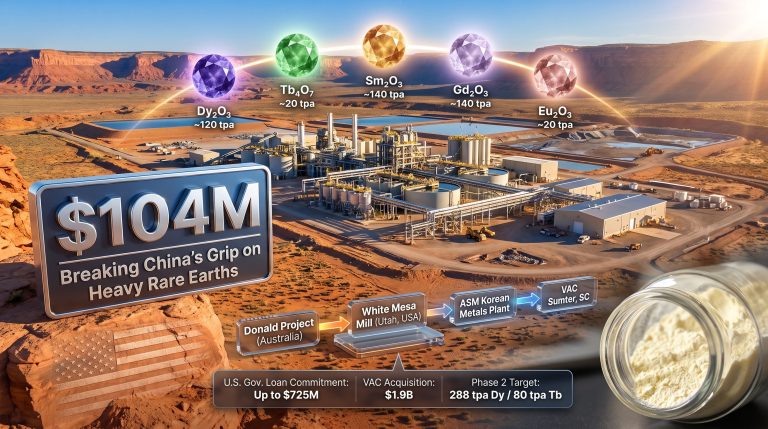
Energy Fuels Inc. has commenced a $104 million construction program at its White Mesa Mill in San Juan County, Utah, targeting commercial-scale production of heavy rare earth oxides. The mill already holds installed separation capacity of approximately 1,000 metric tons per year (tpa) of NdPr oxide, making it one of the most significant rare earth processing assets outside China currently in operation.
The company entered the rare earths sector in 2021, leveraging White Mesa's existing hydrometallurgical infrastructure, which had been developed over decades of uranium processing. This pre-existing capability is a decisive competitive advantage: the mill's licensed solvent extraction circuits and its established regulatory framework for handling naturally occurring radioactive material (NORM) provide a foundation that would take years and hundreds of millions of dollars to replicate at a greenfield facility. The Energy Fuels critical minerals strategy has consistently prioritised leveraging this existing infrastructure to accelerate its market position.
The planned HREE production targets for Phase 1 are as follows:
| Rare Earth Oxide | Chemical Formula | Planned Annual Capacity |
|---|---|---|
| Dysprosium Oxide | Dy₂O₃ | ~120 metric tons |
| Terbium Oxide | Tb₄O₇ | ~20 metric tons |
| Samarium Oxide | Sm₂O₃ | ~140 metric tons |
| Gadolinium Oxide | Gd₂O₃ | ~140 metric tons |
| Europium Oxide | Eu₂O₃ | ~20 metric tons |
Each of these oxides serves distinct industrial functions. Dysprosium and terbium are the critical magnet performance enhancers. Samarium feeds samarium-cobalt (Sm-Co) magnet production, which is used in applications requiring performance at even higher temperatures than NdFeB. Gadolinium is essential in medical imaging contrast agents and has applications in nuclear reactor control materials. Europium, historically associated with red phosphors in display technology, retains specialised applications in lighting and security inks.
Circuit Completion Timeline and Sequencing Logic
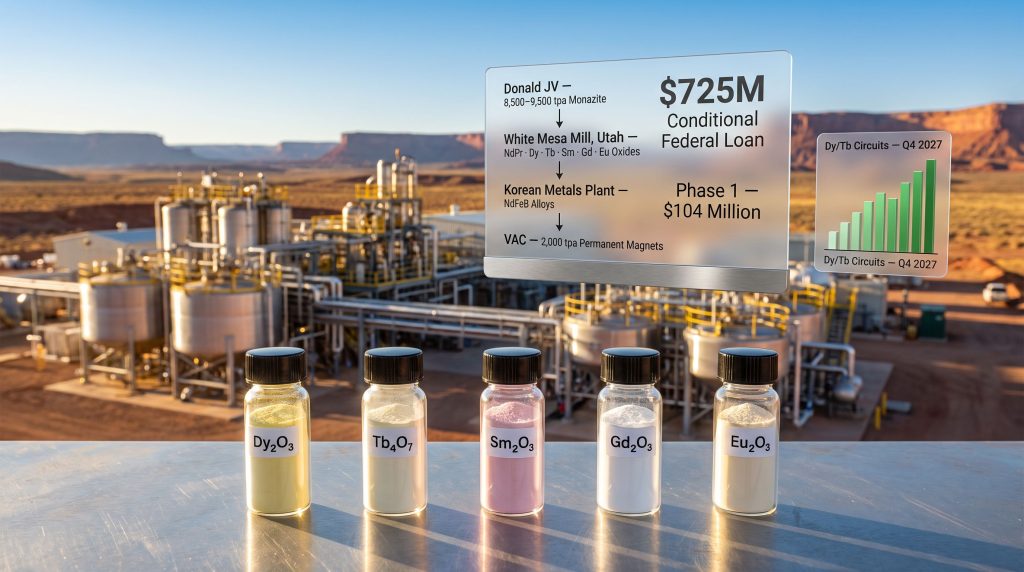
The construction sequencing reflects deliberate commercial prioritisation. Dysprosium and terbium circuits are targeted for completion and commissioning in Q4 2027, with the samarium, europium, and gadolinium circuits following by end-2028. This timeline is explicitly tied to market demand conditions, meaning the Dy/Tb circuits are being prioritised because the commercial pull from magnet manufacturers is most acute for those two elements.
Energy Fuels has already demonstrated dysprosium and terbium oxide production at pilot scale, which meaningfully de-risks the scale-up pathway compared to a project attempting the technical transition for the first time. According to recent reporting on Energy Fuels' expansion, the company could rank among the top rare earth producers in the Western world upon completion of this program.
Phase 2: The Larger Vision
Earlier feasibility materials published in January 2026 outline a substantially larger Phase 2 buildout carrying a capital estimate of approximately $410 million. Phase 2 projections envision raising NdPr separation capacity to potentially more than 6,000 tpa, with dysprosium capacity scaling to approximately 288 tpa and terbium to approximately 80 tpa. These figures would position White Mesa as a globally significant HREE separation facility by any measure.
It is important to distinguish clearly between the current $104 million Phase 1 program, which is under active construction, and the Phase 2 expansion, which remains subject to market conditions and additional capital decisions.
The Feedstock Architecture: Why the Donald Project Is Central
Monazite as the Strategic Mineral Carrier
A processing facility is only as valuable as the feedstock flowing into it. The White Mesa heavy rare earth expansion is fundamentally anchored around monazite concentrate, a phosphate mineral that occurs naturally in heavy mineral sands deposits and carries a uniquely valuable rare earth profile. Unlike many rare earth ores that are overwhelmingly enriched in light rare earths, monazite contains meaningful concentrations of both light and heavy rare earths within a single mineral, making it an exceptionally high-value feedstock for a facility seeking to produce the full rare earth oxide suite.
The primary feedstock source for White Mesa's expanded circuits is the Donald rare earths and mineral sands project in Victoria, Australia, structured as a joint venture between Energy Fuels and Astron Ltd. Subject to a positive final investment decision (FID) expected during Q3 2026, Donald is projected to deliver between 8,500 and 9,500 metric tons of monazite concentrate per year beginning in 2028.
The sizing of the White Mesa expansion has been deliberately calibrated around this anticipated production timeline. Donald monazite, combined with third-party feedstocks already under contract or in active negotiation, is projected to fully utilise both White Mesa's existing NdPr separation capacity and the new HREE circuits being constructed under the $104 million program.
Feedstock Diversification as Risk Management
One underappreciated aspect of the White Mesa model is its multi-source feedstock flexibility. The mill is engineered to process rare earth carbonates and monazite concentrates from multiple global origins, not solely from Donald. This structural flexibility means that delays or shortfalls from a single upstream source do not create a single point of failure for the processing operation.
Supplementary feedstock agreements are being pursued to bridge the period before Donald reaches full production, providing early revenue generation for the expanded circuits. This dual-commodity approach — producing rare earth oxides and uranium simultaneously from the same facility — creates a revenue diversification model unique among Western rare earth processors. The rare earth processing challenges inherent to building such a model outside China make this flexibility all the more valuable.
Financing the Expansion: Federal Loans and Equity Depth
In June 2026, Energy Fuels received a conditional commitment from the U.S. Office of Strategic Capital (OSC) for a 20-year loan of up to $725 million. The financing is structured to support both the White Mesa HREE circuit construction and a proposed American rare earth metals and alloys plant. The OSC loan reflects a deliberate federal industrial policy objective to establish non-Chinese rare earth separation and downstream processing capacity within the United States.
Key conditions remain outstanding, including the completion of due diligence, execution of definitive agreements, and satisfaction of government approval requirements. Energy Fuels has separately applied for grant funding from additional federal agencies.
The combination of a conditional $725 million federal loan facility and approximately $960 million in working capital as of end-March 2026 positions the company with financial flexibility that is notably disproportionate to the $104 million Phase 1 capital requirement. For investors assessing execution risk, the primary variables are regulatory approvals and operational milestones rather than balance sheet capacity.
This context is meaningful. The $104 million Phase 1 construction cost represents a modest call on available resources, with government grants and loans expected to cover the majority of that figure and equity funding covering the remainder.
The Mine-to-Magnet Architecture: Four Stages of Vertical Integration
How the Supply Chain Connects
The White Mesa heavy rare earth expansion does not exist as a standalone processing project. It sits at the oxide separation stage of a four-stage supply chain that Energy Fuels is assembling through a combination of organic development and strategic acquisitions.
Stage 1: Mineral Feedstock
Donald JV in Victoria, Australia produces 8,500 to 9,500 tpa of monazite concentrate, shipped to Utah.
Stage 2: Oxide Separation
White Mesa Mill separates NdPr, Dy, Tb, Sm, Gd, and Eu oxides at commercial scale.
Stage 3: Metals and Alloys Conversion
ASM's Korean Metals Plant and the proposed American Metals Plant convert oxides into NdPr, Dy, and Tb metals and NdFeB and DyFe alloys.
Stage 4: Permanent Magnet Manufacturing
VAC's South Carolina plant (2,000 tpa initial capacity) and European facilities produce finished NdFeB permanent magnets.
The ASM Korean Metals Plant: A Rare Non-Chinese Asset
The pending acquisition of Australian Strategic Materials (ASM) would add the operating Korean Metals Plant to Energy Fuels' supply chain. This facility is one of a tiny number of plants outside China capable of producing rare earth metals and alloys at commercial scale, including NdPr metals, dysprosium and terbium metals, and NdFeB and DyFe alloys. The scarcity of this capability in the Western world cannot be overstated.
ASM shareholders were scheduled to vote on the transaction on August 12, 2026, with Federal Court of Australia approval also required.
The VAC Acquisition and the German Dimension
Energy Fuels agreed to acquire Vacuumschmelze (VAC), a Germany-headquartered permanent magnet manufacturer with deep technological heritage, at an implied equity value of $1.9 billion. VAC recently commissioned a new magnet production plant in Sumter, South Carolina, with an initial annual capacity of 2,000 metric tons of permanent magnets, bringing a transatlantic manufacturing dimension to the supply chain.
The transaction is expected to close in early 2027, subject to national security and strategic sector review by the German government. While the acquisition is expected to clear the review process, Berlin is broadly anticipated to attach conditions protecting domestic German magnet-making capacity, reflecting the broader tension between allied supply chain integration and national industrial policy priorities.
Throughput Alignment Across the Chain
The internal logic of the supply chain mathematics is worth examining closely. Monazite from Donald Phase 1 combined with other feedstock sources is projected to supply roughly 70 percent of ASM's existing and planned metals and alloy capacity in South Korea. That metals and alloy output is in turn expected to produce more than sufficient rare earth alloys to supply the initial 2,000 tpa capacity of VAC's South Carolina plant.
This throughput alignment is not accidental. It reflects deliberate vertical integration planning in which each stage of the supply chain is sized to feed the next without creating chronic surplus or deficit conditions.
The next major ASX story will hit our subscribers first
White Mesa Versus the Greenfield Alternative: Why Infrastructure Matters
| Competitive Factor | White Mesa Mill | Typical Greenfield HREE Project |
|---|---|---|
| Infrastructure Status | Existing operating facility | Full construction required |
| NORM Processing Capability | Licensed and operational | Requires new regulatory pathway |
| Feedstock Flexibility | Multi-source (monazite, carbonates) | Often single-source dependent |
| Dual-Commodity Revenue | Uranium plus rare earths | Rare earths only |
| Downstream Integration | Oxide to metals to magnets | Typically oxide-stage only |
| Dy/Tb Circuit Target Date | Q4 2027 | Typically 2029 or later for greenfield |
The regulatory moat created by White Mesa's existing uranium processing licence is a detail that receives insufficient attention. Processing monazite introduces NORM handling requirements that are technically and regulatorily complex. Most jurisdictions impose lengthy approval processes for new NORM-handling facilities, with timelines measured in years rather than months. The White Mesa Mill's existing framework sidesteps this barrier entirely, providing a time-to-market advantage that cannot be purchased or shortcut by competitors.
Risk Factors and Execution Dependencies
Critical Path Variables
Several discrete risks exist that investors and industry observers should track carefully:
-
OSC Loan Conditionality: The $725 million federal loan remains subject to due diligence completion, definitive agreements, and government approval. Any delay or restructuring of this facility would affect the financing assumptions underpinning the broader program.
-
Donald FID Timing: The Q3 2026 final investment decision for the Donald project is itself contingent on project financing negotiations. A delay at Donald directly impacts feedstock availability for the new White Mesa circuits from 2028 onward.
-
Multi-Jurisdictional Acquisition Risk: The ASM and VAC transactions each carry independent regulatory approval requirements spanning Australia, Germany, and the United States. A failure or material delay in either acquisition would disrupt the downstream conversion pathway for White Mesa oxides.
-
Dy/Tb Price Volatility: Dysprosium and terbium prices have historically experienced sharp cycles driven primarily by Chinese production and export policy decisions. Indeed, China's rare earth export restrictions in 2023 and again in 2025 demonstrated how rapidly the policy environment can shift. A sustained period of artificially suppressed HREE prices through Chinese oversupply tactics could pressure project economics, while tighter export restrictions would strengthen the commercial case for Western production.
-
Demand-Side Timeline Conditionality: The stated Q4 2027 commissioning target for the Dy/Tb circuits is described as dependent on market needs, introducing a layer of demand-side conditionality into what is otherwise a supply-side construction timeline.
The White Mesa expansion's commercial success depends on three interacting variables that are each partially outside the company's direct control: Chinese pricing and export behaviour, U.S. federal loan finalisation, and the successful closing of both the ASM and VAC acquisitions. Each variable represents a discrete execution risk that warrants ongoing monitoring.
Frequently Asked Questions
What rare earth oxides will White Mesa produce following the expansion?
Upon completion of both circuit stages, White Mesa will have capacity to produce approximately 120 tpa of dysprosium oxide, 20 tpa of terbium oxide, 140 tpa of samarium oxide, 140 tpa of gadolinium oxide, and 20 tpa of europium oxide, in addition to its existing NdPr oxide capacity of approximately 1,000 tpa.
When will the heavy rare earth circuits be operational?
The dysprosium and terbium circuits are targeted for commissioning in Q4 2027. The samarium, europium, and gadolinium circuits are targeted for completion by end-2028. Phase 2 capacity scaling remains subject to market conditions and additional capital deployment decisions.
What is the total capital cost and how will it be funded?
Phase 1 construction carries an estimated cost of approximately $104 million, with the majority expected to be covered by government grants and loans. A conditional federal loan commitment of up to $725 million has been received from the U.S. Office of Strategic Capital, subject to further conditions. Phase 2, outlined in earlier feasibility materials, carries an estimated cost of approximately $410 million.
Why is monazite a particularly valuable feedstock for this type of facility?
Monazite is unusual among rare earth-bearing minerals because it carries a naturally diverse rare earth profile spanning both light and heavy elements within the same mineral grain. This makes it exceptionally well-suited to a facility seeking to produce the full commercial rare earth oxide suite from a single feedstock source, rather than requiring multiple mineral inputs to achieve the desired product mix.
The Geopolitical Dimension: Industrial Policy Meets Market Reality
Why Western Governments Are Prioritising HREE Separation Capacity
The U.S. federal commitment to support the White Mesa heavy rare earth expansion reflects a broader industrial policy recognition that upstream mining activity, while necessary, is insufficient on its own to address Western vulnerability in the rare earth supply chain. The critical gap has always been at the separation and refining stage, which requires specialised chemical engineering, significant capital, and long regulatory lead times.
Parallel federal investments in other rare earth projects, including the unlocking of $1.6 billion in federal funding for USA Rare Earth in June 2026, signal that the White Mesa program is part of a systemic commitment to rare earth supply chain diversification rather than an isolated project decision.
The demand drivers underpinning this policy rationale are quantifiable and accelerating. NdFeB magnets with dysprosium and terbium additions are specified components in EV traction motors, direct-drive wind generators, and precision defence guidance systems, each of which carries domestic content and supply chain security requirements that are increasingly embedded in procurement policy and legislative frameworks.
The European Supply Chain Equation
The anticipated VAC acquisition introduces a transatlantic supply chain dimension with significant policy implications. Connecting American oxide production, Korean metals conversion, and European and American magnet manufacturing within a single integrated enterprise creates a genuinely novel Western industrial structure. The conditions expected to be imposed by the German government on the VAC transaction will serve as an early test of how allied nations balance the objectives of supply chain integration against the protection of national industrial bases.
This dynamic has broader implications for how the Western rare earth build-out unfolds over the coming decade. National economic protectionism and allied industrial cooperation are not always compatible, and the resolution of the German review process will provide a meaningful data point for future cross-border critical minerals transactions.
What the White Mesa Expansion Represents for the Western Supply Chain
The significance of the White Mesa heavy rare earth expansion extends well beyond the production volumes it will generate. Upon completion of the Dy/Tb circuits in late 2027, it will represent the first commercial-scale non-Chinese HREE separation facility operating in North America — a structural shift in the global supply chain that has been anticipated for years but has consistently failed to materialise at commercial scale.
Several attributes make this project structurally distinct from previous Western HREE separation attempts:
- Existing infrastructure eliminates the construction and permitting lead time that has stalled greenfield competitors
- Multi-source feedstock design reduces single-point dependency on any one upstream project
- Pilot-scale technical validation of Dy and Tb oxide production reduces metallurgical uncertainty in the scale-up
- Vertical integration pathway through pending metals, alloys, and magnet acquisitions creates a potential end-to-end commercial structure
- Dual-commodity revenue from simultaneous uranium production provides financial resilience unavailable to pure-play rare earth processors
Disclaimer: This article is intended for informational purposes only and does not constitute financial or investment advice. Forecasts, projections, and financial figures referenced herein are based on publicly available company disclosures and third-party reporting. The conditional nature of federal loan commitments, acquisition approvals, and project investment decisions means that actual outcomes may differ materially from projections. Readers should conduct their own due diligence before making investment decisions.
Want to Stay Ahead of the Next Major Mineral Discovery?
Discovery Alert's proprietary Discovery IQ model scans ASX announcements in real time, transforming complex mineral data into actionable opportunities across critical commodities — including the rare earth sector reshaping Western industrial strategy. Explore how historic discoveries have generated substantial returns on Discovery Alert's dedicated discoveries page, and begin your 14-day free trial today to position yourself ahead of the broader market.