July 30, 2026
The $3 Trillion Problem Hidden in Plain Sight: How Industrial Waste Became a Critical Minerals Frontier
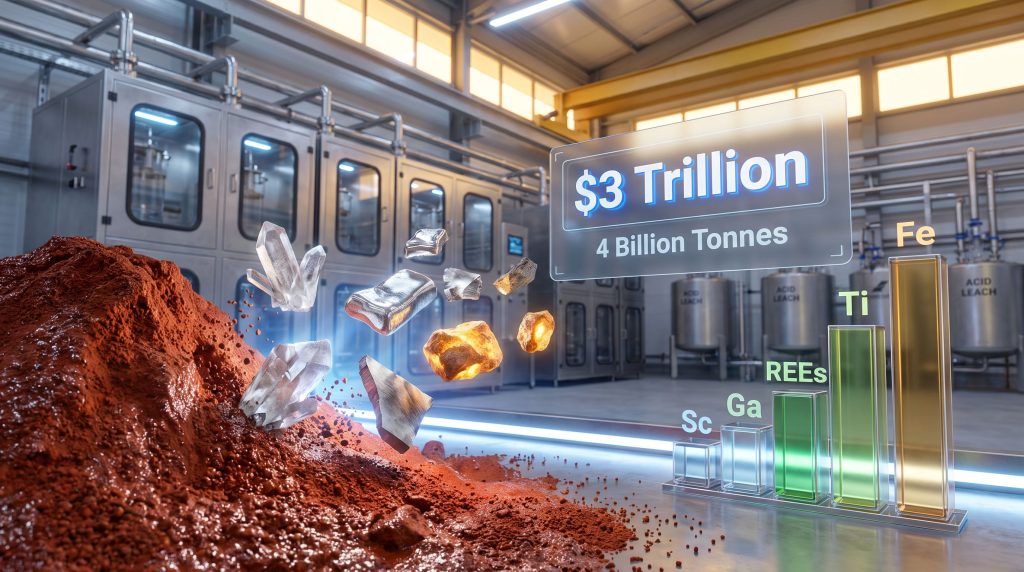
Across the global alumina refining industry, a slow-motion accumulation crisis has been building for decades. Every tonne of alumina produced through the Bayer process generates between one and two tonnes of a caustic, iron-rich slurry that must be pumped into containment ponds and managed indefinitely. This material, known as red mud or bauxite residue, now exists in quantities exceeding 4 billion tonnes worldwide, representing one of the largest concentrations of industrial waste on Earth. What makes this particularly striking is not the scale of the environmental problem, but what is locked inside it: a multitrillion-dollar reservoir of metals that Western nations are currently scrambling to source from geopolitically complex supply chains.
The emerging discipline of red mud critical minerals extraction is reframing this waste as an asset class, and the technical, commercial, and strategic arguments for doing so are converging rapidly.
When big ASX news breaks, our subscribers know first
Understanding Red Mud: Chemistry, Volume, and Hidden Value
Red mud gets its characteristic colour from iron oxide, which typically constitutes between 30 and 50 percent of its dry weight. It is generated when bauxite ore is digested in hot caustic soda solution during the Bayer process, dissolving alumina while leaving behind a slurry of silica, titanium minerals, iron compounds, and trace metals. The resulting pH, typically ranging from 10 to 13, makes the material chemically aggressive and complicates both storage and processing.
What is less commonly understood is that bauxite sourced from different geological regions produces red mud with meaningfully different trace metal profiles. West African bauxites tend to carry higher rare earth element concentrations, while Caribbean and Australasian sources can be richer in scandium and titanium. This geographic variability in feedstock chemistry is a critical factor that processing technology developers must account for, as a process optimised for one feedstock may underperform on another. Furthermore, understanding global bauxite production patterns is essential context for grasping how red mud volumes have accumulated to their current scale.
What the Residue Actually Contains
The recoverable metal profile within red mud extends well beyond iron and alumina:
| Metal/Mineral | Strategic Application | Recovery Status |
|---|---|---|
| Scandium | Aerospace alloys, solid oxide fuel cells | High commercial interest |
| Gallium | Semiconductors, defense electronics | Near-term extraction target |
| Rare Earth Elements (REEs) | Magnets, EV motors, wind turbines | Active pilot programs |
| Titanium (as titania) | Aerospace, pigments, coatings | Co-recovery potential |
| Iron oxide | Steel feedstock, construction materials | Primary separation target |
| Alumina | Refining, ceramics, abrasives | Secondary recovery stream |
| Vanadium | Energy storage, high-strength alloys | Emerging recovery interest |
The concentration levels of high-value metals like scandium and gallium in red mud are typically modest by conventional mining standards. However, the economics of secondary source extraction are governed by a different logic: when feedstock costs are near zero, when ore has already been surfaced, and when volumes are measured in tens of millions of tonnes at a single site, even sub-economic grades transform into viable commercial targets.
"Scale changes the economics entirely. A metal present at concentrations that would be dismissed in a greenfield deposit becomes a strategic asset when the feedstock volume is measured in billions of tonnes and the extraction cost base is structurally lower than conventional mining."
Why the Commercial Case Is Strengthening Now
Geopolitical Pressure on Western Supply Chains
The timing of intensifying interest in red mud critical minerals extraction is not coincidental. Both gallium and scandium sit near the top of Western critical minerals priority lists, and both are currently dominated by Chinese production and processing. China accounts for the overwhelming majority of global refined gallium output, a position reinforced by export controls introduced in 2023 that sent procurement teams across the semiconductor and defence sectors into contingency planning mode.
Scandium tells a similar story. Primary production is concentrated in China and Russia, with limited alternative supply. Yet scandium-aluminium alloys offer performance advantages in aerospace structural components that are difficult to replicate with other materials, making supply chain diversification a genuine engineering and national security concern rather than a policy abstraction. In addition, the broader critical minerals demand surge has amplified pressure on governments and industry to identify domestic processing alternatives urgently.
Red mud stockpiles, many of which sit within the United States, Europe, and Australia, represent a near-zero-cost feedstock already located on Western soil. For critical minerals planners, that geographic positioning carries value independent of the metal prices themselves.
The Economics of Waste Processing vs. Greenfield Mining
The comparative cost structure of red mud processing versus conventional mining is often misunderstood. The key distinctions include:
- No exploration expenditure: The feedstock is already characterised and stockpiled
- No extraction costs: Material does not need to be blasted, loaded, or hauled from depth
- Existing site infrastructure: Many legacy stockpile sites retain basic industrial infrastructure
- Environmental liability offset: Alumina producers currently bear ongoing costs for storage, leachate management, and long-term remediation; a processing agreement converts a liability into a revenue stream
- Potential tipping fee revenue: Processing technology providers may negotiate feedstock access in exchange for reducing the waste management burden on the stockpile owner
This cost structure does not make red mud processing universally economic, but it creates a fundamentally different capital and operating cost profile compared to developing a new mine.
The Technical Architecture of Red Mud Critical Minerals Extraction
Iron Removal: The Gateway That Unlocks Everything Else
The single most consequential technical step in any red mud processing flowsheet is iron removal. Because iron oxide constitutes such a large fraction of the material by weight, its presence suppresses the efficiency of virtually every downstream recovery step. Acid consumption increases, processing volumes remain unnecessarily large, and selectivity for target metals diminishes when iron is still present in the matrix.
Removing iron first creates a leaner, more concentrated material stream in which gallium, scandium, REEs, and titanium minerals are effectively upgraded by mass reduction alone. This is why iron separation functions as the primary processing gate in commercially viable red mud flowsheets, rather than as a co-product afterthought.
The iron product itself can also be directed toward steel feedstock markets, creating an additional revenue stream that partially offsets processing costs.
Extraction Technology: No Single Method Dominates
The extraction technology landscape for red mud processing spans several distinct approaches, each with different trade-off profiles. Advances in critical minerals processing technology are, however, expanding the viable options available to developers.
Hydrometallurgical Methods:
- Acid leaching uses sulphuric or hydrochloric acid to dissolve target metals from the solid matrix. Effective for REEs and scandium, but generates significant acid volumes requiring management
- Selective solvent extraction applies organic extractants to isolate specific metals from leach solutions, enabling high-purity product streams
- Ionic liquid extraction is an emerging technique offering improved selectivity and a lower environmental footprint compared to conventional organic solvents
- Oxidative leaching targets specific metal oxidation states to improve separation selectivity
Pyrometallurgical Methods:
- Carbothermic reduction applies high temperatures to reduce iron oxides to metallic iron, physically separating the iron phase from non-ferrous components
- Roasting pretreatment thermally modifies mineral phases to improve downstream acid leachability
- Microwave-assisted pretreatment offers energy efficiency advantages for phase transformation prior to leaching
Physical Methods:
- Magnetic separation exploits the magnetic susceptibility of iron oxides for dry or wet physical removal
- Gravity separation applies density differences between mineral phases, applicable to coarser particle fractions
"Technical Note: Commercially viable processes typically combine two or more of these techniques. A common architecture pairs magnetic separation for bulk iron removal with acid leaching and solvent extraction for REE and scandium recovery. Feedstock mineralogy, driven by bauxite source geology, heavily influences which combination is most effective."
Modular Systems: The Preferred Commercial Architecture
One of the most strategically important developments in this space is the shift toward modular, relocatable hydrometallurgical processing units. The advantages of modularity are substantial:
- Processing equipment can be deployed directly at the stockpile site, eliminating feedstock transport costs
- Modular systems can be commissioned and validated at pilot scale before commitment to large fixed-plant capital expenditure
- Individual processing modules can be replicated as throughput requirements grow, reducing the risk of single large capital decisions
- Technology providers can serve multiple customer sites with adaptable systems rather than purpose-built facilities
The standard validation pathway for such systems moves from laboratory-scale proof of concept, through a pilot programme (typically characterised by throughput rates in the range of one tonne per week) that generates investor-grade process performance data, and ultimately toward bankable feasibility studies for commercial-scale plants.
This is precisely the pathway being executed by FAST Metals, a mining technology startup founded in 2025 that has developed a patented modular hydrometallurgical system specifically targeting iron removal and subsequent critical mineral recovery from red mud. The company raised $4.3 million in pre-seed financing in a round led by New Climate Ventures, with participation from Azolla Ventures, Astor Swiss, and Rio Tinto through the Mining Tech Accelerator operated jointly with Founders Factory.
The involvement of Rio Tinto's accelerator programme is particularly notable as a validation signal, providing not only capital but access to industrial-scale testing environments that most early-stage ventures cannot replicate. FAST Metals has secured Metalox Mineral Corp. as its first commercial customer, with a pilot programme processing one tonne of red mud and other iron-bearing feedstock per week at Metalox's Florida facility.
The company's leadership structure reflects the importance of pairing deep metallurgical expertise with commercial mining experience. Its co-founder and CEO previously served as a technical director at Glencore with an extractive metallurgy background, while its co-founder and fellow executive led Nyrstar USA when that company's Tennessee zinc assets were acquired by Korea Zinc.
The advisory board includes a former head of copper and zinc trading at Glencore International, alongside Terry McNulty, the creator of the McNulty Curves framework used across the mining and chemical processing industries to assess and quantify project scale-up risk. For investors evaluating early-stage processing technology companies, a team with McNulty-level expertise in its advisory structure represents a meaningful reduction in technical risk uncertainty.
Where the World's Red Mud Is Concentrated
| Region | Notable Stockpile Site | Estimated Volume | Key Metals of Interest |
|---|---|---|---|
| United States (Louisiana) | Gramercy / Atlantic Alumina site | 30+ million tonnes | Gallium, scandium |
| Europe (Hungary, Greece) | Multiple Bayer plant sites | Hundreds of millions of tonnes | REEs, iron, alumina |
| Australia | Queensland and WA refinery sites | Significant volumes | Scandium, REEs |
| Jamaica / Caribbean | Historical bauxite refining | Large legacy stockpiles | Iron, alumina, titanium |
| India | Odisha and Andhra Pradesh | Growing accumulation | REEs, iron |
The United States site at Gramercy, Louisiana, is one of the most closely watched in the sector. ElementUSA is developing a demonstration plant targeting gallium and scandium extraction from the 30-plus million tonne Atlantic Alumina stockpile at that site, with a commercial-scale facility planned as a follow-on phase. Separately, Columbia University and US Critical Materials Corp. have pursued a joint academic-commercial initiative using oxidative leaching and selective separation to recover gallium, scandium, titanium, and REEs.
Barriers That Still Need Solving
The Alkalinity and Waste Management Problem
Red mud's extreme alkalinity creates chemistry challenges that extend beyond the processing circuit itself. The secondary waste streams generated during acid leaching, including neutralisation sludges and spent reagent solutions, require careful management and disposal. This is particularly relevant in jurisdictions with stringent environmental permitting requirements. Closed-loop reagent recycling systems that recover and reuse acid reduce both operating costs and regulatory exposure, but add capital complexity to the processing design.
Economic Sensitivity by Metal and Site
| Cost Driver | Impact on Viability | Mitigation Strategy |
|---|---|---|
| Reagent costs (acid, solvents) | High, often the largest operating cost | Process optimisation, reagent recycling |
| Energy intensity of pyrometallurgical steps | Significant | Microwave pretreatment, renewable energy integration |
| Metal price volatility (scandium, gallium) | High sensitivity for high-value targets | Multi-metal co-recovery to diversify revenue |
| Transport of feedstock to processing facilities | Material for large stockpiles | Modular on-site processing units |
| Permitting and environmental compliance | Variable by jurisdiction | Early regulatory engagement, waste reduction claims |
The multi-metal co-recovery model is particularly important here. A processing flowsheet that can simultaneously recover iron, gallium, scandium, titanium, and REE fractions distributes revenue across multiple metal price cycles, reducing the economic vulnerability that comes with single-metal dependency. Consequently, this approach also strengthens the broader rare earth supply chains that Western governments are urgently trying to diversify.
The Scale-Up Gap
The majority of published red mud extraction research remains at laboratory or bench scale. The transition to pilot and then commercial scale introduces mineralogical variability that laboratory samples cannot capture, increases reagent consumption relative to bench-scale predictions, and presents equipment engineering challenges that require iterative refinement. This is the core reason why pilot programmes generating throughput at the one-tonne-per-week level are so consequential: they are the evidence base on which commercial investment decisions will ultimately be made.
The next major ASX story will hit our subscribers first
Red Mud Within the Broader Secondary Source Landscape
| Secondary Source | Key Metals | Maturity Level | Scale Potential |
|---|---|---|---|
| Red mud (bauxite residue) | Sc, Ga, REEs, Ti, Fe | Pilot to early commercial | Very high (4B+ tonnes globally) |
| Coal fly ash | REEs, Ga, Ge | Research to pilot | High |
| Electronic waste (e-waste) | Co, Li, Au, Pd | Commercial (established) | Medium |
| Mine tailings | Cu, Au, REEs | Pilot to commercial | High |
| Phosphogypsum | REEs, U | Research to pilot | High |
| Spent catalysts | Pt, Pd, Rh, Re | Commercial (established) | Medium |
Red mud stands out within this landscape primarily because of its scale. At over 4 billion tonnes globally, it dwarfs most other secondary mineral sources in absolute volume terms. The embedded metal value, estimated at more than $3 trillion based on current metal pricing applied to average concentration data, reflects a theoretical gross figure; net recoverable value depends entirely on process economics, metal prices, and site-specific variables. Nevertheless, the order-of-magnitude scale of the opportunity justifies the accelerating pace of technology development. For instance, the role of gallium in semiconductors and defence electronics means that even modest gallium recovery rates translate into strategically significant domestic supply contributions.
The Timeline Toward Commercial Reality
Realistic timelines for red mud critical minerals extraction at commercial scale can be mapped across three horizon bands:
- Near-term (1 to 3 years): Pilot programmes at sites like the Metalox Florida facility generate commercial-grade process data, enabling investor-grade feasibility assessments. Gallium and scandium remain the priority recovery targets given their price-to-concentration ratios
- Medium-term (3 to 7 years): First commercial-scale facilities become operational at the highest-value sites, most likely focused on gallium and scandium recovery from established stockpile locations in the United States and Europe
- Long-term (7 to 15 years): Broader REE and multi-metal recovery at scale, potentially integrated directly into alumina refinery operations as a value-added processing step
The near-term window is arguably the most consequential for investment and technology positioning. Companies that can demonstrate pilot-scale performance with investor-grade process data during this period will be strongly placed to attract the larger capital commitments required for commercial deployment. Recent peer-reviewed research further supports the viability of multi-metal co-recovery approaches, providing additional technical confidence for investors evaluating this emerging sector.
"For investors and industry participants alike, the core thesis is straightforward: red mud critical minerals extraction converts a multi-billion-tonne environmental liability into a domestic supply chain asset, at a time when Western nations are actively seeking alternatives to Chinese-controlled production of gallium, scandium, and rare earth elements."
This article contains forward-looking statements and projections based on current industry data and publicly available research. Estimated metal values, timelines, and commercial outcomes are subject to significant uncertainty and should not be interpreted as investment advice. Readers should conduct independent due diligence before making any investment decisions.
Want to Invest in the Next Major Critical Minerals Discovery Before the Broader Market?
Discovery Alert's proprietary Discovery IQ model delivers real-time alerts on significant ASX mineral discoveries — instantly translating complex data across 30+ commodities into actionable insights for both short-term traders and long-term investors. Explore historic discoveries and their extraordinary returns, then begin your 14-day free trial at Discovery Alert to position yourself ahead of the market.