July 30, 2026
The Geology That Geopolitics Built: Why Ionic Clay Rare Earths Are Reshaping Global Supply Strategy
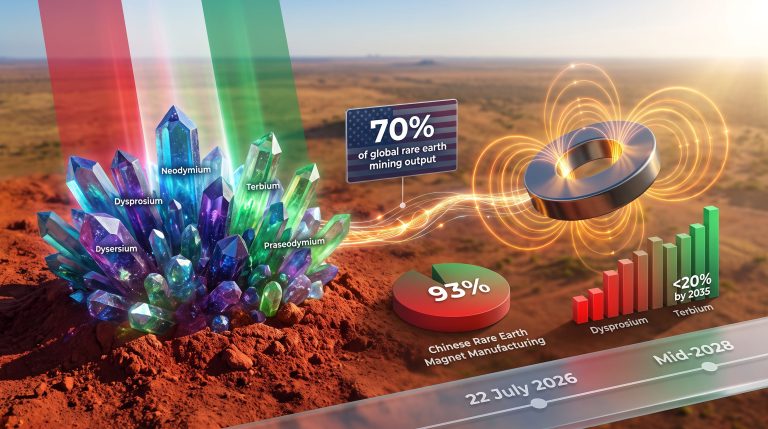
For most of the past four decades, the global rare earth industry has functioned under a quiet but profound structural imbalance. One country, China, not only dominates the mining of these materials but controls the downstream processing infrastructure that converts raw ore into the refined oxides and alloys that power electric vehicles, wind turbines, and precision defence systems. This concentration has persisted not because other nations lack rare earth deposits, but because one specific deposit type, the ionic adsorption clay, remained almost exclusively within Chinese borders. That geological reality is now changing, and the Harena Ampasindava rare earth project in Madagascar sits at the centre of that shift.
When big ASX news breaks, our subscribers know first
Understanding Ionic Adsorption Clays: The Deposit Type That Changed Everything
To appreciate why the Harena Ampasindava rare earth project in Madagascar attracts the level of geopolitical attention it does, it helps to understand what makes ionic adsorption clay deposits fundamentally different from other rare earth sources.
In conventional hard-rock rare earth deposits, such as bastnäsite or monazite systems, rare earth elements are chemically bonded within mineral lattice structures. Liberating them requires intensive crushing, grinding, and aggressive chemical processing. Ionic adsorption clay deposits work on an entirely different principle. Over millions of years of tropical weathering, rare earth ions are leached from parent granite or volcanic rocks and become electrostatically adsorbed onto clay mineral surfaces, particularly kaolinite and halloysite.
The rare earths are not locked inside mineral grains. They sit loosely on clay particle surfaces, held by weak ionic bonds.
This distinction has enormous practical consequences:
- Extraction requires only a dilute electrolyte solution, typically ammonium sulphate or magnesium sulphate, pumped through the ore to displace the rare earth ions
- No crushing or grinding is required, dramatically reducing capital and energy costs
- The heap-leach method used in IAC processing generates significantly less waste rock and tailings compared to conventional mining
- Processing temperatures are ambient, removing the need for high-temperature roasters or autoclaves
Geological insight: IAC deposits are enriched in heavy rare earth elements (HREEs) such as dysprosium and terbium at disproportionately high levels relative to their abundance in hard-rock systems. This is one reason Chinese IAC deposits in Jiangxi Province became so commercially significant, and why the Ampasindava deposit carries strategic weight beyond its tonnage alone.
The catch, historically, has been that economically significant IAC deposits were almost entirely confined to the deeply weathered laterite terrains of southern China. The Ampasindava Peninsula in northwest Madagascar replicates those tropical weathering conditions, creating a deposit with geological characteristics that mirror China's most strategically important rare earth systems but sit entirely outside Chinese jurisdiction. Furthermore, understanding the rare earth processing challenges inherent to conventional deposits makes IAC's simplified metallurgy all the more commercially compelling.
Project Fundamentals: Scale, Grade, and What the Numbers Actually Mean
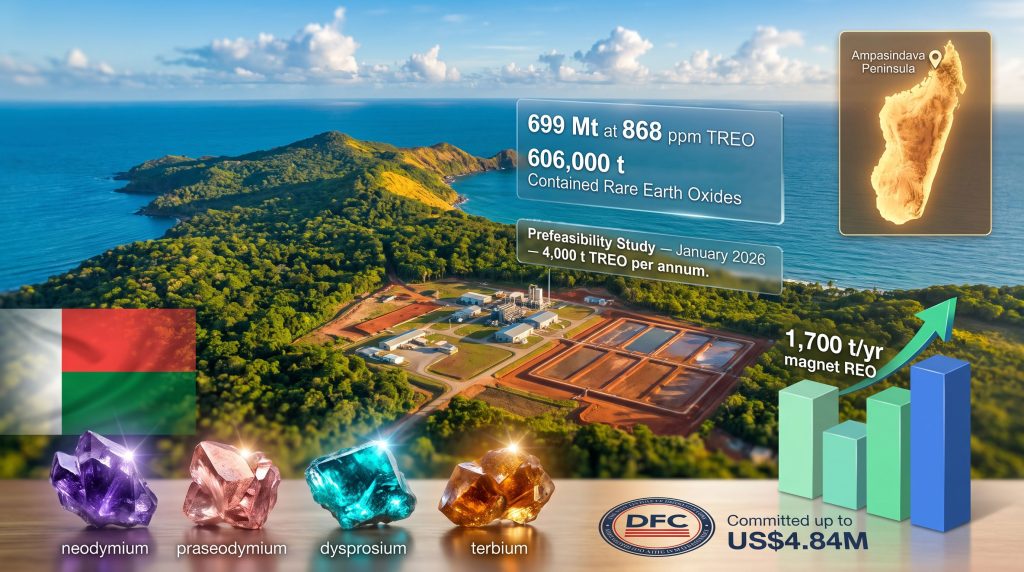
The Harena Ampasindava rare earth project in Madagascar covers approximately 238 square kilometres under licence PR6698 on the Ampasindava Peninsula in Antsiranana Province, roughly 500 kilometres north of the capital Antananarivo. Harena Rare Earths (LON: HREE) holds 100% ownership of the deposit.
The JORC-compliant resource estimate presents a project of considerable scale:
| Metric | Figure |
|---|---|
| Total Resource Tonnage | ~699 million tonnes |
| Average Grade (TREO) | 868 ppm |
| Total Contained TREO | ~606,000 tonnes |
| Licence Area | ~238 km² |
| Deposit Classification | Ionic Adsorption Clay (IAC) |
A grade of 868 parts per million total rare earth oxide is worth contextualising. For hard-rock deposits, this would be considered low-grade. For IAC systems, it falls within the commercially viable range, particularly given the low processing costs inherent to heap-leach methods. What matters in IAC economics is not raw grade alone but the proportion of magnet rare earths within the total rare earth basket, a metric known in the industry as the magnet rare earth element fraction (MREF).
Ampasindava's basket is notably weighted toward the four commercially critical magnet rare earths: neodymium, praseodymium, dysprosium, and terbium. The January 2026 Prefeasibility Study (PFS) quantified this in operational terms:
- Mine life: 20 years at approximately 5 million tonnes of annual plant throughput
- Annual rare earth oxide output: approximately 4,000 tonnes TREO
- Annual magnet rare earth output: approximately 1,700 tonnes of NdPr and DyTb combined
- Pre-production capital estimate: approximately US$142 to US$143 million
The ratio of magnet rare earths to total output, roughly 42.5% of annual production, is commercially significant. In many hard-rock projects, this fraction is lower, meaning a larger volume of less commercially valuable rare earth oxides must be processed and sold to justify capital expenditure.
The Four Elements That Drive the Entire Project's Commercial Case
The Harena Ampasindava rare earth project in Madagascar derives its strategic value almost entirely from four elements. Understanding each clarifies why Western governments are prepared to back the project financially. Indeed, the broader critical minerals demand surge underway globally makes the timing of this project particularly relevant.
| Rare Earth Element | Primary Application | Strategic Sector | Supply Risk |
|---|---|---|---|
| Neodymium (Nd) | EV traction motors, wind turbines | Clean energy, transport | High |
| Praseodymium (Pr) | Magnet alloys, EV drivetrains | Clean energy, transport | High |
| Dysprosium (Dy) | High-temperature magnet performance | Defence, aerospace | Very High |
| Terbium (Tb) | Magnet thermal stability enhancement | Defence, precision systems | Very High |
Neodymium and praseodymium are combined commercially as NdPr oxide and form the primary magnetic phase in neodymium-iron-boron (NdFeB) permanent magnets. These are the most powerful permanent magnets commercially available and are irreplaceable in the traction motors of battery electric vehicles and the direct-drive generators used in offshore wind turbines. Global NdPr demand is forecast to grow substantially through the 2030s as EV penetration accelerates.
Dysprosium and terbium serve a different but equally critical function. Pure NdFeB magnets lose coercivity, their ability to resist demagnetisation, at elevated temperatures. In EV motors, industrial machinery, and military systems, operating temperatures can exceed the threshold at which unmodified NdFeB magnets begin to fail. Dysprosium and terbium are added as dopants to stabilise magnet performance at these temperatures. There is currently no cost-effective substitute for this function.
Lesser-known industry dynamic: The heavy rare earth elements dysprosium and terbium are produced almost exclusively from IAC deposits in China's Jiangxi Province. Hard-rock deposits such as Mountain Pass in California produce virtually no dysprosium or terbium in economically meaningful quantities. This means that even a fully operational non-Chinese hard-rock rare earth sector would leave Western defence and EV supply chains dependent on Chinese DyTb. Projects like Ampasindava, which produce both light and heavy magnet rare earths from an IAC system, represent one of the very few pathways to genuine supply chain independence for these critical heavy rare earths.
The DFC Commitment: Strategic Signal or Project Catalyst?
The U.S. International Development Finance Corporation committed up to US$4.84 million toward the Harena Ampasindava rare earth project in Madagascar, specifically to fund pilot plant construction, laboratory-scale metallurgical testing, and environmental assessment programs.
Measured against the project's total estimated development cost of approximately US$150 million, this commitment covers roughly 3% of the capital required. Taken purely as a financing contribution, it is modest. Taken as a strategic signal, its implications are considerably larger.
The DFC's mandate includes financing projects that advance U.S. national security and foreign policy objectives. A commitment to a frontier-jurisdiction rare earth project signals that the agency has conducted due diligence sufficient to judge the project viable, that the deposit type and product basket align with U.S. supply chain priorities, and that additional, larger financing tranches are plausible as the project matures. The DFC confirmed it could consider further financing subject to due diligence and regulatory approvals as development progresses.
A U.S. State Department spokesperson described the broader investment rationale in terms of countering investment practices from geopolitical rivals that it characterised as opaque and predatory, and identified Madagascar as a country offering multiple opportunities for U.S.-aligned critical mineral investment. This framing reflects a broader Washington posture, not a project-specific endorsement, but it does position Ampasindava within a recognised strategic framework for U.S. government financing. The critical minerals geopolitics driving these decisions extend well beyond any single project.
Processing Pathways: Where the Ore Goes Determines Its Commercial Value
One of the most consequential decisions Harena will make involves not the mine itself but what happens after ore is processed into a mixed rare earth carbonate or separated oxide stream. The destination of that material determines eligibility for government procurement preferences, offtake pricing, and long-term commercial partnerships.
Harena is evaluating refining and separation partnerships across three organisations:
-
MP Materials (NYSE: MP): Operating Mountain Pass in California, MP Materials is the largest rare earth producer in the United States and has invested in building domestic separation capacity. A partnership with MP would route Ampasindava's output through U.S.-based refining infrastructure.
-
USA Rare Earths (NASDAQ: USAR): A domestic U.S. processor focused on establishing American rare earth separation and magnet manufacturing capability, potentially offering a more integrated downstream pathway.
-
Solvay (EBR: SOLB): A Belgian specialty chemicals group with established rare earth separation expertise and processing facilities in Europe, offering an alternative European processing route.
The strategic importance of this decision extends beyond logistics. Under the U.S. Inflation Reduction Act and parallel European Critical Raw Materials Act frameworks, materials processed through allied-nation facilities can qualify for supply chain incentives and government procurement preferences that substantially enhance commercial value above spot commodity pricing. A tonne of separated NdPr oxide that qualifies for allied-nation procurement premiums is worth materially more than the same tonne sold into the open spot market. Consequently, the resilience of rare earth supply chains depends heavily on these downstream processing decisions.
The next major ASX story will hit our subscribers first
Development Timeline and Key Milestones
| Milestone | Status / Target Date |
|---|---|
| JORC Resource Definition | Completed (~699 Mt at 868 ppm TREO) |
| Prefeasibility Study (PFS) | Completed January 2026 |
| DFC Pilot Plant Funding | Committed July 2026 (up to US$4.84M) |
| Exploitation Permit | Expected within weeks of July 2026 |
| Definitive Feasibility Study | In progress |
| Pilot Plant Construction and Testing | Near-term |
| Target Production Commencement | Mid-2028 |
The mid-2028 production target implies a compressed development schedule. For context, most greenfield mining projects in frontier jurisdictions require five to eight years from prefeasibility to first production. Harena's two-year timeline from PFS completion to targeted production reflects either a genuinely simplified operational model, enabled by the low-infrastructure requirements of IAC heap-leach processing, or an optimistic scheduling assumption that will be tested by permitting timelines, financing close, and construction execution. A robust definitive feasibility study will be critical in validating these assumptions before financial close.
Investor caution: Compressed timelines in frontier jurisdictions carry elevated execution risk. The exploitation permit, still pending as of mid-2026, is a prerequisite for construction commencement. Any delay in permitting directly compresses the construction window available to meet a mid-2028 start date. Investors should treat the timeline as a best-case scenario pending permit confirmation.
Risk Matrix: What Could Prevent Ampasindava From Delivering?
The Harena Ampasindava rare earth project in Madagascar carries a risk profile that spans jurisdiction, financing, processing, and competition. A structured assessment clarifies where the most material uncertainties sit.
Jurisdiction and Regulatory Risk
Madagascar presents a complex operating environment. The island nation has experienced periods of political instability and its regulatory framework for extractive industries continues to evolve. Environmental permitting carries additional complexity given Madagascar's status as one of the world's premier biodiversity hotspots, with a high proportion of endemic species concentrated in precisely the tropical weathering terrains where IAC deposits form. Community engagement and biodiversity offset requirements could, however, extend permitting timelines beyond current projections.
Financing Gap
The distance between the DFC's US$4.84 million pilot commitment and the project's US$142 to US$150 million total capital requirement is substantial. Bridging this gap will require a combination of equity issuance, project finance debt, and potentially additional government-backed lending. Each of these financing streams carries its own conditions, timelines, and stakeholder requirements. The complexity of assembling a project finance package for a frontier-jurisdiction rare earth project should not be underestimated.
Processing and Offtake Uncertainty
No binding refining partnership or offtake agreement had been publicly confirmed as of mid-2026. Until a downstream processing agreement is executed, the project lacks the offtake certainty that commercial lenders typically require before committing project finance debt. This creates a sequential dependency: financing requires offtake, offtake requires pilot plant results, pilot plant results require the DFC funding to be deployed. For further context on the Ampasindava project's background, independent sources provide useful supplementary detail.
Competitive Landscape
| Project | Location | Developer | Status |
|---|---|---|---|
| Mountain Pass | California, USA | MP Materials | Operating |
| Mt Weld | Western Australia | Lynas Rare Earths | Operating |
| Nolans Project | Northern Territory, AU | Arafura Rare Earths | Development |
| Browns Range | Western Australia | Hastings Technology Metals | Development |
| Ampasindava | Madagascar | Harena Rare Earths | Pre-construction |
Notably, none of the operating or advanced-development non-Chinese rare earth projects listed above are IAC deposits with meaningful DyTb production. This is precisely where Ampasindava occupies a differentiated position in the competitive landscape. In addition, Harena's full corporate profile provides further detail on the company's broader strategic positioning.
Scenario Analysis: What Ampasindava's Output Means at Scale
| Scenario | Assumed Annual Output | Strategic Impact |
|---|---|---|
| Base Case (PFS) | ~1,700 t magnet REO | Meaningful margin contributor to allied supply |
| Expanded Operations | 2,500+ t/yr post-expansion | Significant diversification for Western defence and EV supply chains |
| Integrated Processing (US/EU) | Full value chain outside China | Maximum strategic and commercial impact |
At base case production, Ampasindava would not independently resolve Western dependence on Chinese rare earth processing. However, it would contribute meaningfully to building the critical mass of non-Chinese IAC production that has been entirely absent from Western supply chain planning. Its greatest long-term value may be as a proof-of-concept that Western-backed IAC rare earth development in Africa is commercially viable, potentially catalysing investment in analogous deposits identified across the continent.
What Needs to Go Right for Ampasindava to Succeed
The pathway from current status to operating mine requires several sequential conditions to be satisfied:
- Exploitation permit granted on schedule without material conditions that increase capital or operating costs
- Pilot plant metallurgical results confirming heap-leach processing economics at the grades indicated by the PFS
- A complete financing package assembled, combining DFC tranches, commercial project finance, and equity
- A binding offtake or processing partnership executed with a U.S. or European refiner before financial close
- A stable political and regulatory environment in Madagascar maintained through construction and first production
Each of these conditions is achievable. None is guaranteed. The interaction between them creates a dependency chain in which delay at any single point extends the timeline for all subsequent steps.
This article contains forward-looking statements and scenario analysis based on publicly available information and the January 2026 Prefeasibility Study. It does not constitute financial advice. Readers should conduct their own due diligence before making investment decisions. Mining projects in frontier jurisdictions carry elevated risks relative to projects in established mining regions.
Want to Track the Next Major Mineral Discovery Before the Market Does?
Discovery Alert's proprietary Discovery IQ model scans ASX announcements in real time, instantly identifying high-potential opportunities across critical minerals, rare earths, and beyond — visit the Discovery Alert discoveries page to see how historic finds have generated exceptional returns, then start your 14-day free trial to position yourself ahead of the broader market.