July 29, 2026
The Global Race to Rewire Critical Mineral Supply Chains
The architecture of global industrial supply chains is undergoing one of its most significant structural shifts in decades. As the energy transition accelerates critical minerals demand for rare earth elements, battery metals, and copper, nations that once relied on a narrow set of trading relationships are actively rebuilding their resource diplomacy from the ground up. The countries best positioned to benefit are not necessarily those with the largest armies or the deepest financial reserves, but those sitting atop untapped mineral wealth or possessing the industrial capacity to transform raw ore into high-value manufactured goods.
It is within this context that the Brazil and South Korea mining cooperation agreement, formalised in mid-2026, carries significance well beyond the typical bilateral trade communiqué. What has emerged between Brasília and Seoul is a structured, multi-layered minerals partnership designed to address one of the defining economic vulnerabilities of the 21st century: dependence on a single nation for the raw materials that power modern industry.
When big ASX news breaks, our subscribers know first
The Strategic Logic Behind Brazil's Rise as a Mineral Diplomacy Power
From Iron Ore Giant to Critical Minerals Powerhouse
Brazil has long been recognised as a commodities behemoth, with its iron ore exports through companies like Vale shaping global steel markets for generations. What is less widely understood is the depth and diversity of Brazil's critical mineral endowment beyond iron ore. The country holds some of the world's largest rare earth element reserves, estimated by the United States Geological Survey at approximately 21 million tonnes of rare earth oxide equivalent, placing it among the top five globally alongside China, Vietnam, Russia, and India.
Crucially, Brazil's rare earth mineralogy includes meaningful concentrations of heavy rare earth elements (HREEs) such as dysprosium and terbium. These elements are functionally irreplaceable in the permanent magnets used in electric vehicle motors and offshore wind turbine generators. The global HREE supply chain remains overwhelmingly concentrated in China, which controls an estimated 85 to 90 percent of global processing capacity for these materials. This concentration creates a structural vulnerability for every industrialised nation pursuing an energy transition.
Brazil also hosts significant laterite nickel deposits, an emerging hard-rock and brine lithium resource base, and extensive underdeveloped copper provinces, many of which remain underexplored relative to comparable geological terranes in Chile and Peru.
Why South Korea Needs a Partner Like Brazil
South Korea's industrial economy is built around sectors that are extraordinarily mineral-intensive. Its dominance in semiconductor manufacturing, EV battery production through companies such as LG Energy Solution, Samsung SDI, and SK On, and consumer electronics means the nation requires a reliable and diversified supply of lithium, nickel, cobalt, rare earths, and copper at scale.
South Korea imports the vast majority of the critical minerals it consumes, and a disproportionate share of that supply flows through Chinese processing infrastructure. For Seoul, this is not merely an economic inconvenience; it represents a strategic exposure that mirrors the energy import dependency the country has worked for decades to reduce. Diversifying mineral supply chains is now embedded in South Korean industrial policy, and furthermore, Latin America has emerged as a priority sourcing region. The ongoing South Korea battery expansion ambitions only reinforce the urgency of securing alternative mineral sources.
What the Brazil and South Korea Mining Cooperation Agreement Actually Covers
A Full Value Chain Architecture, Not Just a Trade Deal
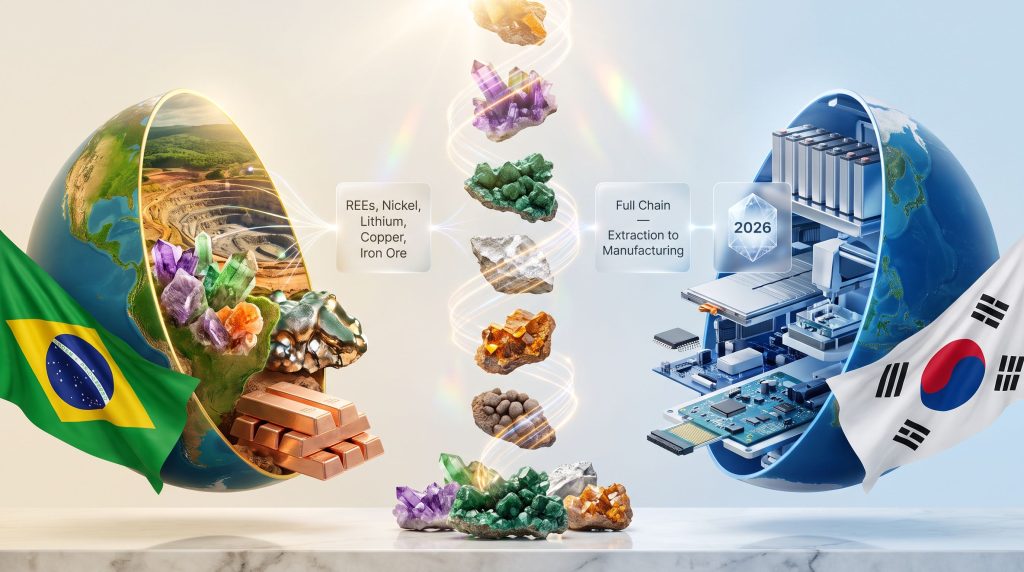
The agreement is structured across the entire mineral value chain, from resource extraction through to downstream manufacturing inputs. This distinguishes it from many bilateral mineral arrangements, which tend to focus narrowly on upstream offtake without committing to technology transfer or processing infrastructure development.
The core pillars of the partnership can be understood across three functional layers:
- Upstream: Joint development and co-investment in Brazilian extraction operations, providing Korean industrial buyers with secured access to raw mineral supply.
- Midstream: Cooperation on technology transfer and refining infrastructure, allowing Brazil to develop domestic processing capacity rather than exporting raw ore.
- Downstream: Support for South Korean manufacturing inputs across the battery and electronics supply chains, closing the loop from mine to factory floor.
Which Minerals Are at the Centre of the Agreement
| Mineral | Brazil's Strategic Advantage | South Korea's Industrial Need |
|---|---|---|
| Rare Earth Elements | Among the world's largest REE reserves, including HREEs | EV motors, wind turbines, and advanced electronics |
| Nickel | Significant laterite deposits across multiple states | Lithium-ion battery cathode production |
| Lithium | Emerging hard-rock and brine resources | Core input for EV battery cells |
| Copper | Extensive underexplored copper provinces | Electrical infrastructure and grid expansion |
| Iron Ore | World-leading production volumes | Steel manufacturing and industrial base |
Beyond Mining: MOUs Spanning Trade, AI, and Industrial Policy
The cooperation framework extends into adjacent domains. Multiple memoranda of understanding signed in parallel with the mining agreement cover areas including artificial intelligence applications in resource mapping, trade facilitation, and broader industrial policy alignment. This signals that both governments view minerals cooperation as one component of a deeper bilateral economic relationship rather than a standalone extractive arrangement. According to Reuters reporting on the partnership, the agreement reflects a deliberate strategic alignment between two nations seeking supply chain resilience.
The POSCO International and Meteoric Resources MOU: Private Sector Reality Check
Why Heavy Rare Earth Offtake Agreements Matter More Than Headlines
One of the most commercially significant elements connected to this broader diplomatic environment is the memorandum of understanding between POSCO International, the trading and resources arm of Korean steelmaker POSCO, and Meteoric Resources, an ASX-listed rare earth developer advancing its Caldeira project in Brazil's Minas Gerais state.
A heavy rare earth offtake agreement is a commercial arrangement in which a buyer secures the right to purchase a defined volume of processed rare earth output from a producer, often before the mine reaches commercial production. These agreements serve two functions simultaneously: they de-risk project financing for the producer and provide supply chain certainty for the downstream buyer. In a market where HREE supply is as concentrated as it currently is, securing offtake from a non-Chinese, non-Chinese-processed source carries a meaningful strategic premium.
Heavy rare earths like dysprosium and terbium are not interchangeable with the more abundant light rare earths such as cerium and lanthanum. The permanent magnet formulations that enable high-torque electric motors and wind turbine generators require specific HREE inputs, and no commercially viable substitute currently exists. This is what gives HREE offtake agreements their outsized strategic significance.
The Caldeira Project's Geological Distinction
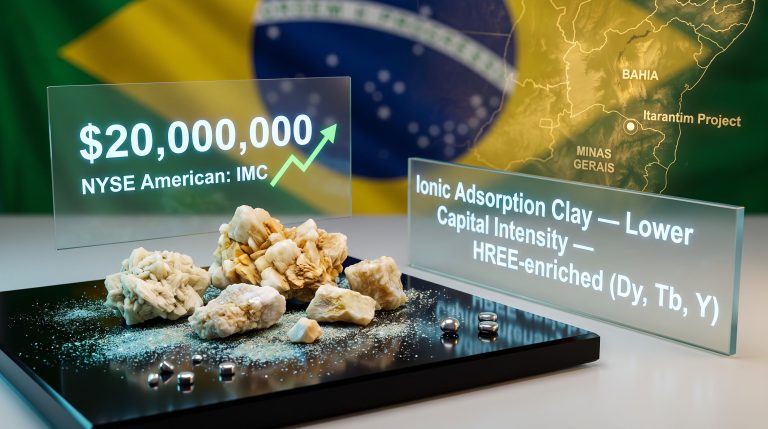
What makes the Caldeira deposit particularly relevant within this diplomatic context is its ionic clay rare earth mineralogy. Ionic clay deposits, most prominently found in southern China's Jiangxi Province, are valued because the rare earth elements are adsorbed onto clay minerals rather than locked within hard crystalline host rock. This allows extraction using simple heap leaching processes with far lower energy requirements and capital intensity than conventional hard-rock rare earth mining.
The presence of a commercially significant ionic clay REE deposit in Brazil is not widely appreciated outside specialist geology circles. Consequently, it means that midstream refining can potentially be achieved at lower cost and with faster permitting timelines than equivalent hard-rock projects, improving the commercial viability of the midstream cooperation envisaged under the broader bilateral agreement.
How This Agreement Compares to Other Critical Minerals Partnerships
Comparative Framework
| Partnership | Key Minerals | Value Chain Depth | Year Formalised |
|---|---|---|---|
| Brazil–South Korea | REEs, Nickel, Lithium, Copper | Full chain (extraction to manufacturing inputs) | 2026 |
| Australia–South Korea | Lithium, Nickel, Cobalt | Primarily upstream and offtake | Ongoing |
| Canada–South Korea | Lithium, Cobalt, Graphite | Upstream and processing | 2023 |
| EU–Brazil Critical Minerals Partnership | REEs, Nickel, Copper | Full chain with sustainability standards | 2023 |
The depth of the Brazil and South Korea mining cooperation agreement compares favourably with other Korean bilateral mineral deals. Australia's partnership with South Korea has historically been weighted toward upstream supply without the same degree of midstream investment commitment. The agreement's explicit inclusion of refining infrastructure cooperation and technology transfer gives it a structural depth that, if executed, would represent a more durable supply chain relationship.
The Mercosur Factor: A Trade Architecture Multiplier
The potential resumption of Mercosur-South Korea trade negotiations adds a further dimension to the partnership's commercial viability. If tariff barriers on processed mineral exports from Mercosur member states to South Korea were reduced through a formalised trade agreement, the economics of developing Brazilian midstream refining capacity would improve materially. Processed rare earth oxides and battery-grade nickel intermediates currently face tariff friction that makes Brazilian supply less cost-competitive than Chinese alternatives. A trade deal would, however, shift that equation considerably.
Risks That Could Constrain Partnership Outcomes
Infrastructure, Regulation, and Technology Sensitivities
No bilateral minerals agreement, however well-structured, translates automatically into commercial output. Several friction points could limit the pace of delivery:
- Infrastructure deficits: Brazil's mineral-rich interior provinces, including parts of Goiás, Minas Gerais, and the Amazon frontier, suffer from inadequate road, rail, and port infrastructure. Moving bulk ore or processed intermediates to export terminals adds cost and complexity that Chilean or Australian competitors do not face to the same degree.
- Regulatory and permitting timelines: Brazil's environmental licensing framework, while improving under recent reform efforts, remains one of the more time-intensive in the Americas. Projects in proximity to sensitive biomes face additional scrutiny that can extend pre-production timelines by several years.
- Technology transfer sensitivities: Rare earth separation and refining technology carries dual-use considerations. Negotiating the terms under which Korean processing expertise is transferred to Brazilian operations will require careful management of intellectual property arrangements.
- Currency and investment risk: Brazilian real volatility and periodic shifts in foreign investment policy create a risk premium for Korean capital deploying into long-duration mining projects. Hedging and investment treaty structures will be important tools for managing this exposure.
The next major ASX story will hit our subscribers first
Scenarios: How the Partnership Could Evolve Through 2035
Three Plausible Pathways
Scenario 1: Accelerated Integration. Korean capital flows into Brazilian rare earth and nickel projects at scale. Brazilian refining infrastructure is developed with Korean technology transfer. Processed outputs feed directly into Korean battery and magnet manufacturing. This scenario requires stable Brazilian regulatory conditions, favourable Mercosur trade outcomes, and sustained Korean industrial demand. It is the most strategically valuable pathway but also the most complex to execute.
Scenario 2: Selective Engagement. The partnership progresses primarily through offtake agreements at the upstream level, without deep midstream investment. Korean buyers secure supply from Brazilian producers but processing occurs in third-country facilities, potentially in South Korea itself. This is a more commercially conservative path but delivers meaningful supply chain diversification.
Scenario 3: Geopolitical Disruption. A shift in Brazilian trade or resource nationalism policy, a deterioration in Mercosur-Korea trade negotiations, or a significant reconfiguration of global rare earth markets driven by China's rare earth export restrictions curtails the partnership's development. This scenario is a tail risk rather than a base case, but the history of Latin American resource nationalism makes it a factor that investors and policymakers cannot ignore.
Frequently Asked Questions: Brazil and South Korea Mining Cooperation Agreement
What minerals are included in the Brazil and South Korea mining cooperation agreement?
The agreement covers rare earth elements, nickel, lithium, copper, and iron ore. Rare earths, including both light and heavy varieties, occupy a central strategic position given Brazil's significant reserve base and South Korea's manufacturing dependence on these inputs. Understanding rare earth supply chains more broadly helps contextualise why this particular bilateral arrangement carries such strategic weight.
Why are heavy rare earths more strategically significant than light rare earths?
Heavy rare earths such as dysprosium and terbium are required in specific permanent magnet formulations used in EV motors and wind turbine generators. They are present in far smaller quantities globally than light rare earths like cerium, and China controls the overwhelming majority of HREE processing capacity. This scarcity and concentration makes them a higher-priority target for supply chain diversification. In addition, their relevance to critical minerals for semiconductors and advanced electronics further amplifies their strategic importance.
Is this a binding treaty or a framework agreement?
The cooperation agreement operates primarily as a framework, establishing intentions and mechanisms for collaboration rather than legally binding production or investment commitments. Commercial reality will be determined by the private sector MOUs and investment decisions that follow from the diplomatic framework. As detailed analysis from Brazil Stock Guide highlights, the private sector dimension will ultimately determine whether government-level commitments translate into tangible mineral flows.
What role does the Mercosur-South Korea trade deal play?
A potential Mercosur-South Korea trade agreement could reduce tariff barriers on processed mineral exports from Brazil, materially improving the economics of midstream refining investment and making Brazilian supply more cost-competitive with Chinese alternatives.
Key Takeaways for Investors and Industry Observers
- Supply chain diversification away from China-dominant rare earth processing is the central strategic driver for both governments, with HREEs representing the highest-priority target.
- The agreement's full value chain architecture spanning extraction, refining, and manufacturing inputs distinguishes it from simpler offtake-focused bilateral arrangements.
- Private sector MOUs, particularly in heavy rare earth offtake, signal that commercial activity is advancing in parallel with government-level diplomacy, reducing the gap between announcement and delivery.
- The potential Mercosur-South Korea trade resumption represents a structural multiplier that could accelerate investment timelines if tariff barriers on processed mineral exports are reduced.
- Brazil's ionic clay rare earth mineralogy, combined with its laterite nickel and emerging lithium resources, positions it as one of the most strategically complete mineral partners available to Asian industrial economies outside Chinese supply chains.
This article contains forward-looking analysis regarding trade agreements, investment scenarios, and mineral market dynamics. These represent analytical perspectives based on publicly available information and should not be construed as financial or investment advice. Outcomes may differ materially from scenarios described. Readers should conduct independent due diligence before making investment decisions.
For further coverage of Latin American mining and bilateral trade developments, BNamericas provides ongoing industry reporting at bnamericas.com.
Looking For The Next Major ASX Mineral Discovery?
Discovery Alert delivers real-time ASX discovery notifications powered by its proprietary Discovery IQ model, helping investors turn complex mineral announcements into actionable opportunities faster. To see how standout discoveries have historically driven exceptional market returns, explore Discovery Alert’s discoveries page and start a 14-day free trial today.