July 29, 2026
The Invisible Metal Powering the AI Age: Why Gallium Supply Chains Are Being Rebuilt From the Ground Up
Semiconductor supply chains have a quiet vulnerability that most investors and policymakers have only recently begun to appreciate. While rare earth elements attract headlines, a far less visible metal sits at the core of some of the most strategically sensitive technologies on the planet. Gallium, a soft silvery metal recovered as a trace byproduct of aluminium refining, underpins the hardware architectures that power 5G networks, AI accelerators, advanced radar systems, and next-generation solar cells. For decades, that supply sat overwhelmingly within a single country's industrial system. That structural fragility is now being forcibly corrected, and the METLEN Greek gallium supply deal with a US tech company announced in July 2026 represents one of the clearest signals yet that a new industrial geography is taking shape.
When big ASX news breaks, our subscribers know first
Why Gallium Is Unlike Any Other Critical Mineral
The Chemistry and Economics of a Byproduct Metal
Gallium occupies a peculiar position in the critical minerals landscape. Unlike lithium, cobalt, or nickel, it is never mined as a primary target. It exists in trace concentrations within bauxite ore, and it is only recovered during the Bayer process used to refine bauxite into alumina. This byproduct status creates a paradox: gallium production is simultaneously abundant in theory and constrained in practice. Its output is structurally capped by the economics of aluminium refining, not by the availability of gallium-bearing rock.
This matters enormously for supply chain planning. A technology company seeking to secure long-term gallium supply cannot simply incentivise more mining. It must locate existing alumina refineries capable of adding gallium recovery circuits and persuade their operators that the capital investment is commercially justified. That is a far more complex and geopolitically sensitive negotiation than signing a conventional mining offtake agreement. Understanding gallium critical mineral dynamics is therefore essential for anyone tracking supply chain risk.
The Compound Semiconductor Dependency
The semiconductor applications that drive gallium demand rely on two primary compounds: gallium nitride (GaN) and gallium arsenide (GaAs). Both are compound semiconductors, meaning they are formed by combining gallium with another element to produce materials with electronic properties that silicon cannot replicate at the required performance levels.
- GaN operates efficiently at high voltages and frequencies, making it the material of choice for 5G base station power amplifiers, electric vehicle charging systems, and defence radar arrays
- GaAs delivers superior electron mobility for high-frequency communications chips, satellite transceivers, and precision optoelectronic devices
- CIGS thin-film solar cells (copper indium gallium selenide) represent an emerging consumption vector as solar manufacturers push beyond conventional silicon panel efficiency ceilings
The absence of viable substitutes in many of these applications means gallium demand is structurally inelastic. Buyers cannot simply switch materials when supply tightens. They either secure supply or halt production.
China's Export Restrictions and the Supply Shock That Changed Everything
How One Policy Decision Restructured Global Procurement
China has historically accounted for more than 80% of global refined gallium production, a concentration that created profound strategic exposure for Western technology industries. In August 2023, Beijing introduced export licensing requirements for gallium and germanium, framing the restrictions as national security measures. The export controls impact on available supply for non-Chinese buyers was immediate, driving a significant price response and accelerating procurement diversification strategies that had previously moved slowly.
The export licensing regime China applied to gallium in 2023 was not merely a trade measure. It was a demonstration that Beijing could selectively constrain the material inputs underpinning Western defence electronics, telecommunications infrastructure, and AI hardware manufacturing.
That demonstration produced an urgent, practical response. US and European technology companies that had previously relied on spot market purchases from Chinese intermediaries were abruptly exposed to supply risk at volumes that threatened production continuity. The search for allied-nation alternatives moved from a long-term strategic aspiration to an immediate procurement priority.
The Geographic Quirk That Made Greece Relevant
Greece holds one of Europe's most significant bauxite deposits, located in the Boeotia region of Central Greece. The Aluminium of Greece facility, operating under METLEN's industrial umbrella, is one of the few refineries in Europe with the feedstock, processing infrastructure, and technical expertise to establish integrated gallium recovery at meaningful scale.
That geographic and industrial coincidence positions Greece as Europe's most credible near-term gallium production node, not through deliberate planning but through the geological inheritance of a bauxite-rich geology and decades of aluminium processing experience. Furthermore, processing challenges associated with critical minerals more broadly have historically slowed the emergence of new Western production centres, making METLEN's existing infrastructure all the more valuable.
METLEN's Production Model: From Bauxite to Critical Mineral
The Integrated Value Chain
Understanding why the METLEN Greek gallium supply deal with a US tech company is commercially significant requires understanding the production architecture behind it. Gallium recovery is not a standalone operation. It is integrated into an aluminium production chain, with each stage building on the last.
| Production Stage | Input Material | Output | Strategic Relevance |
|---|---|---|---|
| Bauxite Mining | Raw ore from Central Greece | Aluminium feedstock | Domestic resource base |
| Alumina Refining | Bauxite via Bayer Process | Alumina + gallium-rich liquor | Gallium extraction point |
| Gallium Recovery | Alumina refining byproduct stream | Primary gallium metal | Critical mineral output |
| Commercial Supply | Refined and qualified gallium | Long-term offtake agreements | US and EU tech sector demand |
The gallium-rich liquor produced during alumina refining is processed through solvent extraction and electrolysis to yield high-purity gallium metal. The grade and consistency of output is critical: semiconductor manufacturers require gallium purity levels of 99.9999% (6N grade) or higher for wafer production, and any deviation from specification can result in batch rejection and costly requalification processes.
First-Mover Advantage and the Qualification Barrier
One of the least-discussed but most commercially significant aspects of the METLEN Greek gallium supply deal with a US tech company is the qualification hurdle that precedes any binding commercial agreement. Before a semiconductor manufacturer or technology firm can commit to purchasing gallium from a new supplier, that supplier's material must pass extensive qualification testing.
This testing can span months and involve rigorous chemical analysis, crystal growth trials, and wafer performance benchmarking. METLEN's investment in gallium production confirms the company's executive chairman has noted that its gallium has already completed extensive qualification testing with the US buyer — a milestone that represents substantial invested time and technical validation. This qualification creates a meaningful commercial moat, as competitors cannot simply replicate the agreement by announcing production capacity.
Deal Structure and Production Targets
What the Agreement Actually Covers
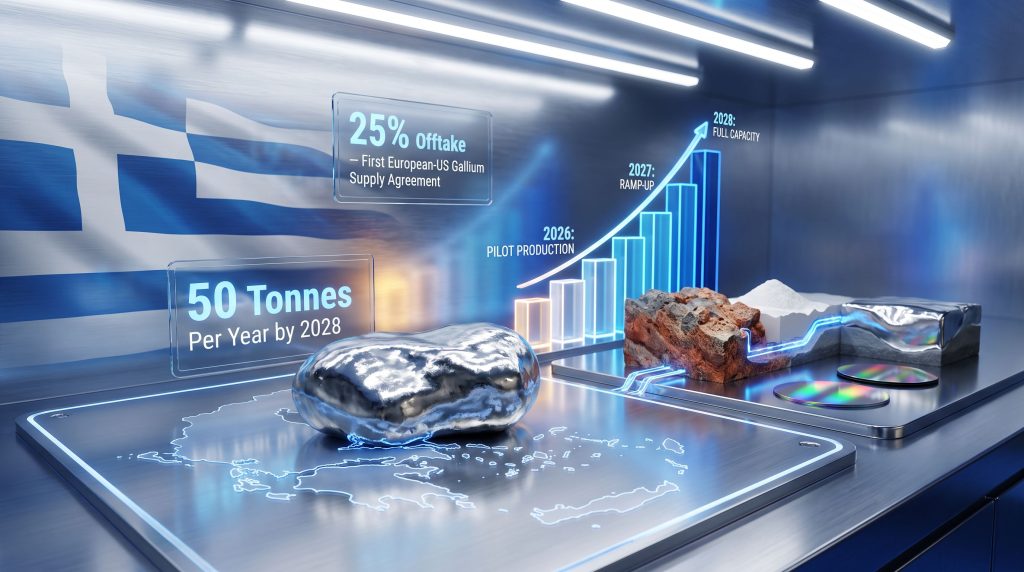
The long-term commercial supply agreement, signed in late July 2026, commits approximately 25% of METLEN's planned annual gallium output to an unnamed US technology company. The identity of the buyer and the commercial terms remain confidential, which is standard practice in strategic mineral offtake agreements where pricing formulas, volume commitments, and delivery schedules represent competitive intelligence.
METLEN is targeting an annual production capacity of approximately 50 tonnes of gallium per year by 2028, which the company has indicated could satisfy the European Union's aggregate gallium consumption requirements. At that production level, the US offtake commitment represents approximately 12 to 13 tonnes per annum directed to a single buyer — a volume that is commercially meaningful in a market where total Western world ex-China supply has historically been measured in dozens of tonnes.
Key Milestones Toward Full Production
| Milestone | Target Date | Significance |
|---|---|---|
| Commercial supply agreement signed | July 2026 | Demand validation and first European-US gallium offtake |
| Facility operational ramp-up | 2027 to 2028 | Physical production commences at scale |
| Full capacity target reached | ~2028 | ~50 tonnes per year; potential EU consumption coverage |
| Strategic Project status confirmed | Already achieved | Institutional and regulatory framework secured |
The 2028 production target is the pivotal watch point for everyone tracking European gallium supply chain development. If METLEN achieves full capacity on schedule, it would represent a genuine structural shift in the EU's critical mineral dependency profile.
The Policy Architecture Behind the Project
Europe's Critical Raw Materials Act and Strategic Project Classification
The European Union's Critical Raw Materials Act, which entered into force in 2024, established a framework for identifying and supporting domestic production of strategically important minerals. Projects classified as Strategic Projects under this legislation benefit from streamlined permitting processes, enhanced access to financing, and greater institutional visibility across EU member states.
METLEN's gallium project has received formal classification as a Strategic Project under the Critical Raw Materials Act. In addition, the European critical raw materials framework has been further reinforced by the European Investment Bank's approval of financing for the project through the REPowerEU mechanism — a funding instrument originally associated with energy independence that has since been extended to cover critical mineral supply chains. The EIB's backing of Europe's first gallium production investment with €90 million in financing to METLEN underlines the institutional seriousness of this initiative.
The European Investment Bank's decision to channel REPowerEU capital toward a gallium recovery project is a revealing policy signal. It reflects an institutional recognition that energy independence and critical mineral independence are not separate objectives but interconnected pillars of the same strategic architecture.
The next major ASX story will hit our subscribers first
Gallium's End-Use Landscape: Who Is Competing for Supply
Applications Across Sectors
The breadth of gallium's end-use applications creates demand competition across multiple high-priority industries, each of which regards secure supply as strategically critical.
| End-Use Sector | Gallium Application | Strategic Priority Level |
|---|---|---|
| Semiconductors and AI chips | GaAs and GaN wafers | Critical |
| Defence electronics | Radar, electronic warfare, missile guidance | Critical |
| 5G and telecommunications | GaN-based power amplifiers | High |
| Solar energy (CIGS panels) | Copper indium gallium selenide thin-film cells | Medium to High |
| LEDs and optoelectronics | GaN-based light-emitting devices | Medium |
The concentration of critical and high-priority applications explains why an unnamed US technology buyer was willing to commit to a long-term offtake agreement from a facility that has not yet reached full commercial production. The alternative — continued dependence on Chinese supply subject to export licensing discretion — carries a risk premium that no major technology or defence-adjacent company can comfortably absorb. Consequently, a broader critical minerals strategy has become indispensable for Western industrial planning.
Is This the Beginning of a European Gallium Industry?
Greece as a Sovereign Mineral Producer
The METLEN Greek gallium supply deal with a US tech company has implications that extend well beyond a single commercial agreement. It establishes proof of concept for European gallium production and demonstrates that a Western buyer is prepared to pay for supply security from an allied-nation source. That combination of demonstrated production capability, completed material qualification, and contracted demand creates a template that other potential European producers will study carefully.
Several other European countries possess bauxite processing infrastructure or import alumina for refining, and the economics of gallium recovery are increasingly compelling as spot prices reflect the structural tightening of ex-China supply. The question is whether the lead time and capital requirements for establishing gallium recovery circuits can be compressed sufficiently to respond to near-term demand growth.
Comparing Supply Chain Postures
| Supply Dimension | China | Europe | United States |
|---|---|---|---|
| Production Share | Historically 80%+ of global output | Nascent; METLEN as first mover | Minimal domestic production |
| Export Policy | Subject to licensing restrictions | Expanding under Critical Raw Materials Act | Dependent on allied-nation imports |
| Key Strategic Risk | Geopolitical leverage over buyers | Ramp-up timeline to 2028 | Supply concentration vulnerability |
The asymmetry in this table underlines the structural urgency. The US has significant gallium demand and minimal domestic production. Europe has emerging production capability but limited history. China retains overwhelming market share and demonstrated willingness to use export controls as a policy instrument. The METLEN deal begins to address this imbalance, but it is one agreement among many that will be needed before Western supply chains can be described as genuinely resilient.
Frequently Asked Questions
What is the METLEN Greek gallium supply deal with a US tech company?
It is a long-term commercial agreement signed in July 2026 under which METLEN will supply approximately 25% of the planned annual gallium output from its Aluminium of Greece facility to an unnamed US technology company. It is reported to be the first commercial gallium supply agreement between a European producer and a US technology firm.
How much gallium will METLEN produce?
METLEN is targeting approximately 50 tonnes of gallium per year by 2028, integrated within its existing bauxite and aluminium operations in Central Greece. The US offtake commitment covers approximately 12 to 13 tonnes of that annual volume.
Why is gallium classified as a critical mineral?
Gallium is essential for manufacturing GaN and GaAs compound semiconductors used in AI processors, 5G infrastructure, defence electronics, and advanced solar panels. Its concentrated production profile, byproduct-only recovery method, and lack of viable substitutes in key applications make it one of the most strategically sensitive materials in Western industrial supply chains.
What does the Strategic Project classification mean for METLEN?
Formal designation as a Strategic Project under the EU's Critical Raw Materials Act means the project benefits from streamlined permitting processes and enhanced access to institutional financing channels, including the European Investment Bank. It also signals European Commission endorsement of the project's relevance to EU supply chain resilience targets.
This article is intended for informational purposes only and does not constitute financial or investment advice. Forecasts and production targets referenced herein are based on publicly available company statements and may not be achieved. Readers should conduct independent due diligence before making investment decisions.
Want to Track the Next Critical Mineral Discovery Before the Broader Market Does?
Discovery Alert's proprietary Discovery IQ model delivers real-time alerts on significant ASX mineral discoveries across more than 30 commodities — including the critical minerals reshaping global supply chains — instantly translating complex data into actionable investment insights for traders and long-term investors alike. Explore historic discoveries and their returns on Discovery Alert's dedicated discoveries page, or begin your 14-day free trial today to position yourself ahead of the market.