
July 29, 2026
The Forgotten Bottleneck: Why Mining Is Only Half the Rare Earth Equation
Most discussions about rare earth supply chains focus on where deposits are located and who controls them. Far less attention lands on the far more consequential question of what happens after ore is extracted from the ground. The processing stage, where raw material is chemically separated into usable oxides and metals, is where genuine strategic leverage lives. It is precisely here that China has built a position that took decades to construct and will take at least as long to meaningfully challenge.
Understanding this distinction is the starting point for making sense of why the U.S. backs Madagascar rare earth project development as part of a broader campaign to challenge China's mineral dominance. The Ampasindava Rare Earths Project, owned by London-listed Harena Rare Earths, represents one piece of a puzzle that is far larger and more structurally complex than a single deposit can solve. However, pieces matter, and this one is worth examining closely.
When big ASX news breaks, our subscribers know first
China's Dual Chokehold: Mining and Refining
China's position in the rare earth sector is unique in modern commodity markets because it operates at two distinct levels simultaneously. At the mining stage, China accounts for approximately 60 to 70% of global rare earth extraction output. That figure alone would represent significant market power, but it is at the refining and separation stage where the strategic leverage becomes qualitatively different.
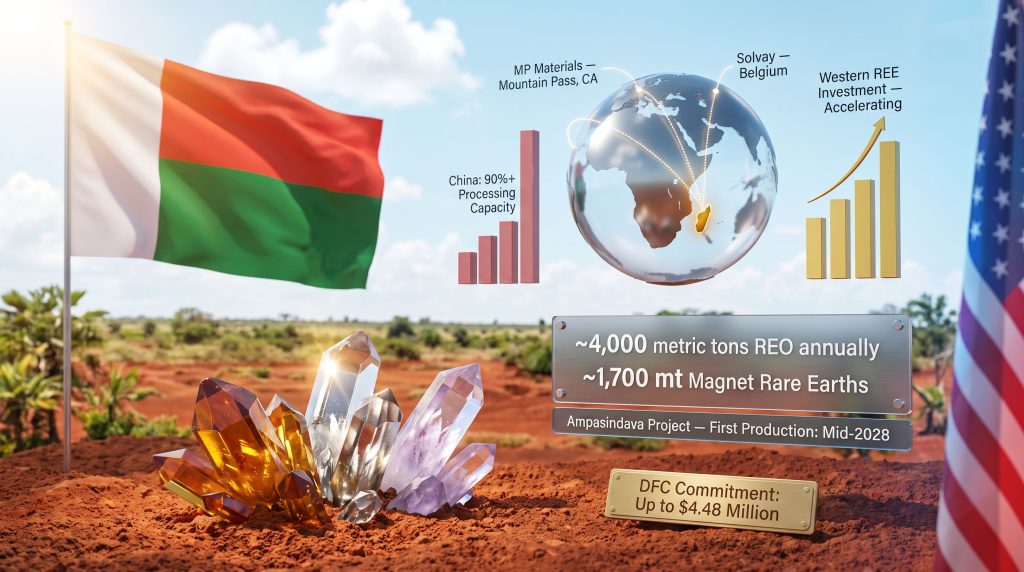
China controls an estimated 90% or more of global rare earth processing and separation capacity. This means a country can discover and develop a world-class rare earth deposit and still be functionally dependent on Chinese refineries to convert that ore into the oxide forms that manufacturers actually require. Furthermore, the ore is worthless to a magnet producer without separation. China's rare earth strategy involved building this processing infrastructure over three to four decades through sustained state investment, subsidised operational costs, and strategic pricing that made Western separation facilities economically unviable.
Critical Insight: The West's rare earth vulnerability is not primarily a geology problem. Significant deposits exist across multiple continents. The problem is processing infrastructure, specialist chemistry expertise, and the multi-decade industrial policy commitment required to rebuild what was effectively ceded to China during the 1990s and 2000s.
A rarely discussed but important technical nuance is that rare earth processing challenges are not uniform across a single industrial process. Different ore compositions require different hydrometallurgical flowsheets, involving solvent extraction circuits tuned to specific element ratios. Ionic clay deposits like Ampasindava, for example, have a distinct geochemical profile compared to hard-rock bastnäsite or monazite ores, meaning processing partnerships must be evaluated for their specific ability to handle the relevant ore chemistry.
What Makes Magnet Rare Earths Commercially Different
Not all rare earth elements carry equivalent market value. The sector divides broadly into light rare earth elements (LREEs) and heavy rare earth elements (HREEs), with further commercial stratification within each group based on end-use demand. The elements receiving the most investor and policy attention are the four magnet rare earths: neodymium (Nd), praseodymium (Pr), dysprosium (Dy), and terbium (Tb).
The Ampasindava deposit contains all four of these elements, which is a commercially significant compositional feature. Neodymium and praseodymium are typically traded together as an NdPr oxide, forming the primary inputs for neodymium-iron-boron (NdFeB) permanent magnets. Dysprosium and terbium serve a different but equally critical function: they are added to NdFeB magnets in small quantities to preserve magnetic performance at elevated operating temperatures, particularly relevant in EV drive motors and wind turbine generators.
| Element | Symbol | Primary Application | Why It Matters |
|---|---|---|---|
| Neodymium | Nd | NdFeB permanent magnets | Core input for EV motors, wind turbines |
| Praseodymium | Pr | NdFeB permanent magnets | Blended with Nd as NdPr oxide |
| Dysprosium | Dy | High-temp magnet additive | Prevents demagnetisation under heat |
| Terbium | Tb | High-temp magnet additive | Critical for performance-grade magnets |
Dysprosium and terbium are particularly supply-constrained because they are classified as heavy rare earths, which occur in lower concentrations and are geographically concentrated in specific deposit types. Their presence in the Ampasindava ionic clay ore body meaningfully elevates the project's commercial profile beyond what headline production tonnage alone would suggest.
Harena expects Ampasindava to produce approximately 4,000 metric tons of rare earth oxides (REO) annually, of which roughly 1,700 metric tons would comprise high-value magnet rare earths. That compositional split, where magnet rare earths represent over 40% of total output, is a notably favourable ratio and is central to the project's commercial case.
The Ionic Clay Advantage: Geology That Favours Economics
Ampasindava's classification as an ionic clay rare earth deposit carries specific technical and economic implications that distinguish it from most Western rare earth projects currently in development.
Ionic clay deposits form through prolonged tropical weathering of rare earth-bearing parent rocks. Over geological timescales, rare earth ions are leached from primary minerals and adsorbed onto clay minerals in a laterite profile. The resulting ore is geologically unusual in two ways:
- The rare earth elements are held loosely on clay surfaces rather than locked into hard mineral lattices, making them amenable to in-situ or heap leach extraction using dilute ammonium sulfate or similar lixiviant solutions.
- The deposit profile tends to be shallow and geometrically simple, reducing mining capital intensity compared to deep hard-rock operations requiring blasting, crushing, and milling circuits.
This deposit type was first developed at large scale in southern China's Jiangxi province, which historically supplied a significant proportion of the world's heavy rare earth elements from ionic clay operations. The parallel is commercially instructive: Jiangxi-style ionic clay deposits became the dominant source of HREEs globally precisely because their processing economics were superior to alternative ore types.
Geological Insight: Ionic clay deposits are geochemically enriched in heavy rare earths relative to light rare earths compared to hard-rock deposits, which is one reason dysprosium and terbium concentrations in Ampasindava are commercially meaningful despite the deposit's relatively modest total tonnage profile.
The DFC Commitment: Reading the Signal Behind the Number
The U.S. International Development Finance Corporation's commitment of up to $4.48 million to Ampasindava is modest relative to the project's estimated $150 million total development cost. Taken at face value as project financing, it barely registers. Taken as a geopolitical signal, however, it communicates considerably more.
Development finance commitments at early project stages serve a distinct market function. They reduce perceived sovereign and regulatory risk for private capital markets, effectively functioning as a credibility endorsement from a major Western government. Institutional investors and project finance banks that might otherwise apply high discount rates to a Madagascar-domiciled early-stage mining project receive a meaningful signal that the project has cleared at least a baseline level of U.S. government due diligence.
The pattern is consistent with broader U.S. development finance strategy across Africa. As Reuters reported, the DFC has deployed similar early-stage capital tools across multiple commodity and infrastructure sectors, including support for Morocco's green ammonia sector, as part of a systematic effort to establish U.S.-aligned footholds before projects reach the capital-intensive construction phase where Chinese state financing has historically been most competitive.
| Development Stage | Capital Requirement | DFC Role |
|---|---|---|
| Pilot plant and environmental programmes | $4.48 million (committed) | Anchor validation, risk signal |
| Project financing and construction | ~$145 million (remaining) | Potential for further tranches |
| Total estimated project cost | ~$150 million | Full development capital |
A U.S. State Department spokesperson confirmed that the initiative aligns with Washington's objective of expanding investment in African mining assets aligned with U.S. supply chain interests, framing it explicitly within a competitive strategic context involving geopolitical rivals. This framing matters for interpreting future capital flows: the DFC commitment is designed to attract, not replace, private sector co-investment.
Processing Partnerships: The Harder Problem to Solve
Securing the mining asset is the more straightforward part of building a Western-aligned rare earth supply chain. The processing question is where the genuine complexity lies. Harena is evaluating potential refining partners in the United States and Europe, with three organisations publicly named as candidates under consideration.
- MP Materials operates the Mountain Pass mine and processing facility in California, representing the most advanced vertically integrated rare earth operation in the United States. Its existing separation infrastructure and stated ambition to extend into magnet manufacturing make it a natural strategic fit for an upstream supplier seeking a complete Western value chain.
- USA Rare Earths is developing domestic U.S. magnet manufacturing and separation capacity, positioning itself as an end-to-end alternative to Chinese processing for the American market.
- Solvay, the Belgian specialty chemicals group, brings decades of rare earth separation expertise developed through its European operations and represents a pathway to European Union supply chain integration.
The choice of processing partner is not merely a commercial decision. It determines which jurisdiction captures the value-added refining margin, which regulatory framework governs the separation facility, and how the final oxide products are positioned relative to U.S. or EU critical minerals policy frameworks.
Speculative Perspective: If Western governments accelerate domestic rare earth separation capacity through policy incentives or direct procurement commitments, the relative attractiveness of U.S.-based processing partners for projects like Ampasindava could increase materially over the 2026 to 2030 period, potentially shifting the economics of the processing decision in ways not yet fully priced into project valuations.
The next major ASX story will hit our subscribers first
Africa's Critical Mineral Landscape: The Competitive Stakes
Madagascar's emergence as a rare earth destination sits within a continent-level competition for critical minerals demand that has intensified substantially over the past decade. Chinese state-linked enterprises established dominant positions across sub-Saharan Africa's copper, cobalt, and lithium sectors long before Western governments treated African mineral development as a strategic priority.
| Mineral | Key African Producers | Primary Western Demand Driver |
|---|---|---|
| Rare Earth Elements | Madagascar, Tanzania, Malawi | EV magnets, wind turbines, defence |
| Cobalt | Democratic Republic of Congo | EV battery cathodes |
| Copper | DRC, Zambia | Grid infrastructure, EV wiring |
| Graphite | Madagascar, Mozambique | Battery anodes |
| Lithium | Zimbabwe, DRC, Mali | EV battery cells |
Madagascar's particular strategic value is its multi-commodity profile. The island nation holds significant reserves of graphite, nickel, and rare earth elements simultaneously, creating an unusually concentrated suite of critical mineral assets relevant to green transition raw materials manufacturing. Graphite from Madagascar already supplies a meaningful share of global battery anode markets, meaning the country has existing infrastructure and investor familiarity with large-scale mining operations.
In addition, Africa faces growing competition for critical minerals investment as the U.S. secures resource partnerships across multiple continents, further underscoring why the DFC's commitment to Ampasindava carries significance beyond its dollar value.
The Structural Barriers Western Governments Must Overcome
Rebuilding meaningful rare earth processing capacity outside China is a multi-decade industrial project, not a policy cycle. The structural barriers are well understood but frequently underestimated in timescale and complexity.
To establish a credible alternative to Chinese rare earth processing, Western nations require:
- Greenfield processing plant construction at industrial scale, with capital costs typically ranging from tens of millions to hundreds of millions of dollars per facility depending on throughput and ore chemistry.
- Specialist workforce development in rare earth hydrometallurgy, a field where Western universities produce very few graduates annually and where China has accumulated decades of tacit industrial knowledge.
- Regulatory permitting for chemical separation facilities involving hazardous reagents, which in the United States and European Union involves multi-year environmental and safety review processes.
- Long-term offtake agreements from downstream manufacturers willing to commit purchase volumes sufficient to justify the capital investment, a chicken-and-egg problem where buyers are reluctant to commit without supply certainty and suppliers cannot finance without committed buyers.
Independent analysts broadly agree that even with sustained and well-coordinated government and private sector investment, displacing China's processing dominance is a minimum ten-year undertaking. The 2026 to 2030 window is more accurately characterised as a capacity-building and validation phase than a structural market inflection.
Ampasindava, if it reaches commercial production by its mid-2028 target, would add approximately 1,700 metric tons per year of magnet rare earths to Western-aligned supply pipelines. That is a meaningful contribution, but it exists within a global magnet rare earth market measured in tens of thousands of tonnes, meaning it represents progress rather than resolution.
Frequently Asked Questions: Ampasindava and the U.S. Rare Earth Strategy
What is the Ampasindava Rare Earths Project?
Ampasindava is an ionic clay rare earth deposit in Madagascar owned by London-listed Harena Rare Earths. It is designed to produce approximately 4,000 metric tons of rare earth oxides annually, with a high-value magnet rare earth component of around 1,700 metric tons per year.
How much has the U.S. committed to the Ampasindava project?
The U.S. International Development Finance Corporation has committed up to $4.48 million to fund pilot plant operations, laboratory testing, and environmental assessment programmes. This is early-stage capital against an estimated total project development cost of approximately $150 million.
What is an ionic clay rare earth deposit?
An ionic clay deposit forms through tropical weathering of rare earth-bearing rocks, leaving REE ions adsorbed onto clay minerals in shallow laterite profiles. This ore type is amenable to low-cost leaching extraction methods and tends to be enriched in heavy rare earths including dysprosium and terbium.
Why does China dominate rare earth processing?
China developed its rare earth processing industry over several decades through state-directed industrial policy, subsidised chemical separation infrastructure, and pricing strategies that undercut Western competitors. Today China controls an estimated 90% or more of global rare earth processing capacity.
When is first production targeted at Ampasindava?
Harena Rare Earths has targeted mid-2028 as its first production milestone, subject to securing an exploitation permit and completing project financing.
Who are the potential processing partners for Ampasindava?
Harena is evaluating MP Materials, USA Rare Earths, and Solvay as potential refining partners, each offering distinct processing capabilities and geographic alignments with U.S. or European supply chain objectives.
Key Takeaways for Investors and Supply Chain Watchers
- The DFC's $4.48 million commitment to Ampasindava functions primarily as a geopolitical validation signal, not a financing solution. Its importance lies in what it may unlock from private capital markets rather than in its direct project contribution.
- Madagascar's combination of rare earth, graphite, and nickel resources positions it as a multi-commodity strategic asset with relevance across EV batteries, clean energy generation, and permanent magnets.
- The Ampasindava deposit's ionic clay geology and heavy rare earth composition, particularly its dysprosium and terbium content, give it commercial characteristics that differentiate it from the bulk of Western rare earth development projects.
- Processing partnerships matter as much as mining success. A mine without a Western-aligned refinery pathway fails to achieve supply chain diversification objectives regardless of production volumes.
- Achieving genuine independence from Chinese rare earth processing is a decade-long structural undertaking. Near-term project developments like Ampasindava are important milestones within that longer journey, not endpoints.
- Investors evaluating rare earth development projects should scrutinise ore composition over headline REO tonnage, processing pathway clarity, and the strength of offtake commitments as the three most commercially decisive variables.
This article contains forward-looking statements and projections relating to project timelines, production targets, and capital requirements. These involve assumptions and uncertainties, and actual outcomes may differ materially from those described. Nothing in this article constitutes financial or investment advice.
Want to Identify the Next Major Mineral Discovery Before the Market Does?
Discovery Alert's proprietary Discovery IQ model delivers real-time alerts on significant ASX mineral discoveries — including critical and rare earth minerals — translating complex geological data into clear, actionable investment insights the moment announcements hit the exchange. Explore Discovery Alert's discoveries page to understand how historic mineral finds have generated substantial returns, and begin your 14-day free trial today to position yourself ahead of the broader market.