
July 28, 2026
The Hidden Bottleneck Reshaping Western Defence Capability
Most discussions about rare earth supply chain vulnerability focus on mining. Where are the deposits? Who controls the geology? These questions, while relevant, miss the actual chokepoint. The critical constraint in rare earth independence is not extraction — it is what happens after ore leaves the ground. Separation, refining, and processing into defence-grade oxides and alloys represent stages where decades of Chinese investment have created a structural dominance that no amount of domestic mining can bypass on its own.
Furthermore, rare earth supply chains extend well beyond geology, and this processing gap is now forcing a fundamental rethink of how Western defence supply chains are organised — and the most consequential experiment in solving it is taking shape inside an active U.S. Army installation in Utah.
When big ASX news breaks, our subscribers know first
Why Heavy Rare Earths Are in a Category of Their Own
Understanding the strategic stakes requires a clear distinction between the two broad families of rare earth elements. Light rare earths such as cerium and lanthanum are relatively abundant and have diverse industrial applications, including catalysts, glass polishing, and phosphors. Heavy rare earths, by contrast, are far scarcer, more geopolitically concentrated, and directly embedded in the most demanding defence and industrial technologies on earth.
Dysprosium and terbium sit at the centre of this concern. Both elements serve as additives to neodymium-iron-boron (NdFeB) permanent magnets, a class of magnet used in precision-guided munitions, electric drive motors, advanced sonar arrays, and aerospace actuators. The critical function these elements perform is thermal stability — without them, high-performance magnets lose their magnetic properties under elevated operating temperatures. In a weapons system or high-endurance electric motor, that is not an acceptable failure mode.
What Makes These Elements So Difficult to Replace?
Key Technical Insight: The weight percentage of dysprosium in a high-performance NdFeB magnet is typically between 2% and 6%, yet its contribution to maintaining coercivity (resistance to demagnetisation) at elevated temperatures is irreplaceable by any currently available substitute.
Global processing capacity for heavy rare earths remains overwhelmingly concentrated in a single country. In addition, rare earth processing challenges compound the risk, as China controls the dominant share of HREE separation globally, creating a single-point-of-failure condition that defence planners now describe as unacceptable.
REalloys Rare Earth Processing on U.S. Army Base: What the Tooele Agreement Actually Represents
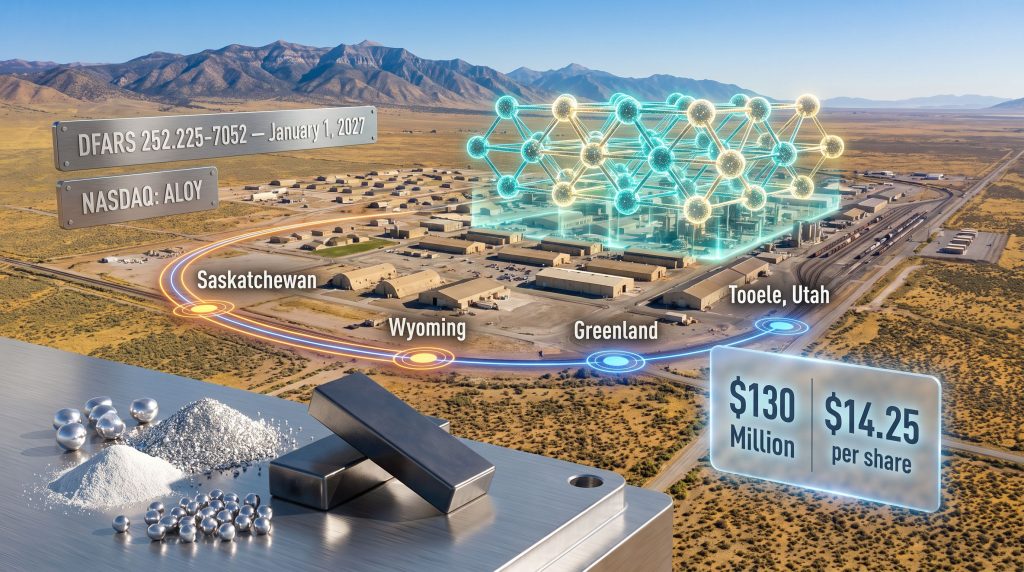
The arrangement between REalloys (NASDAQ: ALOY) and the U.S. Army at the Tooele Army Depot in Utah is genuinely without precedent. In late June 2026, the Army conditionally selected REalloys to enter exclusive negotiations for a long-term Enhanced Use Lease, under which the company would privately finance, design, construct, and operate heavy rare earth processing infrastructure within the perimeter of an active military installation.
No commercial mineral processor has previously been invited to operate inside a U.S. Army depot under this type of arrangement. The mechanism being used — the Enhanced Use Lease, or EUL — has historically been applied to base housing, utilities, and commercial services. Its extension to critical mineral infrastructure represents a meaningful evolution in how the Army thinks about its role in national supply chain security.
The EUL model carries a specific structural advantage: it enables private capital to fund and operate strategic infrastructure on federal land without drawing on taxpayer resources. REalloys bears the full project costs, while the Army gains an embedded processing capability within a secure, controlled environment.
The facility is specifically oriented around dysprosium and terbium processing, reflecting the Army's direct requirements for heavy rare earth inputs across defence platforms. A separate contract, valued at up to $1.7 million, has also been awarded to REalloys by the Defence Logistics Agency to design processing infrastructure for samarium and gadolinium, expanding the scope of defence-grade material development beyond the Tooele project.
Tooele Development Timeline at a Glance
| Milestone | Target Date |
|---|---|
| Conditional selection announced | Late June 2026 |
| Exclusive lease negotiations initiated | Mid-2026 |
| Facility development commencement | As early as 2027 |
| Initial operating capability | No later than 2028 |
| DFARS 252.225-7052 compliance deadline | January 1, 2027 |
Note: The Tooele arrangement currently remains at the conditional selection and exclusive negotiation stage. A final Enhanced Use Lease has not yet been executed, and regulatory approvals represent remaining steps before the arrangement becomes fully binding.
The January 2027 Procurement Deadline and Why Qualification Timing Is Everything
The urgency underpinning REalloys rare earth processing on U.S. Army base cannot be understood without context around DFARS 252.225-7052. Effective January 1, 2027, this Department of Defence acquisition regulation restricts the use of Chinese-origin rare earth materials in covered defence articles. Every defence contractor that currently sources magnets or magnet precursor materials from China will need to demonstrate a compliant domestic or allied-nation alternative.
What makes this deadline consequential is not simply the regulatory change itself — it is the nature of defence supply chain qualification. The process is iterative, technically demanding, and time-consuming:
- Initial material submission — High-purity oxides or alloys are submitted to defence customers for baseline testing.
- Stress and performance evaluation — Materials are tested under simulated operational conditions, including thermal cycling, mechanical stress, and electromagnetic performance assessment.
- Component integration — Qualified materials are incorporated into prototype components and evaluated within subsystem assemblies.
- Scale-up validation — Production-scale batches are verified to meet the same specifications as qualification samples.
- Programme lock-in — Once qualified, a supplier is typically embedded in defence programmes lasting 10 to 30 years.
This sequence cannot be compressed on short notice. Suppliers that begin qualification before the January 2027 deadline are consequently positioned to capture a structural, multi-decade advantage over competitors that enter the process later.
REalloys has already initiated qualification for high-purity dysprosium, terbium, and neodymium-praseodymium (NdPr) oxides, with processed material expected from its Saskatchewan Research Council partnership as early as Q4 2026. This timeline places actual defence-grade material in front of customers before the regulatory threshold takes effect — a sequencing advantage that is difficult to replicate quickly.
A Multi-Continent Feedstock Network Built Without Chinese Dependency
Processing infrastructure is only as resilient as the inputs feeding it. REalloys has constructed a feedstock network spanning multiple geographies and geological environments, reducing single-source concentration at the input stage of the supply chain.
| Feedstock Source | Geography | Material Type | Agreement Structure |
|---|---|---|---|
| Patriot Exploration & Mining | Appalachian Basin, USA | Rare earth-bearing material (~2B+ metric tonnes across 150+ sites) | Letter of Intent — up to 30% of production |
| Ramaco Resources (Brook Mine) | Wyoming, USA | Rare earth elements + scandium oxide | Non-binding MOU |
| Tanbreez Project | Greenland | Rare earth oxides | 15-year binding offtake — 15% of Phase 1 output |
| Saskatchewan Research Council | Saskatchewan, Canada | Processed rare earth oxides | Exclusive 80% offtake |
| Hoidas Lake Project | Saskatchewan, Canada | Rare earth concentrate | 100%-owned asset |
| Existing agreements | Kazakhstan and Brazil | Rare earth feedstock | Existing commercial arrangements |
Several dimensions of this network deserve closer attention.
The Appalachian Basin source is less commonly discussed in rare earth analysis. The region hosts rare earth-bearing material across more than 150 tested sites, and the scale — exceeding 2 billion metric tonnes of identified material — places it among the larger underdeveloped domestic rare earth resource bases in North America. Coal-adjacent and sedimentary-hosted rare earth deposits of this type have been studied by the U.S. Department of Energy as part of broader efforts to identify unconventional domestic sources.
Wyoming's Brook Mine, operated by Ramaco Resources, represents a different geological context: rare earth elements hosted within coal measures, alongside scandium oxide. Scandium is strategically relevant beyond rare earth magnets, as it functions as an alloy strengthener for aluminium in aerospace and defence applications — broadening REalloys' product slate at its Euclid, Ohio facility.
The Saskatchewan Research Council (SRC) is perhaps the most operationally significant element of this network. The SRC operates one of the very few functioning rare earth separation facilities in North America. REalloys holds an exclusive 80% offtake on SRC production, meaning the majority of output from an already-operational plant flows to REalloys' qualification and supply programmes. This is not a processing facility under development — it is an existing asset with demonstrated capability.
The Vertical Integration Play: From Processed Oxides to Finished Magnets
A processor that stops at separated oxides remains a materials supplier. The commercially decisive endpoint in the rare earth value chain is the permanent magnet — the component that defence contractors, automotive manufacturers, robotics companies, and aerospace integrators actually purchase and install.
REalloys' strategic letter of intent with JS Link, a South Korean permanent magnet manufacturer listed on the KOSDAQ exchange, targets the development of a fully integrated North American rare earth magnet manufacturing platform. The intended end markets include defence systems, electric vehicles, aerospace, robotics, and AI hardware infrastructure.
The value chain this architecture targets can be understood as follows:
[Multi-continent feedstock] → [SRC separation, Canada] → [Tooele HREE processing, Utah] → [Euclid alloy metallisation, Ohio] → [JS Link magnet manufacturing] → [Defence and industrial end users]
Each node in this chain is designed to operate without Chinese inputs at any stage — a supply architecture oriented around resilience rather than cost minimisation.
The next major ASX story will hit our subscribers first
Capital Position and What $130 Million Buys in This Market
Execution capacity in critical mineral infrastructure development is ultimately constrained by capital. REalloys closed a $100 million private placement with institutional investors at $14.25 per share in the days following the Tooele announcement. Combined with a $50 million public offering completed earlier in 2026, the company holds approximately $130 million in available capital.
This positions REalloys to run concurrent development workstreams without returning to equity markets in the near term:
- Euclid Facility (Ohio): Processing capacity expansion and alloy metallisation infrastructure
- Tooele Army Depot: Design, financing, and construction of HREE processing facilities
- SRC Partnership (Saskatchewan): Advancing processing operations and producing qualification material
- Defence Qualification Programme: Customer testing, material certification, and supply chain validation
The company's formal inclusion in the Russell 3000 Index, effective June 29, 2026, adds a structural dimension to its capital market positioning. Index inclusion automatically routes capital from passive funds and ETFs that track the index by mandate, creating an institutional demand baseline that does not require active investment decisions. For a company that has operated below the radar of most institutional investors, this represents a meaningful shift in visibility and shareholder base composition.
However, despite this activity, REalloys' market capitalisation remains below $600 million — a figure that some market observers consider inconsistent with the scope of its contracted relationships and capital deployment. Whether that gap closes depends on execution against the milestones outlined above, and investors should conduct their own due diligence before drawing investment conclusions.
The Broader Reshoring Landscape: Rare Earths Within a Wider Strategic Materials Agenda
REalloys' Tooele initiative sits within a larger structural shift in how Western governments approach material security. America's rare earth supply chain remains heavily exposed, and rare earth processing is one component of a domestic materials agenda that now spans lithium, uranium, specialty steel, and primary aluminium.
Morgan Stanley projects rare earth magnet demand to grow three to five times over the coming decade, driven by defence modernisation, electric vehicle adoption, robotics expansion, and AI hardware infrastructure. Furthermore, China's export restrictions on rare earth processing technology and refined materials have accelerated the urgency of this diversification considerably.
| Material | Primary Supply Risk | U.S. Domestic Capacity Status | Key Demand Driver |
|---|---|---|---|
| Heavy Rare Earths (Dy, Tb) | High — processing concentrated offshore | Nascent; Tooele model emerging | Defence magnets, EV motors |
| Lithium | Moderate — processing diversifying | Limited domestic refining | EV batteries, defence electronics |
| Uranium | Moderate — allied nation supply available | Cameco (NYSE: CCJ) key supplier | Nuclear power, naval propulsion |
| Primary Aluminium | Low-moderate | Century Aluminum (NASDAQ: CENX) active | Aerospace, defence structures |
| Flat-Rolled Steel | Low | Cleveland-Cliffs (NYSE: CLF) dominant | Military equipment, manufacturing |
What distinguishes REalloys' position within this landscape is the combination of processing access, contracted feedstock, an operational allied-nation separation facility, and a regulatory deadline that creates time pressure on every defence contractor still sourcing from China. Consequently, U.S. critical minerals policy is evolving rapidly to support exactly this kind of REalloys rare earth processing on U.S. Army base model, and the suppliers that clear the qualification threshold before January 2027 will carry a structural advantage that compounds across decades of defence programme relationships.
As OilPrice.com has noted, the Tooele arrangement represents a historic step in efforts to break China's rare earth dominance — a characterisation that reflects the broader significance of what is being attempted inside that Utah installation.
Investor Note: This article contains forward-looking statements and analysis based on publicly available information. Nothing in this article constitutes financial advice. Investors should conduct independent due diligence and consult a registered financial adviser before making any investment decisions. The Tooele Army Depot arrangement remains at the conditional negotiation stage and has not yet been finalised. All projections, including Morgan Stanley's magnet demand forecast, represent analyst estimates subject to material uncertainty.
Want to Stay Ahead of the Next Major Critical Minerals Discovery?
Discovery Alert's proprietary Discovery IQ model scans ASX announcements in real time, instantly identifying significant mineral discoveries — including those tied to the critical materials reshaping Western defence supply chains — and delivering actionable insights directly to subscribers. Explore how historic mineral discoveries have generated extraordinary returns and begin your 14-day free trial to ensure you're positioned before the broader market moves.