August 22, 2026
The Chemistry Problem That Keeps Western Nations Dependent on Foreign Rare Earth Processing
Rare earth separation is not a mining problem. It is not a geology problem. It is, at its core, a chemistry problem of extraordinary difficulty, one that has taken decades to industrialise at scale and that continues to define the strategic vulnerability sitting at the heart of Western clean energy and defence supply chains. RZOLV and Alkemio rare earth separation technology represents one of the more structurally interesting recent attempts to address this challenge from a genuinely different chemical direction.
The 17 lanthanide elements that make up the rare earth group are notoriously reluctant to separate from one another. Their electron configurations differ by only a single inner-shell electron, producing what chemists call the lanthanide contraction: a progressive, almost imperceptible decrease in ionic radius across the series that leaves adjacent elements with nearly identical chemical behaviour.
Neodymium and praseodymium, for example, two of the most commercially critical rare earths used in permanent magnets, are so chemically similar that isolating one from the other requires not a single clever reaction but rather hundreds of repetitive liquid-liquid extraction cycles in massive industrial facilities.
This is the technical reality that underpins China's dominance in rare earth processing. The country did not simply inherit geological advantage; it built, over roughly four decades, the process engineering expertise, reagent supply infrastructure, and scaled operational knowledge to run those hundreds of extraction stages economically.
Western nations, despite holding significant rare earth mineralisation, largely ceded this middle stage of the value chain during the 1990s and 2000s, a decision whose consequences are now visible in the sourcing dependencies embedded across electric vehicle manufacturing, wind energy deployment, and precision defence hardware. Understanding China's rare earth strategy helps explain why reversing this dependency has proved so difficult.
Against this backdrop, the RZOLV and Alkemio rare earth separation technology partnership announced in mid-2026 represents an early-stage attempt to approach the separation problem from a fundamentally different chemical direction.
When big ASX news breaks, our subscribers know first
Why Conventional Separation Creates Such High Barriers to Entry
Understanding why the RZOLV and Alkemio rare earth separation technology collaboration attracts attention requires first appreciating why conventional rare earth separation is so difficult to replicate outside established processing centres.
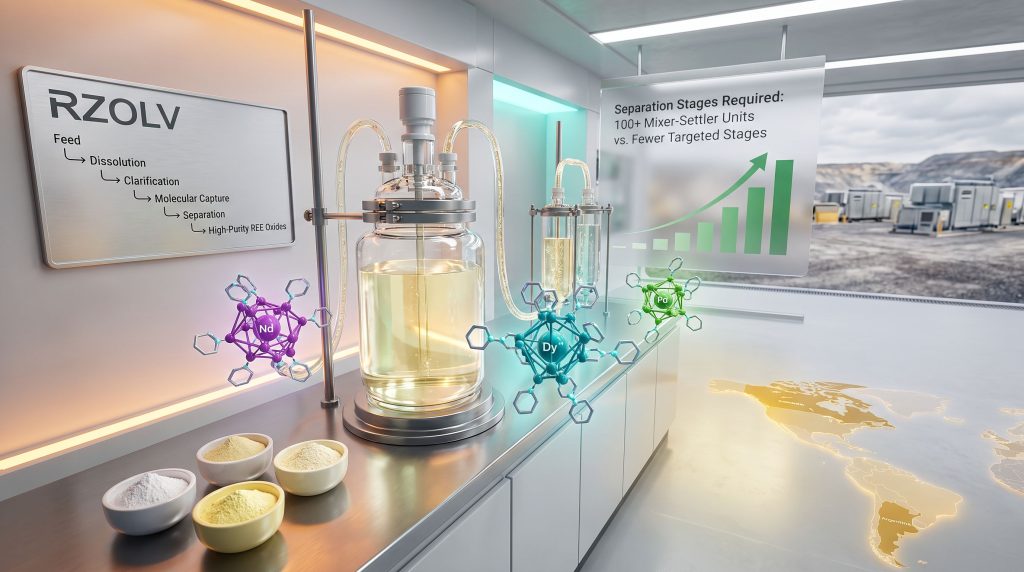
The dominant industrial method, solvent extraction (SX), works by repeatedly cycling a rare-earth-bearing aqueous solution against organic solvent streams, exploiting tiny differences in how individual lanthanide ions partition between the two liquid phases. Because those differences are so small, achieving the 99%+ purity levels demanded by magnet-grade applications requires running the process through sequences that can exceed 100 mixer-settler units in a single facility.
The rare earth processing challenges associated with this chemistry are severe:
- Purpose-built SX facilities require very high capital investment before producing a single kilogram of separated product
- The organic solvents used, compounds such as D2EHPA and PC88A, generate complex waste streams requiring specialised management
- Process optimisation is feedstock-specific, meaning a facility tuned for one ore type may require significant reconfiguration for another
- Minimum economically viable scale is large, making it difficult to build separation capacity in proportion to individual mining projects
The result is a processing architecture that rewards centralisation, long operational experience, and very large capital bases — precisely the conditions that made it rational for Western producers to ship concentrate to established processors rather than build competing domestic capacity.
| Parameter | Conventional Solvent Extraction | Emerging Modular Technologies |
|---|---|---|
| Facility footprint | Large, centralised | Compact, distributed |
| Chemical reagent intensity | High (organic solvents) | Potentially lower |
| Capital expenditure | Very high | Projected lower (lab-stage) |
| Separation stages required | 100+ mixer-settler units | Fewer targeted stages |
| Commercial maturity | Proven at scale | Early-stage / pre-commercial |
Analyst Note: Emerging separation platforms currently operate at laboratory or pilot scale. Performance claims should be interpreted as projected targets pending commercial validation, not proven industrial benchmarks.
What RZOLV Technology Actually Does and Why the REE Application Is Significant
A Hydrometallurgical Platform Built for Clean Metal Dissolution
RZOLV Technologies Inc., based in Canada, has developed a water-based hydrometallurgical reagent system designed to dissolve and mobilise metals from complex feedstocks under comparatively mild processing conditions. The platform was originally engineered as a cyanide-free alternative for gold leaching, addressing both the toxicological risks and the social licence challenges that cyanide use creates across diverse mining jurisdictions.
The core design philosophy centres on generating what metallurgists call a pregnant liquor: a stable, metal-bearing aqueous solution that carries target elements in dissolved form, ready for downstream recovery operations. What distinguishes RZOLV's approach is the reagent system's claimed adaptability — its capacity to unlock different metal species without requiring a complete reformulation of the base chemistry each time a new target element is introduced.
This adaptability is what opened the door to rare earth applications. Preliminary testing using RZOLV's standard, unoptimised gold-leaching formulation demonstrated measurable dissolution of rare earth elements and associated critical minerals into solution. The significance of that result lies in what was not done: the formula was not specifically engineered for REEs, yet it still mobilised them. According to testing of RZOLV for rare earth recoveries, the company has identified a development pathway to tune the reagent specifically for rare earth mobilisation, suggesting that optimised performance could meaningfully exceed what the preliminary tests demonstrated.
Where RZOLV Sits in a Complete Processing Flowsheet
It is important to understand what RZOLV does and does not do in the context of rare earth processing. The technology addresses the leaching and dissolution stage, not the separation stage. In a complete flowsheet, RZOLV would function as follows:
- Feed preparation and mineralogical characterisation of REE-bearing material (ore concentrates, tailings, or secondary sources)
- RZOLV leaching: target rare earths mobilised from solid feedstock into stable aqueous solution
- Solution clarification to remove gangue solids before downstream processing
- Transfer of the pregnant liquor to a selective separation and recovery stage
The technology does not, on its own, separate individual lanthanides from one another. That is precisely why the partnership with Alkemio is structurally logical.
Alkemio's Molecular Recognition Platform: Selective Separation from a Different Chemical Principle
How Ligand-Based Ion Capture Works
Alkemio Bioscience Corp., operating out of Argentina, is developing a rare earth refining and separation platform grounded in molecular recognition principles. Rather than cycling mixed-element solutions through hundreds of solvent extraction stages, Alkemio's approach uses purpose-engineered molecular ligands that bind selectively to specific rare earth ions within a complex solution.
The mechanism draws on coordination chemistry and biomimetic molecular design. Each ligand is structured to preferentially interact with a target ion's specific charge density, coordination geometry, and hydration shell characteristics — functioning analogously to a biological receptor that distinguishes between chemically similar molecules based on precise structural fit.
In the context of lanthanide separation, where ionic radii differences between adjacent elements can be as small as 0.01 to 0.02 angstroms, the precision required of these ligands is considerable. This is not a trivial chemistry problem, and the fact that Alkemio has demonstrated measurable selectivity at laboratory scale is noteworthy, even if commercial-scale validation remains distant.
What the 87% Recovery Figure Actually Means
In controlled laboratory conditions, Alkemio's platform has demonstrated the ability to recover up to 87% of rare earths from solution. However, before interpreting this number, several pieces of critical context are essential:
- The 87% figure reflects aggregate REE recovery, not necessarily individual element separation at high purity
- Laboratory conditions allow precise control of impurity profiles, pH, temperature, and ionic concentrations that real-world feedstocks will not replicate
- Scale-up from laboratory to pilot to commercial throughput consistently introduces recovery losses across virtually every hydrometallurgical technology
- Whether the system can consistently achieve the 99%+ purity thresholds required for NdFeB magnet-grade separated oxides has not been publicly demonstrated
Performance Caveat: All recovery efficiency claims, including the 87% figure, reflect preliminary laboratory results under controlled conditions. These should not be interpreted as guaranteed commercial performance metrics or as validated industrial benchmarks.
Alkemio's Role in the Integrated Flowsheet
Picking up where RZOLV's leaching stage ends, Alkemio's molecular recognition platform would handle the selective capture and separation of individual lanthanide streams:
- Selective ligand capture: engineered molecules bind target REE ions from the RZOLV-generated solution
- Ion exchange or selective elution to release and collect individual lanthanide streams
- Refining and product upgrading toward high-purity separated REE compounds
- Optional calcination or oxide production depending on end-product specification
The LOI Signed in July 2026: What It Commits To and What It Does Not
Understanding the Legal and Commercial Weight of an LOI
On July 15, 2026, RZOLV Technologies and Alkemio Bioscience formalised their exploratory relationship through a non-binding Letter of Intent. The distinction between an LOI and a binding commercial agreement matters significantly for anyone evaluating the partnership's current status.
An LOI establishes a structured framework for investigation. It commits both parties to conduct defined testing and review activities. It does not constitute a joint venture, a confirmed technology integration, a commercial contract, or a guarantee of any future collaboration. Either party can withdraw without commercial consequence if testing results are unsatisfactory.
The LOI framework proceeds through a conditional sequence:
- Initial integration testing to assess chemical compatibility between RZOLV's leach output and Alkemio's molecular recognition inputs
- Results review to determine whether separation quality and purity are relevant to end-use applications
- Feedstock identification: optimal material types for the combined platform, potentially including ore concentrates, mine tailings, and secondary or recycled REE sources
- Modular scalability assessment: whether the combined system can be configured for project-specific deployment
Details of this collaboration were reported across multiple industry sources at the time of announcement, highlighting broader interest in the platform's potential.
The Path Forward If Testing Yields Positive Results
Both companies have indicated that favourable integration results would trigger advancement toward a more enduring commercial structure. The intended progression includes:
- Replacement of the LOI with an expanded joint development agreement
- Project-specific pilot programmes using real-world feedstocks
- Licensing arrangements for third-party operators seeking access to the integrated platform
- Commercial deployment at qualifying REE processing sites
The timeline for reaching any of these milestones is not publicly defined and is contingent on sequential technical outcomes that have not yet been achieved.
Why an Integrated Leach-and-Separate Platform Matters Strategically
The Processing Gap Western Nations Have Not Solved
The rare earth supply chains powering clean energy have three structurally distinct vulnerability points: mining, separation, and downstream manufacturing of magnets and alloys. Western nations have concentrated their recent policy and investment attention largely on mining, with separation receiving considerably less capital commitment despite being the stage where the most significant processing dependency actually resides.
Current Western separation capacity is limited in global terms. The United States, Canada, and Australia collectively process only a fraction of global REE output at the separation stage. MP Materials' Mountain Pass facility in California represents the most advanced Western separation operation in North America, yet even that project has faced commercial challenges in scaling its separation circuit to full capacity.
A modular, integrated leach-and-separate platform addresses a specific structural gap: the inability to process REE concentrates at or near mine sites without shipping complex mixed-element materials to centralised, often offshore, processing infrastructure. The strategic and logistical advantages of mine-site or near-site processing include:
- Reduced concentrate transport risk and cost
- Greater supply chain transparency and auditability
- Faster iteration on feedstock-specific process optimisation
- Distributed capacity growth aligned with new project development timelines
Furthermore, America's rare earth supply chain faces precisely these structural barriers in attempting to build meaningful domestic separation capacity.
Where High-Purity Separated REEs Are Non-Negotiable
The downstream applications driving demand for the RZOLV and Alkemio rare earth separation technology concept require individual lanthanides at very high purity levels. The critical end-use categories include:
| Application | Key REEs Required | Purity Threshold |
|---|---|---|
| EV traction motors (NdFeB magnets) | Nd, Pr, Dy, Tb | 99%+ individual oxides |
| Wind turbine generators | Nd, Pr, Dy | 99%+ individual oxides |
| Defence guidance and radar systems | Dy, Tb, Er, Eu | Application-specific, very high |
| Industrial and humanoid robotics | Nd, Pr | 99%+ individual oxides |
| Advanced communications hardware | Eu, Tb, Y | 99%+ individual oxides |
Each of these applications depends not on total rare earth content but on the purity of individual separated elements. A concentrate containing 60% total rare earth oxides is commercially worthless for magnet manufacturing unless those oxides can be resolved into their individual components at sufficient purity.
The next major ASX story will hit our subscribers first
How the Combined Platform Compares to Other Emerging Separation Approaches
The Competitive Landscape for Non-Conventional REE Separation
Several technology pathways are being explored globally as alternatives to conventional SX-based rare earth separation. Each carries its own technical profile and commercial maturity level:
- Ion exchange resins: established in niche applications but face throughput limitations at commercial scale
- Selective precipitation: lower capital intensity but achieving consistent high purity across the full lanthanide series remains technically demanding
- Membrane separation: an active research area, not yet commercially deployed for REE separation at meaningful scale
- Bioleaching and biomining: early-stage, with potential for low-impact processing of low-grade or secondary feedstocks, but very slow kinetics
- Molecular recognition and selective ligand platforms: the category in which Alkemio operates, representing an emerging approach with genuine selectivity potential but pre-commercial maturity
In addition, ongoing rare earth metals exploration is expanding the range of feedstock types that any viable separation technology will need to accommodate.
What Makes the Two-Stage RZOLV-Alkemio Concept Structurally Distinct
Most competing technology development efforts address a single processing stage, either improving how metals are dissolved from solids or improving how dissolved metals are separated from one another. The proposed RZOLV-Alkemio integration is notable because it seeks to address both stages simultaneously within a unified modular workflow.
The cyanide-free character of RZOLV's leaching chemistry also adds a practically important dimension. Environmental permitting for rare earth processing facilities is a genuine commercial obstacle in many Western jurisdictions. A processing platform that avoids cyanide and potentially reduces organic solvent loading could face a smoother regulatory pathway than conventional alternatives, though this advantage remains theoretical until the integrated system is tested and evaluated by regulators.
Key Risk Factors for Industry Observers and Investors to Understand
Technical Risks at the Current Development Stage
The RZOLV and Alkemio rare earth separation technology partnership carries several substantial technical risks that have not yet been resolved:
- Chemical compatibility uncertainty: RZOLV's leach solution will contain a complex mixture of dissolved species, including gangue elements, pH-altering compounds, and the reagent system itself. Whether Alkemio's molecular ligands retain their selectivity in this specific chemical environment has not been tested
- Scale-up performance degradation: the 87% laboratory recovery figure is likely an optimistic ceiling rather than a commercial floor. Hydrodynamic effects, impurity accumulation, and ligand degradation at higher throughputs are well-documented challenges in hydrometallurgical scale-up
- Feedstock variability: REE-bearing ores differ dramatically in mineralogy. A system optimised for a monazite-hosted deposit will perform differently on a bastnäsite or ion-adsorption clay feedstock
- Purity gap: whether the combined platform can consistently achieve magnet-grade purity specifications remains entirely unvalidated
Commercial and Strategic Risk Factors
Beyond the technical unknowns, however, several commercial considerations warrant clear-eyed assessment:
- The LOI is non-binding; either party can withdraw without consequence
- Neither company has demonstrated the integrated platform at any scale beyond the individual technologies' separate laboratory results
- No public timeline for reaching pilot-scale demonstration has been provided
- Licensing and deployment economics have not been publicly detailed
- Both companies are early-stage, and the combined platform's capital requirement profile is undefined
Disclaimer: This article contains forward-looking analysis and references to early-stage technologies. Nothing in this article constitutes financial or investment advice. Readers should conduct independent due diligence before making any investment decisions related to companies or technologies discussed herein.
Frequently Asked Questions: RZOLV and Alkemio Rare Earth Separation Technology
What is RZOLV's technology and how does it relate to rare earths?
RZOLV Technologies has developed a water-based, cyanide-free hydrometallurgical reagent system originally designed for gold leaching. Preliminary testing using the unoptimised gold-leaching formulation showed measurable dissolution of rare earth elements into solution, prompting the company to investigate an REE-specific optimised version of the reagent.
What is Alkemio's molecular recognition technology?
Alkemio Bioscience is developing a modular separation platform that uses engineered molecular ligands to selectively capture specific rare earth ions from a dissolved solution. In controlled laboratory conditions, the platform has demonstrated recovery of up to 87% of rare earths from solution.
What does the July 2026 LOI actually commit both companies to?
The non-binding Letter of Intent commits RZOLV and Alkemio to evaluate whether their technologies can be integrated into a single modular platform. It does not constitute a joint venture or commercial agreement. If initial testing produces positive results, the parties intend to advance toward a joint development agreement, pilot programmes, and potential licensing arrangements.
Is the combined platform commercially available?
No. Both technologies remain in pre-commercial development. The LOI represents the beginning of an integration evaluation process, and commercial deployment is contingent on multiple sequential technical milestones that have not yet been achieved.
Why does rare earth separation matter so much for clean energy and defence?
Applications including EV traction motors, wind turbine generators, precision defence systems, and advanced robotics all depend on individual rare earth elements separated to very high purity. Without domestic or allied separation capacity, these supply chains remain structurally dependent on offshore processing infrastructure concentrated in a single country.
What would successful integration of these two technologies mean for Western REE supply chains?
If the combined platform achieves its technical targets and scales successfully, it could enable modular, mine-site or near-site REE processing in North America and allied jurisdictions, reducing the need to export complex concentrates for separation. That outcome, however, remains years away and dependent on multiple unresolved technical and commercial questions.
Want to Know Which ASX-Listed Critical Minerals Companies Are Making Significant Discoveries Right Now?
Discovery Alert's proprietary Discovery IQ model delivers real-time alerts on significant ASX mineral discoveries — including rare earth and critical minerals plays — instantly translating complex data into actionable insights for investors at every experience level. Explore historic examples of exceptional discovery outcomes and begin your 14-day free trial today at Discovery Alert to position yourself ahead of the broader market.