August 21, 2026
The Qualification Gate That Separates Producers From Supply Chain Participants
The rare earth sector contains one of the most misunderstood commercial barriers in all of materials science. Unlike bulk commodities such as copper or iron ore, where London Metal Exchange pricing and standardised grades create a relatively transparent market, rare earth oxides operate under a fundamentally different commercial logic. A producer can successfully mine, crack, and separate a heavy rare earth oxide to exceptional purity levels, yet remain entirely locked out of revenue-generating supply relationships until a downstream manufacturer formally validates that material against its own proprietary production tolerances.
This qualification gate is not a formality. It is the defining threshold between a rare earth producer and a functioning commercial supply chain. And for heavy rare earth elements like terbium, where downstream manufacturers apply some of the most exacting acceptance criteria in advanced materials science, crossing that threshold is an achievement that has eluded Western producers for decades.
The Energy Fuels terbium oxide qualification by a Japan rare earth magnet maker represents precisely this kind of inflection point, one that is worth examining not just as a corporate milestone, but as a structural development in the architecture of Western rare earth supply chains and supply chain independence.
When big ASX news breaks, our subscribers know first
Why Terbium Is the Most Demanding Heavy Rare Earth to Qualify
The Chemistry Behind the Commercial Barrier
Terbium sits within the heavy rare earth element (HREE) subgroup, a classification that immediately distinguishes it from higher-volume light rare earths like neodymium and praseodymium. Its primary function in commercial applications is as a performance-enhancing dopant in neodymium-iron-boron (NdFeB) permanent magnets, the magnet class that powers electric vehicle drive motors, aerospace actuators, precision robotics, and high-specification defence systems.
The physics of why terbium matters are specific. Standard NdFeB magnets begin experiencing accelerated demagnetisation above approximately 80 degrees Celsius. In the operating environments of EV motors or aerospace actuators, temperatures regularly exceed this threshold. Terbium, when incorporated into the magnet alloy, extends the material's thermal stability, preserving field strength across a significantly wider temperature range. Without terbium (or its HREE peer dysprosium) as a stabilising agent, next-generation high-performance magnets simply cannot meet the technical requirements of the applications they are intended to serve.
What makes terbium uniquely difficult to qualify is not merely its rarity. It is the convergence of three compounding factors:
- Lower natural abundance relative to neodymium and dysprosium, creating a smaller global pool of producers capable of generating commercially relevant volumes
- Tighter purity acceptance windows applied by magnet manufacturers, given terbium's sensitising effect on magnet grain boundary chemistry
- Greater geographic concentration of processing capacity, historically overwhelmingly centred in China, which means the pool of qualified Western suppliers has been vanishingly small
What Qualification Actually Involves: The Hidden Complexity
One of the least understood aspects of rare earth supply chains is the gap between mining-grade specifications and magnet-grade qualifications. Producing terbium oxide that meets assay purity thresholds is a necessary condition for commercial relevance, but it is not a sufficient one.
Permanent magnet manufacturers assess incoming rare earth oxide materials against a multi-dimensional specification matrix. Furthermore, this matrix typically includes:
- Total rare earth oxide purity (TREO) and the concentration of the target element within that fraction
- Particle size distribution across the oxide powder, which directly affects alloy homogeneity during sintering
- Trace contaminant profiles, with particular sensitivity to elements such as iron, silicon, calcium, and thorium, which can disrupt grain boundary microstructure
- Batch-to-batch consistency, evaluated across multiple production runs to confirm that a supplier can maintain specification adherence at commercial scale
A single off-specification batch entering a magnet production run does not merely produce sub-standard output. It can contaminate an entire sintering furnace load, creating both material waste and significant liability exposure for the manufacturer. This is why qualification timelines in the rare earth permanent magnet industry commonly span 12 to 36 months across multiple trial production cycles, even for materials that arrive at technically impressive initial purity levels.
| Qualification Parameter | Why It Matters |
|---|---|
| TREO purity and Tb fraction | Determines magnet performance ceiling |
| Particle size distribution | Affects alloy homogeneity during sintering |
| Trace contaminant profile | Disrupts grain boundary microstructure if off-spec |
| Batch-to-batch consistency | Confirms commercial-scale reliability |
| Typical qualification timeline | 12 to 36 months across trial production cycles |
Terbium Oxide at $5.5 Million Per Tonne: Understanding the Price Architecture
Why Heavy Rare Earths Command Such Extreme Valuations
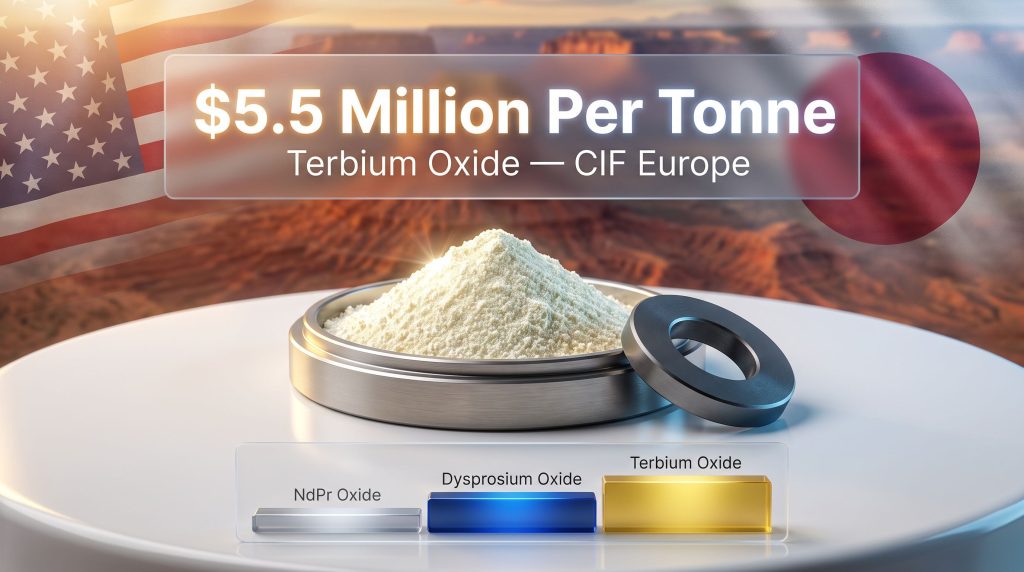
Terbium oxide currently commands approximately $5.5 million per tonne CIF Europe, according to Benchmark Mineral Intelligence pricing data. This price level reflects a confluence of supply-side constraints that are structural rather than cyclical.
Global terbium production is measured in hundreds of tonnes annually, not thousands, making it one of the most volume-constrained examples of critical minerals demand in industrial use. China accounts for the overwhelming majority of global HREE separation capacity, with the processing infrastructure for terbium and dysprosium particularly concentrated within specific Chinese industrial zones. This geographic concentration means that any disruption to Chinese export flows — whether through China's export restrictions, logistics bottlenecks, or geopolitical escalation — creates immediate price sensitivity in Western consuming markets.
For context on where terbium sits within the broader rare earth pricing landscape:
| Rare Earth Oxide | Approximate Price Range (CIF Europe) | Classification |
|---|---|---|
| Terbium oxide (Tb4O7) | ~$5.5 million/tonne | Heavy REE |
| Dysprosium oxide (Dy2O3) | ~$2.0–$2.5 million/tonne | Heavy REE |
| Neodymium-praseodymium oxide | ~$50,000–$80,000/tonne | Light REE |
| Lanthanum oxide | ~$1,000–$2,000/tonne | Light REE |
Note: Rare earth oxide prices are highly volatile and the figures above are approximate reference points. Investors should consult current market data before making any investment decisions.
The price differential between terbium and light rare earths like neodymium-praseodymium reflects both scarcity and processing complexity. Terbium's separation from heavy rare earth concentrate streams requires solvent extraction chemistry that is more operationally demanding than the separation of light rare earth fractions, consequently adding cost layers at every stage of the production chain.
The White Mesa Mill: A Processing Asset With Structural Advantages
Why Existing Infrastructure Changes the Economics of HREE Separation
Energy Fuels Inc. (NYSE American: UUUU | TSX: EFR) has developed its rare earth oxide separation capabilities at the White Mesa Mill in Utah, the only fully licensed and conventionally operating uranium processing facility in the United States. This infrastructure context is commercially significant in ways that are not immediately obvious.
Rare earth separation at commercial scale requires hydrometallurgical infrastructure, solvent extraction circuits, and the regulatory authorisations to handle radioactive co-occurring minerals — particularly thorium and uranium — which naturally accompany monazite-based rare earth feedstocks. Greenfield rare earth processing facilities must build all of this from scratch, navigating both capital expenditure requirements and extended regulatory approval timelines.
The White Mesa Mill's pre-existing hydrometallurgical circuits and its established regulatory framework under the Nuclear Regulatory Commission have allowed Energy Fuels to develop rare earth separation capabilities through circuit adaptation rather than ground-up construction. This is a capital-efficiency advantage that is structurally difficult for greenfield competitors to replicate on a comparable timeline. The broader Energy Fuels strategy reflects this infrastructure-first approach to building Western HREE processing capability.
The Three-Stream Qualification Progression
The Energy Fuels terbium oxide qualification by Japan's rare earth magnet maker represents the third distinct commercial-grade qualification achieved by the White Mesa Mill across its rare earth oxide production portfolio. The sequential nature of these qualifications reflects an escalating technical achievement:
- Neodymium-praseodymium (NdPr) oxide — First qualification achieved; the highest-volume input for NdFeB magnet production; light rare earth fraction
- Dysprosium oxide — Second qualification; heavy rare earth; thermal stability co-enhancer alongside terbium
- Terbium oxide — Third qualification; heavy rare earth; highest per-tonne price point; confirmed by a leading Japan-based manufacturer as of August 2026
Each step in this progression required engagement with progressively more demanding downstream validation processes. Terbium qualification, given its tighter purity tolerances and the smaller global pool of qualifying manufacturers capable of assessing it, represents the most technically significant of the three.
What a Japanese Manufacturer Endorsement Actually Signals
The Commercial Weight of Japanese Quality Standards
Japan occupies a distinctive position in the global rare earth permanent magnet manufacturing landscape. Japanese manufacturers, operating outside China's dominant production ecosystem, have historically applied some of the most technically rigorous material acceptance criteria in the industry. Their qualification programmes are designed to protect production processes where a single contaminant in the feedstock can propagate through an entire sintering batch.
A formal qualification from a manufacturer described as one of the world's largest rare earth permanent magnet producers outside China carries disproportionate commercial credibility. It functions as a proxy signal for product quality at the highest commercial standard currently accessible to Western rare earth producers. This milestone also underscores the broader rare earth geopolitical impact of establishing validated non-Chinese supply sources.
What Qualification Confirms and What It Does Not
Investors and analysts should apply a careful distinction when interpreting qualification announcements in the rare earth sector. Qualification approval is a technical gate clearance, not a commercial commitment.
| Qualification Outcome | Status |
|---|---|
| Material meets manufacturer's technical specifications | Confirmed |
| Approved for commercial magnet production use | Confirmed |
| No further validation or testing required | Confirmed |
| Binding purchase agreement in place | Not disclosed |
| Volume commitments confirmed | Not disclosed |
| Pricing terms agreed | Not disclosed |
The commercial relationship between a qualified supplier and a magnet manufacturer moves from technical approval into procurement negotiation as a separate subsequent process. These negotiations involve volume, pricing, logistics, and supply security provisions that are governed by confidentiality agreements and are rarely disclosed publicly in the rare earth sector. The non-disclosure of the qualifying manufacturer's identity is consistent with standard commercial confidentiality practice in this industry, particularly given the geopolitical sensitivity surrounding rare earth supply chain realignment between China and Western-aligned consuming nations.
Energy Fuels' Vertical Integration Architecture: Three Nodes, One Strategy
From Mine to Magnet: The Supply Chain Framework
Energy Fuels has articulated a strategic objective of establishing a vertically integrated rare earth permanent magnet supply chain spanning extraction, oxide separation, metallisation, alloy production, and finished magnet manufacturing. The terbium oxide qualification slots into the second node of this three-node architecture:
Node 1: Raw Material Extraction
Heavy mineral sands projects supply monazite feedstock to the White Mesa Mill. Energy Fuels' project portfolio across three continents is designed to underpin this feedstock position:
- Varda Mada Project, Madagascar (100% owned)
- Bahia Project, Brazil (100% owned)
- Donald Project, Australia (up to 49% JV interest with Astron Limited)
Node 2: Rare Earth Oxide Separation (White Mesa Mill)
Currently producing commercially qualified NdPr, dysprosium, and terbium oxide streams. The heavy rare earth oxide expansion circuit, targeting terbium and dysprosium production at expanded commercial scale, is under active construction with commissioning targeted by the end of 2027.
Node 3: Magnet Manufacturing (Pending Acquisitions)
- Australian Strategic Materials Limited (ASM): Acquisition targeted to close August 28, 2026, adding metallisation and alloy production capabilities to the integrated chain
- Vacuumschmelze GmbH & Co. KG (VAC): Subject to regulatory approvals, with closing targeted for early 2027, adding rare earth permanent magnet manufacturing capacity in Europe
If both acquisitions complete on schedule, the combination would create a mine-to-magnet supply chain architecture with the White Mesa Mill's now-qualified terbium and dysprosium oxide streams serving as validated inputs for the downstream manufacturing assets being brought into the corporate structure.
The next major ASX story will hit our subscribers first
End-Market Demand Dynamics Sustaining HREE Strategic Relevance
Where Terbium-Dependent Applications Are Growing
The end markets that drive terbium demand are not cyclical commodity consumers. They are, however, structurally growing application categories where the performance requirements of the underlying technology are rising alongside adoption volumes:
| End Market | HREE Dependency Level | Demand Trajectory |
|---|---|---|
| Electric vehicle drive motors | High — thermal stability critical | Strong, underpinned by global EV adoption targets |
| Advanced robotics and automation | High — precision actuator performance | Accelerating with industrial automation buildout |
| Aerospace and defence systems | Critical — high-temperature operating environments | Structurally supported by sustained defence spending growth |
| Direct-drive wind turbine generators | Moderate to high | Growing with offshore wind expansion |
| Consumer and industrial electronics | Moderate | Steady, driven by miniaturisation trends |
A factor that receives limited attention in mainstream coverage is the grade intensity effect within EV motor design. As manufacturers pursue higher power density in next-generation motors, the thermal load on the permanent magnet assembly increases. This trend is pushing motor designers toward higher terbium and dysprosium loading per unit of magnet mass, meaning demand per vehicle is rising even as efficiency improvements continue. Consequently, this creates a demand dynamic where volume growth in EV production understates the growth in HREE demand. Industry observers note that this intensity effect is among the least-discussed structural drivers in the rare earth market.
The 2026–2027 Execution Calendar: Key Milestones and Risk Factors
Near-Term Catalysts
- August 28, 2026 (targeted): ASM acquisition scheme implementation, adding metallisation capability to the supply chain
- End of 2027 (targeted): White Mesa Mill heavy rare earth oxide expansion circuit commissioning for terbium and dysprosium production
- Early 2027 (targeted): VAC acquisition closing, subject to regulatory approvals, adding European magnet manufacturing capacity
Execution Risks Investors Should Monitor
The milestone calendar carries real execution uncertainty that warrants careful assessment:
- Regulatory approval timelines for the VAC acquisition in Europe may extend beyond early 2027 targets, given the complexity of competition and foreign investment review processes in the European manufacturing sector
- The heavy rare earth oxide expansion circuit at White Mesa Mill carries construction execution and ramp-up risk, including potential timeline slippage in a facility operating simultaneously as a uranium processing plant
- Qualification approval does not guarantee procurement volumes; commercial offtake negotiations remain a separate and as-yet unconfirmed process
- Terbium oxide at approximately $5.5 million per tonne creates significant revenue sensitivity to price movements; the pricing environment for HREEs can shift materially in response to Chinese export policy changes
This article contains forward-looking statements and scenario analysis. Nothing herein constitutes financial or investment advice. Past performance of any mineral commodity or company is not indicative of future results. Investors should conduct their own due diligence and consult a licensed financial adviser before making investment decisions.
Frequently Asked Questions
What is terbium oxide used for in permanent magnets?
Terbium oxide is refined into metallic terbium and incorporated into NdFeB magnet alloys to extend their operating temperature range. Without terbium or dysprosium doping, high-performance magnets experience demagnetisation at temperatures above approximately 80 degrees Celsius, making them unsuitable for demanding applications including EV drive motors, defence electronics, and aerospace actuators.
Why do rare earth oxide qualifications take so long?
Magnet manufacturers require incoming rare earth oxide to meet highly specific parameters across purity, particle size, trace contaminant profile, and batch-to-batch consistency. Qualification programmes involve trial production runs, magnet performance evaluation across multiple operational conditions, and extended assessment periods before commercial approval is granted. The process commonly spans one to three years, even for technically high-quality feedstock.
Does terbium oxide qualification mean Energy Fuels has a confirmed sales contract?
No. Qualification confirms that the material meets a manufacturer's technical specifications for commercial production use. No binding purchase agreement, volume commitment, or pricing arrangement has been publicly disclosed in connection with this qualification event.
How concentrated is global terbium supply?
Terbium is produced in far smaller volumes than light rare earths, with global annual output measured in hundreds of tonnes. China accounts for the large majority of global heavy rare earth processing capacity, making terbium one of the most geographically concentrated critical minerals in commercial use. Western-qualified production sources remain extremely limited, which is precisely what makes supply chain qualification milestones from non-Chinese producers commercially significant.
Reframing the Qualification: A Supply Chain Architecture Event
The most analytically useful way to interpret the Energy Fuels terbium oxide qualification by the Japan rare earth magnet maker is not as a product announcement in isolation, but as a supply chain architecture validation with implications that extend well beyond any single commercial relationship.
Three distinct rare earth oxide streams, spanning from light to heavy rare earth categories, now carry commercial-grade qualifications from downstream magnet manufacturers. This transforms the White Mesa Mill from a processing facility with rare earth ambitions into a validated Western supply node with documented downstream acceptance across the full spectrum of magnet-relevant oxide types.
The pending acquisitions of ASM and VAC, if completed on the disclosed timelines, would extend this validated supply node into metallisation and magnet manufacturing, creating an integrated architecture that addresses one of the most structurally exposed vulnerabilities in Western advanced technology production. Whether that architecture generates binding commercial volumes at competitive pricing and sustains operational execution across three continents is the question that the 2026 to 2027 milestone calendar will begin to answer.
For additional context on the rare earth permanent magnet supply chain and the strategic dynamics of heavy rare earth elements in advanced technology manufacturing, institutional-grade coverage of Energy Fuels and related critical minerals producers is available at Crux Investor.
Want to Position Yourself Ahead of the Next Major Critical Minerals Discovery?
Discovery Alert's proprietary Discovery IQ model scans ASX announcements in real time, instantly identifying significant mineral discoveries across rare earths, critical minerals, and beyond — transforming complex data into actionable investment insights before the broader market reacts. Explore historic examples of exceptional discovery returns and begin your 14-day free trial today to secure a market-leading advantage.