July 29, 2026
The Geology That Changes the Economics: Why Ionic Clay Deposits Are Reshaping Rare Earth Investment
Not all rare earth deposits are created equal. The geology of how rare earth elements (REEs) are hosted within a rock formation determines almost everything that follows: extraction complexity, processing costs, environmental footprint, capital requirements, and ultimately, the economics of bringing a project into production. This fundamental geological distinction sits at the heart of understanding why IMC Rare Earths and its IMC Rare Earths $20M IPO on NYSE have attracted meaningful capital markets attention at a pivotal moment for the global critical minerals sector.
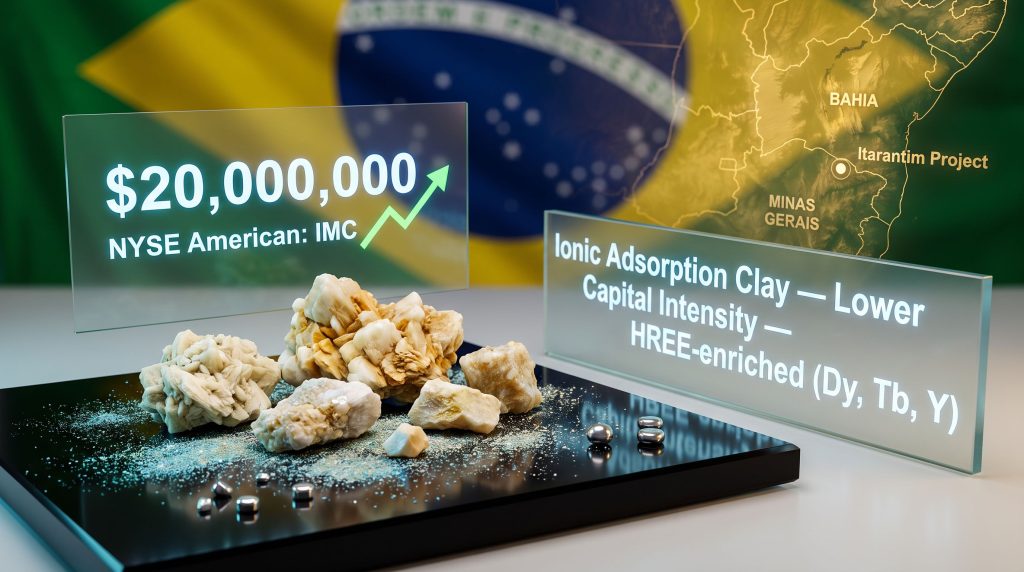
Ionic adsorption clay deposits, the deposit type anchoring IMC Rare Earths' flagship Itarantim Project in Brazil, occupy a unique and strategically valuable position within the rare earth universe. Unlike hard-rock carbonatite deposits or monazite-bearing mineral sands, ionic clay deposits host rare earth elements adsorbed onto clay mineral surfaces rather than locked within crystalline lattice structures. This distinction is not merely academic. It translates directly into the ability to extract REEs using relatively low-energy, solution-based methods, which keeps capital intensity substantially lower than conventional rare earth mining approaches.
The timing of the IMC Rare Earths NYSE IPO is worth examining carefully, not just as a company-specific event, but as a signal of where institutional and retail capital is flowing within the critical minerals demand space in 2026.
When big ASX news breaks, our subscribers know first
Understanding the Itarantim Project: Deposit Type, Geography, and Strategic Significance
The Itarantim Project spans the Brazilian states of Bahia and Minas Gerais, two regions with deep mining histories and established regulatory frameworks for resource extraction. The project is classified as an ionic adsorption clay rare earth deposit, a deposit type that has historically been dominated by southern Chinese provinces, particularly Jiangxi, Fujian, and Guangdong. The China rare earth strategy of maintaining near-monopoly control over this specific deposit type for decades has created a structural supply vulnerability that Western governments and industries have been attempting to address through exploration initiatives outside Chinese jurisdiction.
What makes ionic adsorption clay deposits particularly attractive from an investment standpoint is their typical enrichment in heavy rare earth elements (HREEs), including dysprosium, terbium, holmium, and yttrium. These elements command significant price premiums over light rare earths (LREEs) such as cerium, lanthanum, and neodymium, primarily because of their critical role in high-performance permanent magnets, phosphors, and specialty alloys. The supply base for HREEs outside China remains extremely thin, which creates persistent pricing tension in global markets.
"Dysprosium and terbium, two HREEs commonly associated with ionic clay systems, are essential additives in neodymium-iron-boron (NdFeB) permanent magnets. These magnets are used in electric vehicle traction motors and direct-drive wind turbines, applications where demand growth projections remain robust through the 2030s."
The processing pathway for ionic clay deposits typically involves in-situ or heap-leach extraction using ammonium sulphate or other lixiviant solutions to desorb REEs from clay surfaces. This approach avoids the energy-intensive crushing, grinding, and high-temperature processing required for hard-rock deposits, offering a materially lower cost profile during feasibility and early production stages. Furthermore, for an exploration-stage company, this processing advantage reduces the capital hurdle required to demonstrate economic viability compared to competitors developing hard-rock projects.
Breaking Down the IMC Rare Earths $20M IPO Structure
The IMC Rare Earths IPO priced at $5.00 per share, landing at the midpoint of the originally filed range of $4.00 to $6.00, which itself signals reasonable investor demand calibration rather than either excessive enthusiasm or significant discounting. The company listed on NYSE American under the ticker symbol IMC, commencing trading on July 29, 2026.
| IPO Parameter | Detail |
|---|---|
| Exchange | NYSE American (Ticker: IMC) |
| IPO Price Per Share | $5.00 |
| Shares Offered (Primary) | 4,000,000 ordinary shares |
| Gross Proceeds Raised | $20,000,000 |
| Original Price Range Filed | $4.00 – $6.00 per share |
| Over-Allotment Option | Up to 600,000 additional shares (45-day window) |
| Secondary Resale Registration | 6,100,000 shares (IMC receives no proceeds) |
| Trading Commencement | July 29, 2026 |
Several structural elements of this IPO warrant careful investor attention:
- The over-allotment option grants underwriters a 45-day window to purchase up to 600,000 additional shares at the IPO price, potentially increasing total gross proceeds if exercised in full.
- The 6.1 million secondary resale registration represents shares held by an existing shareholder seeking liquidity, not new capital for the company. IMC Rare Earths receives zero proceeds from these sales.
- Earlier SEC filings had referenced a potential Nasdaq listing, but the final pricing announcement confirmed NYSE American as the listing venue.
"Investor Note: The secondary resale registration of 6.1 million shares creates what market participants refer to as an overhang. This is a supply of shares that could enter the market independently of company-driven capital raises. Investors should factor potential near-term selling pressure into position sizing and entry timing decisions. This does not necessarily indicate weakness in the company's fundamentals, but it is a structural consideration that affects short-term price dynamics."
How the $20 Million Will Be Deployed
For an exploration-stage company with no operating revenue, capital allocation discipline is the primary value-creation lever available to management. IMC Rare Earths has indicated that proceeds from the IPO are directed across four primary categories:
- Exploration drilling and resource definition at the Itarantim Project, moving toward an initial mineral resource estimate under internationally recognised reporting standards.
- Environmental licensing and progression through Brazil's regulatory approval framework, which governs the pathway from exploration licence to mining permit.
- Project licensing activities, encompassing the broader permitting work required under Brazilian federal and state mining regulations.
- General working capital, providing operational runway to sustain corporate functions and technical activities during the pre-revenue development phase.
The sequencing of these expenditure categories matters. Resource definition drilling typically precedes environmental licensing work in terms of capital priority, because a defined resource establishes the project footprint and tonnage assumptions that underpin environmental impact assessments. The quality and scale of the resource estimate IMC Rare Earths ultimately delivers will be a critical de-risking milestone watched closely by the market.
Deposit Type Comparison: Why the Geology Drives the Investment Thesis
| Deposit Type | Processing Complexity | Typical REE Profile | Capital Intensity |
|---|---|---|---|
| Ionic Adsorption Clay | Low to Medium | HREE-enriched (Dy, Tb, Y) | Lower |
| Carbonatite (e.g., Mountain Pass) | High | LREE-dominant (Ce, La, Nd) | Higher |
| Hard Rock (e.g., Monazite) | Very High | Mixed LREE/HREE | Very High |
The deposit type comparison above underscores why ionic clay projects attract disproportionate investor attention relative to their exploration stage. Lower capital intensity at the processing stage translates into faster paths to preliminary economic assessment (PEA) and prefeasibility study (PFS) viability. Consequently, this potentially compresses the timeline between discovery and production decision compared to hard-rock peers.
A critical and often overlooked aspect of ionic clay rare earth deposits is the total rare earth oxide (TREO) grade and the ratio of HREEs to LREEs within that total. Projects with high HREE fractions within TREO grades command higher implied values per tonne of ore because HREEs fetch substantially greater per-kilogram prices in the market. Understanding the various mineral deposit tiers is essential when evaluating where the Itarantim Project sits relative to global peers.
Brazil as a Rare Earth Jurisdiction: Underappreciated Geological Endowment
Brazil holds one of the world's largest rare earth endowments by geological potential, yet it remains significantly underexplored relative to its scale. The country possesses diverse REE-bearing geological systems, from carbonatites in Minas Gerais to ion-adsorption weathering profiles across the broader Brazilian Shield, a Precambrian geological formation covering much of eastern and central Brazil.
Several factors make Brazil an increasingly credible rare earth jurisdiction for international capital:
- A well-established mining regulatory framework through the Agência Nacional de Mineração (ANM), which provides a structured, if sometimes time-consuming, permitting pathway.
- Proximity to Atlantic shipping routes, which improves logistics economics for any future concentrate or separated REE product destined for North American or European processing facilities.
- A large domestic industrial base with growing downstream demand for critical minerals tied to Brazil's own clean energy and EV market development.
- Favourable weathering conditions across much of the Brazilian Shield that promote the formation of deep lateritic and ionic clay profiles, exactly the geological setting required for ionic adsorption REE deposits.
"China currently accounts for approximately 60 to 70 percent of global rare earth mine production, according to U.S. Geological Survey data, and maintains an even larger share of separation and processing capacity. Brazil's rare earth geological endowment positions it as a potential meaningful contributor to supply chain diversification efforts, though translating exploration potential into production remains a multi-year undertaking."
However, the broader rare earth supply chain remains under significant geopolitical pressure, which continues to drive Western governments to actively support non-Chinese rare earth projects.
The next major ASX story will hit our subscribers first
The NYSE American Listing and What It Means for Governance
The choice of NYSE American as a listing venue carries specific implications for governance standards and investor protections. NYSE American, formerly known as NYSE MKT and before that the American Stock Exchange (AMEX), maintains listing standards specifically calibrated for small-to-mid capitalisation companies including exploration-stage miners. Requirements include minimum shareholder equity thresholds, ongoing disclosure obligations under SEC regulations, and compliance with corporate governance standards relating to board composition and audit committee independence.
For a Brazil-domiciled operating company listing in the United States, this regulatory layer provides US investors with a level of disclosure and governance oversight beyond what a purely domestic Brazilian listing would require. This matters for institutional investors with mandates requiring US-regulated securities and for retail investors who benefit from SEC-standardised disclosure documents including the prospectus filed in connection with the IPO.
Critical Minerals IPO Landscape: Contextualising the Raise
| Company Type | Exchange | Raise Size | Stage | Primary Asset Location |
|---|---|---|---|---|
| IMC Rare Earths | NYSE American | $20M | Exploration | Brazil |
| Typical Junior REE Explorer | Nasdaq/NYSE American | $15M–$50M | Exploration to PEA | USA/Australia/Africa |
| Mid-Tier REE Developer | NYSE/ASX | $50M–$200M | Feasibility to Construction | Various |
The $20 million raise positions IMC Rare Earths within the typical funding band for exploration-stage rare earth companies accessing US equity markets. It is neither so small as to suggest limited investor conviction nor so large as to imply aggressive valuation assumptions at the exploration stage. The mid-point IPO pricing at $5.00 per share reinforces this balanced market positioning.
Key Risk Factors Every Investor Should Assess
IMC Rare Earths is an exploration-stage, pre-revenue company. The risks associated with this stage of development are substantial and should be weighed carefully against the speculative upside that rare earth project exposure offers. In addition, the rare earth processing challenges facing the broader sector remain a relevant consideration even for lower-complexity ionic clay operations.
- Exploration risk: No mineral resource has yet been formally defined at Itarantim under international reporting codes. Drilling results may not confirm the grade, tonnage, or spatial continuity required for economic development.
- Permitting risk: Brazil's environmental licensing process can be protracted. State and federal regulatory requirements for mining projects have historically added years to development timelines.
- Rare earth price risk: REE prices are highly volatile and sensitive to Chinese export policy, global EV demand trajectories, and technology substitution trends. HREE prices in particular can move sharply on relatively modest supply or demand shifts.
- Secondary share overhang: The 6.1 million shares registered for resale by an existing shareholder represent a meaningful potential source of near-term selling pressure, independent of company fundamentals.
- Currency and sovereign risk: Operational costs in Brazil are denominated in Brazilian reais, while revenues and capital raises are in US dollars. Exchange rate movements and Brazilian sovereign risk factors, including regulatory change, taxation policy, and political environment, all affect project economics.
- Capital adequacy: $20 million may prove sufficient to advance resource definition drilling and early permitting, but a pathway to production will require substantially larger capital commitments through future equity raises, debt financing, or strategic partnerships.
Frequently Asked Questions: IMC Rare Earths NYSE IPO
What exchange is IMC Rare Earths listed on?
IMC Rare Earths began trading on NYSE American under the ticker symbol IMC on July 29, 2026. Earlier SEC filings had referenced a potential Nasdaq listing, but the final pricing announcement confirmed NYSE American as the listing venue.
How much did IMC Rare Earths raise in its IPO?
The company raised $20 million gross by pricing 4 million ordinary shares at $5.00 per share.
What is the Itarantim Project?
The Itarantim Project is an ionic adsorption clay rare earth deposit located across the Brazilian states of Bahia and Minas Gerais. It represents IMC Rare Earths' principal exploration asset.
What makes ionic adsorption clay deposits strategically valuable?
Ionic clay deposits are valued for their typical enrichment in heavy rare earth elements including dysprosium and terbium, which are critical inputs for high-performance permanent magnets used in electric vehicle motors and wind turbine generators. Their lower processing complexity also makes them more capital-efficient to develop than hard-rock rare earth sources.
Does IMC Rare Earths generate revenue?
No. IMC Rare Earths is an exploration-stage, pre-revenue company. All current activity is directed toward advancing the Itarantim Project toward resource definition and development.
What is the over-allotment option in the IMC IPO?
Underwriters hold a 45-day option to purchase up to 600,000 additional shares at the $5.00 IPO price. If exercised in full, total gross proceeds would increase beyond the initial $20 million raise.
Milestones That Will Define IMC Rare Earths' Near-Term Value Trajectory
For investors establishing or considering a position in IMC Rare Earths following its NYSE listing, the following technical and regulatory milestones represent the key value inflection points to monitor:
- Initial drilling results from the Itarantim Project, particularly TREO grades, HREE-to-LREE ratios, and depth profiles of the ionic adsorption horizon.
- Mineral resource estimate under JORC, NI 43-101, or equivalent international reporting standard, which will establish the scale of the project on a formally audited basis.
- Environmental licensing progress in Brazil, with any advancement through the Licença Prévia (preliminary licence) stage representing a meaningful de-risking event.
- Metallurgical testwork results confirming the extraction efficiency of REEs from the Itarantim clay profile using lixiviant leaching methods.
- Strategic partnership or offtake discussions, which at the exploration stage would signal downstream industry validation of the project's potential.
This article is intended for informational purposes only and does not constitute financial or investment advice. IMC Rare Earths is a pre-revenue exploration company, and all forward-looking statements regarding project development, resource potential, and market conditions involve material uncertainty. Investors should conduct their own due diligence and consider seeking independent financial advice before making investment decisions.
Want to Stay Ahead of the Next Major Mineral Discovery?
Discovery Alert's proprietary Discovery IQ model delivers real-time alerts on significant ASX mineral discoveries, turning complex mineral data into actionable insights for both short-term traders and long-term investors — explore Discovery Alert's dedicated discoveries page to understand how historic finds have generated substantial returns, and begin your 14-day free trial today to position yourself ahead of the market.