July 29, 2026
The Architecture of Dependency: How Three Decades of Chinese Industrial Policy Created a Rare Earth Crisis
The rare earth supply chain problem facing Western nations did not emerge overnight. It is the product of a sustained, deliberate industrial strategy pursued by China since the early 1990s, when export quotas, subsidised processing infrastructure, and low-cost labour allowed Chinese facilities to undercut global competitors so thoroughly that most Western rare earth operations simply shut down. What remains today is a dependency so structurally embedded that a single country controls not just the mining of these minerals, but the refining, separation, alloying, and magnet manufacturing stages that transform raw ore into defence hardware, clean energy systems, and advanced electronics.
Understanding why the US investment in Madagascar rare earths project matters requires understanding this architecture of dependency first, because throwing money at a mine site without addressing the full value chain solves almost nothing.
When big ASX news breaks, our subscribers know first
How Complete Is China's Grip on Rare Earth Supply Chains?
Mining Dominance Is Only Half the Story
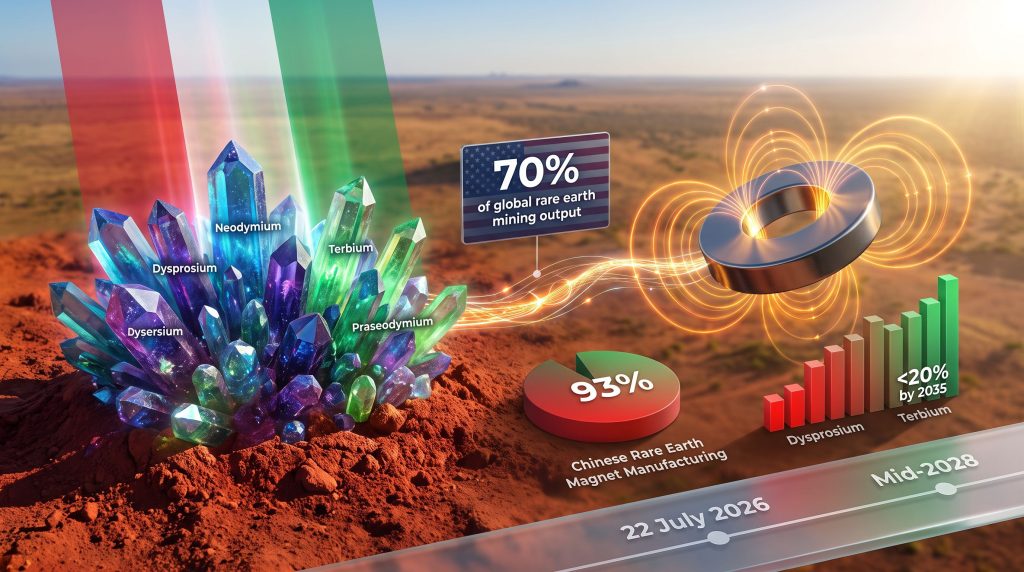
China accounts for approximately 70% of global rare earth mining output, a figure that on its own sounds significant but substantially understates the real nature of the problem. The more consequential statistic sits downstream: Chinese processing and manufacturing facilities account for an estimated 93% of global rare earth permanent magnet production, according to the Center for Strategic and International Studies.
This distinction between extraction and processing is critical and frequently misunderstood. A country can mine rare earth ore and still be entirely dependent on China to make that ore useful, because the separation and refining steps required to isolate individual rare earth elements from mixed ore concentrates are chemically complex, capital-intensive, and environmentally demanding. Furthermore, the rare earth processing challenges that Western nations face stem largely from having abandoned this capability during the 1990s and 2000s, when Chinese competition made domestic processing economically unviable.
The magnet metals that matter most for defence and clean energy applications sit at the highest-value end of this chain:
- Neodymium (Nd) and praseodymium (Pr): The foundational inputs for neodymium-iron-boron (NdFeB) permanent magnets used in EV motors and wind turbines
- Dysprosium (Dy): Added to NdFeB magnets to maintain coercivity at high operating temperatures, essential for EV drivetrains and defence motors
- Terbium (Tb): Enhances magnet performance under extreme heat and stress, among the scarcest and highest-value of all magnet metals
All four are processed almost entirely within Chinese borders.
Why Building New Mines Alone Is Insufficient
The United States has one functioning fully integrated rare earth operation: MP Materials in Mountain Pass, California. It is the only facility in the country that handles mining, separation, refining, and magnet manufacturing under a single operational umbrella. Its existence is the result of significant government and private investment to rebuild capabilities that had atrophied over decades.
Replicating even a fraction of China's processing infrastructure at scale requires coordinated investment across every link in a long and technically demanding chain:
- Exploration and resource definition
- Pilot plant testing and metallurgical studies
- Environmental and social impact assessments
- Permitting and regulatory approvals
- Separation and hydrometallurgical processing facilities
- Alloying and magnet manufacturing capacity
- End-user qualification and supply agreements
Each stage takes years and requires specialised expertise. This is why Bloomberg analysis projects that countries outside China will supply less than one-fifth of global dysprosium and terbium demand by 2035, even under scenarios that assume continued Western investment acceleration. China's processing advantage is expected to persist until at least the mid-2030s simply because the infrastructure gap is too large to close quickly.
What Makes the Ampasindava Deposit Strategically Significant?
Ionic Clay Deposits: A Different Kind of Rare Earth Resource
Located in northern Madagascar, the Ampasindava project developed by Harena Rare Earths sits on what is considered one of the largest rare earth deposits outside of China. Its classification as an ionic clay deposit is not merely a geological footnote; it carries meaningful implications for project economics and processing feasibility.
Unlike hard rock rare earth deposits where minerals are locked within crystalline structures and require energy-intensive crushing, grinding, and chemical leaching to liberate, ionic clay deposits host rare earth elements adsorbed onto clay mineral surfaces. This characteristic allows for lower-energy extraction using simple leaching techniques, without the need for large-scale mineral processing infrastructure at the mine site.
Ionic clay rare earth deposits are the same deposit type that underpins much of China's heavy rare earth production, particularly in Jiangxi Province. This geological parallel is precisely why Western investors and governments are paying close attention to ionic clay discoveries outside Chinese borders.
Harena holds a 100% ownership interest in the project, and the deposit hosts the full suite of high-value magnet metals: neodymium, praseodymium, dysprosium, and terbium. The presence of dysprosium and terbium in particular elevates the strategic profile of the deposit, as these heavy rare earths are both the most critical for high-performance defence and industrial applications and the most difficult to source outside of China.
Project Development Parameters
| Parameter | Detail |
|---|---|
| Deposit type | Ionic clay rare earth |
| Location | Northern Madagascar |
| Ownership | Harena Rare Earths (100%) |
| Estimated development cost | ~US$150 million |
| Target production start | Mid-2028 (subject to milestones) |
| DFC commitment | Up to US$4.84 million |
| Agreement execution date | 22 July 2026 |
| DFC evaluation duration | Nine months |
Decoding the US$4.84 Million DFC Commitment
Seed Capital, Not a Project Finance Package
The US International Development Finance Corporation's commitment of up to US$4.84 million to the Ampasindava project is best understood as a de-risking instrument rather than a development financing solution. Against a total estimated project cost of approximately US$150 million, this initial tranche represents roughly 3.2% of total required capital and is explicitly structured to fund the technical and environmental work required to make the project bankable for institutional investors.
The Project Development Funding Agreement was formally executed on 22 July 2026, following a nine-month due diligence and evaluation process by DFC officials. Harena confirmed that the first payment was already underway at the time of signing, signalling procedural confidence from the DFC in the project's early-stage readiness.
The funding is allocated across four primary workstreams:
- Pilot plant construction and testing: Demonstrating that ore from the Ampasindava deposit can be extracted and processed to produce a saleable rare earth product at technically viable recovery rates
- Laboratory and metallurgical analysis: Characterising ore grade, mineralogy, and processing behaviour to support pre-feasibility and feasibility study work
- Environmental and social impact programmes: A mandatory prerequisite for project permitting and a requirement for any subsequent international development finance
- Permitting advancement: Regulatory approvals without which full-scale construction cannot proceed
The Strategic Logic of Early-Stage US Engagement
A critical dimension of the DFC investment that often goes undiscussed is the competitive framing behind early-stage government-backed financing in frontier mining jurisdictions. Chinese state-backed entities have demonstrated a consistent pattern of anchoring investment in mineral-rich African nations early in project development cycles, before Western capital becomes available or interested. By committing at the seed stage, the DFC is not simply providing capital; it is establishing a financing relationship that shapes the project's development trajectory, downstream processing partnerships, and offtake arrangements.
A US State Department representative confirmed that Madagascar fits within the US strategy to expand American and US-aligned investment in the critical mineral sector, with the country identified as having broader mineral opportunities beyond Ampasindava itself. In addition, the rare earth supply chain considerations driving this engagement reflect a broader recognition that geographic diversification is essential to long-term supply security.
The DFC has indicated that additional capital support beyond the initial commitment could be considered as the project advances, subject to further due diligence and regulatory approvals. This sequenced financing model mirrors how development finance institutions typically operate in resource-stage projects.
The Two-Track US Rare Earth Strategy
Track One: Rebuilding Domestic Infrastructure
The US Department of Defense's US$400 million investment in MP Materials represents the domestic pillar of America's rare earth strategy. MP Materials' Mountain Pass facility is the sole fully vertically integrated rare earth producer in the United States, handling the complete production sequence from mining and separation through to refined material and manufactured magnets.
This investment is designed to establish a genuine mine-to-magnet supply chain within US borders, eliminating dependency on Chinese processing for at least a portion of domestic rare earth demand. The significance of this vertical integration cannot be overstated; without domestic processing and magnet manufacturing, a domestic mine is simply a source of feedstock that still flows through Chinese refining infrastructure.
Track Two: Diversifying Allied-Nation Sourcing
| Investment | Focus | Scale | Stage |
|---|---|---|---|
| DoD to MP Materials | Domestic mine-to-magnet chain | US$400 million | Operational scaling |
| DFC to Ampasindava | Overseas project development | Up to US$4.84 million | Pre-feasibility/pilot |
Madagascar's Ampasindava project represents the early-stage expression of Track Two: building sourcing diversity across geographies that fall outside China's sphere of influence. The DFC's broader mandate includes identifying and anchoring investment in mineral-rich partner nations before Chinese capital does the same. Consequently, the critical minerals coalition of allied nations is increasingly coordinating its approach to ensure that Western capital moves decisively into these opportunities.
Tariffs, Trade Diplomacy, and the Rare Earth Bargaining Chip
The geopolitical dimension of rare earth access became visible in October 2025, when the US reduced fentanyl-related tariffs on Chinese goods from 20% to 10% as part of a broader negotiated arrangement in which China agreed to facilitate US access to rare earth supply chains. This diplomatic exchange illustrates how deeply embedded rare earth access has become within the structure of US-China trade negotiations.
The willingness to offer tariff relief in exchange for mineral access underlines both the urgency of the supply problem and the leverage China holds. China's export restrictions have further sharpened Western awareness of just how consequential this dependency has become. The parallel investment in non-Chinese sources through vehicles like the DFC signals a dual-track approach: short-term diplomatic accommodation with China while building structural independence over the medium and long term.
Rare Earths in Defence: The Numbers Behind the Urgency
Why the Military Cannot Substitute Away from These Materials
Neodymium-iron-boron permanent magnets occupy a position in modern defence systems that has no near-term substitute at equivalent performance levels. Their combination of extremely high magnetic energy density and relatively low mass makes them the material of choice for applications where weight is a binding constraint: guided missile actuators, radar array positioning systems, jet engine control surfaces, sonar transducers, and drone motor systems.
According to the Congressional Research Service, a single F-35 Lightning II fighter jet requires approximately 417 kilograms of rare earth elements across all its systems. In January 2026, Lockheed Martin disclosed that F-35 production rates are running at five times the output of any comparable allied fighter aircraft, meaning that rare earth consumption within F-35 production alone represents a supply chain exposure of significant scale.
Defence Demand Meets Clean Energy Growth
The strategic complication facing Western planners is that the same mineral inputs critical to defence production are simultaneously being drawn upon by the clean energy transition at increasing volumes. Furthermore, the critical minerals demand driven by EV motors, offshore wind turbine generators, and grid-scale energy storage systems all rely on NdFeB magnets using the same dysprosium, terbium, neodymium, and praseodymium.
| Mineral | Primary Defence Use | Primary Clean Energy Use | 2035 Non-Chinese Supply Forecast |
|---|---|---|---|
| Dysprosium | High-temp magnet performance in missiles, jets | EV drivetrain motors | <20% of global demand |
| Terbium | Magnet coercivity in defence systems | High-efficiency wind turbines | <20% of global demand |
| Neodymium | Permanent magnets across all platforms | EV motors, wind turbines | Emerging alternatives developing |
| Praseodymium | Aerospace alloys, magnetic components | High-strength magnet inputs | Emerging alternatives developing |
The convergence of these two demand growth curves, defence procurement expansion and clean energy deployment, is compressing the timeline within which Western supply chain diversification must be achieved.
The next major ASX story will hit our subscribers first
Key Risks Every Investor and Policymaker Should Understand
Development-Stage Realities at Ampasindava
The Ampasindava project remains at pilot and pre-feasibility stage. No commercial production decision has been made, and the US$4.84 million DFC commitment leaves a funding gap of approximately US$145 million between current capital and what is required to bring the project into production. Bridging this gap will depend on:
- Successful pilot plant results demonstrating technically viable extraction and processing
- Completion of environmental and social impact assessments to the standard required for international development finance
- Sustained US government confidence, potentially including follow-on DFC commitments
- Identification and negotiation of processing partnerships in the US or Europe
The Processing Partnership Problem
One of the least-discussed risks facing the US investment in Madagascar rare earths project and comparable initiatives is the processing destination question. Extracting ore from an ionic clay deposit in Madagascar and shipping it to a country with no rare earth processing infrastructure achieves nothing meaningful for Western supply chain independence. The ore must flow to a separation and refining facility capable of producing the individual rare earth oxides or metals that downstream manufacturers actually need.
Harena is actively pursuing processing partnerships with US and European entities, but no confirmed arrangements have been publicly disclosed. Until these partnerships are in place, the project's contribution to genuine Western supply chain resilience remains theoretical. For further context on how processing bottlenecks affect project outcomes, the US Geological Survey's critical minerals programme provides detailed analysis of the technical and economic barriers involved.
Sovereign and Jurisdictional Risk in Madagascar
Madagascar presents risk characteristics typical of frontier mining jurisdictions: infrastructure limitations, historical patterns of political instability, and regulatory environments that can shift with changes in government. The DFC's involvement provides a degree of political risk mitigation insofar as host governments typically have incentive to maintain stable relationships with projects backed by US development finance, but this protection is not absolute.
The rare earth supply chain challenge cannot be resolved through mine development alone. Separation, refining, and magnet manufacturing infrastructure must advance in parallel. Without confirmed downstream processing arrangements, any new mine remains a partial solution at best.
The Decade-Long Horizon of Rare Earth Realignment
Structural Timelines Cannot Be Compressed Arbitrarily
China's commanding position across the rare earth value chain was built over roughly three decades of continuous, policy-directed industrial investment. Bloomberg's analytical projections suggest that even under the most accelerated Western investment scenarios, Chinese dominance across key magnet metals will persist until the mid-2030s at the earliest. This is not pessimism; it reflects the compound effect of infrastructure, expertise, and supply chain relationships that cannot be replicated quickly.
The US investment in Madagascar rare earths project, if it progresses successfully to production by its target of mid-2028, would represent an early contribution to this realignment. However, it would be one project among many that must advance simultaneously for the structural balance to shift meaningfully. The International Energy Agency's critical minerals outlook projects that demand pressures will intensify significantly before new supply becomes available at scale.
What Success Actually Looks Like
For the US investment in Madagascar rare earths project to deliver on its strategic promise, the following conditions must align:
- Pilot plant results confirm economically viable extraction at the anticipated scale
- Environmental approvals are secured without significant delay or redesign requirements
- Follow-on financing of approximately US$145 million is assembled from DFC, development banks, and private capital
- A confirmed processing arrangement with a US or European facility is negotiated and contracted
- Offtake agreements with defence or clean energy manufacturers are established to underpin project economics
- Production commences near the mid-2028 target and ramps to commercial scale within a defined timeline
Each of these conditions carries execution risk. Together they represent a challenging but not implausible pathway, provided the political and financial commitment from the US side remains consistent over the multi-year development horizon.
The US$4.84 million DFC commitment is better understood as a strategic option on a much larger outcome than as a standalone investment. Its value lies not in the capital it provides today but in the technical validation, political signalling, and financing momentum it creates for the years ahead. Whether that option is exercised successfully will depend on factors spanning geology, geopolitics, environmental science, and the pace of global rare earth demand growth, none of which are under any single actor's control.
This article contains forward-looking information regarding project timelines, production targets, and investment outcomes. These represent projections based on current available data and are subject to material change. Readers should conduct independent due diligence before drawing conclusions regarding investment merit or project viability.
Want to Track the Next Major Mineral Discovery Before the Market Does?
Discovery Alert's proprietary Discovery IQ model delivers real-time alerts on significant ASX mineral discoveries — instantly translating complex resource data into actionable insights for both short-term traders and long-term investors. Explore Discovery Alert's discoveries page to understand how historic finds have generated extraordinary returns, and begin your 14-day free trial today to position yourself ahead of the market.