July 30, 2026
The Most Dangerous Gap in Western Manufacturing Has Nothing to Do With Chips
The global conversation about supply chain vulnerability has fixated on semiconductors for years. Yet a quieter, arguably more structurally dangerous bottleneck has been building in parallel: the near-total absence of heavy rare earth separation capacity outside of China. Without dysprosium and terbium, the high-performance permanent magnets powering electric vehicle motors, wind turbines, military guidance systems, and advanced robotics cannot meet the thermal and demagnetisation demands of real-world operating environments.
Furthermore, without separation infrastructure to produce these oxides, even the most ambitious Western clean energy and defence manufacturing programmes remain tethered to Chinese processing decisions. Understanding rare earth supply chains makes clear just how exposed these programmes have become.
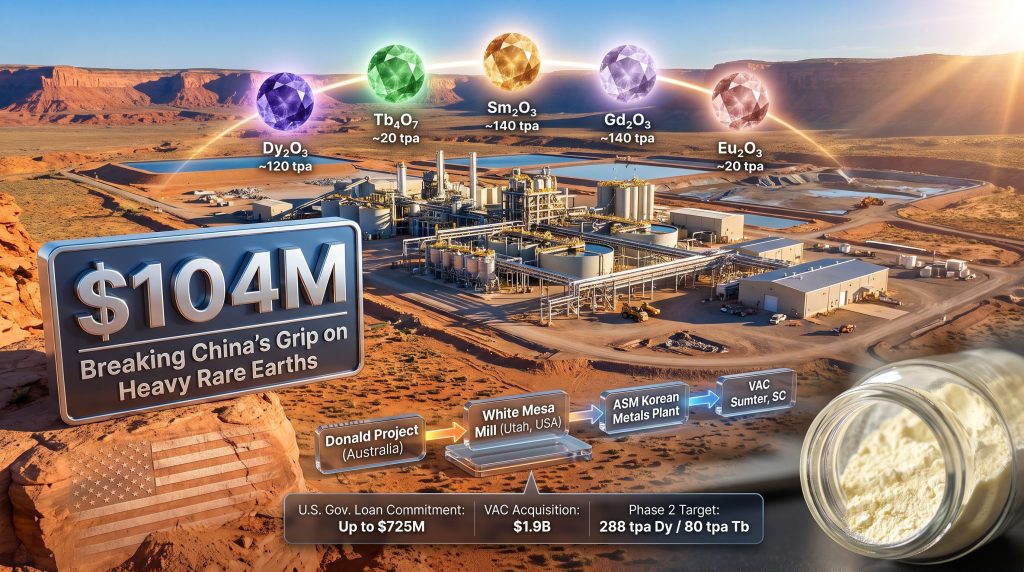
That structural gap is now being directly targeted by the White Mesa heavy rare earth expansion in San Juan County, Utah, where Energy Fuels Inc. has commenced construction on a $104 million buildout designed to make the White Mesa Mill one of the only facilities outside China capable of separating heavy rare earth oxides at commercial scale.
When big ASX news breaks, our subscribers know first
Understanding Why Heavy Rare Earths Are Categorically Different
The rare earth elements are frequently discussed as a single commodity group, but from a supply chain and applications perspective, the distinction between light rare earths (LREEs) and heavy rare earths (HREEs) is critical and often underappreciated.
Light rare earths, including neodymium and praseodymium (collectively NdPr), form the base material for neodymium-iron-boron (NdFeB) permanent magnets. These are already powerful, but they suffer from a performance-limiting weakness: at elevated temperatures, their coercivity drops sharply, meaning they lose their resistance to demagnetisation. This is a serious problem for EV traction motors, which routinely operate at high temperatures under sustained load.
This is where dysprosium and terbium become indispensable. Both elements are added in relatively small quantities to NdFeB magnet alloys, but their effect is disproportionate to the volume used:
- Dysprosium (Dy) increases the coercive force of NdFeB magnets at elevated temperatures, allowing them to maintain performance in demanding thermal environments.
- Terbium (Tb) performs a similar function and can be used in combination with dysprosium, often reducing the total amount of dysprosium needed while achieving equivalent or superior performance thresholds.
- Together, Dy and Tb additions are what separate standard-grade NdFeB magnets from the high-performance variants required in EV motors, direct-drive wind turbines, aerospace actuators, and advanced military hardware.
The strategic danger is compounded by the geographic concentration of HREE processing. China controls an estimated 85 to 90 percent of global rare earth separation capacity, with its grip on heavy rare earth separation even tighter than for light rare earths. This is partly a function of geology: ionic adsorption clay deposits in southern China are unusually enriched in HREEs relative to other deposit types globally, and China has built its processing infrastructure around these feedstocks over decades.
The rare earth processing challenges involved in replicating this infrastructure in Western jurisdictions are substantial, adding further urgency to developments at White Mesa.
The absence of commercial HREE separation capacity in the West is not simply an economic inefficiency. It represents a single-point vulnerability in supply chains that underpin both the clean energy transition and national defence manufacturing.
White Mesa Mill: Repurposed Infrastructure With Rare Strategic Value
The White Mesa Mill has operated as a uranium processing facility since the 1980s, making it the only conventional uranium mill currently licensed and operating in the United States. Its pivot toward rare earth separation, which began in earnest in 2021, represents one of the more intelligent examples of industrial asset repurposing in the critical minerals demand landscape.
The rationale is straightforward: rare earth separation using solvent extraction requires substantial chemical processing infrastructure, containment systems, licensed tailings management, and experienced operational teams. All of these already existed at White Mesa. Rather than building a greenfield rare earth separation facility from scratch, Energy Fuels leveraged existing licensed infrastructure to dramatically reduce both capital costs and permitting timelines.
The mill currently holds installed capacity to produce up to 1,000 metric tons per year of separated NdPr oxide, processing monazite concentrate and mixed rare earth carbonates (MREC) as feedstocks. Monazite is a phosphate mineral commonly recovered as a byproduct of mineral sands operations and is notable for its relatively high HREE content compared to other rare earth bearing minerals such as bastnäsite, which dominates at operations like Mountain Pass in California.
This feedstock characteristic matters enormously. Monazite's HREE enrichment is precisely what makes it the preferred input for an expansion targeting dysprosium and terbium production. The planned Donald Project in Victoria, Australia, a joint venture between Energy Fuels and Astron Ltd., is designed to supply 8,500 to 9,500 metric tons per year of monazite concentrate from 2028 onward, subject to a positive final investment decision expected during Q3 2026.
What the $104 Million White Mesa Heavy Rare Earth Expansion Actually Constructs
The current construction phase adds five new separation circuits targeting oxide products that are either entirely absent or severely undersupplied from non-Chinese sources. The planned annual production capacities upon completion are as follows:
| Rare Earth Oxide | Target Annual Capacity |
|---|---|
| Dysprosium Oxide (Dy₂O₃) | ~120 metric tons |
| Terbium Oxide (Tb₄O₇) | ~20 metric tons |
| Samarium Oxide (Sm₂O₃) | ~140 metric tons |
| Gadolinium Oxide (Gd₂O₃) | ~140 metric tons |
| Europium Oxide (Eu₂O₃) | ~20 metric tons |
Construction is being sequenced strategically. The dysprosium and terbium circuits, the most commercially urgent given their role in high-performance magnets, are targeted for completion by the end of 2027, with commissioning planned for Q4 of that year. The samarium, gadolinium, and europium circuits follow, with a targeted completion date by the end of 2028.
It is worth clarifying the distinction between project phases to avoid confusion about the capital figures involved:
- The $104 million figure covers the current construction phase actively underway as of mid-2026.
- A broader Phase 2 feasibility estimate of approximately $410 million represents the full-scope rare earth processing buildout at White Mesa envisioned for later stages.
- Near-term production targets from the current phase are approximately 35 tpa dysprosium and 12 tpa terbium, scaling toward Phase 2 targets of 288 tpa dysprosium and 80 tpa terbium.
A detail that receives insufficient attention in most coverage: White Mesa will be producing both uranium and rare earth oxides simultaneously at commercial scale upon expansion completion. According to recent reporting on Energy Fuels' expansion, this dual-commodity capability is essentially unique globally and provides a meaningful revenue diversification buffer that most standalone rare earth processing facilities cannot replicate.
Financing Architecture: How the Capital Stack Is Structured
Energy Fuels entered this construction phase from a position of financial strength. The company held approximately $960 million in working capital as of the end of March 2026, providing a substantial equity cushion.
The more significant financing development came in June 2026, when Energy Fuels received a conditional commitment from the U.S. Office of Strategic Capital for a 20-year loan of up to $725 million. This commitment covers both the White Mesa heavy rare earth expansion and a proposed American rare earth metals and alloys plant. The loan remains conditional, subject to completion of due diligence, execution of definitive agreements, satisfaction of closing conditions, and receipt of all required government approvals. Energy Fuels has additionally applied for grant funding from other federal agencies.
The company's strategy positions government grants and loans to fund a large portion of the $104 million construction cost, with existing working capital covering the equity component. This financing architecture significantly de-risks execution for the current construction phase.
Investor Note: The conditional nature of the $725 million loan commitment is a material variable. Until definitive agreements are executed and all conditions are satisfied, this financing cannot be treated as certain. Investors should monitor the progression of due diligence milestones alongside construction progress.
The Donald Project: Upstream Feedstock That Makes the Numbers Work
The sizing and timing of the White Mesa heavy rare earth expansion is explicitly calibrated around anticipated monazite concentrate from the Donald Project in Victoria, Australia. This is not a coincidence of scheduling: the production volumes from Donald were used to dimension the new circuits.
Donald's expected output of 8,500 to 9,500 metric tons per year of monazite concentrate, combined with third-party feedstocks already under contract or in active negotiation, is projected to:
- Fully utilise White Mesa's existing NdPr separation capacity of up to 1,000 tpa.
- Fully feed the new dysprosium and terbium separation circuits at planned throughput rates.
- Provide sufficient HREE-rich material to support the downstream metals and alloys conversion step.
The feedstock risk profile deserves careful consideration:
- The Donald final investment decision has not yet been confirmed as of mid-2026, with project financing negotiations still ongoing.
- Delay or cancellation would require heavier reliance on third-party contracted feedstocks.
- White Mesa's engineering allows for diverse feedstock inputs, providing partial insulation against single-source dependency.
- Monazite from Donald alone is expected to supply roughly 70% of ASM's existing and planned metals and alloys capacity in South Korea, illustrating the tight volumetric interdependency between project stages.
The next major ASX story will hit our subscribers first
From Oxide to Magnet: The Integrated Supply Chain Architecture
What distinguishes Energy Fuels' strategy from simple processing expansion is the explicit effort to build a vertically integrated, mine-to-magnet supply chain entirely outside China. The proposed architecture, contingent on completing pending acquisitions, flows as follows:
Donald Project (Victoria, Australia)
        ↓
Monazite Concentrate
        ↓
White Mesa Mill (Utah, USA)
HREE + LREE Oxide Separation
        ↓
ASM Korean Metals Plant / Proposed American Metals Plant
(NdPr, Dy, Tb metals; NdFeB and DyFe alloys)
        ↓
VAC Magnet Plants (Europe + Sumter, South Carolina)
(Permanent Magnet Manufacturing — 2,000 tpa initial U.S. capacity)
The ASM Acquisition: Adding the Metals and Alloys Link
Australian Strategic Materials (ASM) operates the Korean Metals Plant, one of very few facilities outside China currently producing rare earth metals and alloys at commercial scale. Its product range includes NdPr metals, dysprosium and terbium metals, NdFeB alloys, and dysprosium-iron alloys. The proposed American Metals Plant would add a domestic U.S. production node to this capability. The ASM shareholder vote was scheduled for August 12, 2026, with the transaction also requiring Federal Court of Australia approval and satisfaction of other closing conditions.
The VAC Acquisition: Completing the Chain Into Finished Magnets
The proposed acquisition of Vacuumschmelze (VAC), a Germany-based permanent magnet manufacturer, carries an implied equity value of $1.9 billion. VAC's most strategically relevant asset for U.S. supply chain purposes is its recently commissioned plant in Sumter, South Carolina, which has an initial capacity of 2,000 metric tons of permanent magnets per year. VAC also operates magnet manufacturing facilities in Europe. The transaction is expected to close in early 2027, subject to German national security and strategic sector review.
However, while clearance is anticipated, Berlin is expected to impose conditions designed to protect domestic German magnet-making capacity.
Supply Chain Throughput: How the Volumes Align
| Supply Chain Stage | Capacity or Output |
|---|---|
| Donald monazite concentrate | 8,500 to 9,500 tpa |
| White Mesa NdPr oxide (existing) | Up to 1,000 tpa |
| White Mesa Dy oxide (Phase 1 expansion) | Up to 120 tpa |
| White Mesa Tb oxide (Phase 1 expansion) | Up to 20 tpa |
| ASM Korean Metals Plant | Fed by ~70% of Donald output alone |
| VAC South Carolina plant | Needs alloy supply met by ASM output |
White Mesa Versus the Global HREE Separation Landscape
To appreciate the significance of the White Mesa heavy rare earth expansion, it is worth mapping it against the global population of non-Chinese HREE separation assets. The broader context of critical minerals geopolitics underscores why this comparison matters so profoundly for Western nations.
| Facility | Country | HREE Separation Capability | Status |
|---|---|---|---|
| White Mesa Mill (Energy Fuels) | USA | Dy, Tb, Sm, Gd, Eu (commercial buildout) | Under construction |
| MP Materials (Mountain Pass) | USA | Primarily NdPr (LREE focus) | Operational |
| Lynas Rare Earths (Kalgoorlie/Malaysia) | Australia/Malaysia | NdPr + limited HREE | Operational/Expanding |
| European facilities (various) | Europe | Early-stage or pilot scale | Pre-commercial |
Mountain Pass, the largest rare earth mining and processing operation in the U.S., focuses predominantly on light rare earth separation. Lynas, the largest non-Chinese rare earth producer globally, has begun exploring HREE separation but has not yet established commercial-scale dysprosium and terbium oxide production. This leaves White Mesa positioned to occupy an essentially uncontested space in Western HREE processing upon completion.
Consequently, the critical minerals coalition building across allied nations increasingly points to White Mesa as a cornerstone facility in any credible Western HREE strategy.
Key Risks That Could Affect Timeline and Outcomes
Any rigorous assessment of the White Mesa heavy rare earth expansion must weigh the execution risks alongside the strategic opportunity:
- Donald FID uncertainty: The upstream feedstock anchor remains conditional on a financing and development decision not yet finalised.
- Acquisition completion risk: Both the ASM and VAC transactions involve multiple regulatory, judicial, and shareholder approval steps across multiple jurisdictions.
- Government financing conditionality: The $725 million loan commitment from the U.S. Office of Strategic Capital involves conditions that have not yet been fully satisfied.
- HREE price volatility: Dysprosium and terbium prices are historically volatile, influenced heavily by Chinese export policy. The commissioning timeline is described as contingent on market conditions, introducing a price sensitivity dimension.
- German regulatory conditions on VAC: The anticipated imposition of conditions by Berlin to protect domestic magnet capacity could constrain how VAC's European assets are operationally integrated.
Frequently Asked Questions: White Mesa Heavy Rare Earth Expansion
What rare earth oxides will White Mesa produce after the expansion?
Upon completion of both construction phases, the mill will produce dysprosium oxide (up to 120 tpa), terbium oxide (up to 20 tpa), samarium oxide (up to 140 tpa), gadolinium oxide (up to 140 tpa), and europium oxide (up to 20 tpa), alongside existing NdPr oxide production of up to 1,000 tpa.
When will commercial dysprosium and terbium production begin?
The Dy and Tb circuits are targeted for construction completion by the end of 2027, with commissioning planned for Q4 2027, subject to market conditions and project milestones. Energy Fuels' own project announcements confirm that the expansion is also expected to deliver among the lowest-cost NdPr production globally.
What does the $104 million cover relative to the $410 million Phase 2 estimate?
The $104 million covers the current active construction phase. The $410 million figure represents the full-scope Phase 2 rare earth processing buildout assessed in feasibility studies, encompassing a larger scale of production capacity not included in the current phase.
Why are dysprosium and terbium so difficult to replace in magnets?
Both elements operate at a fundamental materials science level, modifying the crystal structure of NdFeB magnets in ways that no currently available substitute replicates at commercial scale. Their small addition quantities (typically 1 to 5 percent by weight) belie their outsized effect on coercivity and thermal stability, making them irreplaceable for high-demand applications in the current technology paradigm.
What Successful Completion Would Mean for Western Supply Chain Independence
The broader significance of the White Mesa heavy rare earth expansion extends well beyond a single processing facility. It represents a concrete proof-of-concept that existing industrial infrastructure can be systematically repurposed to address the most acute critical mineral processing gaps in Western supply chains, at materially lower cost than greenfield alternatives.
If the full mine-to-magnet architecture is successfully assembled, the implications span multiple sectors:
- EV manufacturers gain access to a non-Chinese source of the HREE-enhanced magnet alloys their highest-performing traction motors require.
- Defence procurement chains gain domestic HREE sourcing for guided systems, radar components, and electric propulsion.
- Wind turbine OEMs gain supply chain diversification for the direct-drive generators increasingly favoured in offshore installations.
- Robotics and aerospace developers gain pricing and availability stability for HREE-dependent components.
Construction is underway, pilot-scale separation of dysprosium and terbium oxides has already been demonstrated, feedstock agreements are in negotiation, and financing structures are taking shape. The key variables that remain open are the upstream FID on Donald, the completion of the ASM and VAC acquisitions, and the ultimate terms of the U.S. government loan facility.
| Metric | Detail |
|---|---|
| Expansion capital cost (current phase) | ~$104 million |
| Government loan commitment | Up to $725 million (conditional, 20-year) |
| Working capital position (March 2026) | ~$960 million |
| Dy oxide capacity target (Phase 1) | ~120 tpa |
| Tb oxide capacity target (Phase 1) | ~20 tpa |
| Dy/Tb circuit completion target | End of 2027 (Q4 commissioning) |
| Sm/Gd/Eu circuit completion target | End of 2028 |
| Primary feedstock source | Donald Project monazite (8,500 to 9,500 tpa from 2028) |
| VAC acquisition implied equity value | $1.9 billion |
| VAC U.S. magnet capacity (Sumter, SC) | 2,000 tpa initial |
This article is intended for informational purposes only and does not constitute financial or investment advice. Forward-looking statements regarding project timelines, production capacities, acquisition completions, and government financing are subject to risks, uncertainties, and conditions that may cause actual outcomes to differ materially from those described. Readers should conduct their own due diligence before making investment decisions.
Want to Stay Ahead of the Next Major Critical Minerals Discovery?
Discovery Alert's proprietary Discovery IQ model scans ASX announcements in real time, delivering instant alerts on significant mineral discoveries — including the rare earth and critical minerals companies driving Western supply chain independence — so subscribers can act before the broader market reacts. Explore historic examples of what major mineral discoveries can return and begin your 14-day free trial at Discovery Alert today.