July 30, 2026
The Midstream Gap Nobody Talks About: Why Processing, Not Mining, Defines America's Next Rare Earth Winner
There is a persistent misconception embedded in mainstream coverage of America's next rare earth winner. The story is almost always framed around mines: how many the United States has, how many China controls, and how quickly new deposits can be brought into production. However, the geological question, while important, is fundamentally secondary to the industrial one. The country that processes rare earths, metallizes them, alloys them, and manufactures them into finished permanent magnets holds the real strategic advantage. That is precisely the position China built over three decades, and that is precisely the gap America is now scrambling to close.
Understanding why that gap exists, how deep it runs, and which companies are positioned to fill it requires looking at the rare earth supply chain not as a single industry, but as five distinct industrial stages, each with its own technical requirements, capital profile, and strategic significance.
When big ASX news breaks, our subscribers know first
The Five Stages Where Strategic Control Is Won or Lost
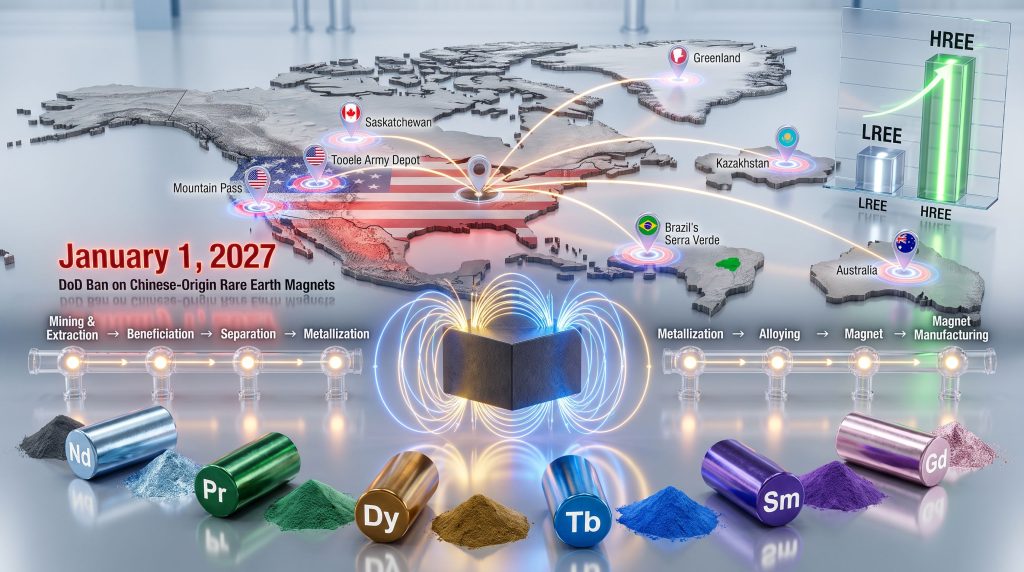
Most discussions about supply chain security focus on stage one: mining. Furthermore, the mine-to-magnet pipeline involves four additional transformations, each progressively more technically demanding and each representing a potential chokepoint if domestic capacity is absent.
| Stage | Description | Current U.S. Capability |
|---|---|---|
| Mining and Extraction | Ore removed from the ground | Limited, with Mountain Pass as the primary active site |
| Beneficiation | Ore concentrated into rare earth concentrate | Partial domestic capacity |
| Separation | Individual rare earth oxides isolated from concentrate | Severely limited outside Mountain Pass |
| Metallization | Oxides converted into pure, usable metals | Near-absent domestically |
| Alloying and Magnet Manufacturing | Metals combined into alloys and formed into permanent magnets | Early-stage domestic development only |
The critical insight here is that China's dominance was never primarily geological. It was built through systematic investment in stages three, four, and five, where Western capacity had been allowed to atrophy. Consequently, even if the United States expanded its mining output significantly tomorrow, without metallization and alloying infrastructure, finished rare earth magnets would still require Chinese processing before they could be used in defence systems or electric vehicles.
Metallization: The Most Overlooked Chokepoint in the Entire Supply Chain
Metallization is the industrial process of converting separated rare earth oxides into high-purity metals suitable for alloying and magnet production. It is technically demanding, capital-intensive, and largely absent from the current North American industrial landscape. China is estimated to control the overwhelming majority of global rare earth metallization capacity, a structural advantage that compounds every other vulnerability in the Western supply chain.
The defence implications are direct and severe. Samarium-cobalt (SmCo) magnets, which are used in fighter aircraft, radar systems, precision-guided munitions, and submarine propulsion, require domestically processed samarium metal to meet increasingly stringent federal procurement rules. Without metallization capability, the upstream work of mining and separating rare earths produces materials that still cannot be used in compliant defence applications. The rare earth processing challenges in this space remain one of the most underreported dimensions of the supply chain crisis.
"The United States has rare earth ore in the ground. What it largely cannot yet do at scale is convert that ore into the high-purity metals and alloys that defence and commercial manufacturers actually need. Closing that gap is the defining industrial challenge of the current supply chain buildout."
Light vs. Heavy Rare Earths: Why the Distinction Shapes Every Investment Decision
Not all rare earth elements carry equal strategic weight. The industry divides them into two broad categories, and understanding the difference is essential for evaluating any investment or policy claim about supply chain security.
Light rare earth elements (LREEs) include lanthanum through gadolinium on the periodic table. They are more geologically abundant, more commercially accessible, and produced in higher volumes globally. Neodymium and praseodymium, the two primary commercial drivers of the permanent magnet industry, fall into this category.
Heavy rare earth elements (HREEs) include terbium through lutetium, plus yttrium. They are scarcer, geographically concentrated in a smaller number of deposits, and carry significantly higher per-unit strategic value. Critically, they are the elements that enable permanent magnets to perform reliably under extreme thermal stress, which is a non-negotiable requirement for most defence applications.
The four elements driving the most acute near-term supply anxiety are:
- Dysprosium (Dy): Added to neodymium-iron-boron (NdFeB) magnets to maintain coercivity at high operating temperatures. Essential for jet engines, missile guidance systems, and advanced electric motors.
- Terbium (Tb): Works alongside dysprosium to extend magnet performance under thermal load. Used in the same defence-critical applications.
- Samarium (Sm): The foundation of samarium-cobalt magnets, which outperform NdFeB magnets in environments where NdFeB compounds are chemically or thermally unsuitable. Used extensively in radar, precision weapons, and aerospace systems.
- Gadolinium (Gd): Applied in specialised defence electronics and nuclear technology applications requiring unique magnetic properties.
Mountain Pass, the only large-scale rare earth mine currently operating in the United States, is primarily a light rare earth deposit. Its ore is rich in neodymium and praseodymium, and MP Materials has developed an SEG+ concentrate that extends somewhat into medium and heavy rare earth territory. However, the deposit's geology means it cannot serve as a comprehensive solution to the heavy rare earth deficit. That structural limitation is exactly what has opened a distinct competitive space for companies building HREE-focused supply chains.
How America Lost Its Processing Infrastructure and What It Would Take to Rebuild It
The United States was once a global leader in rare earth production and processing. Mountain Pass operated as a dominant global supplier through much of the latter half of the twentieth century. The collapse of domestic processing capacity was not the result of a single policy failure. It was the product of sustained cost competition as Chinese rare earth production scaled dramatically through the 1980s and 1990s, systematically undercutting the economic case for maintaining Western processing infrastructure.
By the time Mountain Pass closed in 2002, the institutional knowledge, processing expertise, and industrial infrastructure that had taken decades to build were dispersed or dismantled. Mountain Pass reopened under MP Materials, but rebuilding the full processing and metallization stack from near-zero is a fundamentally different challenge from reopening a mine. Geological resources can be reactivated in years; industrial metallization expertise takes far longer to reconstruct.
The policy response that followed has been significant. Furthermore, the critical minerals executive order framework has accelerated the regulatory push to rebuild domestic capacity:
- Executive Order 13953, signed in 2020, formally addressed the national security threat from critical mineral supply chain dependence.
- The Defence Production Act has been invoked multiple times in relation to critical minerals to accelerate domestic capacity development.
- Successive National Defence Authorisation Acts have progressively tightened restrictions on Chinese-origin materials in defence procurement.
- The most concrete forcing mechanism of all arrived in the form of a hard procurement deadline: effective 1 January 2027, the U.S. Department of Defence will no longer procure rare earth magnets with Chinese-origin inputs.
That 2027 deadline is not a policy aspiration. It is a procurement cutoff, and it is functioning as the primary forcing mechanism driving the current wave of rare earth infrastructure investment across the country.
The January 2027 Procurement Deadline and Its Supply Chain Consequences
The practical challenge embedded in the 2027 deadline is that Chinese-origin rare earth magnets are deeply embedded across current U.S. defence platforms, from fifth-generation fighter aircraft and submarine propulsion systems to precision-guided munitions and advanced radar installations. The timeline for building a complete domestic supply chain from scratch is measured in years to decades, not months.
The realistic near-term strategy involves a dual-track approach:
- Domestic processing of allied-nation feedstock as a bridge solution while domestic mining capacity develops over a longer horizon.
- Accelerated development of midstream metallization and processing facilities capable of accepting concentrate from geographically diversified sources and converting it into compliant domestic products.
This is where the allied-nation feedstock architecture becomes strategically essential. Canada's Saskatchewan Research Council (SRC) operates government-run rare earth separation infrastructure representing one of the most significant non-Chinese separation capabilities in the Western hemisphere. Greenland critical minerals represent some of the largest deposits in the world outside China, with growing Western investment interest. Kazakhstan brings established rare earth processing history, while Brazil's operational rare earth mining offers another feedstock source that sidesteps Chinese processing entirely.
The Contenders: Three Archetypes Competing to Build America's Rare Earth Future
The competitive landscape for America's next rare earth winner can be organised around three distinct strategic archetypes, each with a different risk profile, timeline, and value proposition.
The Established LREE Operator
MP Materials and its Mountain Pass operation represent the strongest currently operational position in American rare earths. The Pentagon's investment in MP Materials provided federal validation and capital to reinforce its role as the foundational domestic light rare earth supplier. The company produces neodymium and praseodymium at commercial scale and is developing magnet manufacturing capability in Fort Worth, Texas.
The strategic ceiling, however, is geological. Mountain Pass cannot solve the heavy rare earth problem. Its deposit physics limit the extent to which it can supply the dysprosium and terbium that high-temperature defence-grade magnets require. That limitation defines the opportunity for companies positioned differently in the supply chain.
The Acquisition-Driven Challenger
USA Rare Earth's announced definitive agreement to acquire Serra Verde Group in Brazil for approximately $2.8 billion represents a different strategic philosophy: acquiring an operational producing asset rather than developing a greenfield project. Serra Verde produces all four key magnetic rare earth elements from an operating mine, which compresses the timeline to commercial output. For instance, rare earth stocks like USAR illustrate how investor interest in this space is accelerating. The key risk factors involve cross-border acquisition complexity, integration execution, and the capital deployment requirements of building a vertically integrated platform around a Brazilian asset base.
The Processing and Metallization Specialist
The third archetype addresses the most acute structural gap in the supply chain: the missing midstream. REalloys (NASDAQ: ALOY) has assembled a multi-jurisdictional feedstock architecture spanning Saskatchewan, Greenland via the Tanbreez Project, Kazakhstan, Brazil, and domestic U.S. sources including coal-hosted rare earth resources. Separately, the company has secured long-term supply agreements with the Saskatchewan Research Council covering separated dysprosium and terbium oxides.
The Defence Logistics Agency awarded REalloys a contract worth up to $1.7 million to design a modular processing facility capable of producing 300 metric tons per year of samarium and gadolinium metals. A subsequent Department of Defence memorandum identified domestic heavy rare earth production as an urgent national priority ahead of the 2027 deadline.
Most recently, the U.S. Army selected REalloys for exclusive negotiations to develop commercial heavy rare earth processing facilities at the Tooele Army Depot in Utah under an Enhanced Use Lease structure, which would make it the first U.S. military installation to host commercial HREE processing. Initial commercial development is targeted for 2027, with full operating capability expected no later than 2028.
The company's end-state vision targets a fully integrated North American rare earth magnet platform with permanent magnet manufacturing capacity of up to 10,000 tonnes annually, developed through a strategic agreement with permanent magnet manufacturer JS Link. An approximately $100 million institutional capital raise completed ahead of the Tooele Army Depot announcement provided fresh capital to accelerate that buildout.
| Archetype | Competitive Advantage | Primary Risk | Timeline to Revenue |
|---|---|---|---|
| Established LREE Operator | Scale, operating mine, Pentagon backing | HREE exposure gap, deposit geology limits | Generating revenue now |
| Acquisition-Driven Challenger | Operational asset, all-four magnetic REE output | Integration execution, capital deployment, cross-border complexity | 2 to 4 years post-acquisition |
| Processing and Metallization Specialist | Addresses the most acute midstream gap, government contract pipeline, diversified feedstock | Technology scale-up, capital intensity, construction execution | 2027 to 2028 targeted operations |
The next major ASX story will hit our subscribers first
The Commercial Demand Picture Beyond Defence
The defence sector provides the urgency and the procurement deadlines, but the commercial demand base for a secure North American rare earth supply chain extends well beyond military applications.
Electric vehicles represent the largest single growth driver for permanent magnet demand. High-performance NdFeB magnets are central to traction motor design across the EV industry, and manufacturers including Tesla depend on a reliable supply of neodymium, praseodymium, dysprosium, and terbium to maintain motor performance and range targets. As EV production scales through 2030, the demand trajectory for magnetic rare earth elements is projected to increase substantially.
Aerospace and advanced manufacturing firms including GE Aerospace rely on rare earth materials in jet engines and avionics where thermal performance requirements are non-negotiable. Technology companies including Apple and Microsoft have growing rare earth dependencies embedded across consumer electronics, data centre infrastructure, and AI hardware systems. Renewable energy infrastructure, particularly direct-drive wind turbines, uses rare earth permanent magnets as a core component, creating a second major growth vector independent of transportation electrification.
The alignment between corporate supply chain resilience objectives, ESG sourcing commitments, and the strategic case for domestic processing is creating a broadening customer base that extends the revenue potential of any successful midstream processing platform well beyond government procurement.
How Investors Should Evaluate Rare Earth Supply Chain Opportunities
Identifying America's next rare earth winner requires a structured analytical framework rather than a reactive response to news flow. Several dimensions deserve careful evaluation:
- Stage of development and proximity to cash flow: Mining, processing, metallization, and magnet manufacturing carry fundamentally different risk profiles and time-to-revenue timelines.
- Feedstock security and jurisdictional diversification: Companies dependent on a single feedstock source carry higher supply disruption risk than those with multi-jurisdictional arrangements spanning allied nations.
- Government contract exposure: Federal contracts from agencies including the DLA and the U.S. Army provide non-dilutive capital and institutional validation, but they do not eliminate execution risk.
- Vertical integration depth and capital requirements: The mine-to-magnet thesis is strategically compelling, but full vertical integration requires sustained capital deployment across multiple years before generating returns at scale.
- Technology readiness: Proprietary metallization technologies are unproven at commercial scale in most cases. The gap between laboratory performance and industrial-scale production is where many critical mineral companies have historically encountered difficulty.
In addition, the broader critical minerals coalition dynamics will shape which companies attract the most favourable financing terms and government partnership opportunities over the coming years.
Important Disclaimer: Government contracts, memoranda, and procurement deadlines are indicators of strategic priority, not guarantees of commercial success. Rare earth development companies carry significant execution, technology, and capital risk. This article does not constitute financial advice. Investors should conduct independent due diligence and consult a registered financial adviser before making any investment decisions in this sector.
The Geopolitical Backdrop: Why China's Export Control Trajectory Changes Everything
China's 2010 rare earth export restriction to Japan following a bilateral maritime dispute provided the clearest early demonstration that mineral supply chains could be weaponised without military action. The 2023 to 2025 period saw a progressive escalation of Chinese export controls covering gallium, germanium, graphite, and rare earth processing technology, representing a systematic tightening of the leverage Beijing holds over industries dependent on Chinese processing.
The trajectory of that export control policy is arguably the single most important external variable for evaluating the urgency and pace of Western supply chain investment. Each new Chinese restriction strengthens the commercial and policy case for domestic processing capacity and increases the premium that U.S. and allied-nation manufacturers will pay for compliant non-Chinese inputs. Consequently, WSJ reporting on rare earth funding has highlighted the surge of private capital now flowing into this space.
The Minerals Security Partnership, a U.S.-led multilateral framework, is coordinating critical mineral supply chain development among allied nations to address exactly this vulnerability. Bilateral agreements between the United States and Canada, Australia, and Greenland are accelerating feedstock security arrangements that reduce the exposure of any single company or supply chain node to unilateral Chinese policy action.
The conclusion that emerges from mapping this landscape is straightforward, even if the execution path is not. America's next rare earth winner will not necessarily be the company with the largest mine. It will be the company that builds, operates, and commercialises the processing, metallization, and manufacturing infrastructure that transforms ore into the finished materials Western defence and industrial supply chains urgently need. The mine is where the story starts. The midstream is where the strategic value is created. And the clock to January 2027 is running.
Want to Capitalise on the Next Major Mineral Discovery Before the Market Catches On?
Discovery Alert's proprietary Discovery IQ model delivers real-time alerts on significant ASX mineral discoveries — turning complex mineral data into actionable insights for both short-term traders and long-term investors. Start your 14-day free trial today and explore how historic discoveries have generated substantial returns for those who acted early.