
July 30, 2026
The Invisible Mine Beneath the Aluminium Industry
Every tonne of alumina refined from bauxite ore generates between one and two tonnes of a caustic, iron-rich slurry that most producers would rather not think about. Over decades of global bauxite production, this material, widely known as red mud or bauxite residue, has accumulated into one of the largest industrial waste stockpiles on Earth. Current estimates place the total volume of red mud held in storage ponds and dry-stack facilities at well over four billion tonnes, with roughly 175 million additional tonnes generated each year. For most of that history, the industry's answer to red mud was simply to store it and hope the regulatory environment never forced a reckoning.
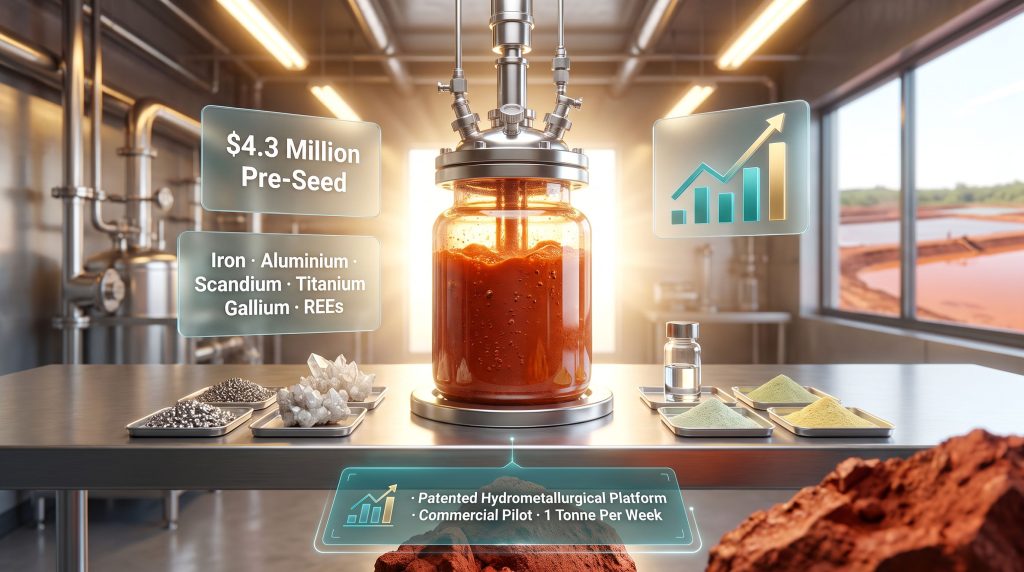
That calculus is now shifting. The same material that has long been treated as a liability is drawing fresh attention as a potential secondary source of metals that Western supply chains urgently need. FAST Metals red mud mineral recovery sits at the centre of this reappraisal, applying a patented hydrometallurgical process to extract commercially relevant metals from a waste stream that has historically been too complex and too costly to monetise.
When big ASX news breaks, our subscribers know first
Why Red Mud Has Never Been Easy to Ignore or Exploit
The Chemistry That Makes Bauxite Residue So Problematic
Red mud derives its name from the high iron oxide content that gives it a characteristic rust-red colouration. The Bayer Process, which has been the dominant method of alumina refining since the late nineteenth century, dissolves aluminium hydroxide from bauxite using concentrated sodium hydroxide under high temperature and pressure. What remains after the aluminium is extracted is a fine-grained slurry with a highly alkaline pH, often exceeding pH 12, that contains iron oxides, silica, titanium dioxide, residual aluminium, and trace concentrations of scandium, gallium, vanadium, and rare earth elements (REEs).
This chemistry creates a dual problem. The alkalinity makes red mud a classified hazardous material in most jurisdictions, imposing significant containment, monitoring, and long-term liability costs on producers. The fine particle size and mineralogical complexity have historically made it resistant to conventional beneficiation methods. Simply running red mud through a standard flotation circuit or magnetic separation plant does not produce clean, sellable metal concentrates.
The Scale of the Stockpile Problem
The 2010 Ajka disaster in Hungary, where a red mud storage dam failed and released approximately one million cubic metres of toxic slurry into surrounding communities and waterways, remains the defining catastrophe that sharpened regulatory attention on bauxite residue management globally. It also illustrated the latent financial risk embedded in every operational red mud pond. As environmental liability standards tighten across the US, the European Union, and Australia, the cost of simply holding this material in long-term storage is rising, making the economics of recovery increasingly attractive even at modest extraction yields.
What Metals Are Actually Locked Inside Red Mud
Understanding the Hidden Mineral Inventory
The mineral content of red mud varies significantly depending on the bauxite source and refining process used, which is itself one of the technical challenges for any recovery technology. That said, the typical composition of globally averaged bauxite residue includes:
- Iron oxides (hematite, goethite): 30 to 60% by weight, making iron the dominant recoverable metal by volume
- Aluminium oxide (Al₂O₃): 10 to 20%, representing residual alumina not captured in primary refining
- Titanium dioxide (TiO₂): 3 to 10%, with potential for titania product streams
- Silica (SiO₂): 3 to 15%, a gangue mineral that must be managed in processing
- Scandium: Typically 80 to 150 parts per million (ppm) in most residues, occasionally higher depending on bauxite origin
- Gallium: Present at trace concentrations, but recoverable given gallium's extreme scarcity and high unit value
- Rare earth elements: Light REEs including cerium, lanthanum, neodymium, and praseodymium, typically 0.05 to 0.15% combined
Scandium concentrations in red mud are frequently higher than those found in dedicated scandium-bearing mineral deposits that are currently under exploration. At 80 to 150 ppm, bauxite residue represents a genuinely competitive feedstock for scandium recovery when processing costs can be managed.
For context, primary scandium deposits being developed globally often target grades of 50 to 400 ppm, meaning red mud is not obviously inferior as a scandium source. The critical variable is always processing cost per unit of recovered metal, not grade alone.
Gallium: The Under-Discussed Co-Product
Gallium deserves particular attention in any analysis of red mud recovery economics. Gallium is not mined as a primary product anywhere in the world. It is recovered almost exclusively as a byproduct of aluminium refining and zinc smelting, and China currently controls approximately 80% of global gallium production. Gallium is essential for compound semiconductors used in 5G infrastructure, solar cells, and defence electronics.
The US government has identified gallium as a critical mineral, and China's export controls introduced in 2023 sent immediate shockwaves through downstream manufacturing supply chains. Furthermore, understanding gallium critical mineral deposits helps contextualise why red mud, as a byproduct of the same aluminium refining process that produces gallium in the first place, carries residual gallium concentrations that become strategically meaningful when processed at scale.
How FAST Metals' Technology Works
Iron Removal as the Key Unlocking Step
FAST Metals' patented hydrometallurgical platform is built around a sequenced extraction architecture. The critical first step involves removing iron from the red mud matrix. This is technically significant because iron dominates red mud by mass, and its presence interferes with the downstream recovery of higher-value metals. By solving the iron problem first, and by converting it into a sellable iron product stream rather than a waste byproduct, the process transforms what would otherwise be a processing liability into a revenue-contributing output.
Once iron is separated, the remaining material is substantially enriched in aluminium, titanium, scandium, gallium, and REE concentrations relative to the original feedstock. Subsequent hydrometallurgical stages then extract these elements into individual product streams, targeting commercially acceptable purity grades.
Modular and On-Site Processing Architecture
A design principle that differentiates FAST Metals' approach from centralised processing models is the emphasis on modular, on-site deployment. Transporting red mud is expensive, environmentally risky, and in many cases legally constrained given its hazardous material classification. A processing system that can be deployed adjacent to existing storage facilities eliminates the transport problem entirely and reduces the regulatory complexity associated with moving classified waste across jurisdictions.
The platform is described as capable of processing iron-rich, low-grade feedstocks with the output being saleable metal streams including gallium, alumina, titania, and rare earth elements. This positions FAST Metals not merely as a waste remediation company but as a critical mineral producer that sources its feedstock at zero or negative cost, given that refiners may be willing to pay to have residue processed rather than stored indefinitely.
Comparing Red Mud Recovery Methodologies
The competitive landscape for bauxite residue valorisation includes several distinct technical approaches, each with meaningful trade-offs:
| Recovery Method | Key Advantage | Key Limitation | Stage of Development |
|---|---|---|---|
| Hydrometallurgy (FAST Metals) | Multi-metal extraction, modular | Process complexity, reagent costs | Commercial pilot |
| Pyrometallurgy | High throughput iron recovery | Extremely energy intensive | Research and industrial |
| Magnetic Separation | Low cost, simple implementation | Limited metal range, poor REE capture | Applied |
| Flash Heating (e.g., Rice University) | Rapid iron and aluminium recovery | Very early stage | Laboratory |
| Bioleaching | Low environmental impact | Slow kinetics, impractical at scale | Research |
| Electrodialysis | Selective ion separation | High capital cost, niche application | Research |
Hydrometallurgy's advantage in this context is its flexibility across multiple metal targets simultaneously. Pyrometallurgical approaches, while capable of processing large volumes of iron-bearing material, typically sacrifice the ability to recover the high-value trace metals, precisely the scandium, gallium, and REEs that justify the economics of red mud processing in the first place.
Magnetic separation captures iron efficiently but leaves the value-bearing fraction behind. Emerging flash heating technology, whilst intellectually promising, remains at a very early laboratory stage. Bioleaching is similarly constrained, being kinetically too slow for industrial application at the throughput rates that would make a dent in multi-billion tonne stockpiles.
The $4.3 Million Pre-Seed Round and What It Signals
Investor Composition and Strategic Significance
FAST Metals closed a $4.3 million pre-seed funding round led by New Climate Ventures, with participation from Azolla Ventures, Humba Ventures, Astor Swiss, and notably Rio Tinto through its involvement with the Founders Factory mining technology accelerator. The investor mix is analytically interesting on several levels.
- New Climate Ventures anchoring the round signals a climate-tech framing, positioning red mud recovery within decarbonisation and circular economy investment theses
- Azolla Ventures brings climate-focused venture capital credentials, reinforcing the environmental co-benefit narrative around waste stream remediation
- Humba Ventures provides emerging technology exposure
- Astor Swiss introduces international capital with potential connections to European industrial markets where red mud stockpiles are substantial
- Rio Tinto via Founders Factory is the participation that will attract the most scrutiny from industry observers
Rio Tinto's involvement through an accelerator structure rather than a direct equity stake is a distinction worth drawing carefully. It represents strategic validation and potential future commercial relevance within the Rio Tinto supply ecosystem, but it should not be interpreted as a formal partnership, offtake commitment, or operational endorsement at this stage. For a pre-seed company, however, the mere presence of a major global miner in its cap table is a credibility signal that meaningfully reduces the perceived technology risk for subsequent investors evaluating a Series A.
At the pre-seed stage in deep-tech mining ventures, the identity of investors frequently carries more signal value than the dollar amount raised. A $4.3 million round with Rio Tinto's name attached will open doors that a $10 million round from anonymous family offices would not.
What Pre-Seed Capital Actually Funds in Deep-Tech Mining
In the mining technology sector, pre-seed capital at this scale is typically allocated across four priority areas: process optimisation at pilot scale, intellectual property protection and expansion, business development activity to convert MOUs into binding commercial agreements, and the technical data generation needed to support a credible Series A pitch. FAST Metals has indicated the new capital will fund technical development alongside commercial operations, with a specific focus on refining recovery efficiency and growing its customer pipeline.
The next major ASX story will hit our subscribers first
The Metalox Partnership: First Commercial Deployment
Florida as a Strategic Entry Point
The inaugural commercial partnership with Metalox Mineral Corporation, involving the processing of one tonne per week of red mud and other iron-bearing waste at Metalox's Florida facility, is a carefully chosen proof-of-concept deployment. Florida is not an arbitrary location. The southeastern United States is home to industrial infrastructure associated with phosphate processing, aluminium operations, and chemical manufacturing, all of which generate iron-rich process residues that could serve as feedstock for FAST Metals' technology beyond conventional red mud.
Reading the Throughput Rate Honestly
One tonne per week of red mud processing needs to be contextualised accurately. At that rate, the system processes roughly 52 tonnes per year, which is industrially negligible relative to the hundreds of millions of tonnes generated annually. The Metalox deployment is explicitly a commercial pilot, designed to demonstrate process repeatability under real operating conditions rather than to deliver volume output. The pathway from one tonne per week to economically meaningful throughput, typically measured in hundreds to thousands of tonnes per day at commercial scale, requires substantial additional capital, engineering optimisation, and validated offtake agreements.
Investor note: FAST Metals' process economics and recovery yields are currently company-reported figures at pilot scale. Independent metallurgical audits and third-party verification represent critical milestones before commercial-scale commitments can be responsibly evaluated by potential offtake partners or institutional investors. This is not unusual for a pre-seed stage company, but it is a material due diligence consideration.
The existence of multiple signed MOUs with additional trading partners alongside the Metalox agreement suggests active pipeline development, though MOUs carry no binding commercial obligation and their conversion rate to definitive agreements will be a key metric to monitor.
The Critical Mineral Supply Chain Context
Western Supply Chain Vulnerability and the Secondary Source Imperative
The strategic context driving interest in FAST Metals red mud mineral recovery extends well beyond any single company's commercial ambitions. Western industrial economies have accumulated a critical mineral dependency on Chinese processing capacity that spans the full value chain from mining through refining to refined metal supply. The broader critical minerals demand surge is consequently accelerating interest in secondary recovery sources. For scandium, gallium, and several light REEs, China's market share in refined production exceeds 70 to 90%.
Bauxite residue stockpiles located in North America, Europe, and Australia represent a geographically distributed secondary resource base for these exact materials. Unlike primary mining projects, which require years of exploration, resource definition, permitting, and construction before producing their first tonne, red mud recovery operations can theoretically be deployed against existing, fully characterised waste stockpiles with known locations, volumes, and approximate compositions.
This characteristic, the ability to begin processing without a greenfield mine development cycle, is what gives secondary recovery technologies their strategic appeal in a policy environment that is actively seeking to accelerate critical mineral supply domestically.
Environmental Co-Benefits and Long-Term Liability Reduction
Beyond the critical mineral narrative, red mud recovery carries a genuine environmental remediation value proposition. Every tonne of bauxite residue processed and converted into saleable products is a tonne removed from a storage facility that carries perpetual monitoring, maintenance, and liability costs. For alumina producers facing tightening environmental regulations and growing stakeholder pressure around legacy waste sites, a technology that converts liability into revenue is commercially compelling independent of the critical mineral angle.
Leadership and Advisory Credibility
FAST Metals was co-founded by CEO Sumedh Gostu, whose technical vision centres on reframing alumina refining waste as an untapped critical mineral resource. The advisory board brings specific commercial credibility that is often underweighted in assessments of early-stage mining technology companies.
Nick Popovic, formerly the head of copper and zinc trading at Glencore International, contributes commodity trading expertise and market access relationships that are directly relevant to FAST Metals' ability to sell metal streams into established trading channels. Commodity trading experience at Glencore's level implies familiarity with the specifications, logistics, and counterparty relationships that govern global metal markets, knowledge that is genuinely difficult to substitute with generic business advisors.
Terry McNulty, a minerals industry specialist, adds technical processing depth to the advisory function. For a company whose value proposition rests entirely on the credibility of its extraction process, mineralogy and processing expertise at the advisory level is a structural requirement rather than an optional enhancement.
Frequently Asked Questions: FAST Metals and Red Mud Mineral Recovery
What is red mud and where does it come from?
Red mud is the caustic, iron-rich residue generated during the Bayer Process refining of bauxite ore into alumina. It is produced at a ratio of roughly one to two tonnes per tonne of alumina refined, resulting in global stockpiles exceeding four billion tonnes.
What metals can be recovered from red mud using FAST Metals' process?
The patented platform targets iron, aluminium (alumina), scandium, titanium (titania), gallium, and rare earth elements including light REEs such as cerium, lanthanum, neodymium, and praseodymium.
How much funding has FAST Metals raised and who are its investors?
FAST Metals raised $4.3 million in pre-seed funding, led by New Climate Ventures with participation from Azolla Ventures, Humba Ventures, Astor Swiss, and Rio Tinto via the Founders Factory mining technology accelerator.
What is the Metalox Mineral partnership?
It is FAST Metals' first commercial deployment agreement, under which the company will process one tonne per week of red mud and iron-bearing waste at Metalox's Florida facility.
Is red mud mineral recovery commercially proven at scale?
No. While the technology has a sound scientific basis and is advancing through commercial pilot stages, no red mud recovery technology has yet been demonstrated at the throughput rates required for industrial-scale critical mineral production. FAST Metals is at a pre-seed, commercial pilot stage.
Why are scandium and REEs from red mud strategically important?
Both material groups are identified as critical minerals by the US, EU, and allied nations. China dominates their refined production, creating supply chain vulnerability. Bauxite residue represents a geographically accessible secondary source that could contribute to domestic supply diversification. In addition, major aluminium producers generating this residue at scale are increasingly incentivised to support recovery solutions that reduce their long-term liability exposure.
Key Metrics at a Glance
| Metric / Factor | Detail |
|---|---|
| Pre-Seed Funding Raised | $4.3 million |
| Lead Investor | New Climate Ventures |
| Strategic Investor | Rio Tinto (via Founders Factory accelerator) |
| First Commercial Partner | Metalox Mineral Corporation |
| Processing Location | Florida, USA |
| Initial Processing Throughput | 1 tonne per week |
| Target Metals | Iron, aluminium, scandium, titanium, gallium, REEs |
| Technology Type | Patented hydrometallurgical platform |
| Current Stage | Commercial pilot / pre-seed |
| Global Red Mud Stockpile | Over 4 billion tonnes |
| Annual Red Mud Generation | Approximately 175 million tonnes |
The Road Ahead: Scale, Validation, and Market Timing
The convergence of three structural forces, the mounting environmental liability of red mud stockpiles, the Western world's urgent need for non-Chinese critical mineral sources, and the maturation of hydrometallurgical processing technology, creates a genuinely favourable backdrop for FAST Metals red mud mineral recovery as a commercial proposition. Timing in deep-tech mining ventures matters enormously, and the current policy and market environment is arguably the most receptive in the sector's history for secondary recovery technologies.
The milestones that will determine whether FAST Metals translates pre-seed momentum into commercial scale are clearly defined, even if their achievement timelines are uncertain. Independent metallurgical validation of recovery yields and process economics, conversion of MOUs into binding offtake agreements, demonstration of process repeatability across varied red mud feedstocks, and the capital raise needed to step from pilot to meaningful throughput represent the sequential challenges ahead.
The scale challenge is real and should not be minimised. Processing one tonne per week is categorically different from operating a facility processing one thousand tonnes per day. Engineering, regulatory, capital, and logistical complexity scale non-linearly with throughput in hydrometallurgical operations. However, recent analysis of red mud valorisation confirms that the value of the mineral inventory locked inside the world's red mud stockpiles, measured in scandium, gallium, REEs, and titanium alone, is sufficient to justify serious commercial and investment attention if the processing economics can be validated at scale.
Furthermore, published research on bauxite residue recovery continues to advance the scientific foundation underpinning technologies like FAST Metals' platform, reinforcing the legitimacy of the commercial thesis even as industrial-scale proof points remain to be established.
This article contains forward-looking statements and analysis based on information available at the time of writing. Red mud mineral recovery technologies remain at early to pilot commercial stages. Investors and industry participants should conduct independent due diligence and should not rely on company-reported figures as the sole basis for commercial or investment decisions. All financial and technical data referenced reflects publicly available information and does not constitute financial advice.
Want to Track the Next Critical Mineral Opportunity Before the Market Moves?
Discovery Alert's proprietary Discovery IQ model delivers real-time alerts on significant ASX mineral discoveries — including those tied to critical minerals like scandium, gallium, and rare earth elements — instantly converting complex data into actionable insights for investors at every level. Explore historic discoveries and the returns they generated, then begin your 14-day free trial to position yourself ahead of the broader market.