July 30, 2026
The Heavy Rare Earth Bottleneck That Western Industry Can No Longer Ignore
Permanent magnet supply chains have a problem that most investors and policymakers are only beginning to understand at full depth. The issue is not simply that rare earth elements are mined predominantly outside Western borders. The deeper structural vulnerability lies in processing, specifically the separation of heavy rare earth oxides like terbium and dysprosium into the high-purity forms that magnet manufacturers actually require. Outside of China, this capability is almost entirely absent at commercial scale. That gap is what makes the Energy Fuels White Mesa Mill expansion one of the most consequential developments in Western critical minerals infrastructure currently underway.
When big ASX news breaks, our subscribers know first
Why White Mesa Mill Occupies a Structurally Unique Position
Most discussions of rare earth supply chains focus on mining. The more instructive lens, however, is processing. A mine that produces rare earth concentrate has limited strategic value without a facility capable of separating individual elements to magnet-grade purity. This separation step, known as solvent extraction or SX processing, requires substantial infrastructure, deep technical expertise, and in the case of monazite feedstocks, the ability to safely manage co-occurring radioactive materials including thorium and uranium.
White Mesa Mill, located in San Juan County, Utah, is the only fully licensed conventional uranium and rare earth processing facility operating in the United States. This dual licensing is not a minor administrative detail. It is the precise reason the facility can accept monazite concentrate, the richest naturally occurring source of combined light and heavy rare earth oxides, without requiring separate radioactive material management infrastructure.
Every other prospective Western rare earth processor working with monazite feedstocks must build or obtain equivalent regulatory permissions from scratch, a process that routinely adds years and hundreds of millions of dollars to project timelines.
The combination of an existing operating licence, demonstrated rare earth pilot processing capability, and a multi-commodity regulatory framework gives White Mesa Mill a structural head start that no greenfield rare earth project in the Western world currently replicates.
The Chemistry Behind Monazite's Strategic Value
Monazite is a phosphate mineral that naturally concentrates a broad spectrum of rare earth elements, including both the light rare earths (neodymium and praseodymium, which form the primary matrix of NdFeB permanent magnets) and the heavy rare earths (terbium and dysprosium, which are added in smaller quantities to enhance magnet performance at elevated temperatures).
The co-occurrence of both light and heavy rare earths in a single feedstock is a significant processing advantage, because it allows a single facility to produce the full suite of magnet-relevant oxides rather than relying on separate ore sources for each element type.
The challenge with monazite has historically been its thorium content, which makes it a radioactively designated material in most jurisdictions. White Mesa's existing licensed status removes this as a barrier, which is why the Energy Fuels critical minerals strategy around this feedstock pathway represents a genuinely differentiated capability rather than simply an incremental capacity addition.
The Energy Fuels White Mesa Mill Expansion: Phase-by-Phase Breakdown
The expansion programme at White Mesa is structured in two distinct phases, each building on the operational and permitting foundations of the previous stage.
Phase 1 Modifications: Unlocking the Heavy Rare Earth Suite
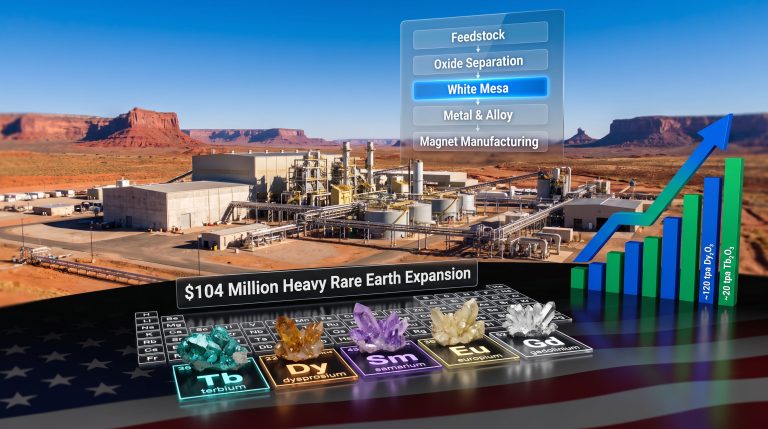
Construction commenced in July 2026 on the Phase 1 heavy rare earth circuit modifications, with an estimated capital cost of $104 million. The existing Phase 1 infrastructure already supports production of up to 1,000 tpa of separated neodymium-praseodymium (NdPr) oxide. The new circuits being added will extend White Mesa's separation capability across five additional elements:
- Terbium (Tb): targeted annual output of approximately 20 tpa
- Dysprosium (Dy): targeted annual output of approximately 120 tpa
- Samarium (Sm): additional commercial volumes
- Europium (Eu): additional commercial volumes
- Gadolinium (Gd): additional commercial volumes
The terbium and dysprosium circuits are targeted for operational commissioning by the end of 2027, with samarium, europium, and gadolinium circuits following by the end of 2028.
Phase 2 Expansion: Industrial-Scale Rare Earth Production
Underpinned by a bankable feasibility study released in January 2026, Phase 2 represents a step-change in production scale. The estimated capital requirement is $410 million, with full commissioning targeted across the 2028 to 2029 window.
| Phase | Key Outputs | Annual Volume | CapEx | Target Completion |
|---|---|---|---|---|
| Phase 1 (existing) | NdPr oxide | ~1,000 tpa | Sunk | Operational |
| Phase 1 modifications | Tb, Dy, Sm, Eu, Gd oxides | Tb: ~20 tpa / Dy: ~120 tpa | ~$104M | 2027–2028 |
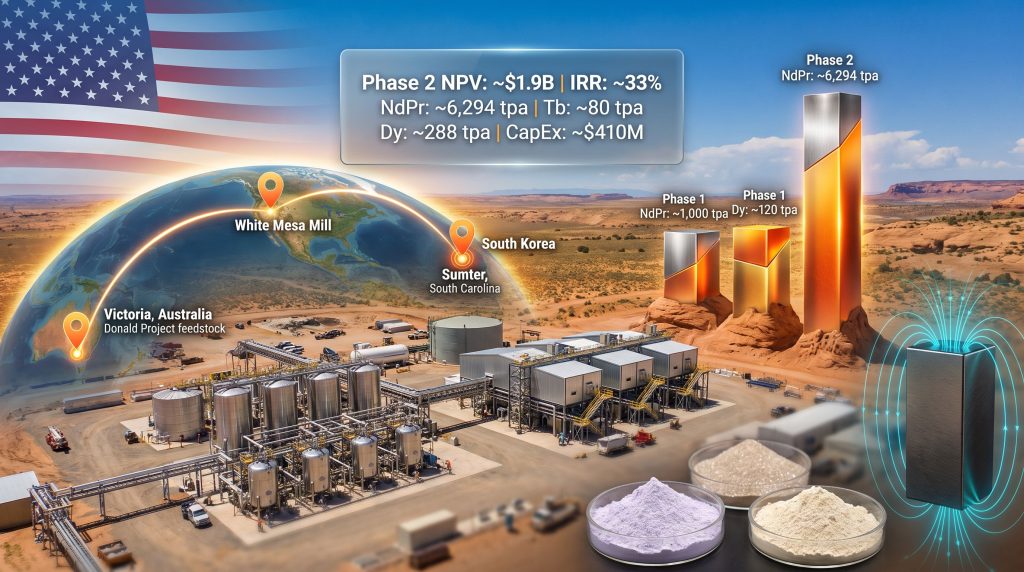
| Phase 2 expansion | NdPr + full heavy REE suite | NdPr: 6,294 tpa / Tb: 80 tpa / Dy: 288 tpa | ~$410M | 2028–2029 |
The Phase 2 feasibility study economics are compelling on paper. The project carries a net present value of approximately $1.9 billion at an 8% discount rate, with an internal rate of return of approximately 33%. However, investors should note that feasibility study economics are inherently sensitive to commodity price assumptions, and rare earth oxide prices, particularly for NdPr, Tb, and Dy, have historically exhibited significant volatility. These figures should be treated as scenario-dependent projections rather than guaranteed outcomes.
Feedstock Architecture: The Donald Project's Role as Upstream Anchor
Processing capacity without a reliable feedstock pipeline is strategically incomplete. Energy Fuels has structured its upstream supply around the Donald Project, a mineral sands joint venture located in Victoria, Australia. The project is projected to supply between 8,500 and 9,500 tpa of monazite concentrate to White Mesa, with first deliveries anticipated in 2028, subject to a final investment decision expected in the third quarter of 2026.
The timing alignment between Donald Project monazite availability and Phase 2 commissioning is deliberate and represents one of the more technically sophisticated aspects of the overall supply chain construction. However, this alignment also creates a binary dependency risk. If the Donald Project final investment decision is delayed or the project encounters permitting complications in Victoria, White Mesa's Phase 2 ramp-up would face a feedstock gap requiring alternative monazite sourcing, which remains a limited global market.
What Makes Monazite Feedstock Logistics Uniquely Complex
Transporting monazite concentrate from Australia to Utah is not a routine bulk shipping exercise. Monazite's thorium and uranium content classifies it as a radioactive material under international transport regulations, requiring specific licensing, packaging standards, and port approvals across multiple jurisdictions.
Furthermore, Energy Fuels' existing experience managing radioactive materials at White Mesa provides operational precedent, but cross-border regulatory coordination between Australian export controls and U.S. import requirements adds a layer of execution complexity that is not commonly appreciated by generalist investors evaluating this supply chain.
Terbium and Dysprosium: Why These Two Elements Drive the Entire Strategic Rationale
Of all the rare earth oxides targeted by the Energy Fuels White Mesa Mill expansion, terbium and dysprosium carry the greatest geopolitical and commercial weight. Understanding why requires a brief look at magnet physics.
NdFeB permanent magnets, the type used in electric vehicle traction motors, offshore wind turbine generators, and high-performance defence systems, lose coercivity (the ability to resist demagnetisation) at elevated operating temperatures. This is a fundamental material limitation. Dysprosium additions to the magnet alloy restore coercivity at high temperatures, enabling motors to operate reliably in demanding thermal environments. Terbium performs a similar function and is increasingly substituted for or blended with dysprosium depending on relative pricing and availability.
The supply concentration problem for both elements is acute. In addition, the rare earth processing challenges associated with heavy rare earths compound the supply risk considerably:
- Global production of terbium and dysprosium is overwhelmingly concentrated in ionic clay deposits in China's Jiangxi and Guangdong provinces
- These ionic clay deposits, sometimes called South China ionic adsorption clay deposits, are geologically unusual in their heavy rare earth enrichment, a characteristic not widely replicated elsewhere in the world
- Unlike hard rock rare earth deposits, ionic clay deposits allow relatively low-cost extraction through in-situ leaching, giving Chinese producers a structural cost advantage in heavy rare earth production that Western hard rock and monazite-based projects must work to offset through processing efficiency
| Element | Primary Function in NdFeB Magnets | Critical End Markets | Global Supply Concentration |
|---|---|---|---|
| Dysprosium (Dy) | Coercivity retention at high temperatures | EVs, wind turbines, defence | Predominantly China (ionic clays) |
| Terbium (Tb) | Temperature stability and coercivity | EVs, defence, robotics | Predominantly China (ionic clays) |
| NdPr | Core magnet matrix | All permanent magnet applications | China dominant, some diversification |
A detail that is often overlooked in coverage of heavy rare earth supply chains is that terbium and dysprosium are not simply scarce in absolute terms. They are scarce in accessible, separable, commercially processable form outside of China. Monazite-bearing mineral sands deposits like Donald represent one of the few non-Chinese pathways to heavy rare earth oxide production at meaningful scale, which is why the White Mesa processing capability, combined with Australian feedstock supply, is structurally significant.
Building a Mine-to-Magnet Supply Chain: From Utah to South Carolina
The White Mesa expansion does not exist as a standalone processing investment. It is the central node in a vertically integrated supply chain that Energy Fuels is constructing across multiple geographies and processing stages.
The downstream architecture is structured as follows:
- Mining and concentrate production: Donald Project (Victoria, Australia) produces monazite concentrate from mineral sands operations
- Rare earth oxide separation: White Mesa Mill (Utah, USA) separates monazite into individual rare earth oxides including NdPr, Tb, Dy, Sm, Eu, and Gd
- Metal and alloy production: Australian Strategic Materials (ASM) processes rare earth oxides into metals and alloys at its facility in South Korea, with White Mesa oxides expected to supply approximately 70% of ASM's feedstock requirements
- Permanent magnet manufacturing: Vacuumschmelze (VAC) converts alloys into finished permanent magnets at its facility in Sumter, South Carolina
Energy Fuels has entered a definitive agreement to acquire 100% of the VAC facility from Ara Partners for approximately $1.9 billion in a combined cash-and-stock transaction. This acquisition, if completed, would transform Energy Fuels from a raw material processor into a fully integrated rare earth magnet supply chain operator, one of very few such entities operating primarily within Western jurisdictions.
The next major ASX story will hit our subscribers first
Competitive Landscape: How White Mesa Stacks Up Against Western Peers
The broader context for the Energy Fuels White Mesa Mill expansion is a global scramble to develop non-Chinese rare earth separation capacity. Consequently, the critical minerals demand surge is intensifying competition among Western nations to establish independent processing infrastructure. The competitive field, however, remains thin:
| Project | Location | Primary Output | Status | Operator |
|---|---|---|---|---|
| White Mesa Mill (Phase 2) | Utah, USA | NdPr + full heavy REE suite | Construction commenced | Energy Fuels |
| MP Materials | California, USA | NdPr oxide | Operating (scaling separation) | MP Materials |
| Lynas Rare Earths | Malaysia / Texas, USA | NdPr, some heavy REE | Operating / Texas in development | Lynas |
| Pensana | Humber, UK | NdPr oxide | Development stage | Pensana |
A critical differentiator that the table above does not fully capture is the heavy rare earth separation dimension. Most Western rare earth projects are focused on NdPr production, because light rare earth separation is considerably more technically mature and commercially accessible outside China than heavy rare earth separation. The ability to produce commercial-scale terbium and dysprosium oxides from a licensed, operating facility is a capability that virtually no Western project outside White Mesa currently demonstrates at production scale.
This is not a marginal distinction. It is the core of the strategic argument for the expansion's significance. Furthermore, the global rare earth competition is expanding beyond traditional Western players, adding further urgency to establishing domestic separation capacity.
Funding Structure and Capital Allocation
The Phase 1 heavy rare earth circuit modifications carry a capital cost of $104 million. Energy Fuels reported working capital of approximately $960 million as of 31 March 2026, providing substantial liquidity headroom. Funding is expected to combine U.S. government grants and loan facilities, including a previously disclosed federal loan commitment, with company working capital covering the remainder.
Phase 2 funding strategy follows a similar structure, drawing on the same federal support framework alongside internal resources. The $410 million Phase 2 capital requirement is substantially larger, making the continuation of government financing mechanisms an important variable in the project's execution timeline.
Disclaimer: All financial figures, NPV estimates, IRR projections, and production targets cited in this article are drawn from company disclosures and feasibility studies. These figures involve forward-looking assumptions about commodity prices, capital costs, and operating conditions that may differ materially from actual outcomes. This article does not constitute financial advice. Investors should conduct independent due diligence before making investment decisions.
Permitting Progress and Construction Timeline
Phase 1 modification permitting was reported to be advancing on schedule with the State of Utah as of mid-2026, a meaningful advantage arising from White Mesa's existing licensed operational status. Greenfield rare earth projects in the United States routinely face multi-year permitting timelines, making White Mesa's incremental expansion pathway considerably less exposed to regulatory delay risk than new-site development.
Key milestones in the construction and commissioning sequence are:
- July 2026: Construction commencement on Phase 1 heavy rare earth circuits confirmed
- End of 2027: Terbium and dysprosium separation circuits targeted for completion
- End of 2028: Samarium, europium, and gadolinium circuits targeted for completion; Donald Project monazite supply anticipated to begin
- 2028 to 2029: Phase 2 full commissioning targeted, synchronising with expanded monazite feedstock availability
Environmental considerations specific to the Utah site include water consumption in an arid region and the ongoing management of thorium-bearing tailings from monazite processing. White Mesa's existing tailings management infrastructure and regulatory framework provide a foundation for managing these obligations, but evolving environmental standards at both state and federal levels remain an area requiring continued monitoring.
Frequently Asked Questions: Energy Fuels White Mesa Mill Expansion
What rare earth oxides will White Mesa Mill produce after the expansion?
Following completion of Phase 1 modifications and the Phase 2 buildout, White Mesa is expected to produce neodymium-praseodymium (NdPr), terbium (Tb), dysprosium (Dy), samarium (Sm), europium (Eu), and gadolinium (Gd) oxides at commercial scale.
What is the total capital cost of the White Mesa Mill expansion?
Phase 1 heavy rare earth circuit modifications are estimated at $104 million. Phase 2 expansion carries an estimated capital cost of $410 million, bringing combined expansion capital to approximately $514 million across both phases.
When will terbium and dysprosium production begin at White Mesa?
The terbium and dysprosium separation circuits are targeted for commissioning by the end of 2027, representing the first commercial-scale production of these elements from a U.S. facility processing monazite feedstock.
What is the primary feedstock source for the expanded mill?
The Donald Project joint venture in Victoria, Australia, is expected to supply 8,500 to 9,500 tpa of monazite concentrate beginning in 2028, subject to a final investment decision anticipated in the third quarter of 2026.
How does the White Mesa expansion connect to magnet manufacturing?
Rare earth oxides separated at White Mesa are expected to supply approximately 70% of the feedstock for Australian Strategic Materials' metal and alloy production in South Korea, which in turn supplies the Vacuumschmelze permanent magnet facility in Sumter, South Carolina — a facility Energy Fuels has agreed to acquire for approximately $1.9 billion.
Readers seeking additional context on the broader competitive landscape can explore analysis at Mining.com, which examines how Energy Fuels could rank among the top rare earth producers in the Western world.
Want to Track the Next Major Critical Minerals Discovery Before the Market Does?
Discovery Alert's proprietary Discovery IQ model scans ASX announcements in real time, instantly identifying significant mineral discoveries across rare earths, critical minerals, and over 30 other commodities — delivering actionable insights to subscribers ahead of the broader market. Explore historic discoveries and the returns they generated, then begin your 14-day free trial at Discovery Alert to position yourself at the forefront of the next major find.