
July 31, 2026
When Geology Does the Processing Work: The Mineralogical Edge Redefining Rare Earth Development
Rare earth project development is rarely straightforward. For most deposits globally, the path from ore in the ground to separated rare earth oxide in a processing facility runs through a gauntlet of energy-intensive acid baking, high-temperature roasting, and complex solvent extraction circuits. These steps exist because the rare earth elements are locked inside hard, chemically resistant crystalline minerals that nature has spent millions of years making stubbornly difficult to break apart. What makes North Stanmore rare earth potential so analytically interesting is that nature, in this case, appears to have already done a significant portion of that work.
The geological processes that have shaped the North Stanmore project in Western Australia over deep time have transformed what was once a conventional rare earth mineral assemblage into something fundamentally different, and potentially far more commercially accessible. Understanding why that distinction matters requires looking at both the mineralogy in detail and the broader global context into which this project is emerging.
When big ASX news breaks, our subscribers know first
The Global Rare Earth Supply Chain: A System Under Structural Stress
The rare earth elements are not particularly scarce in the Earth's crust. What makes them strategically critical is the extraordinary concentration of processing capacity that has developed in one country. China controls an estimated 85 to 90 percent of global rare earth processing and separation capacity, a position built over decades of deliberate industrial policy and underpriced production that effectively drove competing operations out of business during the 1990s and 2000s.
The consequences of that concentration are now becoming acutely visible. Furthermore, western nations building out electric vehicle manufacturing, wind energy infrastructure, and advanced defence systems are encountering a hard constraint: the permanent magnets at the heart of all these technologies depend on rare earth elements, and rare earth supply chains remain overwhelmingly routed through Chinese processing facilities.
Within the rare earth family, two categories attract the most strategic attention:
-
Magnet light rare earths (LREEs): Neodymium (Nd) and praseodymium (Pr) are the functional core of neodymium-iron-boron (NdFeB) permanent magnets, the dominant magnet technology in EV motors and direct-drive wind turbines.
-
Heavy rare earth elements (HREEs): Dysprosium (Dy) and terbium (Tb) are added to NdFeB magnets to maintain coercivity at elevated operating temperatures, a requirement for automotive and industrial applications where thermal performance is non-negotiable.
A deposit capable of supplying both categories from a single project occupies an exceptionally rare position in the global development pipeline. Lynas Rare Earths (ASX: LYC), the only significant non-Chinese producer of separated rare earth products operating at scale, is weighted predominantly toward light rare earths. The HREE gap in Western supply chains remains essentially unfilled, further intensifying the critical minerals demand surge now reshaping global resource investment.
The absence of a credible, scalable non-Chinese HREE supply source is arguably the most acute single vulnerability in the Western critical minerals supply chain today.
What TIMA Analysis Revealed About North Stanmore's Mineralogy
Victory Metals completed a TESCAN Integrated Mineral Analyser (TIMA) study on concentrate produced at its pilot plant, using samples drawn from 18 drill locations distributed across the project area. TIMA technology uses automated scanning electron microscopy combined with energy-dispersive X-ray spectroscopy to quantify the mineralogical composition of a sample with precision that conventional chemical assaying alone cannot achieve. It identifies not just what elements are present, but which specific mineral phases are hosting them and in what proportions.
The findings from that analysis establish the core technical thesis underpinning the North Stanmore rare earth potential:
| Rare Earth Element | Primary Host Phase | Proportion Hosted in Secondary Phosphates |
|---|---|---|
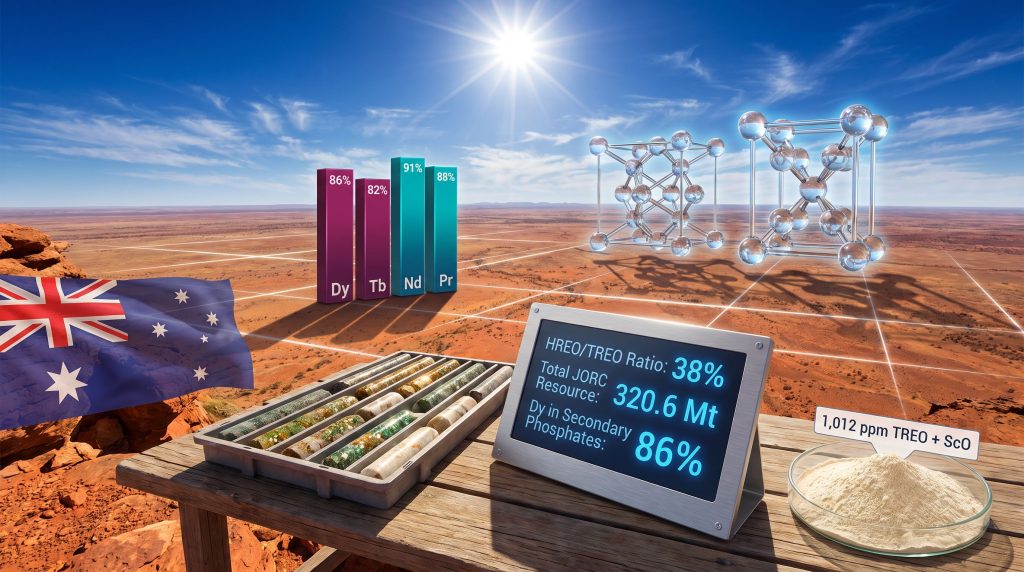
| Dysprosium (Dy) | Churchite and secondary phosphates | 86% |
| Terbium (Tb) | Churchite and secondary phosphates | 82% |
| Neodymium (Nd) | Broader secondary phosphate system | 91% |
| Praseodymium (Pr) | Broader secondary phosphate system | 88% |
The compositional breakdown of the concentrate itself is equally telling. Secondary phosphate minerals, principally churchite, accounted for 5.93% of the analysed concentrate by proportion. Primary monazite and xenotime-type minerals, the dominant rare earth hosts in most conventional deposits globally, represented just 1.13% of the same material. That is a ratio exceeding 5:1 in favour of the secondary mineral system.
Understanding Churchite: The Mineral Most Investors Have Never Heard Of
Churchite is a hydrated rare earth phosphate mineral belonging to the xenotime group structurally, but with a critical chemical difference: it incorporates water molecules into its crystal lattice, making it a hydrated phase. This hydration fundamentally changes its physical and chemical behaviour under processing conditions.
Unlike anhydrous xenotime or monazite, churchite and related hydrated secondary phosphates are generally more susceptible to attack by leaching reagents under milder conditions. The geological weathering process that produced churchite at North Stanmore involved the interaction of groundwater with primary rare earth minerals over extended geological timeframes, dissolving and reprecipitating the rare earth content into these more reactive secondary phases.
This process is sometimes described in technical literature as supergene enrichment or secondary mineral transformation, and it is the same class of geological process that creates the ion-adsorption clay deposits of southern China, which have historically been the world's dominant source of HREEs. The North Stanmore deposit is not a clay-hosted ion-adsorption system in the classical sense, but the principle connecting the two is analogous: natural weathering has pre-conditioned the ore toward lower-energy extraction pathways.
Resource Scale: Putting the Numbers in Context
The scale of the resource underpins the project's strategic significance in a way that few comparable deposits globally can match. In addition, the rare earth processing challenges associated with conventional deposits make North Stanmore's mineralogical profile all the more commercially compelling.
| Metric | North Stanmore | Typical Clay-Hosted REE Deposit |
|---|---|---|
| Total JORC Resource | 320.6 million tonnes | 50 to 150 Mt |
| Indicated Category | 176.5 million tonnes | 20 to 60 Mt |
| HREO/TREO Ratio | 38% | 5 to 15% |
| Projected Mine Life | 60+ years | 15 to 30 years |
| Mineralised Strike Length | 13.5 km | 2 to 5 km |
The HREO/TREO ratio of 38% warrants particular emphasis. In most rare earth deposits worldwide, heavy rare earths represent a small fraction of total rare earth content, often below 5%. A ratio of 38% reflects genuine HREE enrichment at a scale that would be considered exceptional by any global benchmark.
Within the broader resource, a high-grade domain of approximately 52 million tonnes has been identified carrying grades above 1,012 ppm TREO plus scandium oxide. The inclusion of scandium oxide in this grade measurement is notable, as scandium is itself a high-value critical material used in solid oxide fuel cells and as an aluminium alloy additive, and its co-occurrence with rare earth mineralisation may offer additional revenue potential.
The Processing Case: Flotation and Selective Leaching as a Lower-Intensity Pathway
The concentration of rare earth value within secondary phosphate minerals directly informs the processing strategy being evaluated for North Stanmore. Victory Metals has indicated it is pursuing a flotation-led beneficiation approach combined with selective leaching, a circuit architecture made viable by the mineralogical profile confirmed through TIMA analysis.
To appreciate why this matters, it helps to understand what conventional rare earth processing looks like:
-
Mining and crushing of hard rock or soft lateritic material.
-
Physical concentration via gravity separation, magnetic separation, or flotation to produce a mixed mineral concentrate.
-
Cracking of the mineral concentrate, typically through acid baking at temperatures above 200 degrees Celsius or caustic cracking at even higher temperatures, to break the chemical bonds in monazite or xenotime and liberate the rare earth ions.
-
Leaching of the cracked material with water or dilute acid to dissolve rare earth content.
-
Separation of individual rare earth elements through solvent extraction circuits, which involve dozens of sequential mixer-settler units and large volumes of organic solvents.
Steps 3 and 4 in that sequence are particularly energy and reagent intensive, and they are required specifically because primary minerals like monazite and xenotime are chemically resistant. Secondary phosphates, being more reactive by nature, may potentially be leached without the high-temperature cracking step, or may at minimum require significantly milder cracking conditions.
Important Caveat: A mineralogical profile that suggests processing amenability is not the same as confirmed metallurgical performance. The ongoing testwork program and Pre-Feasibility Study (PFS) represent the critical validation gateway between the current technical thesis and a bankable project.
Key Metallurgical Variables Yet to Be Resolved
The TIMA study provides directional guidance, but several commercially critical parameters remain to be confirmed through systematic testwork:
-
Leach recovery rates across the complete range of secondary phosphate mineral types and grain sizes present throughout the deposit.
-
Reagent selectivity, ensuring that leaching conditions target rare earth-bearing phases without dissolving excessive quantities of gangue minerals, which increases reagent consumption and downstream processing complexity.
-
Concentrate quality thresholds required to meet the specifications of potential downstream customers or processing facilities.
-
Circuit scalability from pilot plant volumes to full commercial throughput, where fluid dynamics, heat transfer, and residence time behaviour can differ meaningfully from laboratory results.
-
Optimal processing parameters including pH range, temperature, reagent concentrations, and residence time, all of which must be optimised simultaneously to achieve maximum recovery at minimum cost.
These variables will collectively determine whether the processing advantage suggested by the mineralogy translates into a genuinely competitive cost position at commercial scale.
The Dual-Supply Value Proposition: Why Both HREE and LREE Matter
One dimension of the North Stanmore rare earth potential that deserves more analytical attention than it typically receives is the co-occurrence of both magnet LREE and HREE value within the same deposit. This is not universally the case in rare earth geology, and consequently, it represents a meaningful structural differentiator.
Most carbonatite-hosted deposits, which are the most common geological type for large rare earth accumulations globally, are strongly enriched in light rare earths such as lanthanum, cerium, and to a lesser extent neodymium, but carry very low HREE concentrations. The HREEs tend to concentrate in different geological environments, particularly in granitic pegmatites, ion-adsorption clays, and weathered metamorphic complexes.
North Stanmore's combination of elevated HREEs and commercially significant magnet LREEs within a single, large, contiguous mineralised system offers a structural advantage for any downstream processing or supply relationship:
-
A magnet manufacturer or rare earth processor sourcing from North Stanmore could potentially access both the NdPr required for magnet fabrication and the Dy and Tb required for high-temperature performance enhancement from a single supply agreement.
-
This reduces logistics complexity and potentially strengthens the strategic value of any offtake arrangement, as the counterparty gains supply certainty across the full rare earth input suite for NdFeB magnet production.
-
From a Western supply chain architecture perspective, a single large project covering both value streams is more efficient to support through offtake financing or strategic investment than multiple smaller projects each covering only part of the magnet rare earth suite.
The next major ASX story will hit our subscribers first
Development Milestones and the Path to Feasibility
The completion of the TIMA mineralogy study positions the project at an important technical juncture, but it is one milestone within a longer development sequence. Insights from rare earth exploration insights globally suggest that the near-term roadmap involves several interdependent workstreams:
-
Metallurgical testwork continuation: Translating mineralogical findings into confirmed leach recovery data and reagent consumption profiles across the full deposit variability range.
-
Pre-Feasibility Study advancement: The PFS will integrate metallurgical outcomes with infrastructure assessment, environmental baseline studies, capital and operating cost estimation, and project economics modelling.
-
Resource extension drilling: Targeting the mineralised system outside the current defined resource boundary to assess whether the conceptual exploration target range can be partially converted into formal resource categories.
-
Strategic partnership and offtake discussions: As the project's technical and economic profile becomes better defined, conversations with potential downstream partners, processors, or end-users will likely intensify.
Risk and Reward: An Honest Assessment
Structural Strengths Supporting the Investment Case
-
Exceptional tonnage relative to comparable clay-hosted rare earth projects globally.
-
An HREO/TREO ratio of 38% placing the deposit in the top tier of HREE-enriched projects anywhere in the world.
-
Secondary phosphate mineralogy providing a credible technical basis for a lower-complexity processing strategy.
-
Dual exposure to both the magnet LREE (NdPr) and HREE (Dy, Tb) markets from a single project footprint.
-
Location in Western Australia, a Tier 1 mining jurisdiction offering established regulatory frameworks, skilled workforce availability, and existing infrastructure corridors.
Material Risks That Require Resolution
-
Metallurgical validation risk: The processing thesis must survive rigorous testwork at progressively larger scales before commercial confidence is warranted.
-
Capital intensity: A project targeting more than 60 years of mine life will require substantial upfront capital, and the structure of any project financing remains undefined.
-
Permitting complexity: Environmental approvals for a project of this scale involve multi-agency processes that are difficult to predict with precision in terms of timeline or outcome.
-
Rare earth price cyclicality: HREE and LREE prices are subject to significant volatility, influenced heavily by critical minerals geopolitics and Chinese export policy decisions that can shift market dynamics with limited warning.
-
Scale-up engineering risk: Commercial-scale processing plants routinely encounter performance gaps relative to pilot plant results, and the cost and time required to close those gaps can be material.
This article is informational in nature and does not constitute financial advice. Rare earth projects at the pre-feasibility stage carry substantial development, technical, and market risks. Readers considering any investment decision should conduct their own due diligence and seek independent financial advice.
Key Data Summary
| Parameter | Value |
|---|---|
| Total JORC Resource | 320.6 million tonnes |
| Indicated Resource | 176.5 million tonnes |
| HREO/TREO Ratio | 38% |
| High-Grade Domain | ~52 Mt at 1,012 ppm TREO + ScO |
| Mineralised Strike | 13.5 km |
| Projected Mine Life | 60+ years |
| Dy in Secondary Phosphates | 86% |
| Tb in Secondary Phosphates | 82% |
| Nd in Secondary Phosphate System | 91% |
| Pr in Secondary Phosphate System | 88% |
| Secondary Phosphates in Concentrate | 5.93% |
| Primary Minerals in Concentrate | 1.13% |
The North Stanmore rare earth potential rests on a convergence of three independently significant factors: a resource base large enough to sustain multi-decade production, an HREE enrichment profile that sits well above global norms, and a mineralogical architecture that natural geological processes have already begun to render more processing-amenable than conventional primary mineral systems. Whether that convergence translates into a commercially viable operation will be determined by the metallurgical and feasibility work now underway, but the technical foundation being established is notably more differentiated than most projects at a comparable development stage.
For ongoing reporting on rare earth project developments and Australia's broader critical minerals sector, Australian Mining provides regular coverage at australianmining.com.au.
Want to Be First When the Next Major Rare Earth Discovery Hits the ASX?
Discovery Alert's proprietary Discovery IQ model delivers real-time alerts on significant ASX mineral discoveries — including critical minerals like rare earths — instantly converting complex geological data into actionable investment insights for both short-term traders and long-term investors. Explore historic examples of exceptional discovery returns and start your 14-day free trial today to position yourself ahead of the broader market.