July 31, 2026
The Western Rare Earth Supply Chain Has a Processing Problem, and It Has Nothing to Do With Mining
For decades, the dominant narrative around rare earth supply chain vulnerability has centred on mining access. The assumption embedded in most policy discussions is that if Western nations can identify and develop their own ore bodies, the dependency on China dissolves. This framing is fundamentally incomplete. The deeper constraint has never been geology — it has been processing infrastructure. The rare earth supply chain bottleneck specifically relates to the capacity to chemically separate individual rare earth oxides at commercial scale, outside of Chinese jurisdiction.
Heavy rare earths amplify this problem considerably. While neodymium and praseodymium have attracted the lion's share of investor attention due to their dominance in permanent magnet formulations, terbium and dysprosium operate in a different category entirely. Their separation chemistry is more complex, their global production base is narrower, and their functional role in high-performance applications is irreplaceable under current materials science.
Understanding why Energy Fuels heavy rare earth plant construction in Utah matters requires understanding this distinction first.
When big ASX news breaks, our subscribers know first
Why Terbium and Dysprosium Are a Fundamentally Different Problem
The Chemistry Behind Magnetic Coercivity
Neodymium-iron-boron magnets are exceptional at room temperature. Under elevated thermal conditions, however, their magnetic performance degrades in ways that make them unsuitable for demanding applications without modification. Terbium and dysprosium are added specifically to address this problem, increasing a property called magnetic coercivity — the resistance of a magnet to demagnetisation under thermal stress.
Electric vehicle traction motors routinely operate at temperatures where unmodified NdFeB magnets would lose a significant fraction of their output. Industrial robotics, offshore wind turbine generators, and defence-grade guidance systems face similar constraints. The operating temperature thresholds for automotive motors typically range between 150 and 200 degrees Celsius, a range where dysprosium additions become functionally necessary rather than optional.
Furthermore, what makes this particularly significant from a supply chain perspective is the absence of a commercially viable substitute. Unlike some critical mineral dependencies where materials substitution research has yielded practical alternatives, the coercivity role of terbium and dysprosium in high-performance permanent magnets has not been replicated by any other element or compound at commercial scale. This is a structural dependency that requires dedicated processing infrastructure to address.
"The heavy rare earth supply challenge is architectural rather than scientific. The materials science community broadly understands the problem. What does not yet exist outside China is the separation and refining infrastructure needed to convert raw mineral concentrates into usable oxide products at the volumes required by modern manufacturing."
The Geographic Concentration Problem
Light rare earth supply, while still dominated by China, has seen meaningful diversification over the past decade. Lynas Rare Earths operates commercial neodymium-praseodymium separation in Malaysia. MP Materials processes concentrate from Mountain Pass in California. However, the rare earth processing challenges associated with heavy rare earths have seen almost no equivalent progress outside China.
The hydrometallurgical processes required to isolate terbium and dysprosium from mixed rare earth streams are technically demanding, require significant capital investment, and produce economic returns only at sustained commercial throughput. Very few facilities globally have attempted this at commercial scale, and fewer still have succeeded.
This is the context that makes the commencement of Energy Fuels heavy rare earth plant construction in Utah a development worth examining with more than ordinary attention.
What Is Being Built at White Mesa Mill, and Why This Facility Specifically
From Uranium Processing to Multi-Commodity Critical Mineral Production
White Mesa Mill in San Juan County, Utah, carries a processing heritage that most rare earth developers cannot replicate. Originally built as a uranium processing facility, it holds the distinction of being the only commercially operating conventional uranium mill in the United States. This operational history means the facility already has licensed infrastructure, experienced technical staff, and established regulatory relationships — all of which represent years and tens of millions of dollars of sunk development cost that a greenfield rare earth facility would need to build from scratch.
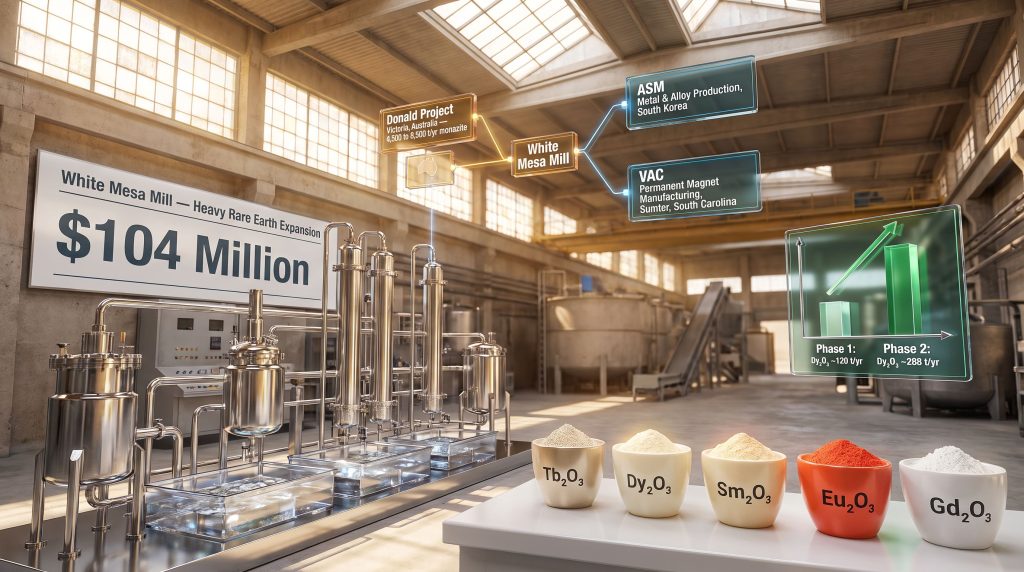
The facility achieved a significant milestone when it became the first US site to demonstrate commercial separation of neodymium-praseodymium oxide from monazite concentrate. That capability is now being extended through a $104 million construction program targeting five additional heavy rare earth oxide products.
Planned Production Capacity Upon Full Commissioning
The expansion covers two sequential construction stages targeting the following annual production capacity:
| Rare Earth Oxide | Annual Capacity Target | Primary End-Use Applications |
|---|---|---|
| Terbium Oxide (Tb₂O₃) | ~20 tonnes | High-performance permanent magnets, phosphors |
| Dysprosium Oxide (Dy₂O₃) | ~120 tonnes | EV motors, wind turbines, defence magnets |
| Samarium Oxide (Sm₂O₃) | ~140 tonnes | Samarium-cobalt magnets, aerospace applications |
| Europium Oxide (Eu₂O₃) | ~20 tonnes | Phosphors, lighting, display technologies |
| Gadolinium Oxide (Gd₂O₃) | ~140 tonnes | Medical imaging (MRI contrast agents), neutron shielding |
The sequencing of construction reflects commercial logic. Stage 1 targets terbium and dysprosium circuits, scheduled for commissioning in Q4 2027, because these two oxides represent the most commercially constrained and highest-value products in the heavy rare earth category. Stage 2, covering samarium, europium, and gadolinium, is targeted for completion in late 2028.
The MREC Circuit: A Rarely Discussed but Critical Piece of Infrastructure
One component of the expansion that receives less attention than the heavy rare earth oxide circuits is the addition of a mixed rare earth carbonate processing circuit. This is technically significant because it expands the range of feedstock materials the mill can accept. Rather than being restricted to monazite concentrate, a mixed carbonate processing capability allows the facility to treat intermediate rare earth products sourced from a broader set of upstream suppliers.
The practical implication is that White Mesa can operate at higher utilisation rates even if its primary planned feedstock source experiences delays. Higher plant utilisation is directly linked to processing economics because fixed costs — including staffing, energy, and maintenance — are spread over larger production volumes, consequently improving the cost per tonne of separated oxide.
Feedstock Security: The Donald Project and Beyond
The Victoria Connection
The primary identified feedstock source for the expanded White Mesa circuits is the Donald Project joint venture located in Victoria, Australia. Subject to a Final Investment Decision targeted for Q3 2026, Donald is designed to produce between 8,500 and 9,500 tonnes of monazite concentrate per year, with production commencement anticipated around 2028, aligning with the Stage 2 commissioning schedule at White Mesa.
Monazite is a phosphate mineral that naturally concentrates heavy rare earths alongside light rare earths and thorium. Its processing chemistry is well understood at White Mesa given the facility's existing monazite experience, but the separation of individual heavy rare earth oxides from monazite-derived mixed streams represents a meaningful technical step beyond the NdPr separation already demonstrated commercially.
The Donald FID represents the single most important near-term binary decision point in the feedstock chain. A positive outcome confirms a multi-year supply relationship between an identified upstream source and the expanded processing circuits.
Future Feedstock Pipeline
Beyond Donald, the company has identified additional potential sources. In addition to these, critical minerals supply security considerations are driving further diversification across the feedstock pipeline:
- Vara Madagascar: A longer-term feedstock development project contributing to Phase 2 expansion volumes
- Bahia, Brazil: An additional future monazite concentrate source targeted as part of the extended processing roadmap
- Third-party mixed rare earth carbonates: Processed through the new MREC circuit to supplement primary feedstock sources
This multi-source approach reflects an important lesson from earlier rare earth processing ventures. Facilities that designed their economics around a single upstream project found themselves in severe difficulty when mine development timelines slipped. Feedstock diversification is not a secondary consideration — it is foundational to commercial viability.
Funding Structure: Why the Capital Stack Matters as Much as the Capital Cost
How the $104 Million Is Being Financed
The expansion is expected to draw from three funding sources:
- A conditional loan commitment from the US Office of Strategic Capital
- Applications for additional US federal grant programs targeting critical mineral processing
- The company's existing working capital, reported at approximately $960 million as of March 31, 2026
The working capital position is the most immediately significant figure. At roughly nine times the total project cost, it means the construction program can proceed without being entirely dependent on external financing timelines. The conditional government loan and grant applications represent potential non-dilutive capital that would reduce drawdown on internal resources.
"The historical failure mode for Western rare earth processing projects has rarely been technical in origin. The more common pattern is capital exhaustion in the gap between construction completion and first meaningful revenue. A working capital buffer of this scale materially reduces that risk compared with underfunded processing ventures that have characterised the sector."
The Uranium Business as a Structural Advantage
A dimension of the funding picture that deserves more attention is the role of White Mesa's uranium operations as an ongoing cash flow contributor. Most rare earth processing projects are developed by companies with no other revenue source, making them entirely dependent on capital markets. White Mesa's uranium milling operations provide a parallel revenue stream that partially offsets the carrying cost of a major construction program — an advantage that pure-play rare earth developers fundamentally cannot replicate.
Furthermore, the broader context of critical minerals demand driven by the energy transition reinforces the strategic rationale for this integrated approach to facility development.
The Mine-to-Magnet Architecture: Where the Strategic Value Actually Lies
Mapping the Full Value Chain
White Mesa is not designed to be a standalone oxide separation facility. The broader strategic architecture positions it as the central processing hub within an integrated supply chain extending from monazite mining to finished permanent magnets. The intended structure operates across three tiers:
- Upstream: Monazite concentrate production from the Donald Project and subsequent feedstock sources
- Midstream: Rare earth oxide separation at White Mesa, covering both light and heavy rare earth products
- Downstream: Metal and alloy production via the pending acquisition of Australian Strategic Materials (ASM), followed by permanent magnet manufacturing via the pending acquisition of Vacuumschmelze (VAC) in Sumter, South Carolina
White Mesa's planned oxide output is expected to supply approximately 70% of ASM's existing and planned metal and alloy capacity based in South Korea. The VAC facility in South Carolina would then represent a domestic US permanent magnet manufacturing end-point for alloys produced from White Mesa oxides.
Why Vertical Integration Changes the Competitive Equation
The permanent magnet value chain has a characteristic that makes vertical integration particularly attractive: value concentration increases sharply at each downstream processing stage. Oxide producers capture a fraction of the value that alloy producers capture, and alloy producers in turn capture less than finished magnet manufacturers.
Chinese producers have understood this for three decades. The competitive dominance China has built in rare earth permanent magnets is not primarily a function of ore body quality or even processing chemistry. It is a consequence of controlling every stage of the conversion process from mineral concentrate to finished magnet, capturing margin at each step. America's rare earth supply chain has historically been limited to selling upstream intermediates at compressed prices — assembling an equivalent Western structure would represent a genuinely different competitive proposition from anything currently operating outside China.
The next major ASX story will hit our subscribers first
How White Mesa Compares to Other Western Heavy Rare Earth Initiatives
| Facility / Project | Location | Stage | Key Heavy REE Products | Notable Differentiator |
|---|---|---|---|---|
| White Mesa Mill (Energy Fuels) | Utah, USA | Under Construction | Tb, Dy, Sm, Eu, Gd | Only US facility with existing commercial monazite processing |
| Lynas Rare Earths | Malaysia / Western Australia | Operating (light REE focus) | Limited heavy REE separation | Largest non-Chinese REE processor by volume |
| MP Materials | California, USA | Operating (NdPr focus) | Limited heavy REE | Mountain Pass mine integration |
| Pensana / Rainbow Rare Earths | Various | Development stage | Tb, Dy targeted | Pre-construction or early development |
The comparison table illustrates the relative scarcity of facilities attempting commercial heavy rare earth oxide separation outside China. White Mesa's transition from engineering to active construction places it ahead of most Western heavy rare earth processing initiatives in terms of execution maturity. For more detail on the facility's development, Energy Fuels' rare earth operations offer a comprehensive overview of the broader mineral sands and rare earth strategy.
Phase 2: The Larger Platform This Construction Program Is Building Toward
The current expansion has been designed as the first stage of a significantly larger processing platform. A Phase 2 program targeted for approximately 2029 would extend annual separation capacity to:
- ~6,294 tonnes per year of NdPr oxide
- ~80 tonnes per year of terbium oxide
- ~288 tonnes per year of dysprosium oxide
The fully integrated supply chain, if Phase 2 is executed and downstream acquisitions are completed, is projected to support approximately 15,700 tonnes per year of permanent magnet output. Phase 2 execution is conditional on several factors: successful FID on Donald, completion and integration of the ASM and VAC acquisitions, and market conditions that support the additional capital commitment.
Key Execution Milestones and Risks to Monitor
Critical Path Through 2029
The following milestones represent the primary indicators of whether the strategic vision translates into operational reality:
- Donald Project FID (Q3 2026): Confirmation of dedicated long-term feedstock
- ASM acquisition completion: Unlocks downstream metallisation and alloy production
- VAC acquisition completion: Adds permanent magnet manufacturing to the integrated chain
- Terbium and dysprosium circuit commissioning (Q4 2027): First commercial heavy rare earth oxide production
- Samarium, europium, and gadolinium circuit commissioning (late 2028): Full Phase 1 product suite operational
- Phase 2 FID (subject to conditions): Determines long-term platform scale
Principal Risk Factors
- Hydrometallurgical commissioning complexity: Commercial-scale rare earth solvent extraction has historically produced timeline overruns across global projects, including at facilities operated by experienced companies
- Feedstock alignment risk: Donald Project ramp-up must synchronise with White Mesa commissioning to avoid underutilisation of the new circuits
- Acquisition integration risk: Executing two major corporate acquisitions simultaneously with a large construction program introduces significant operational complexity
- Heavy rare earth price volatility: Terbium and dysprosium oxide prices have historically experienced sharp swings, and the project's financial returns are sensitive to price assumptions
- Funding conditionality: The government loan commitment remains subject to conditions that could affect timing or final quantum of non-dilutive capital
"The Donald Project FID is the most consequential near-term decision point. Its outcome will determine whether the expanded White Mesa circuits have an identified long-term feedstock foundation or must rely more heavily on third-party sourcing to maintain utilisation targets during the critical early operating phase."
Frequently Asked Questions: Energy Fuels Heavy Rare Earth Plant Construction in Utah
What is Energy Fuels building at White Mesa Mill?
Energy Fuels is constructing a $104 million commercial-scale heavy rare earth oxide separation facility at White Mesa Mill in Utah. The expansion adds production capacity for terbium, dysprosium, samarium, europium, and gadolinium oxides, complementing the facility's existing commercial neodymium-praseodymium oxide separation capability.
When will the heavy rare earth plant be operational?
Terbium and dysprosium separation circuits are targeted for commissioning in Q4 2027. The samarium, europium, and gadolinium circuits are expected to follow during late 2028.
Why are terbium and dysprosium critical for electric vehicles and defence?
Both elements are added to NdFeB permanent magnets to enhance magnetic coercivity and thermal stability. Without these additions, magnets used in EV traction motors and defence systems would lose performance at the elevated operating temperatures encountered in real-world applications. No commercially viable substitute currently exists.
What feedstock will supply the new circuits?
The primary planned source is monazite concentrate from the Donald Project in Victoria, Australia, expected to produce 8,500 to 9,500 tonnes per year from 2028 onward. The new MREC circuit also allows the facility to process mixed rare earth carbonates from third-party sources.
How does this fit into a broader mine-to-magnet supply chain?
White Mesa serves as the central processing hub in the Energy Fuels heavy rare earth plant construction in Utah strategy. Oxides produced there are planned to supply ASM's metal and alloy operations, and those alloys are intended to supply VAC's permanent magnet manufacturing facility in South Carolina, creating an end-to-end Western supply chain from mineral concentrate to finished magnet.
Disclaimer: This article is intended for informational purposes only and does not constitute financial or investment advice. Forecasts, timelines, and production targets referenced in this article are subject to change and involve material execution and market risks. Readers should conduct their own due diligence before making any investment decisions.
Want to Track the Next Major Critical Mineral Discovery Before the Broader Market Does?
Discovery Alert's proprietary Discovery IQ model scans ASX announcements in real time, instantly identifying significant mineral discoveries across rare earths, uranium, and more than 30 other commodities — turning complex data into actionable investment insights as demonstrated by historic discoveries like De Grey Mining and WA1 Resources. Explore Discovery Alert's dedicated discoveries page to understand the kind of returns major mineral discoveries have historically generated, and begin your 14-day free trial today to position yourself ahead of the market.