August 1, 2026
The Quiet Crisis Driving a Global Scramble for Heavy Rare Earths
For decades, the rare earth supply chain functioned as an invisible backbone of modern technology. Few outside specialist circles understood that the magnets inside electric vehicle motors, wind turbine generators, and precision-guided defence systems depend on a narrow group of elements that are extraordinarily difficult to source outside of China. That invisibility is now gone. The Ionic strategic review of Uganda rare earths project has emerged at precisely the moment this structural fragility has moved from theoretical risk to operational emergency.
The distinction that matters most in this unfolding crisis is not between rare earths in general but between light and heavy rare earth elements. Light rare earth elements, or LREEs, include cerium and lanthanum and are more widely distributed globally. Heavy rare earth supply chains, by contrast, including dysprosium, terbium, holmium, and erbium, are far more geologically concentrated and command substantially higher strategic value.
Dysprosium and terbium in particular are essential additives in neodymium-iron-boron permanent magnets, the type used in high-performance EV motors and military systems, because they preserve magnetic performance at elevated operating temperatures. Without adequate HREE inputs, these magnets either underperform or cannot be manufactured to specification.
"Heavy rare earths represent a disproportionately small share of global rare earth production by volume but are critical inputs for the highest-performance permanent magnets underpinning both the clean energy transition and advanced defence capabilities. Projects with a heavy rare earth-dominant product basket occupy a structurally different tier of strategic importance compared to light rare earth-focused assets."
The concentration problem is severe. China accounts for the overwhelming majority of global HREE production, processing, and separation capacity. This dominance is not merely geological but is reinforced by decades of investment in processing infrastructure and feedstock supply agreements. Furthermore, China's rare earth export restrictions have made the arithmetic for Western manufacturers planning supply chains beyond 2026 deeply uncomfortable.
When big ASX news breaks, our subscribers know first
Why Ionic Adsorption Clay Deposits Are the Key to Unlocking Non-Chinese Heavy Rare Earths
Understanding why a project like Makuutu is attracting serious attention requires understanding a geological distinction that is largely unfamiliar outside the rare earth sector. Most people associate mining with extracting minerals from hard rock, where rare earth elements are locked within crystalline mineral structures such as bastnaesite or monazite. These hard-rock deposits require energy-intensive crushing, grinding, and often aggressive chemical processing to liberate the rare earth content.
Ionic adsorption clay deposits, or IAC deposits, are fundamentally different. They form in tropical and subtropical weathering environments where parent rock containing rare earth minerals has undergone deep chemical alteration over geological timescales. Through this process, rare earth ions are released from their original mineral hosts and become adsorbed, or loosely attached, to the surfaces of clay minerals.
Because the rare earths are held electrochemically rather than locked within a hard mineral lattice, they can be extracted using a comparatively gentle leaching process, typically involving dilute ammonium sulfate or similar reagents, at much lower processing cost and complexity than hard-rock alternatives. However, the rare earth processing challenges associated with these deposits should not be underestimated, even given their comparative advantages.
Three characteristics make IAC deposits uniquely valuable in the current geopolitical environment:
- Heavy rare earth enrichment: IAC deposits consistently carry higher proportions of HREEs relative to LREEs compared with most hard-rock deposits. This is a function of the geochemical partitioning that occurs during the weathering process.
- Lower processing complexity: The absence of hard mineral locking means simpler, lower-cost extraction chemistry, which can translate into more competitive project economics.
- Amenability to in-situ leaching: Some IAC deposits can be developed using solution mining approaches that minimise surface disturbance, reducing both capital intensity and environmental footprint.
Globally, the most prolific IAC deposits are concentrated in southern China, particularly in the provinces of Jiangxi, Guangdong, and Yunnan. China's dominance of this deposit type is a primary reason for its commanding position in HREE supply. Finding, defining, and advancing large-scale IAC deposits outside China is exceptionally difficult, which is precisely what makes Makuutu's profile so significant.
What Is the Makuutu Project and Why Does Its Product Basket Matter?
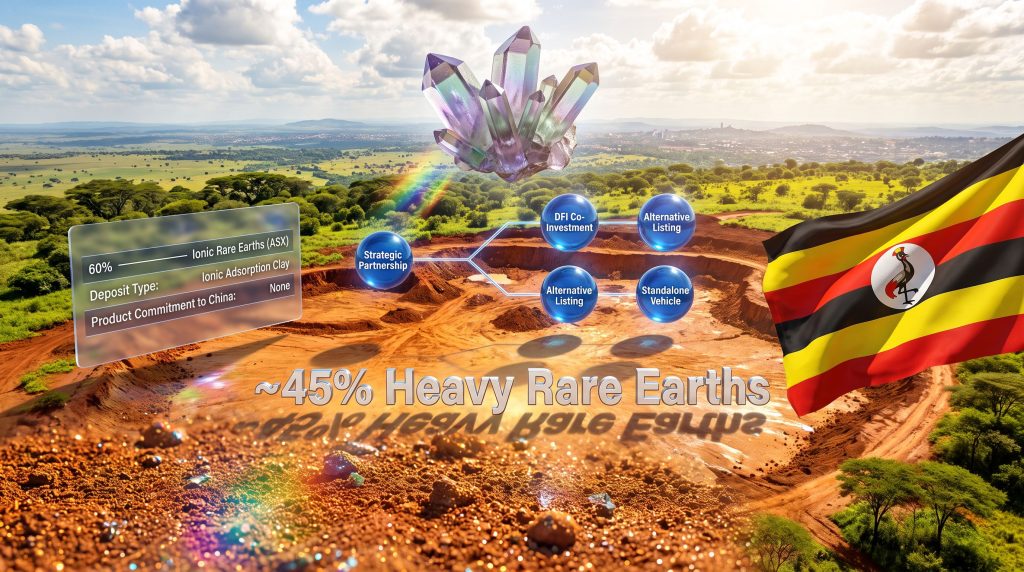
The Makuutu rare earths project sits in eastern Uganda, approximately 120 kilometres east of Kampala, within a region that has seen increasing critical minerals exploration activity as East Africa's geological prospectivity for weathered-profile deposits becomes better understood. The project is operated through Rwenzori Rare Metals, in which ASX-listed Ionic Rare Earths holds a 60% ownership stake.
What distinguishes Makuutu from most non-Chinese rare earth projects is the composition of its product basket. Approximately 45% of the recoverable rare earth content consists of heavy rare earth elements, a proportion that is unusual and commercially significant outside of China's IAC-dominant production base. This HREE weighting places Makuutu in a fundamentally different category from the majority of rare earth projects advancing in North America, Australia, and Africa.
| Project Parameter | Detail |
|---|---|
| Location | Eastern Uganda, approximately 120 km east of Kampala |
| Deposit Type | Ionic Adsorption Clay |
| Heavy Rare Earth Content | Approximately 45% of product basket |
| Operator / Owner | Ionic Rare Earths (ASX) via Rwenzori Rare Metals |
| Ionic Ownership Interest | 60% |
| Product Commitment to China | None |
| Development Stage | Advanced-stage; described as shovel-ready |
The fact that Makuutu's product carries no pre-existing commitment to Chinese processing or offtake buyers is increasingly being recognised as a premium commercial attribute. As China's export controls have progressively tightened, projects that have signed processing or offtake agreements with Chinese counterparties face significant uncertainty about whether those arrangements can survive further geopolitical escalation. Consequently, Makuutu enters the current environment with a clean slate and full flexibility for Western-aligned supply chain integration.
The Ionic Strategic Review: What It Signals and Why It Matters Now
Ionic Rare Earths has initiated a formal strategic review of the Makuutu project through its Rwenzori Rare Metals subsidiary, with the stated objective of evaluating options to enhance value creation and accelerate development. In the junior and mid-tier mining sector, formal strategic reviews of this type carry specific signalling value that extends well beyond routine corporate planning exercises.
When a company publicly announces a strategic review of a major asset, it serves several simultaneous functions. It signals to potential partners and investors that the asset is available for engagement on structural terms. It creates a framework for managing inbound interest in an orderly way. Furthermore, it establishes a timeline expectation that can itself create momentum, both commercially and in capital markets.
The Four Pathways Under Evaluation
The Ionic strategic review of Uganda rare earths project is examining four broad categories of structural alternatives for Makuutu:
- Introduction of strategic or government-backed partners at the project level – This pathway focuses on identifying industrial, downstream, or institutionally backed partners who can bring not just capital but also processing access, offtake commitments, or supply chain integration.
- New investment and financing structures – This encompasses a range of mechanisms from project-level debt and quasi-equity through to blended finance arrangements potentially involving development finance institutions from the US, Japan, EU, or Australia, each of which has articulated critical minerals mandates.
- Alternative jurisdiction listings – The possibility of listing Makuutu-related assets in a market closer to end-user demand, such as North America or Europe, where the investor base for critical mineral equities is growing and valuation multiples for HREE-dominant projects may differ from those available on the ASX.
- Broader structural changes including full or partial divestment – The scenario where Makuutu is carved out as a standalone entity, allowing dedicated rare earth investors to take a position in the asset independently of Ionic's broader business evolution.
"The intersection of Chinese export restriction timelines and growing Western industrial demand has created a narrow but high-value window for advanced, non-Chinese heavy rare earth projects to negotiate partnerships from a position of structural scarcity. Makuutu's combination of HREE dominance and an uncommitted product basket places it in a rare category of genuinely strategic assets."
China's Export Restriction Timeline and Its Effect on Makuutu's Strategic Value
China's approach to controlling rare earth exports has evolved from broad licensing requirements into increasingly targeted restrictions aimed at the most strategically sensitive elements. The progression has been deliberate and measured, with each step designed to maximise leverage over downstream manufacturers while managing the risk of accelerating Western investment in alternative supply.
The enforcement of additional restrictions on heavy rare earth exports from November 2026 represents a meaningful escalation point in this trajectory. For Western manufacturers of permanent magnets, EV motors, defence components, and wind turbine systems, the approaching deadline is forcing supply chain planning decisions that would previously have been deferred. The January 2027 deadline compounds this pressure further, creating a compressed window in which partnerships and offtake arrangements need to be established.
For projects like Makuutu, this timeline compression is simultaneously a challenge and an opportunity. The challenge is execution speed: advancing a project from its current development stage to a position where it can reliably supply Western markets requires capital, partnerships, and infrastructure solutions that take time to assemble. However, the urgency felt by potential partners and end-users has rarely been greater.
US Engagement and the Washington-to-Detroit Supply Chain Logic
Ionic has disclosed that it has spent considerable time engaging with US stakeholders across the rare earth value chain, with discussions spanning both policy-level relationships in Washington and commercial relationships with industrial operators closer to the manufacturing base. This engagement reflects the strategic logic of positioning Makuutu within the US rare earth supply chain specifically, where the combination of industrial demand, policy focus, and available financing mechanisms creates the most favourable partnership conditions currently available globally.
The US rare earth supply chain has structural gaps at multiple points, from primary mining and processing through to magnet manufacturing. Projects offering HREE-dominant product baskets with no Chinese supply chain entanglement are viewed as particularly valuable given the specific composition requirements of the highest-performance permanent magnets used in both defence and commercial applications.
Scenario Analysis: Probability, Value, and Risk Across the Four Pathways
Modelling the most likely outcomes of the Ionic strategic review requires assessing each pathway against the current geopolitical, commercial, and capital markets environment.
| Scenario | Probability Assessment | Primary Value Driver | Key Risk Factor |
|---|---|---|---|
| US-Backed Strategic Partnership | High | Geopolitical alignment and HREE scarcity premium | Regulatory and approval timelines |
| Development Finance Institution Co-Investment | Moderate-High | Sovereign credibility and lower cost of capital | Conditionality requirements and due diligence duration |
| Alternative Jurisdiction Listing | Moderate | Expanded investor base and valuation re-rating | Execution cost, complexity, and dilution risk |
| Standalone Project Vehicle / Partial Divestment | Moderate | Pure-play rare earth capital attraction | Market timing and valuation alignment |
Scenario 1: US-Backed Strategic Partnership – This pathway is arguably the highest probability near-term outcome given the documented engagement with US stakeholders and the alignment of Makuutu's product profile with US supply chain requirements. The most likely structure would involve an equity partnership or offtake-backed financing arrangement with a US industrial or defence-adjacent partner. The primary execution risk is the time required to navigate regulatory approvals in both Uganda and the United States.
Scenario 2: Development Finance Institution Co-Investment – Institutions such as the US Development Finance Corporation, the UK's British International Investment, and Australia's Export Finance agency have all articulated mandates to support critical minerals projects in developing economies. Makuutu's profile aligns with the stated priorities of multiple DFIs. The risk here is procedural: DFI due diligence is thorough and time-consuming, and conditionality requirements around governance and environmental standards must be met before funding can be committed.
Scenario 3: Alternative Jurisdiction Listing – A secondary listing or re-domiciliation to a North American exchange could unlock a meaningfully different investor base. North American institutional investors have demonstrated stronger appetite for critical mineral equities in the current policy environment. The execution risks, including listing costs, regulatory complexity, and potential dilution of existing ASX shareholders, are real but manageable if timed correctly.
Scenario 4: Standalone Project Vehicle – As Ionic's business strategy has evolved toward magnet recycling and refining as its core focus, the logic of maintaining Makuutu within the same corporate structure becomes less clear. A standalone vehicle would allow dedicated rare earth investors to take a pure-play position in the asset. The complexity of executing a structural separation, and the risk of misjudging market timing, are the primary risks to this pathway.
The next major ASX story will hit our subscribers first
The Dual-Track Business Model: Where Makuutu Fits Within Ionic's Evolution
Ionic Rare Earths has been building out its magnet recycling and refining operations as an increasingly central part of its business identity. This pivot toward the recycling of end-of-life rare earth magnets addresses a different point in the supply chain from primary mining but targets the same underlying demand for HREEs in Western markets.
The commercial logic of recycling is compelling in the medium term. As the installed base of EV motors, wind turbines, and other magnet-containing products grows and ages, the volume of recyclable rare earth material available will increase substantially. Recycling also sidesteps the lengthy permitting, development, and processing infrastructure challenges associated with primary mining, making it a faster path to revenue in Western jurisdictions.
However, this strategic evolution creates a portfolio tension. Makuutu is a large-scale primary mining development that requires sustained capital allocation, management attention, and partnership development to advance. In addition, the critical minerals demand surge means that as recycling becomes the core business focus, the risk is that Makuutu receives insufficient internal priority to reach its development potential on a competitive timeline. The strategic review is, in part, a recognition of this tension.
Risk Framework: The Challenges That Could Complicate Makuutu's Development
Jurisdictional and Regulatory Considerations
Operating in Uganda's mining regulatory environment carries risks that are distinct from those facing projects in more established mining jurisdictions. Uganda has been developing its regulatory framework for critical minerals in parallel with growing international interest in its resource base, and the government has shown awareness of the strategic value of its mineral endowment. However, investors and partners conducting due diligence will need to assess project tenure stability, fiscal regime predictability, and the framework for approving foreign investment structures.
Processing and Offtake Infrastructure
One of the defining challenges for all non-Chinese rare earth projects, regardless of their geological quality, is the absence of rare earth separation and processing capacity outside China at meaningful scale. Makuutu's product, once extracted and concentrated, would need to enter a processing pathway that currently has limited capacity outside of China. The development of Western rare earth processing facilities is underway but remains in relatively early stages.
Capital Markets Conditions and Financing Gap
Junior rare earth developers face a structural mismatch between the capital requirements of advancing a project from resource definition to production and the capacity of equity capital markets to provide that funding. Strategic partnerships and DFI involvement have become increasingly necessary bridges across this gap. The timeline risk is real: projects that fail to secure partnership structures within a competitive window may find that geopolitical urgency has shifted to other assets.
Africa's Emerging Role in Western Rare Earth Supply Chains
The re-evaluation of African rare earth projects through the lens of Western supply chain security rather than purely conventional mining economics represents a meaningful shift in how capital and attention are being directed across the continent. East and Central Africa host geological environments that are prospective for tropical weathering-profile deposits including ionic adsorption clays, though the exploration database outside of a handful of advanced projects remains limited.
Uganda's position within East African infrastructure networks, including road and rail corridors and proximity to the port of Mombasa, provides logistical context for how Makuutu's product could reach processing facilities in non-African jurisdictions. The investment required in processing, energy, and logistics infrastructure to bring African rare earth projects to full production scale remains substantial, and the involvement of development finance institutions and bilateral government agreements is likely to be necessary to make the economics work at scale.
| Project or Region | Deposit Type | HREE Exposure | Development Stage | Western Partner Interest |
|---|---|---|---|---|
| Makuutu, Uganda | Ionic Adsorption Clay | Approximately 45% HREE basket | Advanced / Shovel-ready | High, with reported US engagement |
| Penco, Chile (Aclara) | Ion-exchange clay | HREE-enriched | Environmental approval secured | Growing |
| Various West African | Hard rock / carbonatite | Predominantly LREE | Early to mid-stage | Selective |
Frequently Asked Questions: The Ionic Strategic Review of the Uganda Rare Earths Project
What is the Makuutu rare earths project?
Makuutu is an ionic adsorption clay rare earth deposit located in eastern Uganda, approximately 120 kilometres east of Kampala. It is considered one of the most advanced projects of its type outside China, with a product basket that contains approximately 45% heavy rare earth elements, giving it significant strategic value in the context of Western supply chain diversification.
Why has Ionic Rare Earths launched a strategic review?
The review has been initiated to evaluate the full range of structural, financial, and partnership options available to maximise the project's value and accelerate its development. This includes potential partnerships with strategic or institutionally backed investors, new financing structures, and whether a listing in an alternative jurisdiction could better position the project for its target end-markets. For instance, the latest ASX announcement details the full scope of options under consideration.
What role do China's export restrictions play?
China's progressive restrictions on magnet and heavy rare earth exports have substantially elevated the strategic importance of projects offering non-Chinese HREE supply. With additional enforcement measures expected from November 2026 and a broader supply chain planning deadline of January 2027, the timing of the review aligns with a period of heightened interest from potential Western partners.
Is Makuutu's product committed to Chinese buyers?
No. Makuutu's product basket carries no pre-existing commitment to Chinese processing or offtake arrangements, giving potential Western partners complete flexibility in determining how and where the material is processed and sold.
What is Ionic's ownership stake in Makuutu?
Ionic Rare Earths holds a 60% interest in the Makuutu project through its subsidiary Rwenzori Rare Metals.
How does the Makuutu review relate to Ionic's broader strategy?
Ionic has increasingly positioned magnet recycling and refining as the core focus of its business operations. The Ionic strategic review of Uganda rare earths project reflects the company's intent to ensure that Makuutu is structured in a way that maximises shareholder value both independently of and complementary to its recycling-focused activities, recognising that the two business lines may be better served by distinct capital structures and investor bases.
From Corporate Announcement to Structural Inflection Point
The Ionic strategic review of Uganda rare earths project is most usefully understood not as a routine capital markets event but as a reflection of a broader structural shift in how advanced HREE projects are being valued, competed for, and positioned within the emerging architecture of Western rare earth supply chains.
The convergence of three forces — China's escalating export control policy, the US administration's critical minerals industrial strategy, and the maturation of African critical mineral projects — has created conditions that are genuinely unprecedented in the rare earth sector's history outside of China. Projects that can offer HREE-dominant product baskets, clean offtake structures, and advanced development status are in a category of scarcity that the market is only beginning to price correctly.
How Makuutu navigates the partnership, financing, and structural decisions ahead of it will matter beyond Ionic's shareholder register. The outcome of this review could serve as a template for how other advanced African rare earth developers approach the challenge of bridging the gap between resource definition and integration into Western supply chains. In a race where the geopolitical clock is running and the supply chain gaps are real, the projects that solve the partnership and financing equation first will define the next generation of non-Chinese HREE supply. Investors seeking further context may find the ACF Equity Research coverage of Ionic Rare Earths a useful reference point for independent analysis.
Disclaimer: This article is intended for informational purposes only and does not constitute financial or investment advice. Statements regarding project timelines, partnership outcomes, and market scenarios involve uncertainty and should not be relied upon as predictions of future performance. Readers should conduct their own due diligence and consult qualified financial advisers before making investment decisions. Further coverage of Makuutu and the broader rare earths sector is available through Mining Weekly at miningweekly.com.
Want to Position Yourself Ahead of the Next Major Critical Minerals Discovery?
Discovery Alert's proprietary Discovery IQ model delivers real-time alerts on significant ASX mineral discoveries — including critical minerals such as rare earths — instantly transforming complex geological and market data into actionable investment insights for both short-term traders and long-term investors. Explore why historic mineral discoveries have generated extraordinary returns and begin your 14-day free trial today to secure a genuine market-leading edge.