August 3, 2026
The Hidden Bottleneck Inside Every Indian Electronics Factory
Most conversations about supply chain resilience focus on semiconductors, batteries, or display panels. Yet there is a quieter, more structurally embedded vulnerability running through nearly every high-performance electronic device manufactured or assembled in India today. It sits inside the drive motor of every electric vehicle rolling off an Indian production line. It hums inside the cooling fans of every data centre rack supporting India's growing cloud infrastructure. It stabilises the camera lens of every smartphone sold across the subcontinent. That component is the rare earth permanent magnet, and right now, the vast majority of them come from a single country.
India's India rare earth magnet manufacturing scheme represents a direct policy response to this structural exposure. However, understanding what the scheme actually involves, why it was designed the way it was, and what it will take to succeed requires engaging with a set of technical, geopolitical, and industrial realities that go well beyond the headline figures.
When big ASX news breaks, our subscribers know first
Why Rare Earth Permanent Magnets Are Functionally Irreplaceable
Rare earth permanent magnets occupy a unique position in materials science. Their exceptional magnetic flux density relative to physical mass allows hardware engineers to design motors, actuators, and speakers that deliver maximum performance inside shrinking form factors. The primary magnet type in question is neodymium-iron-boron, commonly abbreviated as NdFeB, which incorporates neodymium along with small quantities of dysprosium and praseodymium to achieve specific coercivity and thermal stability characteristics.
What makes these materials genuinely difficult to substitute is not just their magnetic strength in isolation, but the combination of properties they deliver simultaneously:
- High energy product (measured in megagauss-oersteds, or MGOe), which determines how much magnetic work a given magnet volume can perform
- High coercivity, meaning resistance to demagnetisation under heat or opposing magnetic fields
- Compact form factor, enabling miniaturisation that ferrite or alnico magnets simply cannot match
- Stable performance across operating temperature ranges relevant to automotive and industrial applications
For precision applications including electric vehicle permanent magnet synchronous motors (PMSMs), defence guidance systems, and robotics actuators, no commercially available alternative material delivers equivalent performance. This is the foundational reason why rare earth magnet localisation has become a national industrial priority rather than a discretionary preference.
China's Structural Dominance: A Two-Decade Consolidation
The degree of concentration in global rare earth magnet supply is not accidental. It reflects deliberate, long-horizon industrial policy combined with resource endowment, vertically integrated processing infrastructure, and sustained investment in proprietary manufacturing technology. Furthermore, China's rare earth strategy has compounded this advantage over decades, making it exceptionally difficult for other nations to compete at scale.
| Year | China's Share of Global Permanent Magnet Production |
|---|---|
| 2005 | ~50% |
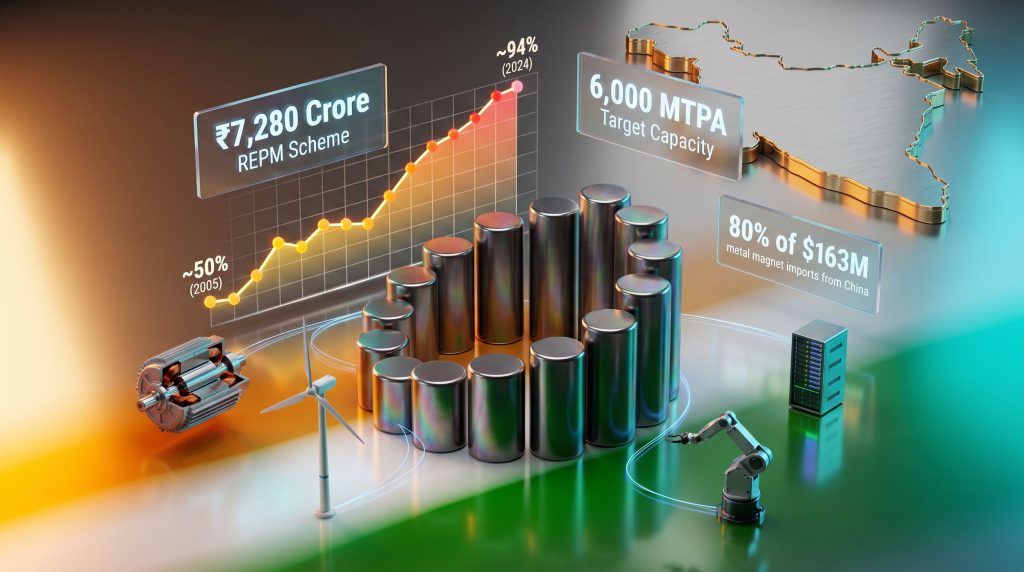
| 2024 | ~94% |
Source: International Energy Agency
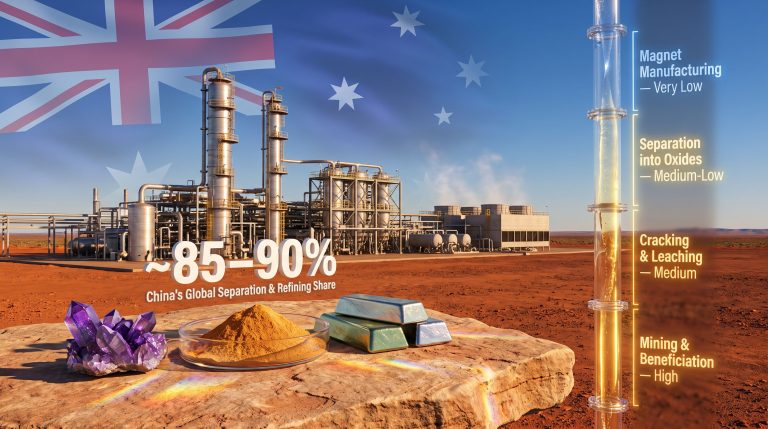
China's near-total dominance at the finished magnet stage is reinforced by its control at every upstream node. The country mines approximately 60% of global rare earth volumes and refines an estimated 91% of global rare earth supply, according to IEA data. This means that even nations attempting to build independent magnet manufacturing capacity face the challenge of sourcing oxide feedstock that overwhelmingly passes through Chinese processing facilities somewhere along its journey.
For India, the import data makes the exposure concrete. In FY26:
- More than 80% of India's $163 million in metal-based permanent magnet imports originated from China
- Of $110.6 million in non-metal-based permanent magnet imports, China accounted for 51% of total volume
Permanent magnets represent approximately 95% of total global rare earth consumption by value, making finished magnet manufacturing the single most economically significant node in the entire rare earth processing chain.
This concentration of sourcing creates a compounding risk profile. A supply disruption, whether triggered by export restrictions, geopolitical friction, or production curtailments in China, would simultaneously affect every downstream sector in India that depends on these components, from EV assembly to defence electronics procurement. Consequently, understanding rare earth supply chains at a structural level is essential to appreciating the urgency behind India's policy response.
The Architecture of India's ₹7,280 Crore REPM Scheme
India's Cabinet approved the scheme for rare earth permanent magnet manufacturing in November 2025, committing ₹7,280 crore to build domestic sintered REPM capacity from the ground up. The scheme's design reflects lessons learned from earlier production-linked incentive programmes, with a deliberate emphasis on sales-linked disbursement to ensure incentives track actual commercial output rather than capital deployment alone.
Core Financial Structure:
| Incentive Component | Allocation |
|---|---|
| Sales-Linked Incentives (5-year disbursement) | ₹6,450 crore |
| Capital Subsidy for Facility Construction | ₹750 crore |
| Total Scheme Outlay | ₹7,280 crore |
The scheme's operational parameters are structured as follows:
- Total duration: 7 years
- Gestation period: 2 years for plant construction and commissioning
- Incentive period: 5 years of sales-linked disbursement post-commissioning
- Target output: 6,000 metric tons per annum (MTPA) of integrated REPM capacity
- Maximum beneficiaries: 5 companies, each allocated up to 1,200 MTPA
Beneficiary selection will occur through global competitive bidding, meaning both domestic and international participants with demonstrated manufacturing capability can apply. Critically, companies holding proprietary intellectual property in magnet manufacturing processes will receive preferential consideration during evaluation.
This IP preference is not cosmetic. Sintered NdFeB production involves patent-protected process technologies including hydrogen decrepitation, jet milling of alloy powders, magnetic field alignment during pressing, and sintering atmosphere control. The majority of foundational patents in this domain are held by Japanese manufacturers and Chinese producers. An Indian manufacturing base dependent on licensed foreign IP would remain structurally exposed to the same concentrated sourcing risks the scheme is designed to address.
The Full Value Chain: Why Integration Is the Strategic Differentiator
One of the less-discussed but most consequential design choices in the India rare earth magnet manufacturing scheme is its emphasis on full vertical integration across the production chain. The scheme does not merely target final magnet assembly. It incentivises manufacturing across three distinct processing stages:
- Oxide-to-Metal Conversion: Reducing rare earth oxides into pure neodymium, dysprosium, and praseodymium metals through molten salt electrolysis or metallothermic reduction
- Metal-to-Alloy Processing: Combining rare earth metals with iron and boron feedstock to produce NdFeB master alloy in the correct stoichiometric ratios
- Alloy-to-Magnet Fabrication: Processing alloy through powder production, compaction, sintering, and post-processing to achieve finished magnets with specified magnetic performance parameters
A scheme that only incentivised final-stage magnet assembly would leave India dependent on Chinese alloy or oxide imports, replicating the supply chain vulnerability at a different node. Full-chain coverage is the structural differentiator that separates genuine industrial sovereignty from rebranded import substitution.
The scheme also covers two distinct magnet manufacturing pathways, each with different process requirements and application profiles:
| Magnet Type | Manufacturing Process | Performance Profile | Key Applications |
|---|---|---|---|
| Sintered REPMs | Powder metallurgy, vacuum sintering | Maximum energy density, rigid geometry | EV motors, wind turbines, defence |
| Bonded REPMs | Polymer matrix, compression or injection moulding | Complex geometries, lower energy density | Sensors, small motors, consumer electronics |
Sintered magnets dominate by volume in high-performance industrial applications, while bonded magnets serve a higher-unit-count but lower-performance segment in consumer devices. India's scheme targets both, reflecting the breadth of the downstream demand profile.
ECMS as the Activation Mechanism: From Policy to Approved Projects
The Electronics Component Manufacturing Scheme (ECMS) functions as the operational framework through which REPM manufacturing approvals are being progressively released. Multiple applications spanning different value chain stages are currently under evaluation by India's Ministry of Electronics and Information Technology (MeitY), with the next ECMS tranche expected to include approvals for rare earth magnet manufacturing centres.
The proposals under review span the full production spectrum, from oxide-to-alloy conversion facilities through to finished sintered and bonded magnet production. MeitY's evaluation framework gives preference to applicants with proprietary process technology, which effectively raises the competitive bar for participation and filters toward projects with genuine long-term manufacturing capability rather than assembly-level operations.
The first concrete proof-of-concept under this framework came in March 2026, when Greater Noida-based Lohum Cleantech received approval for a ₹500 crore rare earth permanent magnet project during the ECMS fourth tranche. The facility is structured to process rare earth oxides through to finished permanent magnets, establishing the complete processing pathway within a single facility. This approval functions as both a validation of the scheme's operational mechanics and a reference architecture for subsequent applicants.
The next major ASX story will hit our subscribers first
The Demand Sectors That Make Domestic REPM Capacity Non-Negotiable
REPMs are not a peripheral input material. They are a load-bearing component across every sector India has identified as a national manufacturing priority. In addition, the convergence of demand across these sectors creates a compounding case for domestic supply capacity. The role of critical minerals for semiconductors and advanced electronics further reinforces the urgency of localising this supply:
- Electric Vehicles: Permanent magnet synchronous motors are the dominant drivetrain architecture globally. Each EV requires between 1 and 3 kg of sintered NdFeB magnets, and India's EV production targets for the late 2020s translate directly into a predictable and growing domestic magnet demand pool
- Wind Energy: Direct-drive offshore wind turbines are among the most magnet-intensive industrial applications, with some designs requiring several tonnes of REPMs per installation
- Robotics and Automation: Servo motors, linear actuators, and precision positioning systems in manufacturing robots depend on high-coercivity magnets that maintain performance across thermal cycling
- Data Centre Infrastructure: Server fan assemblies in hyperscale data centres consume REPMs at significant aggregate scale, a demand category growing in direct proportion to India's AI and cloud computing buildout
- Defence Electronics: Guidance systems, radar assemblies, and secure communications hardware require REPMs with certified performance parameters that cannot be procured from geopolitically sensitive suppliers
- Consumer Electronics: Smartphone vibration motors, camera optical image stabilisation (OIS) systems, and miniature acoustic speakers represent among the highest unit-volume REPM applications globally
Inter-ministerial assessments within India's government identified rare earth magnet localisation as progressing more slowly than required to support these downstream manufacturing ambitions, which directly precipitated the November 2025 scheme approval.
Structural Risks: What Could Constrain India's REPM Ambitions
Understanding the scheme's potential requires honest assessment of the constraints it faces.
Upstream Oxide Dependency
India holds significant rare earth mineral reserves, primarily in monazite-bearing beach sands managed under the Atomic Minerals Directorate. However, commercially scaled rare earth separation and refining infrastructure remains underdeveloped relative to the volumes required to feed a 6,000 MTPA magnet manufacturing sector. The rare earth processing challenges at this stage are substantial, and without parallel investment in upstream processing, India risks substituting Chinese magnet imports with Chinese oxide imports, which is a partial solution at best.
Intellectual Property Barriers
The foundational patent landscape for sintered NdFeB manufacturing is dominated by Japanese and Chinese entities. Indian manufacturers seeking to operate without licensing exposure will need to develop genuinely novel process pathways or acquire IP through strategic partnerships, neither of which is straightforward within a 2-year gestation window.
Precision Manufacturing Workforce
REPM production requires controlled atmosphere processing, metallurgical precision, and quality management systems calibrated to automotive and aerospace-grade specifications. Building this technical workforce capability within the scheme's gestation period represents a significant human capital challenge that industrial policy alone cannot resolve.
Timeline Pressure
Reuters reporting from February 2026 indicated India was targeting the commencement of REPM production by end of 2026, a timeline that requires rapid resolution of approvals, facility construction, and process commissioning in parallel. Demand from India's EV sector alone is on a steep upward trajectory through the late 2020s, creating a narrowing window for domestic supply to displace import dependency at meaningful scale.
How India's Approach Compares Globally
| Country | Policy Mechanism | Target / Investment | Strategic Focus |
|---|---|---|---|
| India | ₹7,280 crore REPM scheme + ECMS | 6,000 MTPA sintered magnets | Full value chain localisation |
| United States | Defense Production Act + IRA incentives | Multiple processing facilities | Allied supply chain diversification |
| European Union | Critical Raw Materials Act | 40% domestic processing by 2030 | Strategic autonomy from single-source dependency |
| Japan | JOGMEC partnerships + recycling R&D | Established domestic industry | Technology leadership and closed-loop recycling |
India's approach is meaningfully differentiated from the US and EU strategies in its primary intervention point. Rather than focusing primarily on upstream ore access or allied-nation feedstock agreements, India's scheme targets finished magnet manufacturing as the first-order priority. This reflects India's position as a large-scale electronics and EV manufacturing destination rather than a resource extraction economy.
Furthermore, the global competitive bidding structure creates an opening for foreign technology holders to co-invest in Indian production facilities. India's bilateral critical minerals agreements with Australia, Canada, and the United States also create a potential upstream feedstock pathway that could, over time, support a more genuinely sovereign magnet supply chain. Progress on the broader rare earth supply chain buildout across allied nations will, consequently, play an important supporting role in this ambition.
Frequently Asked Questions
What is India's rare earth magnet manufacturing scheme?
It is a ₹7,280 crore initiative approved in November 2025 to establish domestic sintered rare earth permanent magnet manufacturing capacity of 6,000 MTPA, structured around sales-linked incentives and capital subsidies disbursed through the ECMS framework.
How dependent is India on Chinese magnet imports?
In FY26, more than 80% of India's $163 million in metal-based permanent magnet imports came from China, with Chinese suppliers also accounting for 51% of non-metal-based permanent magnet imports valued at $110.6 million.
How many companies will benefit from the scheme?
Up to five beneficiaries will be selected through global competitive bidding, each allocated a maximum of 1,200 MTPA of manufacturing capacity.
What is the scheme's operational timeline?
A 7-year total duration comprising a 2-year construction and commissioning phase followed by 5 years of sales-linked incentive disbursement.
Why does the scheme prefer companies with proprietary IP?
Sintered NdFeB manufacturing involves complex, patent-protected process technologies. Applicants with independent intellectual property reduce India's exposure to foreign licensing dependencies and create a more sustainable long-term manufacturing base.
What was the first ECMS-approved rare earth magnet project?
Lohum Cleantech's ₹500 crore oxide-to-magnet facility in Greater Noida, approved during the ECMS fourth tranche in March 2026. Further details on the scheme notification and eligibility parameters are available through India's Ministry of Heavy Industries.
Disclaimer: This article is intended for informational purposes only and does not constitute financial, investment, or policy advice. Forecasts, projections, and timeline references involve inherent uncertainty and should not be relied upon as predictions of future outcomes. Readers are encouraged to conduct independent research and consult qualified advisors before making investment or business decisions.
For ongoing coverage of India's energy and manufacturing sector developments, ET EnergyWorld at energy.economictimes.indiatimes.com provides detailed reporting on critical minerals policy and electronics manufacturing initiatives.
Want to Track ASX Discoveries in the Critical Minerals Driving India's Manufacturing Revolution?
As rare earth permanent magnets become central to electric vehicles, defence systems, and advanced electronics, the mining companies supplying these critical materials represent significant investment opportunities — and Discovery Alert's proprietary Discovery IQ model delivers real-time alerts the moment significant ASX mineral discoveries are announced, turning complex geological data into actionable insights. Explore why historic mineral discoveries have generated exceptional returns and begin your 14-day free trial to position yourself ahead of the broader market.