August 3, 2026
The Hidden Complexity Behind Bulk Mineral Exports and Trace Critical Elements
Most conversations about rare earth supply chains focus on dedicated mining operations, separation facilities, and the well-documented dominance of Chinese processing infrastructure. Far less attention has been paid to a structurally distinct phenomenon: the incidental presence of rare earth elements (REEs) within large-scale bulk mineral commodity exports. This is not a niche issue. When a country sits at the apex of global nickel and bauxite supply chains, even trace REE concentrations embedded in those commodity flows carry significant geopolitical and commercial weight.
Indonesia's recent regulatory turbulence around Indonesia rare earth byproduct exports has thrown this underappreciated dynamic into sharp relief. The disruption was not caused by a new mine, a trade dispute, or a sudden policy reversal. It emerged from something more mundane and arguably more consequential: the absence of defined thresholds for what constitutes an acceptable concentration of rare earth material within a non-REE mineral shipment.
When big ASX news breaks, our subscribers know first
Understanding the Byproduct REE Problem in Bulk Commodity Trade
Why Incidental REE Content Is a Regulatory Blind Spot
Rare earth elements are geochemically dispersed across a wide range of ore types. They are not confined to the ionic clay deposits of southern China or the carbonatite intrusions of central Africa. In Indonesia's case, REE occurrences are primarily tied to three processing streams:
- Tin mining residues from Bangka-Belitung, where monazite, a phosphate mineral carrying cerium, lanthanum, and thorium, accumulates as a processing byproduct
- Lateritic nickel deposits, where REE-bearing minerals can be present in the limonite and saprolite horizons
- Bauxite and alumina refining streams, where certain REE elements report to the ore at trace concentrations
The technical challenge this creates is significant. Unlike a dedicated REE mine, where every tonne of output is defined by its rare earth content, a nickel processing plant or alumina refinery does not treat REE presence as a product variable. It is background chemistry, not a design parameter. Yet as rare earths have become strategically sensitive, governments are increasingly asking: how much REE content is too much before a bulk mineral shipment becomes, legally and commercially, an REE export?
That question had no formal answer in Indonesia until very recently, and the consequences were severe. Furthermore, as critical minerals demand continues to intensify globally, the pressure on producing nations to regulate even trace concentrations has grown considerably.
What Actually Caused the Export Disruption
Three Simultaneous Failures
The Indonesian export delays were not the product of a single policy decision. They resulted from the collision of three distinct forces operating at the same time:
- An incomplete regulatory framework that banned primary REE exports but never defined concentration thresholds for REE content in non-REE mineral products
- A mandatory testing program administered by PT Sucofindo, Indonesia's state-affiliated surveying and testing body, which required surveyor reports verifying REE content in all outbound mineral shipments but lacked clear pass/fail criteria
- Active criminal enforcement against individuals allegedly involved in concealing approximately 390 metric tons of rare earth elements within otherwise legitimate bulk mineral shipments
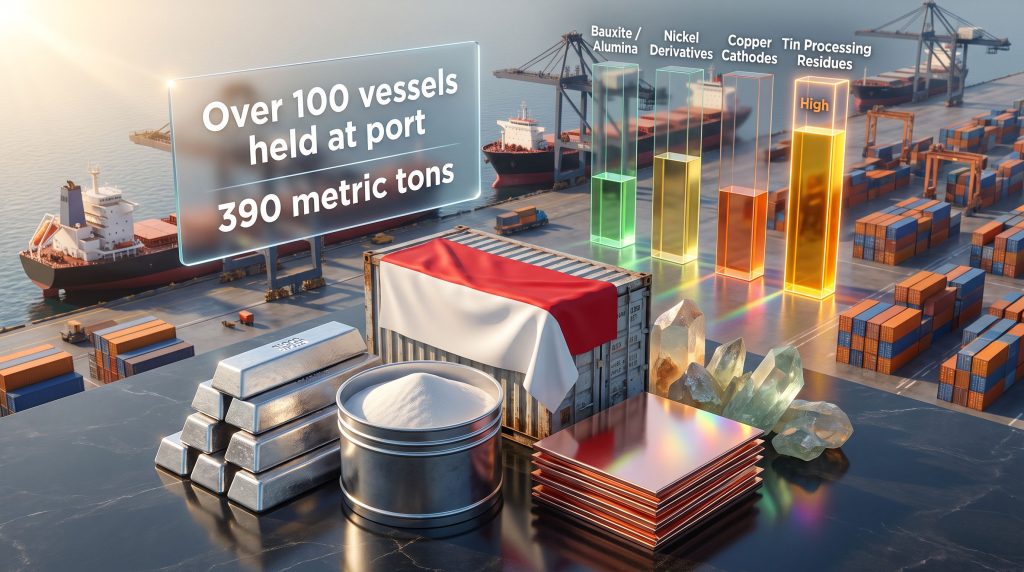
The result was a compliance vacuum. Surveyors, operating without explicit concentration limits, defaulted to holding reports when any REE content was detected. Industry group FINI reported that businesses were waiting on approximately 120 surveyor reports at the peak of the disruption. More than 100 vessels were held at Indonesian ports, unable to depart, across product categories including alumina, copper cathodes, nickel pig iron, ferronickel, and mixed hydroxide precipitate (MHP).
The disruption was not a deliberate embargo. It was a regulatory process failure triggered by the absence of quantitative thresholds that should have been established before the testing program was launched.
According to reporting by Reuters, Indonesian authorities were actively seeking to resolve these mineral export bottlenecks, highlighting the urgency felt at a governmental level.
The Enforcement Dimension Most Coverage Has Underweighted
The criminal prosecution element of this episode deserves closer attention than it typically receives. The 390 metric ton figure attributed to alleged REE concealment within bulk shipments is not trivial. It suggests that the regulatory gap was being exploited systematically, not opportunistically.
This enforcement context explains why Indonesian authorities were reluctant to simply issue blanket clearances for all mineral exports containing trace REE content; the risk of legitimising concealment operations under a permissive interpretation was real. Understanding this enforcement backdrop is essential for supply chain risk managers assessing the permanence of the current transitional framework.
Indonesia's Transitional Policy Response: What Has Actually Changed
The Primary vs. Byproduct Distinction
The Indonesian government's clarification, delivered through the presidential chief of staff, established a foundational legal and regulatory distinction: the prohibition on rare earth exports applies to REEs as a primary product. It does not automatically extend to REE content that exists as an incidental or accompanying element within a primary mining or derivative product.
This primary-versus-byproduct distinction is not new in global mineral regulation, but its formal articulation in the Indonesian context was the key unlock that allowed frozen shipments to move. PT Sucofindo was directed to release approximately 85 delayed surveyor reports, and vessels previously held at port were cleared to proceed.
What Remains Unresolved
The transitional framework is exactly that: transitional. The following critical regulatory elements were flagged as still requiring stakeholder consultation and formal determination:
- Element-specific concentration limits for each REE within non-REE mineral exports
- Standardised laboratory testing methodologies to ensure consistent measurement across different surveying bodies
- Verification mechanisms to prevent the primary/byproduct distinction from being exploited
- Procedural guidelines for how and when surveyor reports are issued when REE content is detected
Until these elements are formalised, exporters face ongoing compliance uncertainty. The transitional guidance resolves the immediate vessel backlog; it does not resolve the structural regulatory question. In addition, critical mineral byproducts in other jurisdictions face similar definitional challenges, suggesting this is a global regulatory frontier rather than an Indonesia-specific anomaly.
Radioactive Material Provisions: A Frequently Overlooked Complexity
One underappreciated dimension of this framework involves naturally occurring radioactive material (NORM). In certain Indonesian mineral streams, particularly those derived from tin processing and some bauxite-bearing formations, REE minerals co-occur with radioactive thorium and uranium isotopes.
The government has indicated that exports containing NORM may be permitted, provided they satisfy defined safety testing and compliance requirements. This is technically significant because monazite, the REE-bearing phosphate mineral most commonly associated with Indonesian tin residues, carries thorium as a structural component. The NORM provision signals that Indonesian authorities are aware of this complexity and are attempting to address it within the transitional framework.
Differential Exposure Across Indonesia's Mineral Export Sectors
Not all affected exporters face equivalent compliance risk as the framework evolves. The following table summarises the relative exposure profile across major affected categories:
| Mineral Product | REE Byproduct Risk Level | Key Compliance Consideration |
|---|---|---|
| Alumina / Bauxite Derivatives | Moderate-High | Highest frequency of REE-positive test results |
| Nickel Pig Iron / Ferronickel | Low-to-Moderate | Strategic sensitivity given EV supply chain role |
| Mixed Hydroxide Precipitate (MHP) | Moderate | Battery precursor status elevates regulatory scrutiny |
| Copper Cathodes | Low | Least likely to breach future concentration thresholds |
| Tin Processing Residues | High | Monazite co-occurrence creates NORM complication |
For nickel derivative exporters specifically, the stakes extend beyond individual shipments. Indonesian nickel supply accounts for roughly half of global mined nickel supply, and MHP has become a critical upstream input for lithium-ion battery cathode manufacturing. Any sustained friction in the surveyor report process for MHP creates measurable downstream risk for battery manufacturers operating on lean inventory models.
Is Indonesia Becoming a Major REE Exporter? The Structural Reality
Despite the international attention this episode has generated, it is important to calibrate expectations accurately. Indonesia is not emerging as a significant primary rare earth exporter. The country does not operate large-scale standalone REE mining operations comparable to those in Australia, China, or Myanmar.
The REE occurrences within Indonesian mineral systems are structurally incidental, meaning they are a function of geochemical association with primary ore types rather than the result of deliberate REE exploration or resource development. Indonesia's government has consistently signalled that its strategic preference is for domestic downstream processing of REE-bearing materials rather than export of raw or semi-processed REE content.
This posture mirrors the trajectory Indonesia has already executed in nickel: progressive export restrictions on unprocessed ore drove substantial investment in domestic smelting, refining, and battery precursor manufacturing. There is every reason to expect a similar regulatory arc for REE-bearing mineral streams over the medium term.
Indonesia's rare earth story is fundamentally a byproduct management story, not a primary REE supply story. The long-term policy direction points toward tighter controls and domestic value capture, not liberalised export.
The next major ASX story will hit our subscribers first
Broader Implications for Global Critical Mineral Supply Chains
A Template for Resource-Nationalist REE Governance
Indonesia's regulatory episode is not an isolated event. It reflects a broader pattern emerging across resource-nationalist mineral-producing nations: as the strategic value of REEs rises, even trace concentrations in bulk commodity exports are being treated as assets requiring sovereign oversight.
This creates a new category of supply chain risk that procurement teams and downstream manufacturers have historically not needed to model. The risk is not that Indonesia will embargo nickel exports. The risk is that evolving REE concentration limit decisions could create unpredictable compliance costs, testing delays, and shipment holds for products that have never previously been subject to REE-related scrutiny.
Consequently, this dynamic sits within a much wider context of rare earth export restrictions being deployed by major mineral-producing nations as instruments of economic leverage and strategic resource management.
What Supply Chain Participants Should Monitor
The following regulatory developments in Indonesia warrant close monitoring by any organisation with material exposure to Indonesian mineral inputs:
- Publication of formal element-specific concentration limits for REE content in non-REE mineral exports
- Accreditation and standardisation of laboratory testing providers authorised to certify shipments
- Any tightening of concentration limits over time that could effectively mandate domestic beneficiation of REE-bearing ores before export
- Criminal enforcement outcomes in the REE concealment cases, which may influence the strictness of ongoing customs and excise oversight
Furthermore, those sourcing battery raw materials from Indonesian producers should pay particular attention to how MHP and nickel intermediate concentration limits are ultimately defined, as these could directly affect procurement timelines and contract terms.
Frequently Asked Questions: Indonesia Rare Earth Byproduct Exports
Are rare earth exports banned in Indonesia?
Indonesia prohibits the export of rare earth elements as a primary product. However, minerals that contain trace or incidental REE content as a byproduct, including alumina, nickel derivatives, and copper cathodes, are not subject to an automatic ban. Exports may proceed provided they satisfy testing and verification requirements currently being finalised.
What minerals were affected by the port delays?
The primary affected categories were alumina, copper cathodes, nickel pig iron, ferronickel, and mixed hydroxide precipitate. These products were held pending mandatory surveyor testing for REE content, resulting in more than 100 vessels delayed at Indonesian ports. Industry analysts at Mining.com have noted that the disruptions represented one of the more significant compliance-driven mineral export bottlenecks in recent years.
What is PT Sucofindo's role in this process?
PT Sucofindo is a state-affiliated Indonesian testing and surveying organisation responsible for administering the mandatory REE content testing program for outbound mineral shipments. It was directed to release approximately 85 previously delayed surveyor reports following the government's transitional policy clarification.
Why does monazite make tin processing residues particularly complex?
Monazite is a phosphate mineral that concentrates light rare earth elements including cerium and lanthanum, but also carries radioactive thorium as a structural component. This means tin processing residues containing monazite require treatment under both REE export regulations and NORM safety frameworks simultaneously, creating a layered compliance burden not applicable to most other affected mineral categories.
What is Indonesia's long-term rare earth strategy?
Indonesia's stated policy direction favours domestic processing of REE-bearing materials rather than export of raw or semi-processed REE content. The current transitional guidelines represent an operational fix for an immediate disruption. The longer-term regulatory trajectory, consistent with Indonesia's approach to nickel, points toward progressive tightening of export conditions and requirements for domestic beneficiation of REE-bearing mineral streams.
Key Takeaways for Investors and Supply Chain Stakeholders
- The Indonesian export disruption was a regulatory process failure rooted in the absence of defined REE concentration thresholds, not a deliberate policy embargo
- The transitional framework has resolved the immediate vessel backlog but leaves the structural regulatory question of permissible REE concentrations unanswered
- Alumina and tin residue exporters face the highest ongoing compliance exposure; copper cathode producers face the least
- Indonesia rare earth byproduct exports remain a developing regulatory story with material long-term supply chain implications for downstream manufacturers
- The domestic processing trajectory seen in nickel strongly suggests a similar regulatory evolution for REE-bearing mineral streams
- The episode signals a medium-term compliance and procurement risk for any organisation reliant on Indonesian nickel derivatives and alumina
This article is provided for informational purposes only and does not constitute financial, investment, or legal advice. Readers should conduct independent due diligence before making any decisions related to mineral commodity procurement or investment in the mining sector. Regulatory frameworks referenced are subject to change as Indonesian authorities continue stakeholder consultations.
Want to Stay Ahead of the Next Major Mineral Discovery Before the Market Catches On?
Discovery Alert's proprietary Discovery IQ model delivers real-time alerts on significant ASX mineral discoveries across critical commodities, instantly transforming complex geological data into actionable investment insights — explore Discovery Alert's historic discoveries page to understand how major finds have generated substantial returns, and begin your 14-day free trial at discoveryalert.com.au to position yourself ahead of the broader market.