August 4, 2026
The Race for Heavy Rare Earths Is Reshaping Where Exploration Capital Flows
The global permanent magnet supply chain has a structural vulnerability that is becoming impossible to ignore. Dysprosium and terbium, the two heavy rare earth elements most critical to high-performance electric motors and defence-grade magnets, are produced almost entirely within China's controlled processing ecosystem. For Western manufacturers and governments seeking to insulate industrial supply chains from geopolitical disruption, the search for alternative HREE sources has become an urgent priority, not a theoretical one.
This supply anxiety is redirecting exploration investment toward jurisdictions that were largely overlooked during previous commodity cycles. Sub-Saharan Africa, and Malawi in particular, is beginning to attract serious geological and financial attention. Against this backdrop, the AuKing Malawi heavy rare earths project acquisition represents a carefully structured entry into one of the continent's most mineralogically compelling rare earth districts. Understanding heavy rare earth supply chains is increasingly essential context for evaluating such moves.
When big ASX news breaks, our subscribers know first
Why Malawi's Chilwa Alkaline Province Deserves Serious Geological Attention
A District Defined by Deep-Time Alkaline Magmatism
Malawi's Mesozoic Chilwa Alkaline Province is not a single deposit story. It is a geological district defined by a cluster of carbonatite and peralkaline intrusions emplaced during a period of continental rifting and alkaline magmatism that produced rare earth-bearing systems across southern Malawi. This is the same province that hosts Kangankunde, one of Africa's most studied rare earth carbonatites, and Songwe Hill, an advanced-stage REE project with an established mineral resource.
What distinguishes the Chilwa Province from other African REE districts is the co-existence of two genetically different REE mineralisation styles. Carbonatite-hosted deposits tend to carry light rare earth element enrichment, dominated by cerium and lanthanum. Peralkaline complexes within the same province, however, including the Zomba-Malosa pluton system, host eudialyte-group minerals that are systematically enriched in heavy rare earths. This geological duality makes the province unusual globally and underpins the investment logic for targeting both mineralisation styles simultaneously.
Eudialyte: The Mineral That Changes the HREE Calculus
Eudialyte is a zirconosilicate mineral that forms within peralkaline magmatic complexes under specific geochemical conditions. It is not merely a carrier of rare earths in the general sense. Eudialyte concentrates the heavy end of the REE spectrum, particularly dysprosium, terbium, erbium, holmium, and yttrium, at grades that can significantly exceed those found in conventional light REE carbonatite systems.
The mineral is gaining attention globally as an alternative HREE host to China's dominant ion-adsorption clay deposits, which are low-grade, geographically concentrated, and environmentally sensitive to extract. Furthermore, unlike ion-adsorption clays, eudialyte-hosted mineralisation can occur as hard rock deposits with clearly defined structural controls, enabling conventional drilling and resource definition methodologies.
Eudialyte presents a distinct metallurgical challenge because it is moderately reactive in acidic leach conditions but sensitive to silica gel formation, which can inhibit processing efficiency. Recent advances in hydrometallurgical flowsheet design have addressed this limitation, improving the commercial viability of eudialyte-based processing at pilot scale. The broader rare earth processing challenges facing the industry make flowsheet innovation at projects like Machinga increasingly significant.
Machinga's Mineralisation Profile: What the Drilling Has Revealed
Near-Surface Grade Results That Benchmark Globally
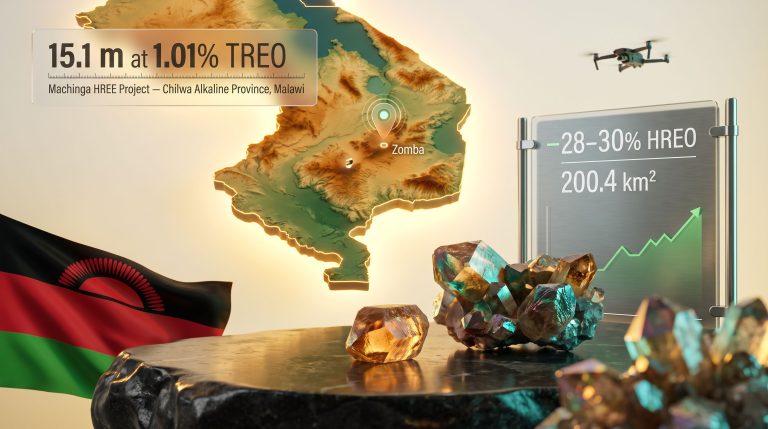
The Machinga Project, comprising exploration licences EL 0529 and EL 0705 across approximately 200.4 km², sits within this peralkaline corridor. REE mineralisation has been defined over a 2 km strike length, with a multi-element anomaly suite encompassing rare earth elements, niobium, tantalum, zirconium, and uranium.
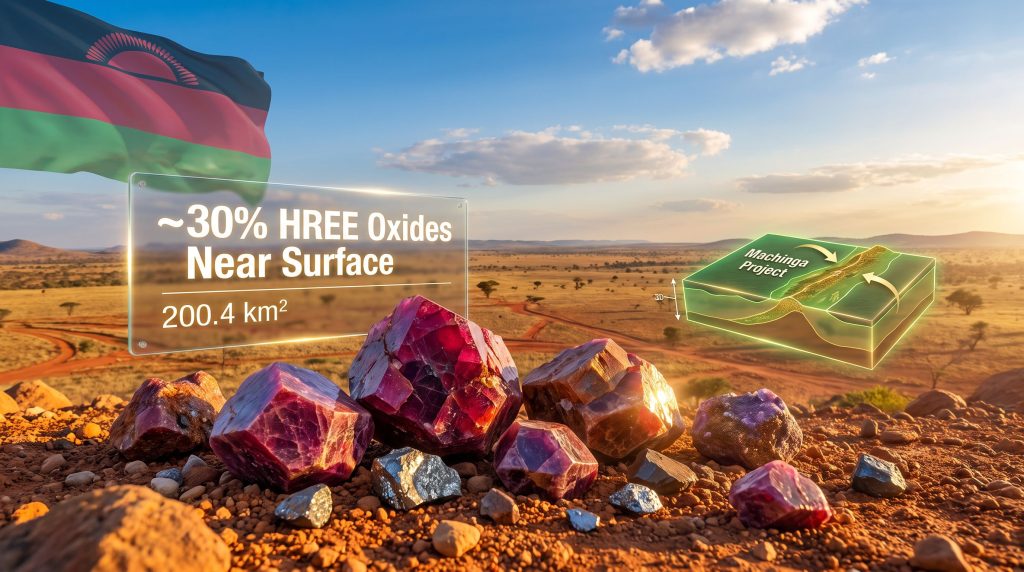
The figure that anchors Machinga's investment case is the near-surface heavy rare earth oxide concentration of approximately 30% reported from 2023 drilling conducted by DY6 Metals and Tusker Minerals. This is not a routine result. Most HREE projects globally require deep drilling to intersect comparable concentrations, making near-surface accessibility both a logistical advantage and a capital efficiency differentiator during early resource definition phases. For further context, Proactive Investors provides detailed coverage of the acquisition structure and its significance.
How Machinga Stacks Up Against Global HREE Peers
| Project | Location | Host Mineralogy | Key Characteristic |
|---|---|---|---|
| Strange Lake | Quebec, Canada | HREE-enriched peralkaline granite | Large tonnage, complex metallurgy |
| Bokan Mountain | Alaska, USA | Peralkaline granite, loparite | High HREE to LREE ratio |
| Machinga | Malawi | Eudialyte in peralkaline complex | ~30% HREE oxides near surface, 200.4 km² |
| Songwe Hill | Malawi | Carbonatite-hosted bastnäsite | Advanced-stage, established JORC resource |
| Ilímaussaq | Greenland | Eudialyte-rich lujavrite | World-class HREE tenor, cold climate logistics |
The comparison to Strange Lake and Bokan Mountain is not arbitrary. Both are peralkaline systems with structural and mineralogical parallels to what has been identified at Machinga. The critical distinction is that Machinga's comparable HREE concentrations occur at shallow depths, which could materially reduce drilling and eventual mining costs relative to deposits requiring deep extraction to access equivalent grades.
Breaking Down the Acquisition Structure: Capital Discipline in Practice
A Four-Tranche Deal Designed to Protect Shareholder Capital
The acquisition architecture deployed for the Machinga deal reflects a disciplined approach to capital exposure at the exploration stage. Rather than committing the full consideration upfront, the structure sequences payments across milestones that reduce financial risk while maintaining seller incentive alignment.
- Exclusivity Payment: A non-refundable A$5,000 cash payment activated a 40-day exclusivity window covering legal due diligence, ASX approvals, and final documentation.
- Cash at Completion: A$750,000 payable in cash upon formal deal close.
- Equity Consideration: A$750,000 in ordinary shares, equating to 30 million shares priced at A$0.025 per share.
- Performance Shares: A$1.25 million in milestone-linked performance shares, equating to 50 million shares at A$0.025 per share.
Total Consideration Summary
| Component | Value (AUD) | Payment Mechanism |
|---|---|---|
| Exclusivity Payment | A$5,000 | Non-refundable cash |
| Cash at Completion | A$750,000 | Direct cash payment |
| Equity Shares | A$750,000 | 30M shares at A$0.025 |
| Performance Shares | A$1,250,000 | 50M shares at A$0.025, milestone-contingent |
| Total | ~A$2.755 million | Staged, equity-weighted |
The performance share tranche, representing the largest single component at A$1.25 million, is only triggered upon achievement of defined exploration or development milestones. This means the maximum deal value is earned progressively rather than paid unconditionally, a structure that aligns vendor incentives directly with project delivery outcomes.
The upfront cash commitment of A$755,000 (including the exclusivity payment) limits initial capital exposure significantly, while the equity weighting preserves cash for the exploration programme itself. Investors assessing dilution impact should note that the full 80 million shares are issued only if milestone conditions are satisfied.
AuKing's Dual-Project Malawi Strategy: District-Scale Thinking
Portfolio Construction Across Two Geological Systems
The Machinga acquisition does not operate in isolation. It builds upon an earlier announced acquisition of a 100% interest in the Tundulu Rare Earth Elements Project in south-eastern Malawi, creating a two-project critical minerals portfolio within the same geological province. AuKing Mining's project portfolio illustrates how this dual-asset strategy positions the company for district-scale exploration across the Chilwa Alkaline Province.
This approach mirrors the district consolidation playbook used by successful junior explorers in established REE jurisdictions, where holding multiple complementary assets within a single province reduces single-asset exploration risk while multiplying geological optionality. The AuKing Malawi heavy rare earths project acquisition is therefore best understood as part of a broader strategic framework rather than a standalone transaction.
Comparing AuKing's Two Malawi REE Projects
| Feature | Tundulu REE Project | Machinga Project |
|---|---|---|
| Area | ~91.5 km² | ~200.4 km² |
| Geology | Carbonatite complex, 5 km wide | Peralkaline / eudialyte-hosted |
| REE Profile | High HREE, low uranium and thorium | ~30% HREE oxides near surface |
| Exploration Status | Early-stage, drilling planned | Historical + 2023 drilling completed |
| Metallurgical Advantage | Low U/Th simplifies processing | Near-surface access reduces drilling cost |
Tundulu's low uranium and thorium content is a meaningful metallurgical distinction. Many rare earth deposits globally carry elevated radioactive byproducts that complicate processing and create regulatory hurdles around waste classification and handling. A lower U/Th profile at Tundulu simplifies the processing flowsheet and reduces the regulatory complexity associated with radioactive material management, a factor that can materially affect project timelines and capital requirements.
The Unexplored Corridors: Where Upside Is Concentrated
Previous drilling at Machinga concentrated on the north-east sector of the main northern anomaly, near the licence boundary. Rock chip results from this campaign indicate that significant mineralisation potential extends westward and southward into areas that have not yet been drill-tested. The western and southern extensions of the northern anomaly represent the highest-priority untested corridors within the current licence area.
This is a geological pattern common to projects that received initial exploration attention during phosphate-focused survey campaigns of earlier decades, where REE was a secondary observation rather than the primary exploration target. Historical radiometric and geochemical datasets captured anomalism across the broader licence area but were never followed up with REE-targeted drilling, leaving most of Machinga's 200.4 km² geochemically characterised but physically undrilled.
The Planned Exploration Programme: Precision Before Drilling
A Technology-Led Approach to Target Generation
The post-acquisition work programme prioritises data integration and high-resolution geophysical surveying before committing drill capital. This sequence reflects an understanding that eudialyte mineralisation in peralkaline systems is structurally controlled, meaning it follows specific geological features such as intrusive contacts, shear zones, and ductile fabric orientations, rather than occurring as a diffuse blanket anomaly.
The planned workflow follows this sequence:
- Historical Data Compilation: Consolidate all prior drilling logs, geochemical assays, and radiometric datasets from DY6 Metals/Tusker Minerals and earlier campaigns into a unified project database.
- Drone Magnetics Survey: Deploy drone-mounted magnetometer platforms to map structural controls at sub-metre resolution across the full licence area.
- LiDAR Survey: Generate high-precision digital terrain models to expose structural lineaments and geological contacts obscured by vegetation cover.
- Structural Interpretation: Integrate magnetics and LiDAR outputs to define the primary structural corridors controlling eudialyte emplacement.
- Drill Target Generation: Rank priority drill collars across the western and southern extensions of the northern anomaly.
- Maiden Drilling Programme: Execute targeted drilling to intersect the highest-priority structural positions.
Drone magnetics offer a particular advantage over conventional ground-based surveys in structurally complex peralkaline terrains. The ability to fly at low altitude over dense vegetation and variable topography produces magnetic data at a spatial resolution previously achievable only through ground-based traverses, which are time-intensive and logistically difficult in remote African settings.
The next major ASX story will hit our subscribers first
Key Risks Every Investor Should Understand
Exploration-Stage Considerations
Any assessment of the Machinga acquisition must account for the following risk factors:
- No JORC Resource: No compliant mineral resource estimate has been established. Historical drilling data requires systematic validation through modern methodology before resource classification is achievable.
- Metallurgical Uncertainty: Commercial eudialyte processing requires specialised hydrometallurgical flowsheets. Pilot-scale testwork has not been completed, and silica gel management during leaching remains a technical challenge requiring flowsheet optimisation.
- Jurisdictional Complexity: Malawi is a developing mining jurisdiction with evolving regulatory frameworks. Licence security, permitting timelines, and fiscal terms carry inherent uncertainty for early-stage projects.
- Dilution Potential: The equity component of the deal introduces up to 80 million new shares upon completion and milestone satisfaction, which investors should incorporate into dilution-adjusted valuation assessments.
- Execution Risk: The exploration timeline depends on mobilisation logistics, equipment availability, and in-country operational capacity, all of which carry execution uncertainty in remote African locations.
This article contains references to forward-looking exploration targets, geological comparisons, and project-level assessments that involve uncertainty. None of the content constitutes financial advice. Investors should conduct independent due diligence and consult a qualified financial adviser before making investment decisions.
Structural Mitigants Worth Noting
- The staged payment architecture limits upfront cash exposure to approximately A$755,000
- Performance shares are milestone-contingent, preventing full consideration payment without demonstrable project progress
- Geological validation from adjacent established projects within the Chilwa Province reduces greenfield uncertainty
However, it is also worth contextualising the broader investment environment. The rare earth geopolitics driving demand for non-Chinese HREE supply are intensifying, which adds a macro-level tailwind to well-positioned exploration assets in stable African jurisdictions. Comparably, critical minerals in Greenland and other emerging jurisdictions face their own distinct regulatory and logistical challenges, further highlighting the relative accessibility of the Malawi opportunity. For instance, the Greenland REE project at Tanbreez illustrates how complex operating environments can constrain even world-class deposits.
Frequently Asked Questions
What are dysprosium and terbium used for?
Both elements are critical inputs for neodymium-iron-boron permanent magnets, which require HREE additions to maintain magnetic performance at elevated operating temperatures. This makes them indispensable for electric vehicle traction motors, offshore wind turbine generators, and defence applications including precision-guided systems. Both are classified as high-criticality minerals by the US Geological Survey due to their near-total sourcing from Chinese supply chains.
What is eudialyte and why does it matter?
Eudialyte is a sodium-calcium-zirconium cyclosilicate that forms in alkaline and peralkaline igneous rocks. Its structural chemistry allows it to accommodate a broad range of rare earth elements, with a systematic preference for heavy REEs over light REEs. This makes eudialyte-bearing peralkaline complexes globally significant as potential alternative HREE sources outside China's ion-adsorption clay dominated production base.
Is Malawi an established mining jurisdiction?
Malawi has a developing but functional mining regulatory framework. The country hosts several advanced-stage mineral projects and has attracted investment from international mining companies. While it lacks the mature regulatory infrastructure of established mining jurisdictions such as Australia or Canada, the presence of nearby advanced projects provides precedent for licence management and permitting pathways.
For ongoing coverage of African critical minerals developments and ASX-listed explorer activity across the continent, Mining Weekly at miningweekly.com provides detailed sector reporting and project updates.
Want to Stay Ahead of the Next Major Rare Earth Discovery on the ASX?
Discovery Alert's proprietary Discovery IQ model scans ASX announcements in real time, instantly identifying significant mineral discoveries — including critical and rare earth minerals — and delivering actionable insights directly to subscribers before the broader market reacts. Explore how major discoveries have historically generated substantial returns on Discovery Alert's dedicated discoveries page, and begin your 14-day free trial today to position yourself ahead of the next significant find.