August 5, 2026
The Hidden Economics of Gallium: Why Aluminium Refining Holds the Key to Western Tech Independence
Few industrial minerals illustrate the fragility of modern supply chains quite like gallium. Unlike copper, lithium, or nickel, gallium cannot be extracted from a dedicated mine. It has no economically meaningful standalone ore deposit anywhere on Earth. Instead, it hides inside bauxite at concentrations so low they are measured in parts per million, and it only becomes recoverable through the complex chemistry of aluminium refining. This geological reality means that the global gallium supply chain is inseparable from the global aluminium industry, and that dynamic has suddenly become one of the most strategically consequential facts in the critical minerals landscape.
The METLEN US gallium supply deal, announced in August 2026, is the first long-term commercial gallium offtake agreement between a European producer and a US technology company ever publicly recorded. Understanding what it means, and why it matters well beyond its headline figures, requires examining the technical, geopolitical, and commercial architecture underpinning it.
When big ASX news breaks, our subscribers know first
Gallium's Geological Peculiarity: Why Supply Is So Difficult to Build
Gallium belongs to a category of minerals that geologists sometimes describe as dispersed elements, meaning they do not concentrate naturally into economically mineable ore bodies. Within bauxite minerals, gallium chemically substitutes for aluminium at the atomic level, a phenomenon known as isomorphous substitution. The result is that gallium occurs at concentrations of just 20 to 80 parts per million (ppm) across most bauxite deposits globally.
This scarcity at source creates a fundamental supply constraint that no amount of exploration drilling can solve. There is no gallium equivalent of a lithium brine lake or a copper porphyry deposit. The only commercially proven pathway to gallium production runs directly through the Bayer process, the century-old alumina refining method used across every major aluminium-producing nation. Furthermore, gallium deposits of any viable scale remain extraordinarily rare outside of integrated aluminium operations.
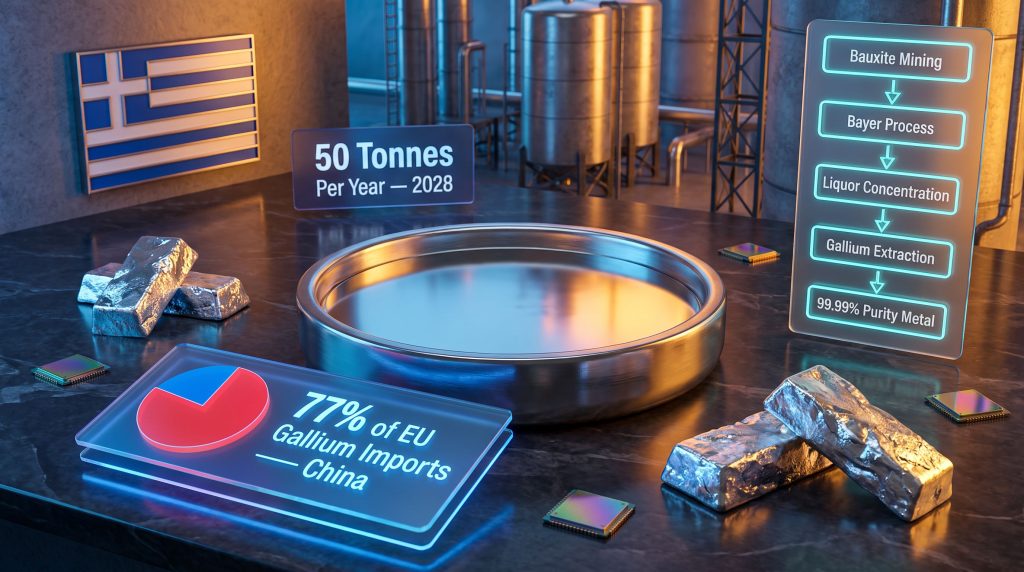
From Bauxite to Gallium Metal: The Six-Stage Extraction Pathway
Understanding how gallium is actually produced clarifies why integrated aluminium operations hold a structural monopoly over its supply:
-
Bauxite Mining – Raw ore is extracted from deposits carrying gallium at 20-80 ppm alongside aluminium minerals.
-
Bayer Process Digestion – Crushed bauxite is dissolved in hot caustic soda solution. Alumina enters solution as sodium aluminate, and gallium, behaving chemically like aluminium, dissolves alongside it.
-
Liquor Recycling and Concentration – The Bayer liquor is continuously recycled through the refinery circuit. Because gallium does not precipitate as readily as aluminium during the crystallisation stage, it progressively accumulates in the circulating liquor, building from trace levels to 100-300 ppm over repeated cycles.
-
Gallium Extraction – Once liquor gallium concentrations reach commercially viable thresholds, solvent extraction or ion exchange processes are used to selectively separate gallium from the liquor stream.
-
Electrolytic Refining – The extracted gallium is refined electrolytically to produce high-purity gallium metal, typically at 99.99% purity or higher, the standard required for semiconductor applications.
-
Downstream Conversion – High-purity gallium metal is further processed into gallium nitride (GaN) or gallium arsenide (GaAs) wafers for end-use semiconductor manufacturing.
A critical but often overlooked fact: approximately 30% of the gallium contained in bauxite remains locked in red mud, the alkaline waste residue of Bayer processing. At commercial scale, this fraction is currently unrecoverable. Any future technology capable of extracting gallium from red mud at scale would represent a significant step-change in global gallium supply, but no such commercially proven process exists today.
China's Dominance and the Supply Chain Rupture That Changed Everything
China's position in global gallium production did not arise from geological advantage alone. It was built through decades of deliberate industrial policy that prioritised integrated bauxite-to-aluminium capacity at a scale no other nation matched. By 2025, China accounted for 77% of the European Union's gallium imports, according to Eurostat data. Canada supplied 11% and the United States just 3%, with all remaining sources contributing negligible volumes.
| Region | Primary Supplier | China's Share | Leading Alternative Sources |
|---|---|---|---|
| European Union | China | 77% | Canada (11%), United States (3%) |
| United States | China | Dominant | Very limited domestic production |
| Japan and South Korea | China | High | Minimal viable alternatives |
When China announced export restrictions on gallium and germanium in 2023, the strategic vulnerability this concentration represented became impossible to ignore. Western governments, technology companies, and defence procurement agencies suddenly faced the prospect of supply interruptions for materials essential to semiconductor fabrication, radar systems, and telecommunications infrastructure. In addition, the export controls impact on related critical minerals demonstrated just how quickly such restrictions can ripple through global supply chains.
The policy response across the EU, United States, and allied nations has been well documented. However, what has been slower to materialise is the commercial response: actual long-term offtake agreements between non-Chinese producers and Western technology buyers. The METLEN US gallium supply deal is the first such agreement at scale to enter the public record.
What the METLEN Deal Actually Involves
Metlen signs a landmark gallium supply agreement covering approximately 25% of the annual output from its planned gallium production facility at Agios Nikolaos, Viotia, in Central Greece. At the facility's projected full capacity of 50 tonnes per year, the contracted volume equates to roughly 12.5 tonnes annually.
The buyer is described as a leading US technology company, though its identity has not been disclosed. Financial terms remain confidential. METLEN has characterised the agreement as the first major commercial gallium supply deal between a European producer and a US technology company.
Key Commercial Parameters at a Glance
- Contracted volume: Approximately 25% of planned annual output
- Full facility capacity: 50 tonnes per year
- Implied annual supply volume: ~12.5 tonnes at full ramp-up
- Production start target: 2027
- Full capacity target: 2028
- Buyer identity: Undisclosed US technology company
- Agreement duration: Long-term (specific term not publicly disclosed)
The deliberate non-disclosure of the buyer's identity warrants its own analysis. In critical minerals trade, procurement sensitivity is common among defence-adjacent manufacturers and semiconductor companies operating under export control frameworks. The fact that METLEN confirmed extensive qualification testing had already been completed by the buyer suggests a relationship that is technically mature and commercially validated, regardless of the identity opacity.
Precedent for buyer anonymity in critical mineral offtake agreements is well established. In lithium and rare earth concentrate deals, buyer identity is frequently withheld for competitive reasons and, in some cases, due to defence procurement regulations that restrict disclosure of supply chain dependencies.
METLEN's Industrial Infrastructure: Why Greece Is the Production Hub
The gallium project is not a standalone greenfield venture. It is embedded within METLEN's existing vertically integrated aluminium operations through its Aluminium of Greece subsidiary, one of Europe's largest integrated aluminium producers. The investment spans two geographically linked sites:
- Parnassus-Giona region – Active bauxite mining operations providing the primary ore feed
- Agios Nikolaos, Viotia – The alumina and aluminium complex where Bayer process refining occurs and where the new gallium recovery circuit will be constructed
This integrated structure is commercially significant. Because gallium recovery is added as a value-extraction layer onto an existing Bayer process operation rather than built as an independent plant, the capital expenditure required is substantially lower relative to the revenue potential. The alumina refinery's operating economics are not dependent on gallium production, which removes the market price risk that would otherwise threaten a standalone gallium producer.
The facility carries EU Strategic Project status under the Critical Raw Materials Act, having been selected as one of 47 projects from 170 applications across 13 EU Member States in 2025. It has also secured financing from the European Investment Bank under the REPowerEU framework, reflecting institutional assessment of the project's technical and strategic viability. Indeed, the broader push for European critical raw materials sovereignty has provided the policy scaffolding that made this project commercially viable.
Demand Drivers: Why Gallium Supply Tightness Is Structural, Not Cyclical
The sectors consuming gallium-based semiconductors are not niche or cyclical. They span the most capital-intensive growth trajectories in the global economy over the next decade.
| Application Sector | Gallium Compound | Primary Growth Catalyst |
|---|---|---|
| AI Data Centres and GPUs | Gallium Nitride (GaN) | Accelerating AI infrastructure buildout |
| Defence Radar and Electronic Warfare | Gallium Arsenide (GaAs) | NATO rearmament and defence procurement cycles |
| 5G and 6G Telecommunications | GaN Power Amplifiers | Global network densification programmes |
| Electric Vehicles and Charging Infrastructure | GaN Power Electronics | EV adoption acceleration across major markets |
| Solar Photovoltaics | Gallium-doped Silicon | Renewable energy deployment mandates |
| Satellite Communications | GaAs Integrated Circuits | Low-Earth orbit constellation expansion |
GaN semiconductors are particularly relevant to AI hardware because they offer superior power efficiency at high switching frequencies compared to silicon-based alternatives. As data centre operators chase performance-per-watt improvements driven by AI workload demands, GaN-based power electronics and RF components are moving from niche applications into mainstream infrastructure deployment.
The structural nature of this demand growth means gallium supply tightness cannot be resolved by demand destruction. The technology transitions underway require gallium; there is currently no material substitute for GaN or GaAs in high-frequency, high-efficiency semiconductor applications.
The next major ASX story will hit our subscribers first
The Aluminium-Gallium Nexus as a Competitive Moat
One of the least appreciated dynamics in the gallium supply chain is the degree to which the economics of gallium recovery depend on alumina refinery scale. Gallium extraction equipment represents a relatively modest incremental capital investment when added to a large-scale refinery, but the return on that investment improves dramatically with throughput volume.
Smaller or older alumina refineries face a structural disadvantage: their Bayer liquor circuits may not accumulate gallium to sufficient concentrations to justify extraction infrastructure. This creates a winner-take-more dynamic where the largest, most modern integrated alumina refineries are the only facilities capable of economically viable gallium production. Furthermore, the scale of bauxite production at the national level directly determines which countries can realistically enter the gallium supply chain.
METLEN's Agios Nikolaos complex, operating at industrial scale with modern Bayer process infrastructure, sits at the productive end of this spectrum. The competitive moat is not merely technical. It is geological, operational, and logistical simultaneously.
Risk Factors Investors and Procurement Officers Should Evaluate
No assessment of the METLEN US gallium supply deal would be complete without acknowledging the risk landscape surrounding it.
China's Ongoing Export Control Leverage
China retains the ability to adjust or escalate gallium export restrictions at any point, introducing price volatility that could complicate the economics of long-duration supply agreements. Western buyers entering multi-year offtake contracts must factor in scenarios where Chinese gallium re-enters the market at suppressed prices, potentially undermining the commercial case for higher-cost European production.
Bayer Process Yield Variability
Gallium recovery yields are sensitive to bauxite grade variability. Not all bauxite ore from the Parnassus-Giona region will carry identical gallium concentrations, and seasonal or geological variation in feed ore quality can affect liquor accumulation rates and extraction efficiency.
Retrofitting Complexity Across the Industry
While METLEN's facility is being purpose-designed with gallium recovery integrated from the outset, other European alumina refineries seeking to add gallium recovery capabilities face a more complex retrofit challenge. Capital costs, process chemistry adjustments, and operational disruption during installation all create friction in the broader European gallium supply buildout. Consequently, the wider aluminium industry faces a significant transitional challenge in adapting existing infrastructure.
Production Timeline Execution Risk
The 2027 production commencement target and 2028 full-capacity timeline represent ambitious engineering schedules. Any delays in EU permitting processes, equipment procurement, or construction would push the supply contribution of the METLEN facility further into a period of sustained Western gallium demand growth.
Disclaimer: The above risk factors are presented for informational and analytical purposes only. They do not constitute financial advice. Investors should conduct independent due diligence before making any investment decisions related to companies, sectors, or markets discussed in this article.
Frequently Asked Questions
What is the METLEN US gallium supply deal?
It is a long-term agreement under which METLEN Energy & Metals will supply approximately 25% of the annual gallium output from its planned 50-tonne-per-year Greek facility to an undisclosed leading US technology company. It is the first publicly recorded commercial gallium offtake agreement between a European producer and a US technology buyer.
When will METLEN's gallium facility begin production?
METLEN targets production commencement in 2027, with a full ramp-up to 50 tonnes per year expected by 2028.
Why can gallium only be produced from aluminium refineries?
Gallium does not form standalone ore deposits. It occurs within bauxite at 20-80 ppm and only becomes commercially extractable after concentrating in Bayer process liquor during alumina refining. This makes integrated alumina refineries the sole viable commercial source of gallium globally.
How dominant is China in global gallium supply?
As of 2025, China supplied 77% of EU gallium imports according to Eurostat, making it by far the dominant global producer. Canada and the United States supplied 11% and 3% respectively.
What EU support has the METLEN gallium project received?
The project holds Strategic Project designation under the EU Critical Raw Materials Act, was selected from 170 applications across 13 EU Member States, and has secured European Investment Bank financing under the REPowerEU framework.
Why is the US buyer's identity not disclosed?
METLEN has not publicly named the buyer, and financial terms remain confidential. This is consistent with procurement sensitivity protocols common in defence-adjacent and dual-use technology manufacturing, as well as standard competitive confidentiality in critical mineral supply agreements. Mining Technology reports that this level of discretion is increasingly standard practice in strategic mineral offtake arrangements of this nature.
A New Transatlantic Trade Corridor Takes Shape
The METLEN US gallium supply deal represents more than a single commercial transaction. It marks the point at which European critical mineral ambitions crossed from policy aspiration into bankable commercial reality. For years, the EU's Critical Raw Materials Act and related frameworks were met with scepticism about whether they would generate actual production capacity or merely well-intentioned documentation.
The fact that a US technology buyer has committed to a long-term offtake agreement, conducted extensive qualification testing, and entered a contractual relationship with a European gallium producer before that producer has even commenced commercial operations is a strong signal that Western supply chain diversification is advancing beyond rhetoric.
With production beginning in 2027 and full capacity of 50 tonnes per year targeted by 2028, METLEN's timeline aligns with the window of greatest Western gallium supply vulnerability — a period in which AI infrastructure investment, defence procurement, and renewable energy deployment are simultaneously accelerating demand for gallium-based semiconductors. As other European alumina refineries assess the economics of gallium recovery additions, the commercial template established by this agreement may prove as significant as the volumes it delivers.
Want to Know When the Next Critical Mineral Discovery Hits the ASX?
Discovery Alert's proprietary Discovery IQ model delivers real-time alerts the moment significant mineral discoveries — including critical minerals like gallium — are announced on the ASX, turning complex geological data into actionable investment insights for both short-term traders and long-term investors. Explore historic discovery returns on Discovery Alert's dedicated discoveries page and begin your 14-day free trial today to position yourself ahead of the broader market.