August 8, 2026
The Hidden Battleground in Rare Earths: Why Processing Beats Mining Every Time
Investors tracking the rare earths sector often fixate on mineral discovery and resource size, yet the most consequential competitive advantages are being built not underground but inside processing plants. The fundamental reality is that owning a large rare earth deposit is far less commercially powerful than controlling what happens to the ore after it leaves the mine. This dynamic has shaped the strategic positioning of every serious non-Chinese rare earth developer over the past decade, and it explains why Lindian Resources' decision to secure 100% ownership of the Lindian Resources SARECO rare earths processing facility in Kazakhstan represents something considerably more significant than a routine corporate transaction.
The value chain in rare earths is deceptively complex. Between mining and the end-use market for permanent magnets sit several critical processing steps, and the companies that control those steps capture margins that pure miners simply cannot access.
When big ASX news breaks, our subscribers know first
Understanding Where Value Actually Lives in the Rare Earths Chain
From Rock to Reactor: The Processing Hierarchy
The rare earth value chain follows a clear hierarchy, with each step adding substantial margin but also requiring significant technical capability and capital:
- Mining and beneficiation produces a mineral concentrate, the lowest-value tradeable product
- Hydrometallurgical processing converts concentrate into mixed rare earth carbonate (MREC), unlocking meaningful value uplift
- Solvent extraction and separation produces individual rare earth oxides such as neodymium oxide and praseodymium oxide
- Alloying and magnet manufacturing represents the highest-value end of the chain, dominated by Chinese and Japanese manufacturers
Mixed rare earth carbonate occupies a strategically compelling position in this hierarchy. It sits above raw concentrate, meaning producers have already performed substantial value-added work, but below fully separated oxides, which require advanced solvent extraction chemistry and significant additional capital. For non-Chinese producers, MREC represents an accessible commercial endpoint that can be sold to Western separation facilities without requiring the full downstream investment that separated oxide production demands.
Furthermore, understanding the rare earth processing challenges involved at each stage helps explain why so few non-Chinese developers have successfully navigated the full value chain.
"The NdPr content within any given MREC product is the primary pricing driver. Monazite-derived MREC tends to carry relatively high NdPr concentrations compared to MREC produced from other feedstock types, giving monazite-based producers a pricing advantage in commercial negotiations with downstream buyers."
Why Separation Capacity Is the True Chokepoint
China controls an estimated 85–90% of global rare earth separation capacity, a structural reality that creates profound vulnerability for Western manufacturers reliant on neodymium-iron-boron permanent magnets for electric vehicle motors and wind turbine generators. The volume of NdPr oxide required to meet projected EV production targets through the 2030s is substantial, and the separation bottleneck outside China remains the sector's most pressing unsolved problem.
Every operational MREC facility established beyond Chinese borders marginally reduces this dependence and adds commercial optionality for downstream buyers seeking supply chain diversification. Consequently, the broader rare earth supply chain remains one of the most strategically contested domains in global critical minerals policy.
What Makes the SARECO Facility Genuinely Rare
The Technical Infrastructure Already Operating at Stepnogorsk
The Lindian Resources SARECO rare earths processing facility in Kazakhstan is not a concept or a feasibility study. It is an existing, commissioned hydrometallurgical plant. According to Lindian Resources' project overview, the following circuits and infrastructure are already in place:
- Sulphuric acid bake circuit for concentrate cracking
- Water leaching and solid-liquid separation systems
- Multi-stage impurity removal and purification circuits
- Carbonate precipitation infrastructure for MREC production
- Dedicated rail spur enabling concentrate receipt and MREC export
- Reagent-handling and chemical storage systems
- Two additional warehouses totalling approximately 15,500 square metres
- Existing workforce and operational permits
This combination of installed processing circuits, logistics connectivity, and existing regulatory standing is extraordinarily difficult to replicate from scratch. The rail spur alone is a critical logistical asset, enabling cost-efficient transport of bulk monazite concentrate inbound from Kazakhstan or beyond, and outbound dispatch of finished MREC product to customers across both European and Asian markets.
The Kazatomprom-Sumitomo Provenance: What It Signals
SARECO was originally developed through the involvement of Kazatomprom, Kazakhstan's state-owned uranium enterprise and the world's largest uranium producer by volume, alongside Sumitomo Corporation, one of Japan's largest and most internationally active trading conglomerates. The involvement of two such institutionally credible entities in SARECO's original development carries meaningful implications.
These organisations do not construct processing facilities to substandard specifications. The engineering standards embedded in SARECO's design, the regulatory approvals obtained, and the operational protocols established during the facility's development reflect institutional-grade requirements rather than junior developer shortcuts. This provenance effectively de-risks the physical asset itself, shifting the primary execution question from whether the facility can perform technically to whether Lindian can ramp it to nameplate capacity on schedule.
Build vs. Buy: The Capital Efficiency Case in Stark Numbers
| Development Pathway | Estimated Capital Requirement | Timeline to First Production |
|---|---|---|
| Greenfield MREC facility (comparable scale) | More than A$500 million | Multi-year permitting plus construction |
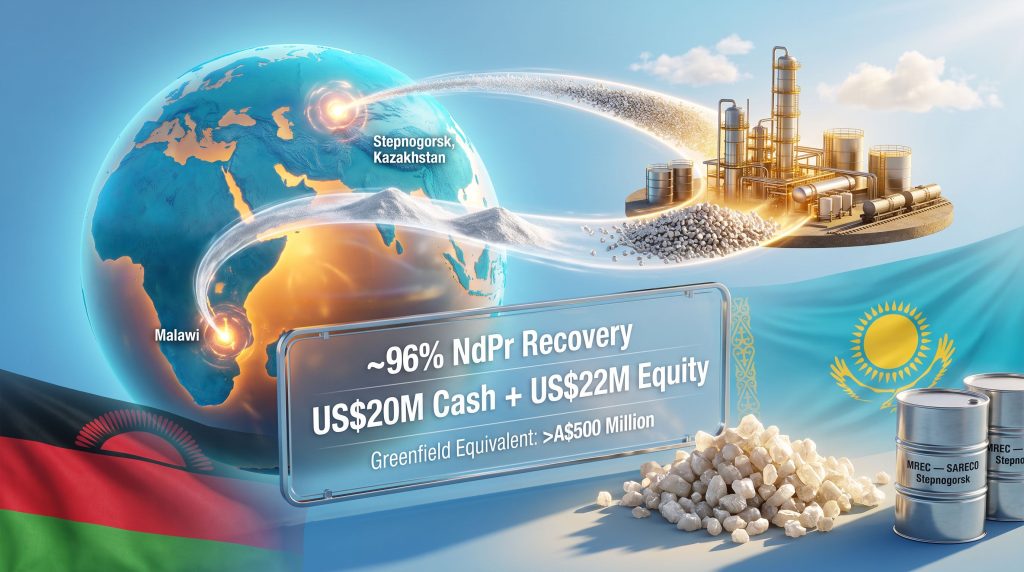
| SARECO acquisition (100% ownership) | Up to US$20M cash + up to US$22M equity | Existing infrastructure, Q4 2026 target |
| Capital efficiency difference | Greater than A$480M equivalent saving | Multiple years of lead time avoided |
The replacement cost argument is not abstract. Building an equivalent hydrometallurgical MREC facility from greenfield would require land acquisition, environmental approvals, detailed engineering, construction contracts, commissioning, and operator training across a timeline measured in years rather than quarters. The SARECO transaction compresses that entire pathway into a single acquisition at a fraction of the cost.
How Lindian Moved From 51% to Full Ownership
The Due Diligence Trigger
The original structure envisaged Lindian holding a 51% majority stake in SARECO alongside RA Group's 49% interest. Following the completion of comprehensive due diligence spanning legal, tax, technical, and environmental dimensions, Lindian elected to exercise the option to acquire the remaining interest outright. This decision reflects a clear-eyed assessment that full operational control is worth the incremental consideration, particularly when the alternative involves navigating joint venture governance structures during the critical commissioning and ramp-up phase.
Transaction Consideration: How the Deal Is Structured
As reported by Mining Technology, the acquisition is structured across several consideration components:
| Consideration Component | Value | Key Detail |
|---|---|---|
| Cash payment | Up to US$20 million | Asset purchase price component |
| Ordinary shares to RA Group | Up to US$15 million | Equity component at A$0.775 per share |
| Performance rights to RA Group | Up to US$7 million | Linked to 1 and 2 years of commercial production |
| Total maximum consideration | Up to US$42 million | Cash plus equity combined |
The performance rights structure deserves particular attention. By tying US$7 million of the equity consideration to sustained commercial production milestones over two years, the transaction structure aligns RA Group's financial interests directly with SARECO's operational success. This is a sensible risk-sharing mechanism that incentivises the vendor to support a smooth transition to full commercial operations.
What 100% Ownership Unlocks That 51% Cannot
The practical differences between majority and full ownership in a processing facility context are substantial:
- Complete margin capture: 100% exposure to MREC production economics rather than 51%
- Exclusive marketing control: unilateral authority over all off-take negotiations and customer relationships
- Unencumbered capital allocation: freedom to deploy expansion capital into warehousing or downstream processing without requiring partner approval
- Governance simplicity: elimination of joint venture board mechanics that can introduce delays into operational decision-making
- Balance sheet clarity: single-entity ownership simplifies financial reporting and investor comprehension
This structure also complements the broader context of the rare earth supply deal activity occurring across the sector, as vertically integrated players increasingly seek to lock in processing and offtake arrangements simultaneously.
The Kangankunde-SARECO Integration: A Two-Continent Supply Chain
Malawi to Kazakhstan: The Feedstock Logistics
Lindian's Kangankunde rare earth project in Malawi anchors the upstream end of this supply chain. Kangankunde hosts one of the world's highest-grade carbonatite-hosted rare earth deposits, and the Stage 1 development plan targets production of approximately 12,500 tonnes per annum of monazite concentrate. This concentrate will be transported from Malawi and delivered via rail to the SARECO facility at Stepnogorsk for hydrometallurgical processing into MREC.
The geographic logic of this supply chain is unconventional but commercially rational. Kazakhstan's industrial infrastructure, established chemical handling capability, and rail connectivity to both European and Asian markets make it a pragmatic processing hub for African-sourced feedstock, particularly given the absence of comparable processing capacity in most African nations and the prohibitive cost of establishing such capacity in proximity to the mine.
ANSTO Testwork: The Metallurgical Validation
Independent metallurgical testwork conducted by ANSTO (the Australian Nuclear Science and Technology Organisation) on Kangankunde monazite concentrate through the SARECO flowsheet produced results that meaningfully reduce the technical risk of the integrated project:
- 98% NdPr extraction achieved during sulphuric acid bake and water leaching stages
- ~96% overall NdPr recovery from concentrate through to final MREC product
- Final MREC certified as exempt from radioactive transport and handling requirements under applicable IAEA standards
"A 96% end-to-end NdPr recovery rate across the full flowsheet from concentrate to finished MREC is a technically strong result by industry standards. Many comparable hydrometallurgical flowsheets for monazite-derived feed report recovery rates meaningfully below this threshold, particularly when dealing with the thorium management challenges inherent in monazite processing."
Why the IAEA Radioactivity Exemption Changes the Commercial Equation
Monazite is a phosphate mineral that concentrates rare earths alongside thorium, a naturally occurring radioactive element. This creates a regulatory classification challenge that is not widely understood outside the sector. In most jurisdictions, materials above certain radioactivity thresholds are classified as radioactive material for transport and handling purposes, triggering a cascade of regulatory requirements, safety protocols, and customer acceptance hurdles that can materially complicate commercialisation.
Achieving IAEA-exempt classification for the final MREC product means it can be transported, stored, and handled as a conventional industrial chemical rather than a radioactive material. For potential off-take customers, particularly those operating in jurisdictions with strict nuclear regulatory frameworks, this distinction is commercially decisive. Projects that cannot demonstrate IAEA-exempt status for their MREC output face a significantly constrained buyer universe compared to those that can.
Kazakhstan as a Processing Hub: The Industrial and Geopolitical Context
Why Stepnogorsk Is Not a Random Choice
Stepnogorsk's selection as a rare earth processing location is grounded in industrial logic that predates the current critical minerals cycle. The city was developed during the Soviet era as a centre for uranium and rare metals processing, and this legacy translates directly into the type of infrastructure and skilled workforce that hydrometallurgical processing requires. Existing chemical handling expertise, industrial-grade utility systems, and a regulatory framework familiar with complex metallurgical operations create a baseline competency that genuinely new industrial locations cannot easily replicate.
Kazakhstan's rail network also provides logistics access across a remarkably wide geographic footprint, connecting Stepnogorsk to Chinese industrial clusters to the east and to European markets via trans-Caspian and trans-Eurasian rail corridors to the west. This dual-access positioning is a commercially underappreciated attribute for a MREC producer seeking to diversify its customer base.
In addition, the rare earth geopolitics surrounding Central Asian processing hubs have grown increasingly significant as Western governments accelerate their critical minerals diversification strategies.
Alternative Kazakhstan Feedstock: A Bridge Strategy Worth Watching
One of the less-publicised elements of Lindian's SARECO strategy is the active assessment of Kazakhstan-based feedstock sources that could enable processing operations to commence ahead of full Kangankunde production ramp-up. This is a strategically astute approach. A processing facility that sits idle during the period between commissioning and full feedstock availability generates fixed operating costs without corresponding revenue.
The existence of local rare earth concentrate sources within Kazakhstan that could serve as interim feedstock provides a potential bridge solution, and their availability signals something important about Kazakhstan's broader rare earth resource base, which is less widely recognised than the country's uranium endowment.
The next major ASX story will hit our subscribers first
Financial Foundation and the Path to First Cash Flow
Capital Position Following the Institutional Raise
Lindian completed an A$100 million institutional capital raising to fund the integrated development programme encompassing both Kangankunde Stage 1 and SARECO. The company has indicated it is fully funded to advance both assets to first cash flow from a capital availability perspective. This removes one of the most common risk factors that investors apply discount rates against in junior resources companies: the question of whether sufficient capital exists to reach the production milestone.
The performance rights structure within the SARECO transaction also has an important secondary effect. By deferring US$7 million of consideration to future production milestones, the upfront cash requirement is reduced, preserving working capital for operational expenditure during the commissioning and ramp-up phase. America's rare earth supply chain priorities are similarly driving capital towards processing-capable developers rather than pure explorers, reinforcing the strategic logic of Lindian's integrated model.
Key Milestones for Investors to Track
| Milestone | Target Timing | Significance |
|---|---|---|
| Formal completion of SARECO acquisition | Near term | Transfers legal title and operational control |
| First processing run at SARECO | Q4 2026 | Validates facility readiness and flowsheet performance |
| First production at Kangankunde Stage 1 | Q4 2026 | Establishes primary feedstock supply |
| First MREC dispatch and marketing | Post-commissioning | Confirms commercial operability and market access |
| Assessment of downstream expansion | Medium term | Warehousing footprint positions for oxide production |
A Template Others Will Try to Replicate
What the SARECO Model Teaches the Broader Sector
The capital efficiency embedded in the SARECO acquisition — acquiring institutional-grade existing processing infrastructure at a fraction of greenfield replacement cost — offers a replicable framework for other rare earth developers attempting to capture downstream value without committing the balance sheets of much larger companies. The combination of an African carbonatite ore body, Central Asian hydrometallurgical infrastructure, and an ASX-listed capital markets vehicle represents an architecture that did not exist in the sector several years ago.
Whether this specific geographic combination proves to be the optimal model or merely one of several viable approaches remains to be seen. What is clear is that the separation of mining and processing locations, when connected by the right logistics, regulatory, and technical infrastructure, can generate processing capacity at cost structures that purely domestic development pathways cannot match. The Lindian Resources SARECO rare earths processing facility in Kazakhstan, as a result, stands as a genuinely instructive case study for the sector as a whole.
Disclaimer: This article is intended for informational purposes only and does not constitute financial or investment advice. Statements regarding timelines, production targets, capital costs, and recovery rates reflect company guidance and independent testwork results as disclosed by Lindian Resources. Forward-looking statements involve inherent uncertainty and actual outcomes may differ materially from projections. Investors should conduct independent due diligence and seek qualified financial advice before making investment decisions.
Readers seeking additional context on Lindian Resources' SARECO acquisition and rare earths processing strategy can explore related coverage at proactiveinvestors.com.au, which provides supplementary reporting on the company's development milestones and ASX announcements.
Want to Stay Ahead of the Next Major Mineral Discovery Before the Market Moves?
Discovery Alert's proprietary Discovery IQ model delivers real-time alerts on significant ASX mineral discoveries — including rare earth opportunities — cutting through complex data to surface actionable insights the moment they hit the exchange; explore historic discoveries and their returns to understand what early positioning can mean, then begin your 14-day free trial at Discovery Alert to secure your market-leading edge.