August 10, 2026
Why the Global Race for Ex-China Rare Earths Is Reshaping the Critical Minerals Investment Landscape
The architecture of global rare earth supply chains is under greater stress today than at any point since China consolidated its processing dominance in the 1990s. Governments across the United States, European Union, Japan, and Australia are actively working to reduce dependence on Chinese-controlled rare earth refining, which currently accounts for roughly 85 to 90% of global processing capacity. Against this backdrop, the discovery and development of large, high-confidence, hard-rock rare earth deposits outside Asia is no longer just commercially attractive — it is strategically urgent.
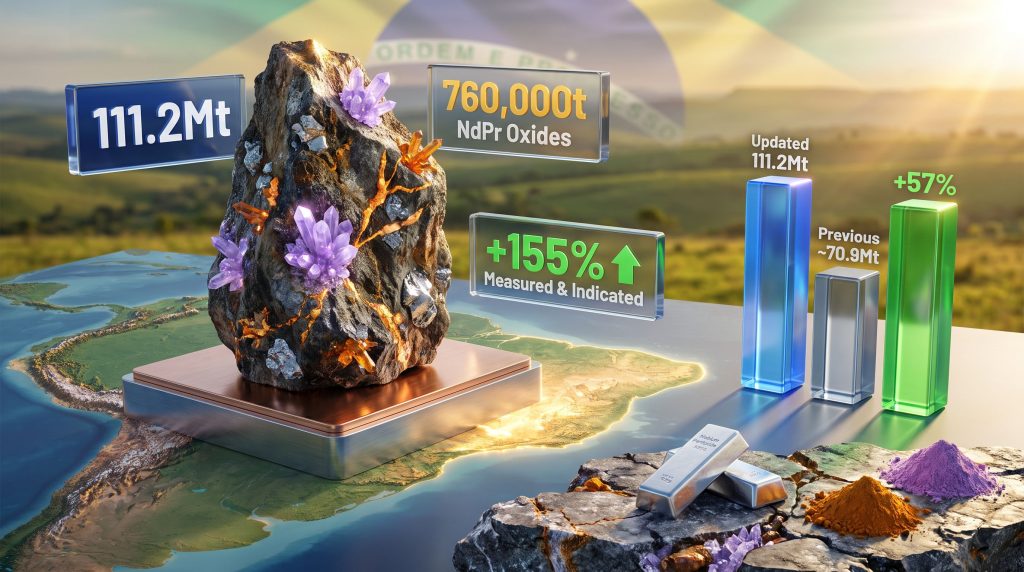
It is within this macro context that the St George Mining Araxá resource upgrade, announced in August 2026, carries significance well beyond a single drill programme milestone. The Araxá project in Brazil's Minas Gerais state now holds a total Mineral Resource Estimate of 111.2 million tonnes (Mt) grading 3.57% total rare earth oxide (TREO) and 0.57% niobium pentoxide (Nb₂O₅), representing a 57% increase from the prior estimate. More critically, the Measured and Indicated (M&I) resource expanded by 155% to 75.2Mt, a jump that fundamentally changes how financiers, engineers, and institutional investors assess the project.
When big ASX news breaks, our subscribers know first
Decoding the Resource Numbers: What the St George Mining Araxá Resource Upgrade Actually Signals
Raw tonnage figures in mining announcements can be misleading without context. The more informative lens is resource category confidence, and the Araxá upgrade delivers convincingly on this dimension.
The JORC Classification Framework and Why Category Confidence Matters
Under the JORC Code — the reporting standard used across Australian-listed mining companies — mineral resources are classified into three categories based on the level of geological understanding and data density. Understanding mineral deposit tiers is therefore essential for interpreting what the Araxá upgrade truly represents:
- Inferred Resources represent the lowest confidence tier, typically based on limited drill spacing and broader geological inference
- Indicated Resources reflect a higher level of geological continuity and data density, suitable for preliminary economic assessments
- Measured Resources are the highest-confidence category, underpinned by close-spaced drilling and detailed geological modelling — these are the figures that directly support bankable feasibility studies and project debt financing
With 68% of the Araxá resource now sitting in Measured and Indicated categories, the project has cleared a critical threshold for serious development planning. This is not simply a scale story — it is a quality-of-knowledge story. Banks and project finance institutions typically require a minimum proportion of M&I resources before engaging in term sheet discussions, and Araxá has moved decisively into that territory.
The Full Resource Picture at a Glance
| Metric | Previous Estimate | Updated Estimate | Change |
|---|---|---|---|
| Total Mineral Resource (Mt) | ~70.9Mt | 111.2Mt | +57% |
| TREO Grade | 4.06% | 3.57% | Moderate dilution from volume growth |
| Nb₂O₅ Grade | 0.62% | 0.57% | Moderate dilution from volume growth |
| Measured & Indicated (Mt) | ~29.5Mt | 75.2Mt | +155% |
| M&I TREO Grade | 4.56% | 3.64% | Dilution offset by volume |
| M&I NdPr Grade | — | 0.69% | New disclosure |
| Contained TREO (Mt) | — | 3.98Mt | — |
| Contained NdPr Oxides (t) | — | 760,000t | — |
| Contained Nb₂O₅ (t) | — | 630,000t | — |
The moderate grade dilution across TREO and Nb₂O₅ is a natural outcome of bringing more rock into the resource envelope. When a deposit grows substantially by volume, peripheral zones with slightly lower grades are incorporated. What matters most is that the contained metal inventory expands — and at Araxá, 3.98 million tonnes of contained TREO and 630,000 tonnes of contained Nb₂O₅ represent a resource of globally meaningful scale.
Key Insight for Investors: Grade dilution accompanied by a larger M&I resource base is generally a positive development for project economics. It provides more scheduling flexibility, better blending options, and a longer mine life — all of which improve the bankability of a future feasibility study.
Understanding NdPr, TREO, and Nb₂O₅ as Araxá's Three Value Pillars
Not all rare earth content is created equal. The commercial value of any rare earth deposit hinges heavily on its distribution — the proportion of high-value elements relative to lower-value ones.
-
NdPr Oxides (Neodymium-Praseodymium): These are the critical inputs for neodymium-iron-boron (NdFeB) permanent magnets, the most powerful magnets commercially available. NdFeB magnets are essential in EV traction motors and direct-drive wind turbine generators. Araxá's 760,000 tonnes of contained NdPr oxides within the M&I category places it among the largest undeveloped NdPr inventories on earth. At a typical NdPr oxide price environment, this alone represents extraordinary long-term value potential.
-
TREO (Total Rare Earth Oxide): The aggregate measure of all 17 rare earth elements present in the ore. While TREO grade and tonnage define overall resource size, the NdPr fraction within TREO is the key commercial differentiator. Araxá's NdPr grade of 0.69% within the M&I resource is geologically meaningful for a large-tonnage hard-rock deposit.
-
Nb₂O₅ (Niobium Pentoxide): Niobium is a specialty metal used primarily to strengthen steel alloys through high-strength low-alloy (HSLA) steel technology. Adding as little as 0.1% niobium to steel can increase tensile strength by up to 30%, enabling lighter and more durable structures across automotive, construction, and aerospace applications. With 630,000 tonnes of contained Nb₂O₅, Araxá's niobium co-product provides meaningful revenue diversification that single-commodity rare earth projects simply cannot replicate.
An additional noteworthy detail: within the broader resource sits a high-grade core — 830,000 tonnes of TREO grading above 6.29% and 120,000 tonnes of Nb₂O₅ above 0.90%. This premium subset could serve as a prioritised mining target in early project life, supporting stronger initial economics before lower-grade zones are blended into the production profile.
How Araxá Stacks Up Against Global Peers
Benchmarking the Project Against the Undeveloped Critical Minerals Pipeline
| Benchmark | Araxá (St George Mining) | Global Context |
|---|---|---|
| Undeveloped hard-rock REE projects in South America | Largest | No comparable hard-rock project exists on the continent |
| Undeveloped niobium Measured Resource globally | Largest | Tier-1 positioning in global niobium development |
| Contained NdPr oxides (M&I) | 760,000t | Among the largest undeveloped NdPr inventories globally |
| M&I resource share of total | 68% | Well above typical early-stage project thresholds |
The distinction between hard-rock and ionic clay rare earth deposits deserves particular attention, as it carries significant implications for development credibility, processing economics, and investor appetite. Furthermore, the critical minerals demand surge across global markets has intensified the scrutiny applied to each deposit type.
Hard-Rock vs. Ionic Clay: A Critical Distinction Rarely Explained in Mainstream Coverage
Ionic clay rare earth deposits — predominantly found in southern China and increasingly explored in Southeast Asia — host rare earth elements adsorbed onto clay minerals. They can be processed at relatively low cost using simple leaching methods, but they carry growing liabilities:
- Environmental regulators in Southeast Asia are imposing stricter controls on heap leach operations associated with ionic clay mining
- Grade variability is high across ionic clay deposits, making resource estimation and mine planning more complex
- The geopolitical concentration of ionic clay resources in China means that supply chains dependent on them remain exposed to trade disruption risk
Hard-rock carbonatite deposits like Araxá, by contrast, benefit from well-understood mineralogy and decades of global metallurgical research. The processing pathway is more complex upfront, but the consistency and predictability of hard-rock ore makes it significantly more attractive to institutional lenders and off-take partners who value supply reliability.
Geological Note: Araxá sits within a carbonatite complex — the same geological setting that hosts Brazil's CBMM Araxa niobium mine, one of the most productive critical mineral operations in the world. This geological kinship is not coincidental; it reinforces the technical credibility of the mineralisation model at St George Mining's adjacent project.
East Araxá: The Upside Catalyst That Isn't in the Headline Number
An Adjacent Zone With Unquantified But Potentially Significant Scale
One of the most strategically important aspects of the August 2026 St George Mining Araxá resource upgrade is what it does not include. East Araxá, a geologically distinct mineralised zone adjacent to the main deposit, was entirely excluded from the updated 111.2Mt resource estimate.
This is a meaningful detail for investors doing serious project-level analysis. The current headline resource represents only the core deposit. A maiden resource estimate for East Araxá is targeted for delivery during the December quarter 2026, and any tonnage declared from this zone will be fully additive to the existing base.
Ongoing drilling at East Araxá suggests the mineralised system extends beyond currently drilled boundaries. Step-out drill results will be the primary near-term newsflow catalyst for the project, and their interpretation relative to the main deposit's grade profile will shape expectations for the magnitude of any maiden resource.
Speculative Scenario: If East Araxá delivers even a modest initial resource of 15 to 25Mt at comparable grades to the main deposit, total project inventory could approach or exceed 130 to 135Mt — a scale threshold that would further differentiate Araxá from virtually all other undeveloped rare earth projects globally. This remains speculative pending drill results, but the geological precedent within the broader carbonatite complex supports cautious optimism.
The Development Roadmap: From Drill Results to Feasibility
Technical Advisory and Economic Study Progress
The engagement of Worley as technical adviser represents an important signal about where St George Mining is positioning Araxá in its development lifecycle. Worley is a globally recognised engineering, procurement, and project delivery firm with extensive experience in large-scale resource project development across multiple commodities and jurisdictions.
Engagement of a firm of this calibre at the current project stage indicates a deliberate transition from pure exploration to active development planning. Economic studies including a definitive feasibility study and mine planning are now underway, with metallurgical testwork progressing simultaneously to define the processing flowsheet and inform operating cost assumptions.
Key Development Milestones to Monitor
| Milestone | Target Timing | Strategic Significance |
|---|---|---|
| East Araxá maiden resource | Q4 2026 | Fully additive to existing 111.2Mt base |
| Preliminary economic assessment / scoping study | TBC | First quantified indication of project economics |
| Metallurgical testwork completion | Ongoing | Defines processing flowsheet and production costs |
| Prefeasibility study | TBC | Gateway to institutional financing discussions |
| Bankable feasibility study | TBC | Required for project debt financing and construction decision |
Comparable critical minerals projects at similar development stages have typically required 12 to 24 months to complete prefeasibility studies after engaging major technical advisers, though timelines vary significantly based on deposit complexity and testwork requirements.
Macro Tailwinds: The Structural Forces Behind Rare Earth and Niobium Demand
The Supply Chain Diversification Imperative
China's dominance of rare earth processing is not a new development, but the policy responses to it have accelerated markedly. The US Inflation Reduction Act and the EU Critical Raw Materials Act both establish frameworks that incentivise domestic and allied-nation supply chains for critical minerals. The rare earth geopolitical impact of these policy shifts is reshaping capital allocation across the entire sector, with niobium classified as a critical mineral by Australia, the United States, and the European Union.
Importantly, global niobium supply is extremely concentrated. Brazil's CBMM currently supplies approximately 80 to 85% of world niobium demand, making any new niobium source of scale inherently strategically valuable — irrespective of the broader rare earth narrative.
NdPr Demand: The EV and Wind Energy Connection
The demand case for NdPr rests on a straightforward technology adoption curve. NdFeB permanent magnets are the enabling technology for:
- EV traction motors: Most modern battery electric vehicles use permanent magnet motors, particularly in higher-efficiency models. Global EV penetration is projected to continue growing through 2030 and beyond, with multiple forecasts pointing to sustained NdPr demand growth of 8 to 12% annually through the latter part of this decade.
- Direct-drive wind turbines: Offshore wind installations increasingly favour permanent magnet generators, which eliminate mechanical gearboxes and reduce maintenance requirements in difficult marine environments.
- Defence and aerospace applications: Permanent magnets are critical components in guided munitions, radar systems, and advanced aircraft — giving NdPr supply chain security a direct defence dimension that Western governments are increasingly focused on.
Araxá's 760,000 tonnes of contained NdPr oxides could support decades of production at commercially meaningful rates, positioning the project as a potential long-term strategic supplier well beyond the current investment cycle.
The next major ASX story will hit our subscribers first
Share Price Performance and Investor Psychology
How Markets Are Pricing Araxá's Development Progress
St George Mining shares have risen approximately 105% over the 12 months to August 2026, compared to approximately 3% for the All Ordinaries Index (ASX: XAO) over the same period. This outperformance of roughly 102 percentage points reflects a progressive market rerating as the resource base has grown and confidence categories have improved.
Understanding what drives valuation for pre-production critical minerals companies requires a different analytical framework than that applied to cash-flow-generating businesses. Key value drivers include:
- Resource size and confidence category: M&I tonnage carries a higher market-implied value per tonne than Inferred resources, because it is closer to the capital-raising and feasibility study requirements of the development pathway
- Grade relative to comparable projects: Higher NdPr grades within TREO reduce processing costs per unit of payable metal and improve project economics
- Commodity price sentiment: NdPr oxide prices are notoriously cyclical, and investor appetite for rare earth equities often moves ahead of underlying commodity price signals
- Management and technical adviser credibility: The involvement of recognised engineering firms signals seriousness of intent and provides a proxy for execution capability
- Macro thematic momentum: Critical minerals sentiment can drive significant re-rating of early-stage projects when policy developments or geopolitical events heighten perceived urgency
Important Disclaimer: Past share price performance is not a reliable indicator of future returns. St George Mining remains a pre-revenue, resource-stage company. Investors face material risks including commodity price volatility, permitting uncertainty, project financing risk, metallurgical complexity, and execution risk across feasibility and construction phases. Nothing in this article constitutes financial advice.
Frequently Asked Questions: St George Mining Araxá Resource Upgrade
What is the total size of the Araxá Mineral Resource Estimate after the August 2026 upgrade?
The updated resource stands at 111.2 million tonnes grading 3.57% TREO and 0.57% Nb₂O₅, representing a 57% increase from the prior estimate of approximately 70.9Mt.
Why is the 155% increase in Measured and Indicated resources the most important figure?
Measured and Indicated resources are the categories directly usable in bankable feasibility studies and project financing applications. A 155% expansion to 75.2Mt means that 68% of the total resource now sits in high-confidence categories, materially advancing the project's credibility with lenders, off-take partners, and institutional investors.
How much NdPr oxide does the Araxá project contain?
The updated Measured and Indicated resource contains approximately 760,000 tonnes of contained NdPr oxides, placing Araxá among the largest undeveloped NdPr inventories globally.
What is East Araxá and why does it matter?
East Araxá is a geologically distinct adjacent zone that was excluded from the August 2026 resource estimate. A maiden resource for this zone is targeted for the December quarter 2026 and will be entirely additive to the existing 111.2Mt base, representing unquantified but potentially significant upside.
Why does Araxá have the largest undeveloped niobium Measured Resource globally?
The Measured category represents the highest level of confidence in the JORC classification framework. No other undeveloped niobium project globally has declared a larger volume in this category, a distinction that reflects both the scale of the deposit and the density of drilling that has been completed.
What technical work is currently underway?
Economic studies including feasibility and mine planning are underway with technical adviser Worley. Metallurgical testwork is progressing in parallel to define the processing flowsheet and underpin future cost estimates.
Key Takeaways for Investors and Industry Observers
The St George Mining Araxá resource upgrade is best understood not as a single data point, but as a series of compounding signals about project trajectory:
- Scale confirmation: At 111.2Mt, Araxá has achieved the tonnage threshold that justifies serious feasibility investment
- Confidence uplift: The 155% M&I expansion is the most financially consequential aspect of the upgrade, directly enabling the next phase of development financing
- Dual-commodity optionality: The combination of NdPr and niobium in a single deposit provides revenue diversification unavailable to most rare earth development projects
- Quantified upside remaining: East Araxá is a genuine, unpriced growth option sitting adjacent to the main deposit, with a maiden resource expected before year-end 2026
- Development transition: The engagement of Worley and the commencement of feasibility-level work marks a definitive shift from exploration-stage to development-stage project positioning
- Macro alignment: Structural demand growth for NdPr and the strategic concentration of niobium supply provide a supportive long-term context for patient capital
Readers seeking primary source documentation can access St George Mining's original announcement via the ASX platform. Publicly available research from the International Energy Agency's Critical Minerals reports and the Australian Critical Minerals Council provides broader context on supply chain dynamics and critical mineral demand projections.
Want to Spot the Next Major Critical Minerals Discovery Before the Market Does?
Discovery Alert's proprietary Discovery IQ model scans ASX announcements in real time, instantly identifying significant mineral discoveries across rare earths, niobium, and 30+ other commodities — turning complex data into clear, actionable investment insights. Explore how historic discoveries have generated extraordinary returns on the Discovery Alert discoveries page, then begin your 14-day free trial to position yourself ahead of the market.