August 11, 2026
The Supply Chain Architecture That's Quietly Reshaping Asia's Resource Future
Rarely does a bilateral diplomatic meeting produce outcomes that reverberate across global commodity markets, semiconductor supply chains, and naval strategy simultaneously. Yet the August 2026 meeting between Australian Prime Minister Anthony Albanese and Vietnamese President To Lam has done precisely that, formalising a Comprehensive Strategic Partnership that positions two mid-sized economies as architects of a new Indo-Pacific resource order.
To understand why this matters, it helps to start not with the politics, but with the physics of supply chain concentration. When a single nation controls the extraction, processing, and export of materials essential to modern technology, the entire downstream economy becomes a hostage to that nation's policy decisions. That structural vulnerability has driven a decade of quiet repositioning by resource-rich middle powers, and the Australia and Vietnam strategic partnership critical minerals framework is one of the most consequential expressions of that realignment to date.
When big ASX news breaks, our subscribers know first
The Economic Foundation: Trade Numbers That Tell a Deeper Story
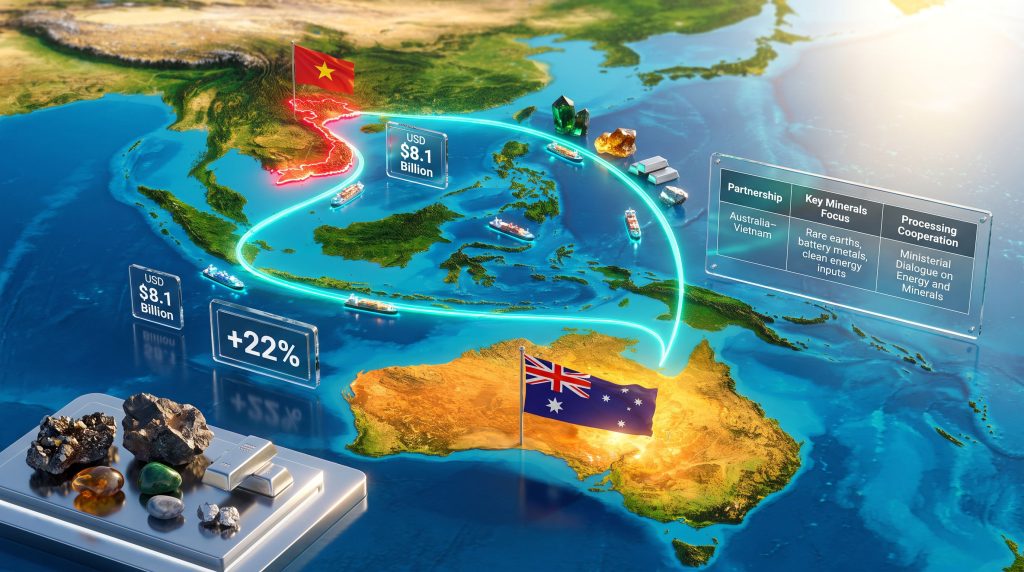
Before examining the minerals dimension, the bilateral trade data itself deserves scrutiny. According to the joint statement issued during President To Lam's official visit to Australia, bilateral trade between the two nations reached USD $8.1 billion in the first half of 2026 alone, representing a 22% year-on-year increase that significantly outpaces broader global trade growth trends.
| Metric | Detail |
|---|---|
| Bilateral trade value (H1 2026) | USD $8.1 billion |
| Year-on-year growth rate | +22% |
| Vietnam's key exports to Australia | Electronics, smartphones, garments |
| Australia's key exports to Vietnam | Coal, minerals, natural gas |
What this asymmetry in trade flows reveals is not imbalance, but complementarity. Vietnam exports finished and semi-finished manufactured goods, many of which depend on mineral inputs sourced globally. Australia exports the upstream commodities that feed those manufacturing ecosystems. The logical next step, which this partnership explicitly pursues, is integrating those supply chains vertically rather than allowing third parties to capture the value in between.
A 22% surge in a single half-year period is not organic trade growth. It reflects deliberate supply chain restructuring by manufacturers and procurement teams who have already concluded that Vietnam is a preferred manufacturing base and Australia a preferred resource supplier. The formal partnership is, in many respects, catching up with what the private sector has already begun building.
Vietnam's Rare Earth Endowment: A Geological Perspective
Vietnam's mineral significance is not widely appreciated outside specialist circles, and that gap in understanding represents both an information asymmetry and a potential investment opportunity for those who recognise it early.
Vietnam holds rare earth deposits that rank among the largest in the world by estimated reserve volume. According to the United States Geological Survey, Vietnam's rare earth reserves are estimated at approximately 22 million tonnes, placing the country second globally behind only China. Yet the critical distinction between reserve size and commercial production capacity is where the real story lies.
Despite holding this extraordinary resource endowment, Vietnam's rare earth extraction and processing infrastructure remains significantly underdeveloped relative to the geological opportunity. The country has historically exported rare earth concentrates in relatively raw form, capturing only a fraction of the value that flows to processors and manufacturers downstream. Furthermore, this structural gap creates a specific and well-defined role for Australian technical expertise, particularly given the growing focus on rare earth supply chains across the Indo-Pacific.
Several factors make Vietnam's rare earth geology particularly notable:
- Many Vietnamese deposits contain light rare earth elements (LREEs) including cerium, lanthanum, and neodymium, the latter being critical for permanent magnets used in electric vehicle motors and wind turbines
- Some northern Vietnamese provinces host ion-adsorption clay deposits, a geological formation that yields heavy rare earth elements including dysprosium and terbium at significantly lower extraction costs than hard rock mining
- The Dong Pao deposit in Lai Chau province represents one of the most studied rare earth projects in Southeast Asia, with mineralisation characteristics that have attracted sustained foreign investor interest
- Vietnam's rare earth mineralogy is distinct from Chinese ionic clay deposits in several respects, including the distribution of individual rare earth elements within ore bodies, which affects the economic viability of different processing pathways
"The processing gap is arguably more strategically significant than the resource base itself. Nations that control refining and separation capacity determine who can manufacture the downstream products that drive the clean energy transition. Vietnam's ambition to move up that value chain aligns precisely with what Australia's mining services and technology sector can deliver."
What the Partnership Actually Covers: Defence, Minerals, and Maritime Law
The formal agreements signed during President To Lam's visit span a wider range of domains than critical minerals alone, and understanding the full architecture helps explain why the minerals cooperation component is likely to prove durable rather than aspirational.
The partnership encompasses:
- Defence and security cooperation as a foundational layer, providing the institutional trust necessary for deeper economic integration
- A Memorandum of Understanding between the Vietnam Coast Guard and the Australian Border Force on maritime law enforcement cooperation
- A separate border forces cooperation agreement enhancing mutual assistance mechanisms between the two nations' frontier security agencies
- Supply chain cooperation across critical minerals, semiconductors, and clean energy inputs, with a ministerial-level dialogue mechanism to drive implementation
- Agricultural cooperation extending the partnership's economic dimensions beyond the resources sector
- Joint commitment to freedom of navigation, peaceful dispute resolution, and open trade architecture
The Ministerial Dialogue on Energy and Minerals is structured to convene at minimum once per two-year cycle at the political level, though working-group engagement between technical agencies is expected to operate on a more continuous basis. This architecture matters because it creates accountability for delivery without requiring constant high-level diplomatic attention, a design that tends to produce more sustained implementation than purely summit-driven frameworks.
The South China Sea Dimension and Its Supply Chain Implications
One aspect of this partnership that receives insufficient attention in purely economic analysis is its maritime security architecture. Both the critical minerals trade routes and the broader bilateral commercial relationship depend on safe, reliable passage through waters where territorial disputes remain active and unresolved.
Australia regularly deploys naval vessels and surveillance aircraft across the Indo-Pacific, including the South China Sea, a waterway where Vietnam, China, and several neighbouring states maintain overlapping and contested territorial claims. In April 2026, Australia joined Canada and the United States in a multilateral transit through the South China Sea, demonstrating both capability and willingness to operate in contested maritime space alongside like-minded partners.
The joint commitment in the Albanese-Lam statement to peaceful dispute resolution and freedom of navigation is not diplomatic boilerplate. It is a direct signal about the security architecture that both nations believe is necessary to underpin the commercial relationship they are building. Critical mineral shipments, whether in concentrate or processed form, travel through these waters. The MOU between the Vietnam Coast Guard and Australian Border Force on maritime law enforcement cooperation adds an operational dimension to what would otherwise remain a purely declaratory commitment.
"Freedom of navigation in the South China Sea is not merely a legal principle. For nations seeking to build reliable supply chains through the region, it is a commercial prerequisite. Maritime security cooperation between Australia and Vietnam directly strengthens the physical infrastructure of the minerals trade relationship."
How the Australia-Vietnam Framework Compares to Other Indo-Pacific Minerals Partnerships
Australia has pursued bilateral critical minerals agreements across the Indo-Pacific with considerable energy, and understanding where the Vietnam partnership sits within that broader matrix helps identify what is genuinely novel about it. Notably, China's rare earth strategy has accelerated many of these diversification efforts among like-minded nations.
| Partnership | Key Minerals Focus | Processing Cooperation | Institutional Mechanism |
|---|---|---|---|
| Australia-Vietnam | Rare earths, battery metals, clean energy inputs | Technology transfer, mining services | Ministerial Dialogue on Energy and Minerals |
| Australia-Japan | Lithium, nickel, cobalt | Downstream processing investment | Critical Minerals Partnership (2022) |
| Australia-South Korea | Lithium, graphite, rare earths | Joint venture frameworks | Critical Minerals Supply Chain MOU |
| Australia-India | Cobalt, lithium, rare earths | Refining capacity development | Critical Minerals Investment Partnership |
What distinguishes the Vietnam framework from these other arrangements is the combination of Vietnam's specific geological endowment in rare earths, its existing manufacturing integration with global technology supply chains, and its geographic position within ASEAN. Vietnam is not simply another buyer of Australian minerals. It is a potential processing and manufacturing hub that could transform Australian raw material exports into inputs for high-value products destined for global markets.
This positions the partnership differently from agreements with Japan or South Korea, which are primarily about securing Australian supply for established downstream industries. The Vietnam model involves a more ambitious co-development logic, building processing capacity in a nation that has the geological resources, the manufacturing workforce, and the geographic access to serve as a regional rare earth refining centre.
The next major ASX story will hit our subscribers first
The Semiconductor Supply Chain Connection
The explicit inclusion of semiconductors in the cooperation agenda reflects a strategic insight that minerals and chips are not separate policy domains but interdependent elements of the same supply chain. The rare earth elements and specialty metals used in semiconductor fabrication, including certain lanthanides used in polishing compounds and specialised dopants, connect Vietnamese geological endowment directly to chip manufacturing capacity. Indeed, the convergence of minerals and semiconductors as intertwined strategic concerns has become a defining feature of Indo-Pacific economic policy.
Vietnam has already attracted significant semiconductor assembly and testing investment from major global manufacturers, positioning itself as an emerging node in chip supply chains. Consequently, connecting that downstream capability to upstream minerals cooperation with Australia creates the architecture for a vertically integrated industrial cluster that neither country could build independently.
Step-by-Step: How the Critical Minerals Cooperation Framework Is Designed to Operate
Understanding the operational mechanics of this framework helps distinguish it from agreements that remain purely symbolic.
- Ministerial-level engagement through the Energy and Minerals Dialogue establishes strategic priorities, signals investment intent, and creates political accountability for delivery
- Agency-level working groups between relevant government departments identify specific supply chain gaps, project pipelines, and regulatory barriers requiring attention
- Private sector facilitation through investment promotion bodies and bilateral trade missions connects Australian mining, processing, and technology companies with Vietnamese counterparts and project opportunities
- Technology transfer mechanisms support Vietnamese capacity-building in sustainable extraction, beneficiation, and separation technology, areas where Australian expertise has genuine competitive depth
- Monitoring and review processes track progress against supply chain diversification objectives and allow course correction without requiring fresh political mandates
- Multilateral alignment ensures bilateral outputs integrate with broader Indo-Pacific frameworks, preventing duplication and maximising the leverage of bilateral commitments
Commercial Opportunities and Risk Factors for Australian Mining Companies
For Australian companies in the mining services, technology, and development sectors, the formalisation of this partnership creates a more defined commercial landscape in Vietnam. The surge in critical minerals demand driven by the global energy transition makes these opportunities particularly timely. Several specific opportunity areas emerge from the framework's design:
- Processing technology export: Australian expertise in rare earth beneficiation and separation represents a direct commercial opportunity in a market that needs exactly these capabilities
- Mining services: Environmental management, tailings engineering, and sustainable extraction consulting are areas where Australian firms have internationally recognised capability
- Joint venture development: The framework's emphasis on mutual investment creates a more hospitable regulatory signal for Australian companies considering project-level commitments in Vietnam
- Clean energy minerals supply chains: The explicit inclusion of clean energy in the cooperation agenda opens pathways for Australian lithium, nickel, and cobalt producers to align export strategies with Vietnamese manufacturing demand
What Risks Should Investors Consider?
However, investors and companies considering exposure to this theme should weigh a realistic set of risk factors:
- Vietnam's mining regulatory environment includes requirements around state participation and resource nationalism considerations that require careful navigation
- Rare earth processing technology transfer involves intellectual property risks that demand robust contractual frameworks
- The gap between diplomatic frameworks and commercially bankable project outcomes has historically been significant in the critical minerals sector
- Currency, political, and sovereign risk considerations apply to any Vietnam-based investment, regardless of bilateral diplomatic architecture
Disclaimer: This analysis contains forward-looking observations about commercial and geopolitical trends. These should not be interpreted as financial advice. Investors should conduct independent due diligence before making any investment decisions related to companies or projects referenced in this context.
Frequently Asked Questions
What is the Australia-Vietnam Comprehensive Strategic Partnership?
It is a formal bilateral framework elevating the relationship between Australia and Vietnam across defence, economic, and diplomatic domains, formalised through agreements signed during Vietnamese President To Lam's official visit to Australia in August 2026.
Which Critical Minerals Are the Primary Focus of Australia-Vietnam Cooperation?
Rare earth elements represent the most strategically significant mineral category given Vietnam's exceptional geological endowment. Battery metals relevant to clean energy supply chains and materials linked to semiconductor manufacturing are also explicitly included in the cooperation agenda. The broader context of critical raw materials transition further underscores why this cooperation carries such strategic weight.
Does Vietnam Have the Rare Earth Reserves to Make This Partnership Commercially Significant?
Vietnam holds an estimated 22 million tonnes of rare earth reserves according to USGS data, ranking second globally. The commercial significance is real, though it is contingent on developing extraction and processing infrastructure that currently lags well behind the geological opportunity.
How Does This Partnership Relate to Australia's Strategy of Reducing Supply Chain Dependence?
The Australia and Vietnam strategic partnership critical minerals framework is one element of a broader Australian strategy of building diverse supply chain partnerships across Asia, reducing the concentration risk that comes from over-reliance on any single supplier for critical materials. Vietnam's role as a manufacturing hub and resource holder makes it a particularly valuable node in that diversification strategy.
When Did Bilateral Trade Between Australia and Vietnam Reach $8.1 Billion?
The $8.1 billion figure represents bilateral trade in the first half of 2026 only, representing a 22% increase compared to the same period in the prior year, as reported in the joint statement issued by both leaders.
Vietnam's Long-Term Trajectory: From Minerals Exporter to Processing Hub
The most consequential long-term question raised by this partnership is whether Vietnam can successfully transition from a country that exports mineral concentrates to one that captures the processing and manufacturing value that currently flows elsewhere. That transition would represent a fundamental shift in the global rare earth supply chain, reducing both Chinese dominance in separation capacity and the dependence of technology manufacturers on a single geographic source.
Australia's role in that potential transition is not passive. The technology, capital, and regulatory expertise that Australian companies can bring to Vietnam's minerals sector could meaningfully accelerate the timeline on which Vietnamese processing capacity becomes commercially competitive. Whether that potential is realised depends on the quality of implementation that follows the diplomatic framework, a challenge that has historically proven more difficult than the framework-building itself.
What is clear is that the architecture being constructed between Canberra and Hanoi has the structural characteristics of a durable strategic alignment rather than a transactional trade arrangement. The combination of defence cooperation, maritime security coordination, and Australia and Vietnam strategic partnership critical minerals development creates mutual dependencies that are difficult to unwind, which is precisely the kind of institutional stickiness that gives long-term supply chain investments their foundation.
For further reporting on the Australia-Vietnam Comprehensive Strategic Partnership and its critical minerals dimensions, readers can refer to ongoing coverage published by Mining Weekly and broader Indo-Pacific trade analysis from the Australian Strategic Policy Institute.
Want to Identify the Next Major ASX Mineral Discovery Before the Market Does?
Discovery Alert's proprietary Discovery IQ model scans ASX announcements in real time, transforming complex mineral data across more than 30 commodities into clear, actionable insights — whether you're tracking rare earth opportunities or broader critical minerals themes shaping the Indo-Pacific. Explore how historic discoveries have generated substantial returns on Discovery Alert's dedicated discoveries page, and begin your 14-day free trial today to position yourself ahead of the market.