August 13, 2026
The Hidden Vulnerability Powering America's Rare Earth Rush
The global economy runs on magnets. Not the rudimentary kind found on refrigerator doors, but extraordinarily powerful neodymium-iron-boron (NdFeB) permanent magnets that silently drive electric vehicle motors, spin offshore wind turbine generators, and guide precision defence systems. These magnets share a critical dependency: they cannot be manufactured without neodymium and praseodymium, two rare earth elements that the United States currently imports in processed form almost entirely from a single foreign supplier. The Apex Rift rare earth project Nebraska sits at the centre of efforts to change that dependency.
According to the U.S. Geological Survey's Mineral Commodity Summaries, China accounts for roughly two-thirds of global rare earth oxide mine production and controls an even larger share of downstream processing capacity. For American manufacturers operating across defence, clean energy, and advanced technology sectors, this represents a structural vulnerability that federal policy alone cannot resolve without a functioning domestic rare earth supply chain extending from the ground up.
That upstream supply chain gap is exactly what makes the Apex Rift rare earth project Nebraska geologically significant. Operated by Apex Critical Metals (CSE: APXC; US-OTC: APXCF), the Rift Project sits within the Elk Creek Carbonatite Complex in southeastern Nebraska and is emerging as one of the more compelling pre-resource rare earth discoveries currently under active drilling anywhere in North America.
When big ASX news breaks, our subscribers know first
Understanding Carbonatite-Hosted Rare Earth Deposits: Why Geology Matters First
Before evaluating any specific drill result, investors and analysts benefit from understanding what makes carbonatite-hosted deposits geologically distinctive. Carbonatites are igneous rocks of magmatic origin composed of more than 50% carbonate minerals. They are relatively rare geologically but disproportionately important economically because they tend to concentrate rare earth elements, niobium, and phosphate at grades that can support commercial extraction.
The world's most productive rare earth mine, MP Materials' Mountain Pass operation in California, is hosted within a carbonatite complex. So is the Wicheeda project in British Columbia, currently being advanced by Defense Metals. The Elk Creek Carbonatite Complex in Nebraska belongs to this same geologically elite category.
Carbonatite deposits are globally significant not just for their grade potential, but for the compositional quality of their rare earth baskets. Unlike ion-adsorption clay deposits common in southern China, carbonatite-hosted systems frequently concentrate the magnet-critical light rare earths, particularly neodymium and praseodymium, that command premium pricing from permanent magnet manufacturers.
Furthermore, what makes the Elk Creek district particularly notable is that meaningful historical exploration work was conducted here long before Apex's current campaign. Legacy intercepts attributed to work by Molycorp and Quantum Rare Earth Developments include intervals of 155.5 metres at 2.7% REO and 236.2 metres at 2.10% total REO (TREO), providing geological confidence in the system's scale and continuity well before a single 2026 drill hole was turned.
Apex Rift Rare Earth Project Nebraska: Location, Land Position, and Geological Setting
The Rift Project is situated approximately 100 kilometres south of Lincoln in the southeastern corner of Nebraska, a location that offers logistical advantages rarely discussed in geological assessments but critically important for development economics. Access to established road infrastructure, proximity to Midwestern industrial corridors, and a relatively benign regulatory environment for mineral exploration collectively reduce the friction associated with advancing a project from drill core to resource definition.
The project covers a land position of approximately 3,024 to 3,500 acres, depending on ongoing land consolidation. The Elk Creek Carbonatite Complex itself is a multi-commodity geological system hosting rare earth elements alongside niobium mineralisation, the latter being the focus of NioCorp Developments' (Nasdaq: NB) advanced Elk Creek project, which has published a net present value assessment providing district-level geological validation independent of Apex's own results.
How Does the Rift Project Compare to Peer North American Rare Earth Developments?
| District / Project | State/Province | Host Rock | Key REE Focus | Development Stage |
|---|---|---|---|---|
| Elk Creek / Rift Project | Nebraska | Carbonatite | NdPr, Total REO | Active Drilling |
| Mountain Pass (MP Materials) | California | Carbonatite | Light REEs | Producing |
| Wicheeda (Defense Metals) | British Columbia | Carbonatite | Light REEs | Feasibility |
| Ucore Louisiana Plant | Louisiana | N/A (Processing) | Separation | Development |
Dissecting the 2026 Drill Results: Grade, Width, and What the Numbers Actually Mean
Apex's 2026 drill program has delivered a sequence of assay results that are notable both for their individual grade quality and for what they collectively reveal about the geometry of the Rift mineralised system. In addition, these results reflect broader rare earth exploration insights that underscore the strategic value of North American carbonatite discoveries.
Cumulative 2026 Drill Results at a Glance
| Drill Hole | Broad Interval (m) | Broad Grade (% REO) | High-Grade Sub-Interval (m) | High-Grade (% REO) |
|---|---|---|---|---|
| RIFT26-002 | 81.6 | 2.02% | N/A | N/A |
| RIFT26-005A | 137.2 | 2.01% | N/A | N/A |
| RIFT26-008 | 191.9 | 2.50% | 14.9 / 12.3 | 5.09% / 5.63% |
| RIFT26-012 | ~150 | >2.00% | 8.0 | 4.48% |
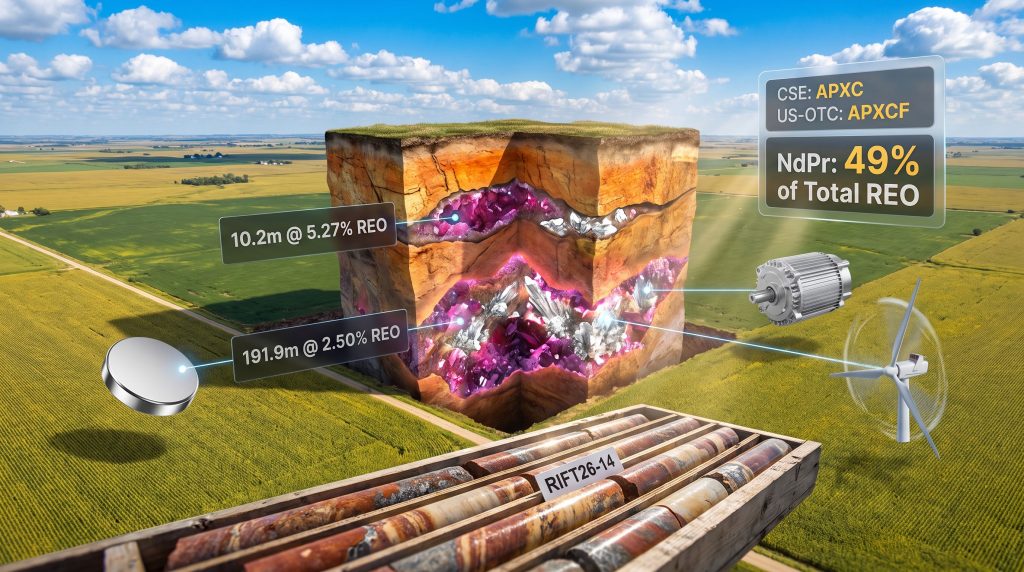
| RIFT26-014 | ~150 | >2.00% | 10.2 | 5.27% |
Two patterns emerge from this dataset that carry real interpretive weight.
First, the broad intervals consistently exceed 2% total REO across widths ranging from roughly 80 metres to nearly 192 metres. In the context of carbonatite-hosted rare earth deposits, bulk-tonnage intervals of this grade and width are competitive with global peers at comparable development stages. For context, the IEA and USGS both note that most operating carbonatite rare earth mines globally operate at feed grades in the 3–9% REO range after beneficiation, meaning that a primary resource grading above 2% REO over 150-metre widths represents a credible bulk-mining target.
Second, the high-grade sub-intervals embedded within those broader envelopes, with results reaching 5.63% REO over 12.3 metres in hole RIFT26-008 and 5.27% REO over 10.2 metres in hole RIFT26-014, introduce the possibility of a selective mining scenario within the larger tonnage system. This kind of nested grade architecture, where a high-grade core sits within a broader lower-grade halo, is a recognised and economically attractive deposit geometry.
The latest assays from holes RIFT26-012 and RIFT26-014 represent the strongest grade-times-width results recorded south of the initial discovery area at the Rift Project, according to Apex Critical Metals. This southward extension of high-grade mineralisation meaningfully expands the system's known footprint.
The Trinity Zone: Structural Controls and the Path to Resource Definition
The primary target within the Rift Project is the Trinity Zone, a structural feature characterised by a shallow west-dipping orientation that is considered favourable for both resource modelling and future mining geometry. Shallow-dipping mineralised systems are generally preferred in bulk open-pit mining scenarios because the geometry allows efficient access to ore without excessive waste stripping.
As of March 2026, the project had completed 5,175 metres of total drilling across six completed holes and two in progress, representing Apex's first full systematic drill campaign following receipt of a Nebraska Department of Environment and Energy (NDEE) drill permit in early 2026. This was the company's inaugural permitted program, meaning the current dataset is the foundation upon which all future resource modelling will be built.
Mineralisation within the Trinity Zone has now been traced across more than 700 metres of strike length, with the system remaining open in all directions. In resource geology, this open-ended characteristic is not merely a technical footnote. It signals that the boundaries of the mineralised system have not yet been defined by drilling, which means the eventual inaugural mineral resource estimate (MRE), targeted for Q1 2027, will represent a minimum footprint rather than a complete picture of the deposit's scale.
Why Open-Ended Strike Length Is a Key Value Driver
- Open mineralisation in all directions means step-out drilling can continue to expand the resource beyond the Q1 2027 MRE.
- Each additional hole that returns on-grade results adds geological confidence and potential resource tonnes without requiring re-characterisation of existing data.
- The consistency across multiple holes separated by meaningful distances reduces the interpolation risk in the eventual resource block model.
- Historical intercepts from prior operators in the district further anchor the geological confidence of the current modelling exercise.
The NdPr Premium: Why Basket Composition Determines Real Economic Value
One of the most poorly understood aspects of rare earth project economics among generalist investors is the distinction between total REO grade and the economic value of the rare earth basket. Not all rare earth oxides are created equal. Cerium and lanthanum, which frequently dominate the rare earth basket in many carbonatite-hosted deposits, trade at relatively low prices because their industrial applications, while broad, do not generate the same demand intensity as magnet rare earths.
Neodymium (Nd) and praseodymium (Pr), collectively referred to as NdPr, are the specific elements that feed NdFeB permanent magnet production. The IEA's Critical Minerals Market Review notes that demand for rare earth elements used in permanent magnets is projected to grow substantially through 2030 and beyond, driven by EV adoption curves, offshore wind expansion, and defence procurement. There is currently no commercially viable substitute for NdFeB magnets in high-performance motor applications.
Against this backdrop, the NdPr enrichment profile at the Rift Project deserves particular attention:
- Drill hole RIFT26-002 returned an average NdPr proportion of 49% of total REO over a 10-metre interval grading 0.75% REO.
- Hole RIFT26-003 extended the NdPr-enriched horizon across at least 120 metres of strike, demonstrating that the enrichment reflects a structural feature of the deposit rather than a localised anomaly.
A deposit where NdPr constitutes approximately half of the total rare earth basket represents a fundamentally different economic proposition than a cerium-lanthanum dominated system of equivalent grade. The revenue-generating potential per tonne of ore is substantially higher, even before considering any processing premium for magnet-feedstock quality product.
NdPr Basket Economics: A Framework for Interpreting Grade Data
| Metric | What It Measures | Why It Matters |
|---|---|---|
| Total REO Grade (%) | Aggregate concentration of all rare earth oxides | Indicates deposit scale and bulk grade |
| NdPr Proportion (% of basket) | Share of basket attributable to magnet rare earths | Determines revenue quality per tonne |
| NdPr Grade (% TREO x NdPr %) | Effective magnet rare earth concentration | Most relevant metric for offtake discussions |
| HREO Proportion | Heavy rare earth content (Dy, Tb, etc.) | Additional premium if present in economic quantities |
The next major ASX story will hit our subscribers first
Demand Architecture: The Multi-Sector Forces Driving Rare Earth Investment
The investor interest currently flowing into rare earth exploration projects outside China is not speculative in origin. It reflects a convergence of structural critical minerals demand across multiple technology sectors that share a common dependency on permanent magnet materials.
Electric Vehicles: NdFeB permanent magnets are the dominant technology in EV traction motors. Unlike internal combustion engines, electric drivetrains have no viable pathway to avoid rare earth magnet dependency at current performance requirements. Global EV sales growth directly and proportionally increases NdPr demand.
Offshore Wind: The transition from gearbox-driven wind turbines to direct-drive permanent magnet generators significantly increases the rare earth content per megawatt of installed capacity. Offshore wind projects, which are being developed at scale across the Atlantic and Pacific coastlines, represent a sustained long-cycle demand source independent of automotive cycles.
Artificial Intelligence Infrastructure: This is a demand driver less commonly discussed in rare earth narratives but increasingly material. AI data centres require large numbers of precision cooling fans, actuators, and servo motors, all of which depend on permanent magnet technology. Robotics platforms, being deployed at accelerating rates in warehousing, manufacturing, and defence logistics, represent another layer of structural NdPr demand.
Defence Applications: Guided munitions, radar systems, and autonomous platforms each incorporate rare earth-based components. Defence critical materials have been explicitly identified as a national security priority by the U.S. Department of Defense, and domestic sourcing is increasingly a criterion in defence procurement discussions.
Key Risks and the Path to De-Risking: What Investors Need to Understand
The Rift Project's geological credentials are compelling at the exploration stage, but the distance between drill core and commercial production is long and subject to material uncertainties that disciplined investors must account for.
Risk Summary
| Risk Category | Nature of Risk | Relevant Mitigant |
|---|---|---|
| Geological | Mineralisation may not sustain grade at depth or on strike | 700m+ open strike; consistent multi-hole results |
| Metallurgical | Carbonatite REE processing requires specific flowsheets | Flowsheet development ongoing; no public results yet |
| Resource Classification | No NI 43-101 or JORC compliant resource published | Q1 2027 MRE target with active program underway |
| Regulatory | State and federal permitting requirements | NDEE permit already granted for current program |
| Market Price | REE price volatility can compress project economics | Structural demand growth supports medium-term pricing |
| Corporate Concentration | Single-asset exploration company | All corporate risk concentrated in Rift Project outcome |
The metallurgical dimension deserves particular emphasis for investors new to the rare earth sector. High REO grades in drill core are a necessary but not sufficient condition for economic viability. However, the rare earth processing challenges associated with carbonatite-hosted deposits require multi-stage processing flowsheets involving physical beneficiation to produce a rare earth concentrate, followed by hydrometallurgical separation to isolate individual rare earth oxides. The efficiency, cost, and environmental profile of this processing chain will ultimately determine the project's economics. No metallurgical test work results from the current program have been publicly disclosed as of the time of writing.
It is also important to note that all grade data reported by Apex to date is exploratory in nature. Results are not yet compliant with NI 43-101 or JORC resource classification standards, meaning the numbers cannot yet be used in formal economic modelling. The Q1 2027 inaugural MRE publication will represent the first step toward investment-grade resource characterisation.
This article contains forward-looking statements and financial analysis based on publicly available information. It does not constitute investment advice. Readers should conduct independent due diligence before making any investment decisions. Exploration-stage mining companies carry significant risk, and past drill results do not guarantee the delineation of an economic mineral resource.
Frequently Asked Questions: Apex Rift Rare Earth Project Nebraska
What Is the Apex Rift Project?
The Rift Project is a carbonatite-hosted rare earth exploration asset operated by Apex Critical Metals (CSE: APXC; US-OTC: APXCF), situated within the Elk Creek Carbonatite Complex in southeastern Nebraska. The company is targeting an inaugural mineral resource estimate for Q1 2027, supported by a 2026 drill program that has returned multiple intercepts above 4% total rare earth oxides within broader 150-metre intervals grading above 2% REO.
Why Does the NdPr Enrichment at Rift Matter Economically?
NdPr oxides are the primary feedstock for NdFeB permanent magnets, which are essential components in EV motors, wind turbines, and defence systems. When NdPr constitutes approximately 49% of a deposit's total rare earth basket, as observed in certain Rift intervals, the revenue-generating potential per tonne of ore is substantially higher than for deposits dominated by lower-value cerium and lanthanum.
When Will Apex Publish an Inaugural Mineral Resource Estimate?
Apex has targeted Q1 2027 for the publication of its first mineral resource estimate. The estimate will be based on data from the 2026 drill campaign and will represent the first formally classified resource for the Apex Rift rare earth project Nebraska under applicable reporting standards.
What Is the Significance of the Trinity Zone's Open Strike Length?
With mineralisation traced across more than 700 metres of strike and remaining open in all directions, the Trinity Zone has not been geologically bounded by current drilling. Consequently, the Q1 2027 MRE will represent a minimum resource footprint, with potential for meaningful resource growth through continued step-out and infill drilling programs.
How Does the Rift Project Fit Into the Broader North American Rare Earth Development Landscape?
The project joins a small but growing group of Western rare earth developments that includes MP Materials' producing Mountain Pass mine, Defense Metals' Wicheeda project in British Columbia, and Ucore Rare Metals' planned Louisiana separation facility. At the exploration stage, Rift's combination of broad high-grade intervals, confirmed NdPr enrichment, and open-ended strike length distinguishes it within this peer group. For further detail on the project's technical report, the filing on the Rift Project provides additional context for investors conducting due diligence.
Want to Be First When the Next Major Rare Earth Discovery Hits the ASX?
Discovery Alert's proprietary Discovery IQ model scans ASX announcements in real time, instantly identifying significant mineral discoveries — including critical and rare earth metals — and delivering actionable alerts directly to subscribers before the broader market reacts. Explore historic discoveries and the returns they generated, then begin your 14-day free trial to position yourself ahead of the next major find.