August 13, 2026
The Hidden Bottleneck in the Clean Energy Supply Chain
Permanent magnets sit at the centre of nearly every technology the world is rushing to deploy. Electric vehicle motors, offshore wind turbines, defence guidance systems, and industrial robotics all depend on high-performance neodymium-iron-boron (NdFeB) magnets to function. Yet despite this centrality, the processing chain that produces these magnets remains overwhelmingly concentrated in a single geography. More than 85% of global rare-earth separation capacity and an even higher proportion of magnet manufacturing sits within China, creating a structural vulnerability that no amount of upstream mining investment can resolve on its own.
This is the industrial problem that frames everything Energy Fuels Inc. (NYSE American: UUUU | TSX: EFR) is attempting to solve through its Energy Fuels mine-to-magnet strategy. Rather than positioning itself as simply another rare-earth mining or processing company, Energy Fuels is constructing a vertically integrated platform that aims to control every meaningful value-adding stage of the supply chain — from monazite extraction in multiple jurisdictions through to finished permanent magnet manufacturing on US soil.
Understanding why this ambition matters, and what it will take to execute it, requires looking well beyond the headline numbers. Furthermore, the broader rare earth supply chain vulnerabilities facing Western nations make this strategy particularly timely.
When big ASX news breaks, our subscribers know first
What a Mine-to-Magnet Platform Actually Means
The term mine-to-magnet is used loosely in the critical minerals sector, but its precise meaning is important for investors evaluating supply chain credibility. A genuine mine-to-magnet platform requires ownership or contractual control of four distinct processing stages, each of which is technically complex and capital-intensive in its own right.
| Supply Chain Stage | Energy Fuels Asset or Planned Capability | Strategic Function |
|---|---|---|
| Feedstock / Mining | Donald Project (Victoria, Australia) + Vara Mada (Madagascar) + Bahia (Brazil) | Monazite-rich mineral sands supply |
| Separation / Refining | White Mesa Mill, Utah (Phase 1B expansion underway) | Separated rare-earth oxide production including heavy REEs |
| Metallisation / Alloys | Australian Strategic Materials (ASM), South Korean metals plant | Oxide-to-metal and alloy conversion |
| Magnet Manufacturing | Vacuumschmelze (VAC), Sumter, South Carolina | Finished permanent magnet production |
Most Western rare-earth developers have pursued only the first two stages, extracting ore and selling separated oxides to third-party downstream processors, almost all of which are located in China or Japan. Energy Fuels is attempting to capture the full value chain, accepting significantly higher capital requirements and execution complexity in exchange for margin capture across every stage and genuine supply chain independence.
Why Heavy Rare Earths Are the Most Strategically Exposed Segment
A distinction that is rarely explained clearly outside specialist circles is the functional difference between light and heavy rare earth elements. Light rare earths — principally neodymium and praseodymium — provide the baseline magnetic strength of NdFeB magnets. They are relatively more abundant and, while still concentrated in Chinese processing, are at least produced in meaningful volumes at a handful of Western facilities.
Heavy rare earths, however, tell a different story. Terbium and dysprosium are added to NdFeB magnets specifically to increase their coercivity — the resistance to demagnetisation under thermal stress. Without these elements, permanent magnets used in EV motors or aerospace applications would lose performance at elevated operating temperatures. This makes terbium and dysprosium indispensable rather than optional, and their processing is even more heavily concentrated in China than that of light rare earths.
Key Technical Insight: Coercivity is the property that prevents a magnet from being demagnetised by external magnetic fields or heat. In high-performance applications such as traction motors operating above 150°C, terbium and dysprosium additions can represent a relatively small fraction of magnet weight but the majority of magnet value per kilogram.
The Phase 1B expansion at White Mesa is specifically designed to address this gap. The project targets production of approximately 20 tonnes of terbium oxide and 120 tonnes of dysprosium oxide annually — output volumes that would position the Utah facility as one of the very few sources of separated heavy rare-earth oxides outside Chinese control.
White Mesa Mill: The Midstream Anchor of the Platform
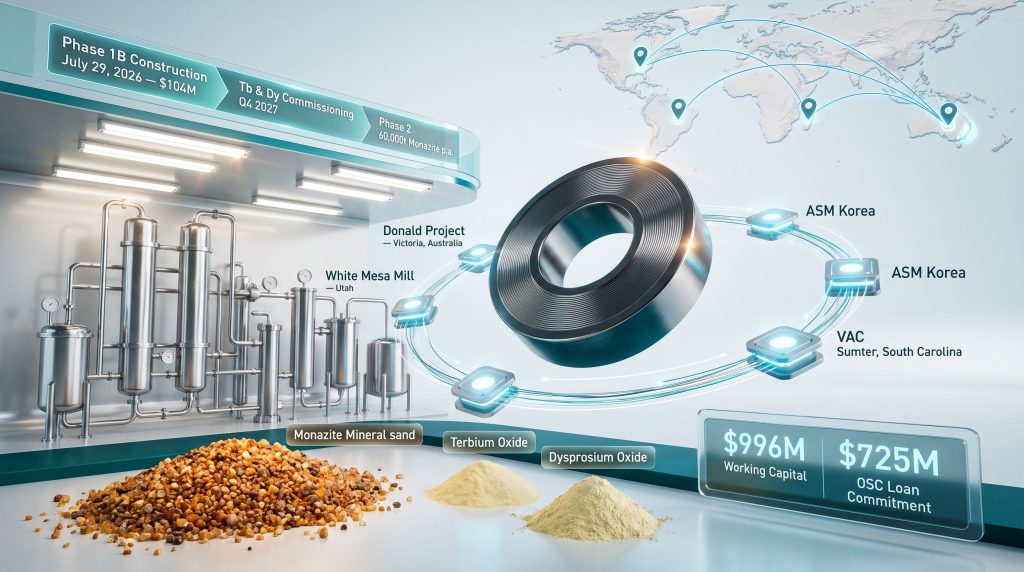
Construction of the $104 million Phase 1B expansion began on July 29, 2026, making the White Mesa Mill the most active rare-earth construction site within the United States at the time of writing. The expansion introduces a new mixed rare earth carbonate (MREC) processing circuit, and the technical design of this circuit deserves particular attention. In addition, the rare earth processing challenges facing the broader industry make this engineering milestone all the more significant.
The MREC Circuit: Why Simultaneous Output Changes the Economics
Historically, processing facilities that handle both uranium and rare earths have faced a difficult operational trade-off. The chemical environments required for uranium recovery and rare-earth separation can conflict, often forcing operators to run alternating production campaigns or build entirely separate facilities — both of which increase unit costs and reduce asset utilisation.
The MREC circuit at White Mesa is engineered to eliminate this constraint. By processing carbonate-rich monazite feedstocks, the circuit is designed to produce separated rare-earth oxides and natural uranium concentrate concurrently, rather than in sequence. This matters enormously for the economics of the operation: fixed costs across the facility can be allocated across multiple revenue streams simultaneously, improving overall plant efficiency and reducing the effective cost per unit of rare-earth output.
The phased construction timeline for White Mesa is as follows:
| Milestone | Target Date | Output |
|---|---|---|
| Terbium and dysprosium separation commissioning | Q4 2027 | ~20t Tb oxide / ~120t Dy oxide per year |
| Samarium, europium, and gadolinium circuits | Late 2028 | Additional separated heavy REE oxide streams |
| Phase 2 expansion (potential) | Post-2028 | Mill capacity up to 60,000 tonnes monazite per annum |
The sequencing reflects a deliberate engineering approach: target the highest-value heavy rare earths first, then broaden the suite of separated elements as the facility scales.
Monazite as a Feedstock: What Investors Need to Understand
Monazite is a phosphate mineral that occurs naturally within titanium and zirconium mineral sands deposits. It is produced as a byproduct of mineral sands extraction, which means that unlike primary rare-earth ores, monazite supply is linked to the economics of the titanium and zirconium industries rather than rare-earth prices alone. This creates a nuanced feedstock dynamic: monazite availability is partly driven by demand for titanium pigment and zircon, not solely by rare-earth market conditions.
Monazite is particularly rich in both light and heavy rare earths, and critically, it contains meaningful concentrations of terbium, dysprosium, and other heavy elements that are scarcer in conventional hard-rock rare-earth deposits such as those containing bastnäsite. This mineral characteristic is one reason why Energy Fuels has specifically targeted monazite-bearing mineral sands projects as its feedstock base rather than pursuing more conventional rare-earth deposits. The growing critical minerals demand driven by the global energy transition further reinforces this strategic feedstock choice.
The Donald Project: Primary Supply Node
Energy Fuels currently holds a 12.7% joint venture interest in the Donald Project in Victoria, Australia, with a contractual option to increase its stake to 49%. The company has secured a 100% offtake agreement for monazite concentrate from the project, targeting annual supply of 8,500 to 9,500 tonnes beginning from 2028.
The Final Investment Decision for Donald is targeted for Q3 2026 and is contingent on finalising an A$220 million project debt facility with Export Finance Australia and other lenders. This financing milestone is one of the most consequential near-term variables in the entire mine-to-magnet timeline.
Investor Watch: A delay or failure to secure the Donald Project debt facility would not simply push back one component of the strategy. It would postpone White Mesa's primary monazite supply pipeline entirely, with knock-on effects for ASM feedstock volumes and VAC alloy availability. The interdependence of these stages means that feedstock risk propagates across the entire platform.
Geographic Feedstock Diversification Beyond Australia
To reduce concentration risk, Energy Fuels is also advancing two wholly owned feedstock projects:
- Vara Mada Project (Madagascar): Provides future optionality in a monazite-bearing jurisdiction outside Australia, adding geographic diversification to the upstream supply base.
- Bahia Project (Brazil): Adds a South American feedstock node, reducing single-country dependence and providing a potential alternative supply pathway if Donald faces delays.
This multi-geography feedstock strategy reflects an understanding that supply chain resilience requires redundancy, not just volume.
The Downstream Acquisitions: Closing the Loop
Australian Strategic Materials: Bridging Oxides to Metals
The Energy Fuels partnership approach extends naturally into the acquisition of Australian Strategic Materials, which connects White Mesa's oxide output to the metallisation stage. ASM operates a metals plant in South Korea that converts rare-earth oxides into metals and alloys — the form required for magnet manufacturing. Approximately 70% of ASM's planned feedstock requirements are intended to be sourced from White Mesa's Utah oxide production, creating a direct and traceable material flow between the US separation facility and the South Korean conversion plant.
The ASM acquisition was targeted for completion by the end of August 2026, subject to regulatory and shareholder approval processes. Energy Fuels' announcement of this acquisition underscored its commitment to building a fully integrated Western supply chain from mine to finished magnet.
Vacuumschmelze (VAC): Domestic Magnet Manufacturing at Scale
VAC's permanent magnet facility in Sumter, South Carolina currently operates at 2,000 tonnes per annum capacity, with an engineered design ceiling of 12,000 tonnes per annum — a potential sixfold increase. The transaction equity value stands at $1.9 billion, making it the single largest capital commitment in the mine-to-magnet build-out.
The Sumter facility is one of the very few permanent magnet manufacturing operations located within the United States, a geographic attribute that carries significant long-term commercial relevance given the increasing policy focus on domestic defence and industrial supply chains. VAC's alloy requirements are planned to be sourced 100% internally from ASM's output, completing the material flow loop:
Donald (monazite) → White Mesa (separated oxides) → ASM Korea (metals & alloys) → VAC Sumter (permanent magnets)
Financial Foundation: Balance Sheet and Uranium Cash Generation
Executing a multi-billion-dollar vertical integration strategy across four jurisdictions and four processing stages simultaneously requires a financial position that most emerging critical minerals companies simply cannot assemble. Energy Fuels enters this build-out from an unusually strong liquidity base. Furthermore, America's rare earth supply chain ambitions are increasingly underpinned by policy-level financing mechanisms that companies like Energy Fuels are well-positioned to access.
Q2 2026 Balance Sheet Snapshot
| Financial Metric | Value (as of June 30, 2026) |
|---|---|
| Total working capital | $996 million |
| Cash and cash equivalents | $58.4 million |
| Marketable securities | $878.3 million |
| Product inventory | $75 million |
| Net loss (Q2 2026) | $34 million (primarily transaction costs) |
The reported net loss of $34 million is primarily attributable to transaction costs associated with the ASM and VAC acquisitions rather than underlying operational deterioration — an important distinction for investors interpreting the headline figure.
The Uranium Business as a Cash Bridge
Energy Fuels produced 865,000 pounds of finished uranium oxide during Q2 2026 at a weighted-average cost of $23 per pound, of which 310,000 pounds were sold during the quarter. This low-cost uranium production provides a recurring revenue stream that funds the company's critical materials transition without requiring the rare-earth business to reach profitability immediately.
Unlike pure-play rare-earth developers that must raise equity capital at every development stage, Energy Fuels is funding its transition from an established, cash-generating processing platform. This structural advantage reduces dilution pressure during the capital-intensive build-out period.
Additionally, the US government's Office of Strategic Capital has issued a conditional $725 million loan commitment structured as a 20-year term facility, providing long-duration, non-dilutive capital to support White Mesa expansions and downstream metals plant development. This loan commitment is conditional and subject to final terms; investors should monitor its formal closure as a distinct milestone. Analysts at Crux Investor have noted that this financing structure is rare among Western critical minerals developers and materially strengthens the platform's execution credibility.
The next major ASX story will hit our subscribers first
Execution Risks: A Framework for Investors
The Energy Fuels mine-to-magnet strategy is architecturally sound, but its realisation depends on executing multiple complex processes simultaneously, across multiple jurisdictions, under competitive and regulatory pressures.
| Risk Category | Specific Exposure | Mitigation Factor |
|---|---|---|
| Acquisition completion | ASM and VAC regulatory and shareholder approvals | Strong balance sheet; existing operational credibility |
| Feedstock supply | Donald Project FID and A$220M debt facility negotiation | 100% offtake secured; Export Finance Australia involved |
| Construction execution | Phase 1B capital overruns and commissioning delays | $104M budget established; construction commenced July 2026 |
| Market timing | REE oxide price volatility during ramp-up period | Uranium business provides revenue bridge |
| Metallurgical complexity | Heavy REE separation circuits carry inherent commissioning risk | Phased commissioning sequence reduces simultaneous complexity |
One risk that deserves particular attention is the metallurgical complexity of heavy rare-earth separation. Terbium and dysprosium are present in significantly lower concentrations than light rare earths, and their separation requires solvent extraction circuits with more demanding chemical engineering specifications. Consequently, commissioning delays in these circuits are common across the global industry and should be regarded as a realistic probability rather than an outlier scenario.
Key Milestones and Catalysts to Monitor Through 2028
Near-Term Catalysts (2026)
- ASM acquisition closing: targeted for the end of August 2026, pending regulatory and shareholder approvals.
- Donald Project FID: expected in Q3 2026, contingent on finalising the A$220 million project debt facility.
- VAC regulatory and shareholder approvals: ongoing through late 2026 and into early 2027.
Medium-Term Milestones (2027 to 2028)
- White Mesa Phase 1B terbium and dysprosium commissioning: targeted Q4 2027.
- Samarium, europium, and gadolinium circuits: targeted for completion by late 2028.
- ASM Korean metals plant activation: commencement of oxide-to-metal conversion using White Mesa feedstock.
Long-Term Platform Scale (Post-2028)
- Phase 2 expansion potential: White Mesa mill processing capacity could grow to 60,000 tonnes of monazite per annum.
- VAC capacity scale-up: Sumter facility targeted to reach 12,000 tonnes per annum from its current 2,000-tonne base.
Frequently Asked Questions
What is the Energy Fuels mine-to-magnet strategy in simple terms?
It is a plan to own and operate every major stage of the rare-earth supply chain within Western-aligned jurisdictions, connecting monazite feedstock extraction through to finished permanent magnet manufacturing. This reduces dependence on Chinese processing capacity across the full value chain.
Why does terbium and dysprosium production matter so much?
These heavy rare earth elements are essential for maintaining magnet performance under heat. Without them, NdFeB magnets lose coercivity at elevated temperatures, making them unsuitable for EV motors and aerospace applications. Western separation capacity for these elements is extremely limited, which is why the Phase 1B expansion at White Mesa targets these specific materials first.
What financial resources does Energy Fuels have to fund this strategy?
As of June 30, 2026, the company held $996 million in working capital, comprising $58.4 million in cash, $878.3 million in marketable securities, and $75 million in product inventory. This is supplemented by a conditional $725 million loan commitment from the US Office of Strategic Capital and ongoing uranium cash generation.
What is the single most important near-term milestone?
The Donald Project Final Investment Decision in Q3 2026 is arguably the most consequential short-term catalyst. It determines whether White Mesa's primary monazite supply pipeline is secured from 2028 onwards, which in turn drives the oxide volumes available to ASM and ultimately the alloy supply for VAC.
What distinguishes this approach from other Western rare-earth developers?
Most Western developers stop at oxide separation and sell to third-party downstream processors. However, the Energy Fuels mine-to-magnet strategy extends further, capturing value across metallisation and magnet manufacturing as well. This accepts higher capital and execution risk in exchange for greater margin capture and genuine supply chain control from mine to finished magnet.
This article contains forward-looking analysis and is intended for informational purposes only. It does not constitute financial or investment advice. Investors should conduct their own due diligence and consult qualified advisers before making investment decisions. All financial figures, timelines, and project parameters are sourced from publicly available company disclosures and are subject to change.
Want to Track the Next Major Critical Minerals Discovery Before the Market Moves?
Discovery Alert's proprietary Discovery IQ model scans ASX announcements in real time, instantly identifying significant mineral discoveries across rare earths, uranium, and over 30 other commodities — turning complex data into actionable opportunities for investors at every level. Explore historic discoveries and their exceptional returns, then begin your 14-day free trial at Discovery Alert to position yourself ahead of the broader market.