August 13, 2026
The Processing Bottleneck That Mining Alone Cannot Solve
Across the global critical minerals landscape, a persistent and underappreciated problem sits not in the ground but in the factory. Governments and investors have poured considerable attention into mine development, yet the more consequential constraint on Western supply chain security is the ability to transform raw ore and industrial waste into refined, usable metal products. Conventional processing routes for critical metals are chemically intensive, multi-stage operations that have historically concentrated in a small number of jurisdictions.
The result is a supply chain architecture where mining capacity and processing capacity are geographically misaligned, creating structural vulnerabilities that no amount of new mine permitting can fully resolve. Furthermore, critical minerals demand continues to surge globally, placing even greater pressure on an already strained processing infrastructure.
It is within this context that Flash Joule Heating critical metals processing is emerging as one of the more technically credible candidates for disrupting how the world extracts value from complex metal-bearing feedstocks.
When big ASX news breaks, our subscribers know first
How Flash Joule Heating Works: Thermal Shock as a Processing Tool
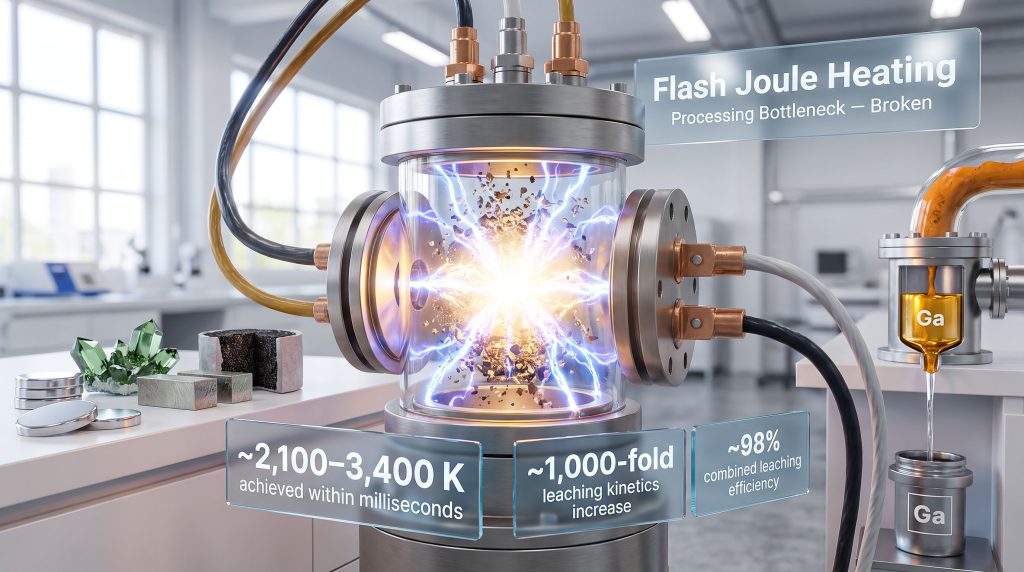
Flash Joule Heating processing is a fundamentally different approach to unlocking metal value from ore, concentrate, or industrial residue. Rather than dissolving metals in acid baths over extended periods or subjecting feedstocks to sustained high-temperature smelting, the process delivers intense electrical pulses through a conductive material, generating resistive heating that raises the feedstock temperature to somewhere between approximately 2,100 and 3,400 Kelvin within a window spanning milliseconds to seconds.
The physics of what happens at those temperatures is what makes FJH commercially interesting. The extreme thermal shock:
- Disrupts the crystalline mineral structures that lock target metals in place within the host matrix
- Breaks molecular bonds at a speed and intensity that conventional roasting cannot replicate
- Alters the oxidation states of metal species, changing their chemical reactivity
- In configurations involving chlorinating agents, drives the formation of volatile metal chlorides that can be selectively collected as separate product streams
The process was originally developed at Rice University and has since moved into applied commercial research territory. One of its most practically significant characteristics is what it does not require: large volumes of acid reagents, sustained high-temperature furnaces drawing energy over hours, or substantial process water volumes in the core treatment step.
These omissions matter enormously when evaluating the feasibility of building new processing capacity in regions where chemical infrastructure, water access, or energy costs constrain conventional refining options.
Key Concept: Flash Joule Heating achieves in milliseconds what conventional roasting or leaching accomplishes over hours, fundamentally compressing the processing timeline while reducing reagent dependency at the core treatment stage.
How Flash Joule Heating Compares to Conventional Processing Methods
Understanding where FJH sits relative to established processing routes requires an honest look at both its demonstrated advantages and the areas where conventional approaches currently hold structural advantages.
Side-by-Side Performance Benchmarks
| Processing Metric | Conventional Hydromet/Pyromet | Flash Joule Heating (Lab/Pilot Scale) |
|---|---|---|
| Processing temperature | 800–1,600°C (sustained) | ~2,100–3,400 K (milliseconds) |
| Acid consumption | High (multi-stage leaching) | Significantly reduced or eliminated |
| Water intensity | High | Substantially lower |
| Processing time (PGMs) | Multi-stage, days | Up to ~75% reduction reported |
| Leaching kinetics (battery black mass) | Baseline | ~1,000-fold increase reported |
| Combined leaching efficiency (Li-ion black mass) | Variable | ~98% with dilute acid reported |
| Heavy metal contamination in residue | Retained | Cd, Hg, As, Pb, Cr significantly reduced |
Where FJH Outperforms Legacy Processing Routes
The performance data that has emerged from laboratory and pilot-scale testing across several feedstock types is notable:
- Battery black mass: Leaching kinetics accelerated by approximately 1,000-fold, with around 98% combined leaching efficiency achieved using dilute rather than concentrated acid
- E-waste precious metals: Evaporative separation enabling reported recoveries above 80% for rhodium, palladium, and silver, and above 60% for gold
- Rare earth magnets: FJH combined with chlorination achieving both purity and yield exceeding 90% in a processing window measured in seconds
- Hazardous contaminant co-benefit: Simultaneous reduction of cadmium, mercury, arsenic, lead, and chromium concentrations in treated residues
Where Conventional Processing Retains Advantages
- Established regulatory approval pathways and demonstrated bankability for project finance
- Proven industrial throughput at multi-tonne-per-hour commercial scale
- Mature workforce skills, equipment supply chains, and vendor ecosystems
- Extensively replicated performance data at commercial scale across many operations
Analytical Note: The strongest independent evidence for FJH performance currently sits at laboratory and pilot scale. Commercial-scale validation remains the critical next threshold for the technology's adoption across supply chains.
A Feedstock-by-Feedstock Look at Flash Joule Heating Applications
Rare Earth Elements: Compressing the Front End of a Complex Chain
Rare earth processing challenges are notorious for their multi-stage character. Conventional flowsheets typically move ore through physical concentration, leaching, solvent extraction, and precipitation before producing a product suitable for downstream separation into individual rare earth compounds. Each stage adds cost, chemical consumption, and potential yield loss.
FJH testing applied to unbeneficiated ore — meaning material that had only been crushed and ground rather than first upgraded through flotation or other concentration steps — demonstrated a striking transformation. Feedstock containing approximately 12% total rare earth oxides was converted into a product containing more than 83% rare earth chlorides by weight in a single, unoptimized treatment cycle.
Equally significant was what happened to specific rare earth species within that run. Concentrations of neodymium and praseodymium, the two rare earths most critical to high-strength permanent magnets used in electric motors and wind turbines, increased by more than four times within the same processing step.
The resulting chloride intermediate is not a finished rare earth product, but it is a high-grade input that can feed into existing downstream separation infrastructure, potentially bypassing several capital-intensive and chemically demanding front-end processing steps.
A detail that carries strategic weight and is not widely appreciated outside the processing industry: neodymium-praseodymium enrichment at the front end of the flowsheet can meaningfully reduce the volume of material that needs to pass through solvent extraction circuits, which are among the most technically demanding and environmentally regulated components of rare earth refining.
Germanium: Strategic Recovery from Industrial Waste
Germanium occupies a peculiar position in the critical minerals hierarchy. It is a byproduct metal, meaning it does not typically justify primary mining on its own merits but instead accumulates in the residues and intermediate products of other industrial processes, particularly zinc smelting. Its applications in semiconductor substrates, fibre optic systems, and infrared optical components give it outsized strategic importance relative to the modest volumes produced globally.
FJH testing across three distinct secondary feedstocks produced the following enrichment results:
- Zinc smelter waste: Up to 280-fold germanium enrichment
- Semiconductor manufacturing waste: Up to 240-fold enrichment
- Defence-related industrial waste: Up to 35-fold enrichment
Data Highlight: A 280-fold germanium enrichment from zinc smelter waste represents a transformative concentration step, turning a trace-level industrial byproduct into a commercially meaningful intermediate that could support further refining into specification-grade germanium.
The strategic context here is worth underscoring. Germanium supply is heavily concentrated geographically, and China's rare earth restrictions have focused investor and government attention on alternative supply pathways. Recovering germanium from waste streams that are currently landfilled or stockpiled represents a fundamentally different approach to supply diversification that does not require discovering new ore deposits.
Platinum Group Metals: Faster Recycling of High-Value Catalysts
The automotive catalytic converter recycling market is one of the most established secondary markets for platinum group metals globally, yet conventional recycling routes remain multi-stage, chemically intensive, and time-consuming processes that typically span multiple days from feedstock receipt to refined product.
FJH testing on spent automotive catalytic converters produced platinum, palladium, and rhodium concentrated into a product exceeding 60% platinum group metals in a single, unoptimized treatment cycle. Initial results indicate processing time could be reduced by approximately 75% compared with conventional multi-stage PGM recycling routes.
The commercial significance of this improvement is amplified by the price volatility of palladium and rhodium in particular. Both metals have experienced dramatic price swings driven by supply concentration and demand sensitivity, making faster throughput time in recycling operations a meaningful economic variable, not merely a technical preference.
Red Mud: Unlocking Value from a Global Environmental Liability
Red mud is generated at enormous scale as a byproduct of the Bayer process used to refine alumina from bauxite ore. Global stockpiles are measured in billions of tonnes, and managing these residues represents an ongoing environmental and financial liability for alumina producers. The material is alkaline, contains heavy metals, and presents containment challenges. It also contains aluminium, iron, silicon, and trace quantities of strategic metals including gallium and scandium.
FJH treatment results on red mud demonstrated:
- Approximately 99% iron removal
- Approximately 94% silicon removal
- Retention of roughly 95% of aluminium value
- Concentration of gallium into a separate, enriched product stream
Gallium is a critical input for compound semiconductors, solar cells, and defence electronics, with supply overwhelmingly concentrated in China. The ability to recover gallium as a co-product from red mud treatment — a material that would otherwise represent a waste management cost — illustrates the compounding value that a multi-output processing approach can generate from a single feedstock.
Commercial Models for Flash Joule Heating Technology Deployment
Three Pathways to Market
The commercial architecture for deploying FJH technology is not confined to a single model. Three distinct pathways are emerging:
- Owned processing operations: Building and operating proprietary FJH facilities targeting specific, high-value feedstock streams. Electronic waste processing in Texas represents the nearest-term application of this model.
- Technology licensing: Licensing FJH processing know-how and feedstock-specific flowsheets to companies that control their own metal-bearing materials and prefer to process in-house.
- Strategic processing partnerships: Entering joint arrangements with feedstock owners who bring ore, concentrate, or industrial residue to the FJH platform for toll processing or co-development under commercial agreements.
A crucial operational detail that shapes all three models is that FJH is not a universal configuration. Each feedstock type requires optimisation work to establish the electrical pulse parameters, temperature profile, and any supplementary reagents that maximise recovery, selectivity, and product purity for that specific material.
An important and underappreciated dynamic within the commercial development process is that an increasing number of feedstock testing campaigns are being initiated by industry participants seeking processing solutions for materials they already control, rather than being purely technology-push exercises. This demand-pull dynamic is a meaningful signal of genuine market interest in FJH as a processing solution.
Key Technical and Commercial Risks at Scale
The Scale-Up Gap
Every novel processing technology faces the same fundamental challenge in transitioning from laboratory demonstration to commercial operation: bench-scale results do not automatically translate to industrial throughput. For FJH, the specific scale-up risks include:
- Energy consumption: Delivering high-voltage electrical pulses at commercial throughput rates creates a meaningful demand on power infrastructure, with implications for operating cost and grid connectivity requirements
- Material handling consistency: Feeding heterogeneous feedstocks, which vary in particle size, moisture content, and composition, reliably into a high-voltage thermal system is an engineering challenge distinct from the core processing chemistry
- Reactor durability: Repeated extreme thermal cycling places substantial stress on reactor components, and equipment longevity under commercial operating conditions remains to be demonstrated
- Process control: Maintaining consistent thermal profiles across a large feedstock volume requires control systems that do not have direct analogues in conventional processing equipment
Regulatory and Environmental Considerations
Ultrafast high-temperature processing of heterogeneous feedstocks generates gaseous byproducts that require characterisation and management. Regulatory permitting for novel thermal processing technologies does not follow established templates, and the classification of FJH-treated output streams as processed intermediates versus regulated waste materials will affect downstream handling, transport, and customer acceptance.
Risk Framing: All reported FJH performance metrics in this article reflect laboratory or pilot-scale results from unoptimised processing runs. Independent commercial-scale validation is the definitive threshold that will determine whether FJH transitions from a compelling research platform to a transformative industrial processing technology.
The next major ASX story will hit our subscribers first
Why Flash Joule Heating Matters for Supply Chain Resilience
Processing as the Real Chokepoint
The strategic vulnerability embedded in global critical mineral supply chains is not primarily about mining capacity. It is about the geographic concentration of processing capacity. Countries that control refining infrastructure for rare earths, germanium, gallium, and platinum group metals hold leverage over downstream manufacturers regardless of where the ore is mined.
Flash Joule Heating critical metals processing offers a reduced dependence on acid reagents, large water volumes, and sustained high-temperature infrastructure, which could lower the capital and logistical barriers to building processing capacity in regions that currently lack the chemical industry infrastructure to support conventional operations. Furthermore, European critical raw materials supply initiatives are actively seeking precisely this kind of domestically deployable processing technology. This is a structural advantage with implications for supply chain geography that extend well beyond any single feedstock or application.
The Multi-Feedstock Advantage
Perhaps the most underappreciated commercial characteristic of a successful FJH platform is the optionality it creates. A processing technology platform applicable across rare earths, platinum group metals, germanium, gallium, battery materials, and industrial waste streams can pivot between feedstocks based on market conditions, feedstock availability, and commercial agreement timing.
This flexibility is qualitatively different from a conventional processing operation built and optimised for a single commodity stream. Industrial waste streams — including red mud, zinc smelter residue, and spent catalytic converters — represent particularly compelling feedstock opportunities because their holders often face environmental management costs that make processing agreements economically attractive from both sides of the transaction.
Near-Term Development Milestones and Future Scenarios
The development pathway for Flash Joule Heating critical metals processing in the near term centres on several specific milestones:
- Optimising recovery rates, selectivity, and product purity across tested feedstock types through additional processing campaigns
- Completing customer and strategic-partner feedstock testing programmes that convert industry interest into technical validation
- Developing feedstock-specific processing flowsheets that can form the basis of commercial agreements
- Conducting scale-up engineering assessments to bridge the gap between pilot results and commercial deployment
- Converting active industry discussions into binding processing, partnership, or licensing agreements
Looking further out, three distinct scenarios describe the range of possible outcomes for FJH technology adoption:
- Scenario A — Niche Specialist: FJH establishes a profitable commercial position in two or three high-value feedstock niches such as PGM recycling and electronic waste, without displacing conventional processing at broad scale
- Scenario B — Platform Disruptor: Successful scale-up across multiple feedstock types enables FJH to compete directly with conventional hydrometallurgy and pyrometallurgy across a broad range of critical metal supply chains
- Scenario C — Licensed Infrastructure: FJH technology is widely licensed to existing mining and processing companies, functioning as an add-on module that enhances recovery from conventional operations rather than replacing them outright
For independent commercial-scale validation to be credible, it would need to demonstrate consistent performance across multiple production runs, energy consumption benchmarks competitive with conventional alternatives at industrial throughput, regulatory acceptance of product streams, and bankable capital and operating cost structures.
Rice University's research into rapid Flash Joule Heating techniques has provided foundational evidence supporting the technology's rare earth recovery potential, whilst production-scale system validation work now underway is beginning to address the commercial-scale gap that remains the technology's most critical outstanding threshold. Until that evidence is fully established, the technology's extraordinary laboratory-scale results should be understood as a technically credible proof of concept rather than a confirmed industrial benchmark.
This article contains forward-looking statements and references to development-stage technology performance metrics. All FJH results cited reflect laboratory or pilot-scale testing from unoptimised processing runs. Past laboratory performance is not necessarily indicative of future commercial outcomes. Readers should conduct independent research and seek professional financial advice before making any investment decisions.
Want to Know When Significant Mineral Discoveries Hit the ASX?
Discovery Alert's proprietary Discovery IQ model delivers real-time alerts the moment significant ASX mineral discoveries are announced, translating complex data across more than 30 commodities into clear, actionable insights for investors at every level — explore Discovery Alert's discoveries page to understand how major mineral finds have historically generated substantial returns, and begin your 14-day free trial today to position yourself ahead of the broader market.