August 19, 2026
The Quiet Crisis Behind the Critical Minerals Race
Most conversations about rare earth supply chains begin and end with China. However, the more revealing story sits elsewhere: in the persistent failure of private capital markets to fund the very projects that Western governments insist are strategically essential. If these minerals are so critical, why won't institutional investors finance them? And what does it mean when the answer is, increasingly, the U.S. government itself?
Understanding the mechanics of that financing gap, and Washington's deliberate effort to fill it across African project sites, reveals something important about the true state of the global rare earth market. Furthermore, it exposes the considerable distance between policy ambition and commercial reality when it comes to US funding African rare earth projects.
When big ASX news breaks, our subscribers know first
Why Private Capital Is Largely Absent From African Rare Earth Development
The Risk Premium Problem
Commercial investors operate on a straightforward calculus: risk-adjusted returns must be competitive with alternatives. African rare earth projects fail this test on multiple dimensions simultaneously.
First, there is geological and execution risk. Many African rare earth deposits are located in jurisdictions with limited mining infrastructure, complex permitting environments, and underdeveloped logistics networks. The capital required to bring a project from discovery through feasibility, permitting, construction, and into production is substantial, often running into hundreds of millions of dollars, with timelines stretching across a decade or more.
Second, there is pricing risk, and this is where China's structural dominance becomes a direct deterrent to private sector participation. Beijing controls an estimated 85 to 90 percent of global rare earth processing capacity, giving it significant leverage over downstream pricing. When Chinese producers flood the market, rare earth oxide prices can collapse rapidly, destroying the economics of competing projects that carry a much higher cost structure.
Senior DFC executives, speaking to Reuters, confirmed that private investors remain wary of African rare earth projects specifically because Chinese market intervention can undermine pricing and project economics at any point in a project's lifecycle.
Third, there is the offtake problem. Without committed buyers willing to sign long-term purchase agreements at prices that support project financing, lenders have no basis for providing debt. The rare earth magnet supply chain remains dominated by Chinese buyers and processors, meaning Western-aligned projects often lack credible commercial pathways to market even when the geology is favourable.
The Oversupply Problem Hiding Inside the Demand Story
There is a widely repeated narrative that soaring electric vehicle and wind turbine production will drive insatiable critical minerals demand for neodymium-praseodymium (NdPr) permanent magnets, and by extension, for the rare earth oxides that feed them. This narrative is broadly accurate over a long enough time horizon. However, it obscures a more uncomfortable near-term reality.
The global pipeline of announced rare earth development projects is substantially larger than projected NdPr magnet demand can absorb. Olimpia Pilch, Head of Strategy at Critical Minerals Africa, has stated publicly that the number of announced rare earth projects far exceeds what current and near-term demand for NdPr magnets can support. Consequently, this creates a structurally competitive environment where only the lowest-cost, highest-grade, best-located projects are likely to reach sustained commercial production.
This oversupply dynamic at the project pipeline level is one reason institutional investors remain cautious. Even if a project's geology is sound and its jurisdiction manageable, the question of whether its output will have a market, at a price that sustains the operation, remains genuinely uncertain.
How the U.S. Government Is Filling the Financing Gap
The DFC as a Catalytic Capital Provider
The U.S. International Development Finance Corporation was established to deploy capital in markets where private investment is insufficient relative to U.S. strategic interests. Critical minerals in Africa fit this mandate precisely. The DFC does not position itself as a permanent or substitute investor; its stated objective is to move projects from high-risk early stages to a commercially de-risked position where private institutional capital can rationally enter.
This is sometimes described in development finance as catalytic or first-loss capital: government absorbs early-stage risk so that the private sector can eventually participate on terms it finds acceptable. In practice, the DFC deploys a range of instruments, including equity commitments, loans, technical assistance, and environmental programme support.
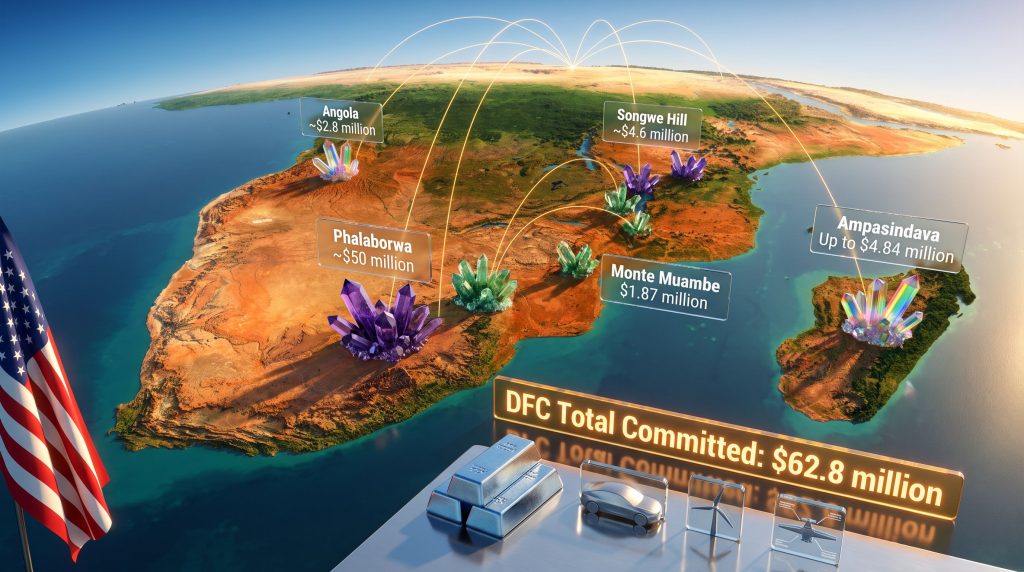
As of mid-2026, the DFC has committed a total of $62.8 million to rare earth projects across four African countries: Malawi, Angola, Madagascar, and South Africa. Critically, not one of these projects has yet reached commercial production. The agency has been transparent about this limitation, with senior executives acknowledging directly to Reuters that private capital is not coming in, and that the DFC's role is explicitly to bridge that gap.
The Full Toolkit: Beyond Simple Loan Commitments
The U.S. government's engagement in African rare earth development is not limited to the DFC. Several agencies play complementary roles across different project stages.
| Financing Tool | Deploying Agency | Stage of Project Supported |
|---|---|---|
| Equity / Loan Commitment | DFC | Development to pre-production |
| Grant Funding | USTDA | Pre-feasibility and scoping |
| Export Finance | U.S. EXIM Bank | Project financing pursuit |
| Technical Assistance | DFC / USTDA | Environmental, lab, pilot work |
The U.S. Trade and Development Agency (USTDA) focuses on earlier-stage validation work, including pre-feasibility studies and technical scoping. The U.S. Export-Import Bank has been identified as a potential financing source for at least one project in Angola, though that commitment has not yet been finalised. Together, these agencies form a layered government financing apparatus that can engage a project from initial scoping through to construction-stage financing.
Where U.S. Funding Is Going: A Project-by-Project Breakdown
South Africa: Phalaborwa Rare Earths
The single largest allocation in the DFC's African rare earth portfolio is approximately $50 million directed toward the Phalaborwa Rare Earths project in South Africa, backed by Dublin-based mining investment company TechMet. According to reporting by the Washington Post, with the total project financing requirement estimated at around $317 million, the DFC commitment represents a meaningful but still partial contribution to what remains a capital-intensive undertaking. Phalaborwa is currently in pre-production and has not yet achieved operational status.
Madagascar: Ampasindava Pilot Plant
The DFC has committed up to $4.84 million to the Ampasindava project in Madagascar, operated under the Harena Rare Earths banner. These funds are directed toward pilot plant construction, laboratory testing, and environmental programmes. The project remains in early-stage technical development, with the funding focused on generating the technical data needed to advance toward feasibility.
Malawi: Songwe Hill
Approximately $4.6 million in DFC commitment has been directed to the Songwe Hill project in Malawi. Support here is concentrated on de-risking the project at the development stage, consistent with the DFC's broader strategy of reducing technical and environmental uncertainty before private capital can be engaged.
Mozambique: Monte Muambe
The USTDA has provided a grant of $1.87 million to support pre-feasibility study work at the Monte Muambe project, developed by Altona Rare Earths. This is the earliest-stage intervention in the U.S. government's African rare earth portfolio, focused on generating the foundational technical and economic data required for future investment decisions.
Angola: Longonjo and the EXIM Bank Pursuit
The Longonjo rare earth project in Angola, developed by Pensana, has been identified as a potential recipient of up to $160 million in financing from the U.S. Export-Import Bank. This would represent the single largest individual commitment in the U.S. government's African rare earth engagement, but it remains a financing pursuit rather than a finalised award.
Consolidated Project Tracker
| Country | Project | Agency | Commitment | Current Status |
|---|---|---|---|---|
| South Africa | Phalaborwa | DFC | ~$50 million | Pre-production |
| Madagascar | Ampasindava | DFC | Up to $4.84 million | Pilot plant phase |
| Malawi | Songwe Hill | DFC | ~$4.6 million | Development stage |
| Mozambique | Monte Muambe | USTDA | $1.87 million (grant) | Pre-feasibility |
| Angola | Longonjo | EXIM Bank (pursued) | Up to $160 million | Financing pursuit |
What Does De-Risking Actually Mean in Rare Earth Project Development?
The Three Stages of Risk Government Capital Is Targeting
The term de-risking is used frequently in development finance but rarely explained with precision. In the context of rare earth project development, it refers to the sequential reduction of three distinct categories of uncertainty:
-
Technical and geological risk – Uncertainty about whether the deposit can be economically extracted and processed. Pilot plant programmes, laboratory testing, and resource definition drilling reduce this risk category.
-
Environmental and regulatory risk – Uncertainty about whether permits will be granted and on what conditions. Environmental impact assessments, community engagement programmes, and pre-feasibility studies are designed to advance this front.
-
Commercial and market risk – Uncertainty about whether the project's output will have buyers at prices that sustain operations. This is the hardest category to address with government capital alone, as it depends on downstream market structures and offtake agreement availability.
U.S. government agencies are actively engaging the first two categories across their African portfolio. The third remains the most structurally challenging, and arguably the most important for determining which projects ultimately reach production.
"Government development finance institutions are not designed to be the permanent capital stack for mining projects. Their logic is to absorb early-stage uncertainty until the risk profile becomes acceptable to commercial lenders, at which point private capital is expected to step in and take the project across the finish line."
Why Africa? The Resource and Geopolitical Logic
Africa's Position in the Global Critical Minerals Landscape
Africa holds a disproportionate share of the world's critical mineral endowment. The continent contains significant rare earth deposits across multiple jurisdictions, alongside large reserves of cobalt, lithium, manganese, and other battery and technology metals. For a U.S. administration seeking to build supply chains that reduce reliance on Chinese processing, Africa represents an accessible, geopolitically alignable source of raw material. As the Brookings Institution has noted, Africa can provide a faster solution to U.S. critical minerals needs than many alternative strategies.
The DFC's Africa-focused deployment reflects this logic directly. Africa accounts for approximately 20 to 25 percent of the DFC's total global investment portfolio, making it the agency's second-largest regional focus. Rare earth commitments sit within a broader critical minerals mandate that spans lithium, cobalt, nickel, and graphite across multiple African jurisdictions.
China's Export Control Tightening as an Accelerant
China's progressive tightening of rare earth export controls over recent years has added urgency to Washington's Africa strategy, and the rare earth geopolitics at play cannot be overstated. By restricting the flow of processed rare earth materials and rare earth magnet alloys to Western markets, Beijing has demonstrated its willingness to use mineral supply chains as a geopolitical instrument.
It is important to note, however, that the existence of a policy environment favouring supply chain diversification does not translate into direct project-level support for any specific development. Individual projects must still navigate commercial, technical, and market challenges on their own merits.
The next major ASX story will hit our subscribers first
The Demand-Side Case: What Rare Earths Are Actually Used For
Understanding why Washington is investing at all requires clarity on the downstream applications that make rare earth elements strategically significant.
| Application Sector | Key Rare Earth Elements | Strategic Importance |
|---|---|---|
| Electric Vehicles | NdPr (Neodymium, Praseodymium) | Permanent magnet motors |
| Wind Turbines | NdPr, Dysprosium | Direct-drive generator magnets |
| Defence Systems | NdPr, Terbium, Dysprosium | Guidance systems, radar, actuators |
| Consumer Electronics | Lanthanum, Cerium, Europium | Displays, batteries, polishing |
Neodymium-praseodymium is the workhorse combination driving demand growth, primarily because of its role in the sintered permanent magnets used in EV traction motors and wind turbine generators. These magnets have no commercially viable substitute at current performance requirements, which is why NdPr supply security has become a central concern for both industrial policy and defence planning in Western nations.
The defence dimension adds a layer of urgency that purely commercial analysis misses. Rare earth magnets appear in precision-guided munitions, radar systems, submarine motors, and aircraft actuators. Furthermore, the energy security implications of supply disruption extend well beyond the clean energy transition, threatening military readiness in ways that policymakers are increasingly unwilling to ignore.
Is the U.S. Commitment Large Enough to Matter?
The Scale Gap Between Commitment and Infrastructure Need
The $62.8 million committed by the DFC across four African countries is a meaningful signal of intent, but it needs to be measured against the true cost of building rare earth production infrastructure. The Phalaborwa project alone carries an estimated total financing requirement of approximately $317 million. Building a single rare earth project from development through to commercial production typically requires capital in the hundreds of millions of dollars, plus years of technical preparation.
In this context, $62.8 million across four projects is best understood as seed capital, not a supply chain solution.
The Processing Bottleneck That Capital Alone Cannot Fix
Perhaps the most underappreciated structural challenge in building a non-Chinese rare earth supply chain is that mine-level investment addresses only the first link in a long chain. Rare earth ore must be separated into individual oxide streams, then converted into metal alloys, then formed into magnet precursors, and finally manufactured into finished magnets. China dominates each of these downstream processing stages, not just the mining step.
Western nations have largely lost the industrial knowledge base and manufacturing ecosystem required to perform these steps at scale. Rebuilding that capacity will require:
- Investment in rare earth separation and processing facilities outside China
- Development of metal alloying and magnet manufacturing capabilities in Western-aligned nations
- Long-term offtake agreements that give downstream processors confidence to invest
- Sustained policy commitment that outlasts electoral cycles
Capital commitments to African mine development, however strategically motivated, do not resolve any of these downstream challenges on their own.
Structural Barriers Beyond the Capital Question
Even well-funded African rare earth projects face obstacles that money alone cannot eliminate:
- Pricing volatility driven by Chinese market interventions makes project economics unpredictable over the long development timelines involved
- Project pipeline overcrowding means that even viable projects compete for a limited pool of offtake demand, depressing the commercial urgency for any single development
- Western magnet manufacturing capacity remains insufficient to absorb new sources of supply at meaningful scale
- Development timelines typically run ten years or more from discovery to production, outlasting most policy planning horizons
Three Scenarios for the Road Ahead
Scenario 1: Catalytic Success
Government capital successfully reduces technical and regulatory risk at two or three African projects to the point where institutional lenders and equity investors engage at scale. One or more projects reach commercial production before 2032, establishing proof of concept for the broader Western supply chain development strategy.
Scenario 2: Structural Stagnation
Projects remain in extended development limbo, unable to attract commercial offtake agreements or private financing despite government de-risking. The pipeline of announced projects continues to grow, further diluting investor attention and suppressing the urgency of any individual development. The DFC's commitments produce technical data but no production.
Scenario 3: Selective Viability
The most likely near-term outcome sees one or two projects — those with the strongest geology, lowest cost structures, and best-positioned jurisdiction profiles — reach commercial production within a decade. The broader project pipeline consolidates significantly, with the majority of announced developments failing to advance beyond feasibility. US funding African rare earth projects proves most valuable at those it supports earliest and at the largest scale.
"The honest assessment of US funding African rare earth projects is that it represents a necessary but not sufficient condition for supply chain change. The capital is real. The strategic intent is clear. But the commercial, processing, and market structure challenges that keep private investors away will not be resolved by government grants and DFC loans alone."
Frequently Asked Questions
What is the DFC and why is it involved in African mining?
The U.S. International Development Finance Corporation is a government agency that deploys capital in markets where private investment is insufficient relative to American strategic interests. Its involvement in African rare earth mining reflects Washington's broader effort to build critical mineral supply chains that reduce dependence on Chinese processing dominance.
How much has the U.S. committed to rare earth projects in Africa?
The DFC has committed $62.8 million across projects in Malawi, Angola, Madagascar, and South Africa. Additionally, the USTDA has provided a $1.87 million grant to a Mozambique project, and the U.S. EXIM Bank is being pursued for up to $160 million in financing for the Longonjo project in Angola.
Why won't private investors fund African rare earth projects?
Private investors cite a combination of high geological and execution risk in frontier jurisdictions, Chinese market intervention that can rapidly undermine project economics, the absence of committed commercial offtake agreements, and the structural oversupply of announced rare earth projects relative to near-term NdPr demand.
What is NdPr and why does it matter?
Neodymium-praseodymium (NdPr) is a combination of rare earth elements used to produce sintered permanent magnets. These magnets are essential components in EV traction motors, wind turbine generators, and a range of defence applications. There is no commercially viable substitute at current performance thresholds, making NdPr supply security a genuine strategic concern for Western economies.
Has any U.S.-backed African rare earth project reached production yet?
No. As of mid-2026, none of the projects receiving DFC or USTDA support in Africa have reached commercial production. All remain at various stages of development, from pre-feasibility through to pre-production.
This article is intended for informational purposes only and does not constitute financial or investment advice. Forecasts, scenarios, and market projections described herein involve inherent uncertainty and should not be relied upon as predictions of future outcomes. Readers should conduct their own research and consult qualified advisers before making investment decisions. Commitment figures and project statuses reflect information reported as of mid-2026 and may have changed subsequently.
Want to Identify the Next Major Mineral Discovery Before the Broader Market Does?
Discovery Alert's proprietary Discovery IQ model delivers real-time alerts the moment significant ASX mineral discoveries are announced, transforming complex geological data into clear, actionable investment insights for traders and long-term investors alike — explore historic discoveries and the extraordinary returns they generated to understand what early positioning can mean, then begin your 14-day free trial at Discovery Alert to secure your market-leading edge.