August 20, 2026
The Bottleneck That Has Been Holding Japan Back in the Global Minerals Race
For decades, the architecture of global critical mineral supply chains was treated as a commercial matter, left largely to private industry and market forces. That assumption has been systematically dismantled over the past several years as resource nationalism, export controls, and geopolitical competition have redrawn the rules of engagement. Nations that once relied on open markets to source strategic materials are now discovering that speed, sovereign capital, and institutional flexibility determine who secures the inputs that power modern economies.
Japan finds itself at a particularly sharp inflection point in this dynamic. The country's industrial base, spanning electric vehicles, consumer electronics, semiconductors, and defence systems, depends heavily on a category of materials that cannot be sourced domestically. These materials have increasingly been subject to supply disruption from a single dominant supplier. The question Japan's policymakers are now answering is not whether the state needs to intervene more decisively in mineral markets, but whether the existing institutional architecture is agile enough to do so effectively.
The proposed reform of JOGMEC's investment mandate is the most direct answer yet to that question.
When big ASX news breaks, our subscribers know first
Understanding the Structural Problem Japan Is Solving
Why the Co-Investment Requirement Became a Liability
Japan proposes giving JOGMEC more freedom to invest in critical minerals, and to understand why this matters, it helps to understand what has constrained JOGMEC until now. The Japan Organization for Metals and Energy Security has long served as Japan's primary state instrument for upstream resource investment. However, its operational rules required that any independent acquisition of mineral rights either involve a Japanese private-sector company as a co-investor or include a commitment to transfer those rights at a later point to a domestic entity.
This framework made logical sense in an era when project timelines were longer, competition was less intense, and Japanese industrial conglomerates had both the appetite and the capacity to participate in upstream resource deals. That era has effectively ended. Global mineral asset competition now moves at a pace where investment windows can close within months, and the requirement to wait for a domestic corporate partner has repeatedly placed Japan at a structural disadvantage against state-backed entities that face no such conditions.
The consequences of this bottleneck are not theoretical. China's rare earth export restrictions on gallium and germanium, which were tightened significantly from mid-2023 onward, created immediate procurement disruptions for Japanese manufacturers in the semiconductor and electronics sectors. Japan sources a substantial share of its rare earth requirements from Chinese suppliers, leaving its industrial base exposed each time Beijing adjusts its export control parameters.
China's Export Controls as the Immediate Catalyst
China's progressive tightening of rare earth and critical metal export controls has functioned as both a supply shock and a strategic signal. For Japanese manufacturers in the automotive, electronics, and advanced manufacturing sectors, the disruption has been measurable. Key materials affected include:
- Gallium and germanium, both subject to tightened Chinese export licensing requirements since 2023, with significant implications for compound semiconductor production
- Rare earth elements including neodymium and dysprosium, essential for the permanent magnets used in electric vehicle motors and wind turbine generators
- Heavy rare earths, where China maintains an especially dominant processing position, limiting Japan's ability to source alternatives at comparable purity levels
What makes China's export control strategy particularly effective is that it targets materials where processing concentration, not just mining concentration, creates the dependency. Even where ore is mined outside China, a large proportion of global rare earth separation and refining capacity remains within Chinese borders. Japan's vulnerability therefore extends beyond raw ore sourcing to mid-stream processing, a dimension that upstream investment alone cannot fully resolve but can meaningfully begin to address.
Japan's Economic Security Promotion Act: The Legal Foundation
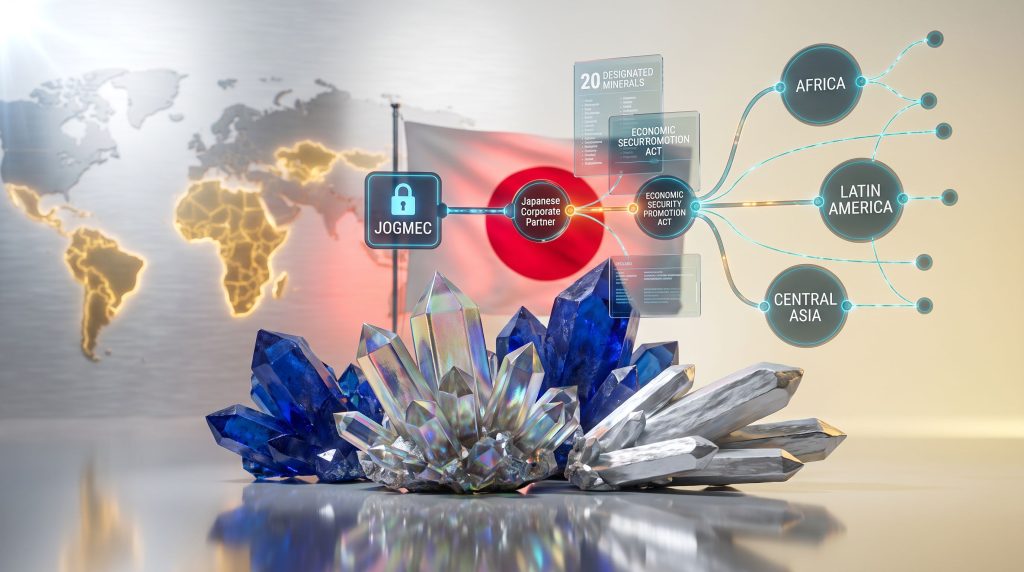
Before JOGMEC's mandate can be reformed, there must be a legal architecture to define what counts as a strategic material and what forms of state intervention are permissible. Japan's Economic Security Promotion Act provides precisely that foundation. The legislation designates 20 minerals as essential materials eligible for government-backed funding and institutional intervention.
The designated minerals span the full spectrum of modern industrial and technological requirements:
| Mineral Category | Key Examples | Primary Industrial Application |
|---|---|---|
| Battery metals | Lithium, nickel, cobalt, manganese | EV batteries, energy storage systems |
| Rare earth elements | Neodymium, dysprosium, terbium | Permanent magnets, motors, turbines |
| Semiconductor inputs | Gallium, germanium | Compound semiconductors, electronics |
| Industrial minerals | Graphite, fluorite | Battery anodes, industrial processing |
| Structural metals | Chromium, vanadium | Defence alloys, aerospace components |
The Act establishes the legal basis for state-directed investment in upstream mineral supply chains and treats supply chain resilience as a matter of national security rather than purely commercial policy. This legislative framing is significant because it provides METI with the statutory authority to justify interventionist investment decisions on grounds that extend beyond conventional cost-benefit analysis.
Policy context worth noting: Japan's Economic Security Promotion Act is among the more structurally comprehensive legislative frameworks for critical mineral governance in Asia, codifying the state's role in upstream resource markets rather than relying on ad hoc administrative guidance.
What the JOGMEC Reform Actually Changes
A Before-and-After Comparison
The Ministry of Economy, Trade and Industry presented the proposed revision to an expert mining policy panel, with the ministry indicating it will incorporate panel feedback before finalising the operational details of the new framework. The core structural changes can be summarised as follows:
| Dimension | Current Framework | Proposed Revised Framework |
|---|---|---|
| Co-investment requirement | Mandatory Japanese company participation | Conditional, waivable under specific circumstances |
| Independent acquisition | Requires rights-transfer commitment | Permitted alongside foreign resource holders |
| Eligible minerals | 20 under Economic Security Promotion Act | Same 20 designated minerals |
| Decision trigger | Japanese partner availability | Project timeline and supply disruption risk |
| Competitive posture | Reactive and partner-dependent | Proactive and market-responsive |
The Conditions That Trigger Independent Investment Authority
The reform is not a blank cheque. JOGMEC's ability to invest without a Japanese corporate partner is specifically conditioned on circumstances where waiting for domestic participation would materially delay project development or increase the probability of supply disruption. This conditional framing is architecturally important for several reasons:
- It preserves the policy preference for public-private co-investment as the default model
- It creates a defined bypass mechanism for situations where market speed demands unilateral action
- It limits the scope for JOGMEC to function as an unconstrained sovereign wealth vehicle
- It maintains alignment with Japan's broader industrial policy objectives by keeping domestic participation as the preferred outcome
The conditionality also provides political cover for what is, in practice, a significant expansion of state investment authority in global commodity markets.
Benchmarking Japan Against Competing National Strategies
How Peer Nations Deploy State Capital in Mineral Markets
Japan's proposed JOGMEC reform does not occur in isolation. It is a direct response to the demonstrated effectiveness of competing national investment models. Understanding where Japan has been relative to its peers clarifies why the reform is being characterised as urgent rather than merely prudent.
United States: US critical minerals support has been deployed through a combination of the Defense Production Act, Export-Import Bank financing, and bilateral investment frameworks to back critical mineral projects in allied and partner nations. METI explicitly cited U.S. backing for a Brazilian rare earth mining operation as a competitive pressure point that illustrated the cost of Japan's institutional constraints.
China: State-owned enterprises operate with near-unconditional investment mandates, enabling rapid asset acquisition across Africa, Latin America, and Southeast Asia. Chinese entities do not face the co-investment conditions that have historically applied to JOGMEC, giving them a first-mover advantage in project origination.
South Korea: Korea Resources Corporation (KORES) operates under a similarly flexible state-investment model. South Korea's experience provides a regional benchmark for what a reformed JOGMEC could achieve in terms of asset coverage and supply-chain reach.
European Union: The European critical raw materials strategy establishes strategic project designations and funding mechanisms, though the EU's fragmented member-state structure makes coordinated state investment more complex than Japan's centralised METI-JOGMEC model.
Investor observation: Nations with the most flexible state investment mandates in mineral markets have generally been able to secure more diversified upstream positions. Japan's reform moves toward this model while retaining more structural guardrails than China or Russia maintain.
The Geopolitical Leverage Created by JOGMEC's Expanded Mandate
There is a dimension to this reform that extends well beyond supply-chain logistics. By enabling JOGMEC to invest directly alongside foreign resource holders, Japan is positioning itself as a more credible bilateral partner for resource-rich nations that are actively seeking to attract sovereign or institutional co-investors.
Many mineral-rich developing nations have expressed a preference for diversifying their investment relationships beyond Chinese state-owned enterprises. Furthermore, a JOGMEC that can commit capital quickly and without requiring a Japanese corporate intermediary becomes a more attractive partner in precisely these contexts. This dynamic is particularly relevant in mineral-rich regions of:
- Sub-Saharan Africa, where significant deposits of cobalt, manganese, graphite, and rare earths overlap with governments seeking to negotiate improved terms with major investors
- Central Asia, where lithium, uranium, and rare earth deposits remain underexplored relative to their geological prospectivity
- Latin America, where lithium triangle resources and Brazilian rare earth deposits have attracted intense sovereign investment competition
Japan's participation in the Minerals Security Partnership, a coalition of allied nations coordinating approaches to critical mineral supply-chain resilience, provides an additional diplomatic context within which JOGMEC's expanded mandate could be deployed. In addition, the Australia-Japan joint statement on critical minerals cooperation signals how bilateral frameworks are increasingly being used to reinforce these supply-chain objectives.
Lesser-Known Dimensions of Japan's Rare Earth Vulnerability
The Processing Concentration Problem That Mining Investment Alone Cannot Fix
One of the less widely appreciated aspects of Japan's rare earth supply risk is that it is not simply a question of where ore is mined. It is fundamentally a processing concentration problem. China controls an estimated 85 to 90 percent of global rare earth separation and refining capacity, meaning that ore extracted in Australia, Canada, or Africa frequently still passes through Chinese processing facilities before reaching Japanese manufacturers.
This mid-stream dependency creates a vulnerability that persists even when upstream mining diversification is achieved. For Japan's JOGMEC reform to fully address supply-chain risk, equity positions in mining projects would ideally be paired with investments in or partnerships with non-Chinese rare earth separation facilities. Consequently, emerging processing capacity in Australia, the United States, and Estonia represents potential nodes in a diversified supply chain, though the technical complexity and capital intensity of rare earth separation present significant barriers.
Why Heavy Rare Earths Are the Most Acute Concern
Within the rare earth category, heavy rare earths warrant particular attention. Elements such as dysprosium and terbium are essential for producing high-performance permanent magnets that can operate at elevated temperatures, a requirement for EV motors in performance applications. Heavy rare earth deposits are far less geographically distributed than light rare earths, with significant known resources concentrated in Myanmar, China, and a small number of other jurisdictions.
Myanmar's heavy rare earth production, much of which is controlled by Chinese-linked commercial interests operating in border regions with limited regulatory oversight, introduces additional supply-chain governance concerns. Japanese manufacturers seeking ethically traceable material sourcing face considerable complexity in this space. JOGMEC's ability to invest in alternative heavy rare earth projects, without waiting for Japanese corporate partners to align, could meaningfully accelerate Japan's access to more secure and traceable sources of these critical inputs.
The next major ASX story will hit our subscribers first
Implications for Global Mineral Capital Markets
What a More Agile JOGMEC Means for Junior Miners and Project Developers
The practical market implications of Japan proposing to give JOGMEC more freedom to invest in critical minerals extend to the global junior mining sector. A JOGMEC that can act as an independent institutional investor without requiring a Japanese corporate co-participant represents a new category of potential capital for project developers in politically stable jurisdictions.
For junior miners in MSP-aligned nations advancing projects across the 20 designated mineral categories, this reform could:
- Expand the pool of potential strategic investors willing to commit equity at development-stage milestones
- Provide access to JOGMEC's substantial technical expertise in resource evaluation and project de-risking
- Create offtake relationship pathways with Japanese industrial end-users, even where those end-users are not ready to commit investment capital directly
- Improve the economics of projects where Japanese offtake interest exists but corporate co-investment has been the missing structural element
However, critical minerals demand continues to accelerate globally, meaning increased institutional interest from a reformed JOGMEC could also compress the valuation discounts that junior critical mineral developers have historically traded at. This would be particularly relevant for projects with confirmed Japanese industrial relevance in stable jurisdictions.
Important disclaimer: Any discussion of valuation impacts or investment outcomes involves inherent uncertainty. This analysis represents structural observations about potential market dynamics and should not be interpreted as investment advice or a prediction of specific asset price movements.
Frequently Asked Questions: Japan's JOGMEC Reform and Critical Minerals Policy
What is JOGMEC and what does it actually do?
JOGMEC, the Japan Organization for Metals and Energy Security, is a state-owned body tasked with securing Japan's upstream access to metals and energy resources. According to JOGMEC's financial support activities, its remit includes equity investment in mineral exploration and development projects, provision of exploration guarantees, technical assistance to Japanese resource companies, and supply-chain resilience programmes across strategic commodity categories.
Why is the co-investment requirement being reconsidered now?
The combination of China's tightening export controls on rare earths and critical metals, the acceleration of global competition for mineral assets, and the demonstrated agility of competing state investment vehicles has made the structural bottleneck increasingly costly. METI's proposal directly acknowledges that the existing rules have disadvantaged Japan in fast-moving competitive environments.
Does this reform give JOGMEC unlimited investment authority?
No. The reform introduces a conditional bypass mechanism rather than unconditional autonomy. JOGMEC can invest independently only when waiting for Japanese corporate participation would materially delay a project or elevate supply disruption risk. METI retains oversight and will define the operational parameters following expert panel review.
Which minerals are covered?
The reform applies to the 20 minerals designated as essential materials under Japan's Economic Security Promotion Act. This covers lithium, nickel, cobalt, manganese, graphite, rare earth elements, gallium, germanium, fluorite, and other inputs critical to battery technology, semiconductor manufacturing, and clean energy infrastructure.
What happens next in the policy process?
The proposal has been presented to an expert mining policy panel convened by METI. The ministry will incorporate panel recommendations before finalising the operational details of the revised framework. No final implementation timeline has been confirmed at this stage.
Key Takeaways for Understanding Japan's Critical Minerals Strategy
Japan's proposal to give JOGMEC more freedom to invest in critical minerals is best understood not as a single policy change but as a structural adaptation to a permanently altered competitive environment. Several dimensions of this shift deserve emphasis:
- The reform directly targets the institutional bottleneck that has made Japan slower than peer nations in securing upstream mineral positions
- China's export control escalation on rare earths and metals provided both the immediate catalyst and the clearest illustration of Japan's vulnerability
- The 20 minerals covered span the full spectrum of Japan's electric vehicle, semiconductor, and clean energy industrial requirements
- JOGMEC's expanded mandate creates new potential pathways for resource-rich nations seeking to diversify their sovereign investment relationships
- The conditional design of the reform reflects Japan's preference for structured state intervention rather than open-ended sovereign capital deployment
- Mid-stream processing concentration remains a structural vulnerability that upstream investment reform alone cannot resolve, pointing to likely future policy interventions in rare earth supply chains outside China
The broader trajectory is clear: Japan is reconfiguring its state investment architecture to compete more effectively for the mineral inputs that will determine industrial competitiveness across the next several decades. Whether the pace of that reconfiguration will match the speed at which the competitive landscape continues to shift remains the central question for observers of Japan's critical minerals strategy.
Want to Track the Next Major Critical Mineral Discovery Before the Market Does?
Discovery Alert's proprietary Discovery IQ model scans ASX announcements in real time, instantly identifying significant mineral discoveries across lithium, rare earths, gallium, and the full spectrum of critical materials reshaping global supply chains — converting complex data into clear, actionable insights for investors at every level. Explore how historic mineral discoveries have delivered exceptional returns, and begin your 14-day free trial today to position yourself ahead of the market.