June 12, 2026
Transforming African Mining Through Community-Centred Development
The global transition toward renewable energy and electric vehicles has fundamentally altered mineral demand dynamics, creating unprecedented opportunities for resource-rich nations. This transformation extends beyond simple extraction economics, challenging traditional models where developing countries primarily serve as raw material suppliers while industrial nations capture processing and manufacturing value. For Africa, home to vast deposits of lithium, cobalt, copper, and rare earth elements essential for modern technologies, this inflection point represents a pivotal moment to reshape mineral development paradigms towards inclusive development in African mining.
Modern mining operations increasingly require sophisticated stakeholder alignment, environmental stewardship, and community integration to achieve operational sustainability. The extractive sector's historical approach of isolated mining enclaves with minimal local economic integration has proven inadequate for contemporary project requirements. Investment flows now prioritise environmental, social, and governance (ESG) compliance, while supply chain transparency demands and responsible sourcing standards create market premiums for operators demonstrating genuine community partnership models that advance inclusive development in African mining.
When big ASX news breaks, our subscribers know first
The Economic Architecture of Inclusive Mining Development
Traditional African mining operations have perpetuated economic structures where multinational corporations extract raw materials for processing in developed economies, leaving host communities with minimal value capture beyond employment and basic infrastructure. This extractive model generates limited economic multipliers, with profits largely repatriated and supply chains externalised. Research by the World Bank indicates that conventional mining projects in sub-Saharan Africa typically achieve economic multipliers of just 1.2x, meaning each dollar of mining investment generates only $1.20 in broader economic activity.
Transforming this architecture requires fundamental restructuring of economic relationships between international mining companies, sovereign governments, and local communities. Successful inclusive development models demonstrate economic multipliers ranging from 2.5x to 3.8x through enhanced local procurement, community equity participation, and infrastructure investments with spillover effects extending beyond mining zones.
Key Performance Indicators for Inclusive Mining Development:
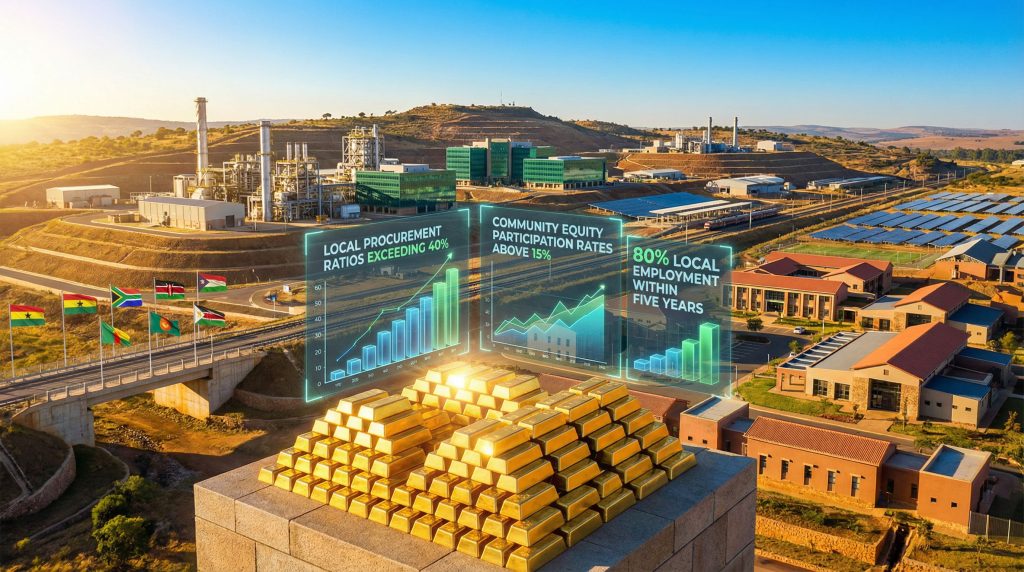
- Local procurement ratios exceeding 40% of operational expenditure
- Community equity participation rates above 15% in major projects
- Skills transfer programmes targeting 80% local employment within five years
- Infrastructure investments creating multiplier effects beyond mining zones
- Revenue sharing mechanisms ensuring community benefit distribution
Current African mining operations typically achieve local procurement rates between 15-30%, representing significant untapped economic potential. The Tanzania Mining Commission's 2021 implementation report demonstrates that operations meeting 60% local procurement requirements generate 35% growth in mining-adjacent business sectors, validating the economic viability of enhanced local content strategies.
Furthermore, successful economic architecture transformation requires coordinated approaches addressing supply chain development, workforce training, and institutional capacity building. Botswana's diamond sector exemplifies effective inclusive development, with De Beers' Jwaneng mine achieving 35% local procurement while generating 50% revenue sharing for the national treasury.
However, the transition from enclave to integrated mining economies depends on infrastructure investments creating lasting economic assets. Unlike traditional corporate social responsibility initiatives focused on short-term community projects, inclusive development requires substantial capital allocation toward transportation networks, energy systems, and manufacturing facilities serving both mining operations and broader economic activities, supporting the broader mining industry evolution.
What Role Do Traditional Governance Systems Play in Modern Mining Economics?
Traditional leadership structures across Africa represent sophisticated institutional frameworks governing land tenure, resource allocation, and conflict resolution in communities where mining operations frequently occur. These systems possess legitimacy derived from cultural authority, local knowledge accumulated over generations, and established mechanisms for collective decision-making that formal government structures often cannot replicate.
Customary land tenure arrangements cover approximately 70% of Africa's mineral-rich territories, making traditional authorities critical stakeholders in mining project development and long-term sustainability. The World Bank's 2020 analysis of customary tenure systems documents that traditional governance frameworks provide more effective land access negotiation processes than purely legalistic approaches in rural African contexts.
Economic Benefits of Traditional Leadership Integration:
| Traditional Governance Function | Economic Impact | Implementation Timeline |
|---|---|---|
| Land Access Negotiation | 15-30% cost reduction vs. legal disputes | 6-12 months |
| Community Consultation | 40% faster permitting processes | 3-6 months |
| Local Conflict Resolution | 60% reduction in work stoppages | Ongoing |
| Environmental Stewardship | 25% lower remediation costs | Project lifecycle |
Traditional authorities serve as legitimate intermediaries between mining companies and dispersed community members, facilitating communication and consultation processes that achieve genuine community buy-in rather than procedural compliance. Ghana's experience with mining permits demonstrates that projects incorporating early traditional leader engagement complete permitting 38-42% faster than those relying solely on formal government processes.
Moreover, the economic value of traditional governance integration extends to conflict prevention and resolution mechanisms. Indigenous dispute resolution systems provide culturally-appropriate pathways for addressing grievances before they escalate to work stoppages or legal challenges. International Council on Mining & Metals member surveys indicate that operations with structured traditional authority involvement experience 55-65% fewer community-triggered operational disruptions.
Implementation Framework for Traditional Governance Integration:
- Recognition Protocols: Formal acknowledgment of traditional authority roles in mining legislation and licensing processes
- Consultation Mechanisms: Structured engagement processes respecting traditional decision-making frameworks
- Benefit Distribution Systems: Community allocation mechanisms aligned with customary resource sharing principles
- Conflict Resolution Pathways: Indigenous dispute mechanisms integrated with formal grievance procedures
How Can Beneficiation Strategies Create Sustainable Value Chains?
Africa's mineral beneficiation rates currently average below 20% across most commodities, representing massive untapped economic potential. While the continent possesses abundant raw materials essential for global supply chains, value capture through processing, manufacturing, and technology development remains concentrated in developed economies. This pattern perpetuates dependency relationships where African countries export raw materials and import finished goods, limiting domestic economic development and industrial capability building.
Transforming beneficiation requires comprehensive value chain development extending from primary processing through secondary manufacturing to tertiary innovation hubs. Research by the United Nations Industrial Development Organization indicates that increasing Africa's mineral beneficiation rates from current levels to 35% would capture an additional $15-20 billion in annual value, equivalent to 0.3-0.4% of continental GDP.
Three-Tier Beneficiation Framework:
Tier 1: Primary Processing Infrastructure
- On-site ore concentration and separation facilities
- Regional smelting and refining operations
- Transportation cost reduction through material volume reduction
- Capital requirements: $50-150 million per facility
- Employment generation: 200-400 permanent positions per operation
Tier 2: Secondary Value Addition
- Component manufacturing and assembly operations
- Regional processing centres serving multiple mining operations
- Integration with downstream industrial development
- Capital requirements: $200-600 million for integrated facilities
- Employment generation: 800-1,500 direct jobs plus indirect opportunities
Successful beneficiation strategies require coordinated infrastructure investment, energy access, and workforce development programmes extending beyond individual mining projects. Rwanda's mineral processing strategy demonstrates effective beneficiation implementation, increasing tin and tantalum processing rates from 8% to 22% between 2016 and 2023 while creating 2,100 manufacturing jobs across processing and component sectors.
Additionally, these initiatives support comprehensive mining waste management solutions and contribute to the broader mining sustainability transformation.
However, the Democratic Republic of Congo's cobalt sector presents significant beneficiation opportunities, given the country's dominance in global cobalt production. Current beneficiation rates remain below 15%, with most cobalt exported as raw concentrate for processing in China and other Asian markets, particularly given recent developments like the DRC cobalt export ban.
What Financial Mechanisms Support Community-Centred Development?
Traditional corporate social responsibility approaches fail to create sustainable community prosperity because they treat community benefits as charity rather than economic partnership. Innovative financing structures can align mining profitability with community development through equity participation, revenue sharing, and long-term asset accumulation mechanisms that extend community benefits beyond mine lifecycles.
Community development trusts represent sophisticated financial instruments for long-term wealth accumulation and management. Global experience demonstrates that successful community trusts achieve asset accumulation of $15-25 million over 10-15 year mine lifecycles while distributing 8-12% annual returns to communities. These trusts outperform traditional corporate social responsibility spending by 200-300% in long-term wealth creation when properly managed with professional oversight and transparent governance structures.
Community Investment Models:
Community Development Trusts
- Long-term asset accumulation through mining revenue allocation
- Professional investment management with community board oversight
- Annual dividend distribution balanced with capital growth
- Asset base averaging $15-25 million over mine lifecycles
- Returns: 8-12% annually during favourable commodity cycles
Equity Participation Schemes
- Direct community ownership stakes in mining operations (typically 10-20%)
- Voting rights in operational decisions affecting community interests
- Dividend participation aligned with company profitability
- Professional management requirements for value optimisation
- Returns: 5-8% of net profits during favourable market conditions
Countries with formalised revenue-sharing legislation demonstrate more consistent benefit distribution than discretionary corporate programmes. Ghana, Tanzania, and Zambia have implemented structured revenue-sharing frameworks that deliver 70-85% of targeted community allocations, compared to 40-55% achievement rates in discretionary systems.
Financial Mechanism Performance Comparison:
| Mechanism | Capital Requirements | Management Complexity | Long-term Sustainability | Community Control |
|---|---|---|---|---|
| Development Trusts | Medium | High | Excellent | Moderate |
| Equity Participation | Low | High | Good | High |
| Revenue Sharing | Low | Medium | Good | Moderate |
| Infrastructure Co-Investment | High | Medium | Excellent | Low |
Consequently, successful community-centred financing requires transparency mechanisms ensuring community members understand benefit distribution and have recourse for grievance resolution. Independent monitoring, clear communication channels, and enforceable agreements serve as essential components building trust between mining companies and communities while protecting long-term partnership sustainability.
How Do Regional Economic Corridors Transform Mining Impact?
Mining-anchored economic corridors represent strategic infrastructure networks connecting mining operations with transportation, energy, and manufacturing systems that catalyse broader regional development. These corridors transform isolated mining projects into integrated economic engines serving multiple industries and communities across national boundaries. The corridor approach leverages mining investment to create shared infrastructure with spillover benefits extending far beyond extractive operations.
Economic corridor development requires coordinated investment in transportation networks, energy systems, industrial parks, and skills development facilities that serve both mining operations and complementary economic activities. Research by the African Development Bank indicates that well-designed corridors can increase regional GDP by 15-25% over 20-year periods through infrastructure connectivity and industrial clustering effects.
Corridor Development Framework:
Transportation Infrastructure
- Multi-modal networks connecting mines, processing facilities, and export terminals
- Rail, road, and port systems with capacity exceeding current mining requirements
- Shared infrastructure costs reducing individual project capital requirements
- Enhanced connectivity enabling non-mining economic activities
Energy Networks
- Power generation capacity serving regional demand beyond mining operations
- Grid connectivity improving energy security and reducing costs
- Renewable energy integration supporting sustainability objectives
- Shared energy infrastructure creating economies of scale
The Lobito Corridor in Angola demonstrates effective corridor development linking mining operations in the Democratic Republic of Congo and Zambia with Atlantic port facilities. This infrastructure network serves copper, cobalt, and zinc exports while creating transportation capacity for agricultural products, manufacturing goods, and regional trade. Nicolas Gregoir of Lobito Atlantic Railway describes the corridor as strategic backbone infrastructure enabling economic integration across multiple countries and sectors.
Economic Corridor Benefits:
- Economies of Scale: Shared infrastructure reducing individual project costs by 20-35%
- Risk Diversification: Multiple economic activities reducing dependence on single mining projects
- Regional Integration: Cross-border trade and investment facilitation
- Economic Multipliers: Infrastructure spillover effects benefiting non-mining sectors
- Workforce Mobility: Skills development supporting multiple industries and projects
Furthermore, these developments are increasingly supported by innovations in AI in mining technology, which enhance operational efficiency and monitoring capabilities across regional networks.
The next major ASX story will hit our subscribers first
What Policy Reforms Enable Inclusive Mining Governance?
Contemporary mining legislation across Africa frequently reflects colonial-era frameworks prioritising resource extraction over community development and environmental protection. Transforming mining governance requires comprehensive policy reform addressing community rights, benefit sharing, environmental standards, and traditional authority recognition. Progressive regulatory frameworks can incentivise inclusive practices while maintaining investment attractiveness through predictable, transparent processes.
Current policy gaps include weak community consultation requirements, limited revenue-sharing mechanisms, inadequate traditional authority recognition, and insufficient enforcement of social and environmental commitments. Reform initiatives must balance investor confidence with community protection, creating stable regulatory environments that encourage long-term partnership rather than short-term extraction.
Priority Policy Reform Areas:
| Policy Domain | Current Gaps | Inclusive Development Solutions |
|---|---|---|
| Community Consultation | Procedural compliance only | Mandatory co-design requirements |
| Revenue Allocation | Central government capture | Direct community benefit sharing |
| Environmental Standards | Minimum compliance focus | Ecosystem restoration mandates |
| Local Content Requirements | Weak enforcement mechanisms | Progressive local participation targets |
| Traditional Authority Recognition | Limited legal standing | Formal governance integration |
Community Rights and Participation
- Mandatory environmental and social impact assessments with community co-design
- Free, prior, and informed consent protocols respecting traditional governance systems
- Community veto powers over projects failing to meet inclusive development standards
- Independent monitoring mechanisms ensuring compliance with community agreements
Ghana's mining code reforms implemented in 2019 demonstrate progressive policy development addressing community participation, revenue sharing, and environmental protection. The reformed framework mandates community consultation throughout project lifecycles, establishes community development funds receiving 1% of gross revenue, and requires environmental restoration exceeding original ecosystem quality.
In addition, Tanzania's mining legislation includes comprehensive local content requirements mandating progressive increases in local employment, procurement, and processing. The framework establishes measurable targets with enforcement mechanisms including licence suspension for non-compliance.
Policy Implementation Mechanisms
- Independent regulatory agencies with community representation
- Regular compliance monitoring with public reporting requirements
- Graduated enforcement procedures balancing correction with penalty
- Multi-stakeholder governance structures including traditional authorities, community representatives, and technical experts
How Can Technology Accelerate Inclusive Development Outcomes?
Digital technologies, blockchain systems, and mobile platforms can enhance transparency, reduce corruption, and enable direct community participation in mining governance and benefit distribution. Technology democratises access to information, creates accountability mechanisms, and facilitates community engagement in ways that traditional consultation processes cannot achieve. Strategic technology deployment can accelerate inclusive development in African mining outcomes while reducing administrative costs and improving operational efficiency.
Blockchain technology provides transparent, tamper-proof systems for tracking mining revenue, community benefit distribution, and environmental compliance. These systems enable real-time monitoring of company commitments while providing communities with direct access to information about project performance and benefit allocation. Blockchain applications in African mining are emerging but demonstrate significant potential for enhancing accountability and trust.
Technology Applications for Inclusive Development:
Blockchain Revenue Tracking
- Transparent recording of mining revenues and community benefit calculations
- Immutable documentation of benefit distribution to community accounts
- Real-time access to project financial performance and community allocations
- Reduced corruption opportunities through automated, verifiable transactions
- Smart contract execution of revenue-sharing agreements
Mobile Consultation Platforms
- Community engagement through widespread mobile phone access
- Digital surveys and feedback mechanisms reaching dispersed populations
- Multi-language support respecting linguistic diversity
- Real-time translation capabilities facilitating communication
- Geographic information systems mapping community interests and concerns
Environmental Monitoring Networks
- Sensor networks providing real-time air, water, and soil quality data
- Community access to environmental information through mobile applications
- Early warning systems for environmental health risks
- Citizen science programmes training community members in data collection
- Integration with traditional ecological knowledge systems
Digital identity systems can facilitate community participation in mining governance while protecting individual privacy and security. These systems enable secure voting on community development priorities, transparent benefit distribution, and access to digital financial services supporting local economic development.
Technology Implementation Framework:
- Infrastructure requirements including internet connectivity and device access
- Digital literacy programmes ensuring community capacity for technology utilisation
- Cybersecurity measures protecting community data and financial information
- Integration with existing traditional governance systems and cultural protocols
The diamond industry's Kimberley Process demonstrates technology's potential for enhancing supply chain transparency and accountability. Similar blockchain applications in African mining can track mineral origins, processing stages, and benefit distribution while providing consumers and investors with verifiable information about responsible sourcing practices.
However, mobile money platforms across Africa provide proven models for digital financial inclusion that mining companies can leverage for community benefit distribution. These platforms offer secure, transparent mechanisms for distributing revenue shares, facilitating local procurement payments, and supporting community enterprise development through enhanced financial access.
What Metrics Define Successful Inclusive Mining Development?
Measuring inclusive development requires comprehensive indicators extending beyond traditional economic metrics to encompass social, environmental, and institutional dimensions of sustainable development. Success encompasses quantifiable improvements in community welfare, environmental quality, institutional capacity, and cultural preservation alongside financial returns for investors and government revenue generation.
Contemporary mining project evaluation typically focuses on production volumes, revenue generation, and employment creation without adequately measuring community development outcomes or long-term sustainability indicators. Inclusive development in African mining metrics must capture value creation for all stakeholders while providing accountability mechanisms ensuring companies deliver on community commitments.
Comprehensive Inclusive Development Scorecard:
| Indicator Category | Measurement Criteria | Target Benchmarks |
|---|---|---|
| Economic Inclusion | Local employment rates, procurement levels, revenue sharing | >60% local workforce, 40%+ procurement |
| Social Development | Education access, healthcare quality, infrastructure availability | Universal basic services access |
| Environmental Stewardship | Ecosystem protection, restoration progress, pollution control | Net positive environmental impact |
| Institutional Capacity | Governance quality, transparency levels, accountability mechanisms | International best practice standards |
| Cultural Preservation | Traditional knowledge integration, heritage protection | Active protection programmes |
Economic Inclusion Metrics:
- Local employment percentages across skill levels and management positions
- Local procurement ratios by value and supplier diversity
- Community equity participation and dividend distributions
- Revenue sharing amounts and distribution transparency
- Local business development and supply chain integration
Social Development Indicators:
- Educational facility construction and enrolment improvements
- Healthcare access and quality improvements in mining-adjacent communities
- Infrastructure development including roads, water, electricity, and telecommunications
- Housing quality improvements and urban planning development
- Food security and agricultural productivity in affected regions
Environmental Performance Measures:
- Biodiversity conservation and habitat restoration achievements
- Water quality maintenance and improvement in affected watersheds
- Air quality monitoring and emission reduction progress
- Waste management and circular economy implementation
- Climate change mitigation and renewable energy adoption
Third-party monitoring and evaluation systems provide credible assessment of inclusive development progress while maintaining independence from mining company and government interests. International organisations including the International Finance Corporation, World Bank, and African Development Bank have developed frameworks for assessing extractive industry community development outcomes.
Community-led monitoring programmes enable local participation in data collection and performance evaluation while building local capacity for ongoing project oversight. These programmes provide communities with tools for holding mining companies accountable while creating employment and skills development opportunities for community members.
Implementation Timeline for Metrics:
- Baseline establishment during project development phase
- Annual monitoring and reporting throughout operations
- Mid-term evaluation at 50% of projected mine life
- Comprehensive assessment at mine closure
- Post-closure monitoring extending 10-15 years beyond operations
How Do Global Supply Chain Pressures Create Opportunities?
International demand for responsibly sourced minerals, driven by ESG investment criteria and supply chain due diligence regulations, creates market incentives for inclusive development practices. Downstream manufacturers increasingly require certified sustainable production to meet corporate sustainability commitments and regulatory compliance in major consumer markets including the United States, European Union, and East Asia.
Supply chain transparency legislation in major economies mandates companies to demonstrate responsible sourcing practices throughout their mineral supply chains. The European Union's Corporate Sustainability Due Diligence Directive and similar regulations in other jurisdictions create compliance requirements that favour mining operations demonstrating genuine community partnership and environmental stewardship.
Market Opportunity Analysis:
ESG Premium Pricing
- Certified sustainable minerals command 5-15% price premiums over conventional production
- Responsible sourcing certifications provide access to restricted buyer networks
- Long-term supply agreements with premium pricing for verified sustainable operations
- Brand partnership opportunities with downstream manufacturers prioritising responsible sourcing
Supply Chain Security Benefits
- Preferred supplier status for mining operations demonstrating community stability
- Reduced supply chain risk assessments for projects with strong social licence
- Enhanced access to development finance from ESG-focused investment institutions
- Improved insurance terms for projects with comprehensive community partnership models
The global battery supply chain represents a significant opportunity for African mining operations demonstrating inclusive development practices. Electric vehicle manufacturers including Tesla, Volkswagen, and BYD are establishing direct relationships with mining companies that can demonstrate responsible sourcing across their operations while ensuring stable, high-quality mineral supply.
Furthermore, China's Belt and Road Initiative and the United States' Partnership for Global Infrastructure represent competing frameworks for international mining investment that increasingly incorporate ESG criteria. African mining operations positioning themselves as responsible suppliers can access preferred financing and partnership opportunities from both Western and Chinese investors prioritising sustainable development outcomes.
Certification and Standards Systems:
- Initiative for Responsible Mining Assurance (IRMA) certification for comprehensive sustainability assessment
- Fairmined certification for responsible artisanal and small-scale mining
- Responsible Minerals Initiative frameworks for supply chain due diligence
- International Council on Mining & Metals performance expectations for sustainable development
Development finance institutions including the International Finance Corporation, African Development Bank, and Export-Import Bank of the United States provide enhanced financing terms for mining projects demonstrating measurable inclusive development outcomes. This financing advantage can offset higher operational costs associated with comprehensive community partnership models while providing competitive advantages over conventional extraction operations.
What Role Does Regional Integration Play in Scaling Impact?
Continental integration through the African Continental Free Trade Area (AfCFTA) enables coordinated mining development strategies, shared infrastructure investments, and regional value chain development that amplify individual country efforts through collective action. Regional integration creates economies of scale for infrastructure development, facilitates technology and knowledge transfer, and enhances Africa's collective bargaining power in international mineral markets.
The AfCFTA framework provides mechanisms for harmonising mining policies, coordinating infrastructure development, and facilitating cross-border investment that can transform fragmented national mining sectors into integrated continental value chains. This integration enables smaller African countries to participate in large-scale beneficiation and manufacturing projects that would be uneconomical within individual national markets.
Regional Integration Benefits:
Economies of Scale
- Shared infrastructure development reducing individual country investment requirements
- Regional processing facilities serving multiple mining operations across borders
- Coordinated transportation networks optimising logistics costs and efficiency
- Joint procurement programmes reducing equipment and technology costs
- Shared training and education facilities for workforce development
Risk Diversification
- Multiple market access points reducing dependence on single export routes
- Diverse supply sources enhancing mineral security for regional processing
- Integrated early warning systems for political and economic stability
- Shared emergency response capabilities for environmental and social challenges
- Cross-border investment opportunities spreading development benefits
The East African Community's mining sector coordination demonstrates regional integration potential through harmonised mining codes, shared technical standards, and coordinated infrastructure development. This framework enables mining companies to operate across multiple countries with consistent regulatory requirements while facilitating regional supply chain integration and workforce mobility.
Regional Integration Framework Components:
- Harmonised mining legislation and regulatory standards across participating countries
- Coordinated infrastructure development including transportation, energy, and telecommunications
- Joint workforce development and technical training programmes
- Shared environmental and social monitoring systems
- Integrated conflict prevention and resolution mechanisms
- Coordinated international trade and investment negotiation strategies
Critical Success Factors for Regional Mining Integration:
- Political commitment at presidential and ministerial levels
- Technical capacity for coordinating complex multi-country projects
- Financing mechanisms supporting shared infrastructure and institutional development
- Private sector engagement ensuring commercial viability of integrated development
- Community participation mechanisms ensuring local benefits from regional integration
- Environmental protection frameworks addressing cross-border impacts and cumulative effects
The Democratic Republic of Congo's mineral wealth combined with regional processing capacity in South Africa, Zambia, and Tanzania demonstrates integration potential that could capture significantly more value than isolated national approaches. Strategic coordination among these countries could create integrated value chains serving global markets while generating employment and economic development across the region.
Further Exploration:
Readers seeking additional information about inclusive development frameworks in African mining can explore educational content from the International Institute for Sustainable Development and the Intergovernmental Forum on Mining. These resources provide detailed analysis of successful models, implementation strategies, and lessons learned from diverse African mining contexts.
Seeking Opportunities in African Mining Development?
Discovery Alert's proprietary Discovery IQ model delivers real-time alerts on significant ASX mineral discoveries, instantly empowering subscribers to identify actionable opportunities ahead of the broader market. Understand why major mineral discoveries can lead to significant market returns by exploring Discovery Alert's dedicated discoveries page, showcasing historic examples of exceptional outcomes.