June 12, 2026
Africa's Aluminium Paradox: Why the World's Most Resource-Rich Continent Produces So Little Metal
Consider a peculiar contradiction at the heart of global aluminium supply chains. The African continent holds an estimated 30% of the world's bauxite reserves, yet contributes less than 3% of global primary aluminium output. This structural gap between raw material abundance and downstream processing capacity is not accidental. It reflects decades of capital allocation decisions that prioritised extraction over transformation, leaving African economies locked into the lowest-margin position in the mineral value chain.
Angola sits within this broader paradox, but with a set of structural advantages that most sub-Saharan African nations cannot match. Its expanding hydroelectric generation infrastructure, proximity to Atlantic shipping routes, and a government actively redirecting economic ambition away from petroleum dependency have collectively created conditions that are now attracting Chinese industrial capital at meaningful scale.
The emergence of the Huatong Angola Electrolytic Aluminium Project in Barra do Dande, Bengo Province, and the China CAMC Angola aluminium smelter expansion through CAMC Engineering's subsequent involvement in Phase II of that project, represents a tangible expression of this strategic shift. Understanding what is being built here, who is building it, and what it means for Angola's industrial future requires examining both the macro forces reshaping Chinese overseas investment and the specific technical and financial architecture of the project itself.
When big ASX news breaks, our subscribers know first
Understanding the Huatong Angola Electrolytic Aluminium Project: A Multi-Phase Industrial Blueprint
The Architecture of a Long-Horizon Industrial Commitment
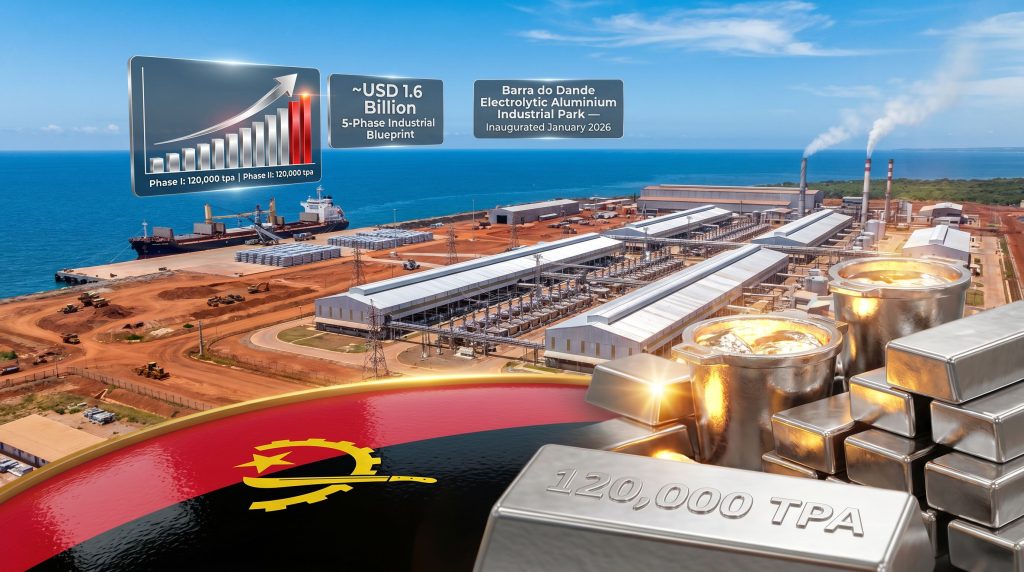
The Huatong Angola Electrolytic Aluminium Project is not a single-phase construction endeavour. It is a master-planned industrial park conceived across five sequential phases, developed by subsidiaries of Hebei Huatong Wire and Cables Group, with a total investment target of approximately USD 1.6 billion over an 8 to 10 year development horizon.
This kind of long-duration, multi-phase industrial commitment is rare in sub-Saharan Africa outside the extractive sector. It signals that the project's developers view Angola not merely as a low-cost production location but as a long-term industrial hub capable of supporting a fully integrated aluminium value chain from primary smelting through to fabricated metal products.
Phase I was inaugurated in January 2026, representing the project's first operational milestone. The phase delivered:
- A nameplate production capacity of 120,000 tonnes per annum of primary electrolytic aluminium
- A capital investment of approximately USD 250 million
- Approximately 1,200 direct jobs created at the Barra do Dande site
- A fully operational smelting complex providing the foundational infrastructure for subsequent phases
The table below summarises the project's key parameters as currently known:
| Project Parameter | Detail |
|---|---|
| Location | Barra do Dande, Bengo Province, Angola |
| Lead Developer | Hebei Huatong Wire and Cables Group (subsidiaries) |
| Total Planned Investment | ~USD 1.6 billion |
| Development Horizon | 8–10 years (five phases) |
| Phase I Capacity | 120,000 tonnes per year |
| Phase I Investment | ~USD 250 million |
| Phase I Jobs Created | ~1,200 direct |
| Phase I Inauguration | January 2026 |
The Downstream Ambition Behind the Numbers
What distinguishes this project from a conventional greenfield smelter is its explicitly stated intention to progressively incorporate downstream aluminium product lines as subsequent phases are commissioned. Rather than stopping at primary metal production, the five-phase blueprint envisions transitioning toward value-added outputs such as aluminium wire, cable, sheet, and potentially extrusions.
This downstream trajectory is strategically significant. Primary aluminium sold as ingot typically captures a fraction of the value available from fabricated products. A tonne of aluminium wire or extruded section commands materially higher margins than a tonne of primary metal, and positions Angola as a supplier to regional construction, infrastructure, and manufacturing markets rather than simply a raw material exporter feeding Chinese or European downstream processors.
Furthermore, the leading aluminium mining companies globally have demonstrated that vertically integrated operations consistently outperform pure commodity producers across commodity price cycles, reinforcing the strategic logic of Angola's downstream ambitions.
"The progression from primary smelting to fabricated aluminium products represents a fundamental shift in how African mineral wealth is monetised. Each phase of downstream integration increases the value retained within the Angolan economy and reduces exposure to commodity price volatility at the primary metal level."
What the China CAMC Phase II Contract Actually Involves
Contract Structure and Scope of Works
On 11 June 2026, at the 17th International Forum and Exhibition on Infrastructure Investment and Construction, CAMC International Engineering (Jiangsu), a wholly owned subsidiary of China CAMC Engineering, formalised a contract valued at RMB 1.717 billion, equivalent to approximately USD 253.39 million, for Phase II of the Huatong Angola Electrolytic Aluminium Production Line Project.
The contract covers Sections 1 through 6 of Phase II, encompassing full engineering, procurement, and construction (EPC) responsibilities. Under this framework, CAMC Jiangsu is responsible for:
- Engineering design across all six sections of the phase
- Equipment procurement, including sourcing and logistics for specialised electrolytic production machinery
- Installation of all plant, equipment, and associated infrastructure
- Commissioning of the completed production lines to operational readiness
The EPC contract structure is the dominant delivery model for large-scale industrial projects in emerging markets, as it consolidates responsibility for design, procurement, and construction under a single contractor. This arrangement reduces coordination risk for the project owner while concentrating execution risk with the contractor, a balance that suits both Hebei Huatong's preference for streamlined project management and CAMC's capability profile as an integrated engineering group.
How Phase II Expands the Production Framework
Phase II is designed to add a further 120,000 tonnes per annum of electrolytic aluminium production capacity, precisely matching the output established under Phase I. The modular structure of Sections 1 through 6 allows for staged commissioning rather than a single simultaneous start-up, which materially reduces technical and financial risk during the ramp-up period.
The comparative structure of Phase I and Phase II is outlined below:
| Parameter | Phase I | Phase II |
|---|---|---|
| Capacity Added | 120,000 tpa | 120,000 tpa |
| Investment Value | ~USD 250 million | ~USD 253.39 million |
| Status | Inaugurated January 2026 | Contract signed June 2026 |
| EPC Contractor | Not publicly specified | China CAMC Engineering (Jiangsu) |
| Sections Covered | Full phase | Sections 1–6 |
On completion of Phase II, the Barra do Dande complex will have a combined electrolytic aluminium capacity of 240,000 tonnes per annum, positioning it as a material producer within the African context and establishing the infrastructure foundation for subsequent higher-value downstream phases.
Who Is China CAMC Engineering and Why Does This Contract Matter Strategically?
CAMC's Operational Profile in Emerging Market Infrastructure
China CAMC Engineering occupies a specific and increasingly important niche within China's overseas industrial investment ecosystem. Unlike pure construction contractors or resource acquisition vehicles, CAMC operates as an integrated EPC provider with a demonstrated track record across infrastructure, energy, and industrial projects in developing economies, particularly across Africa and Central Asia.
The use of CAMC International Engineering (Jiangsu) as the contracting entity reflects a common structural pattern in Chinese overseas industrial projects, where a domestically registered subsidiary serves as the vehicle for international contract execution. This structure facilitates equipment procurement from Chinese suppliers, personnel deployment, and financial administration in a format that aligns with Chinese export finance and banking systems.
CAMC's involvement in Angola's aluminium sector signals something beyond a routine EPC award. It represents the application of China's integrated industrial export model to a sector where Chinese contractors have historically been less active than in civil infrastructure. The aluminium industry requires highly specialised electrolytic equipment, process engineering expertise, and operational commissioning capabilities that not all EPC contractors can credibly deliver. CAMC's selection by Hebei Huatong indicates confidence in its technical depth across these requirements.
The Significance of the June 2026 Contract Signing Venue
The 17th International Forum and Exhibition on Infrastructure Investment and Construction serves as a structured deal-making platform specifically designed to facilitate Chinese overseas infrastructure and industrial project agreements. The formalisation of the Phase II contract at this forum is not incidental. It reflects the project's alignment with the broader framework of Chinese-led industrial development initiatives in Africa.
A contract value of RMB 1.717 billion at a single forum event also communicates something about CAMC's ambitions in the African industrial space. This is not a peripheral project for the company but a flagship engagement that could serve as a reference case for future aluminium and heavy industrial EPC awards across the continent.
How This Project Fits Within China's Africa Industrial Strategy
The Transition from Resource Extraction to Industrial Co-Development
China's engagement with Africa has undergone a measurable strategic evolution over the past two decades. The early phase of this engagement was characterised by resource offtake arrangements, where Chinese capital funded infrastructure in exchange for preferential access to raw materials. This model, while delivering significant physical infrastructure across the continent, drew persistent criticism for failing to generate meaningful downstream industrial capacity within African economies.
The Huatong Angola project represents a more recent iteration of Chinese industrial engagement, one oriented toward manufacturing capacity creation rather than extraction. By establishing electrolytic aluminium production within Angola, the project generates:
- Domestic industrial employment rather than simply export revenue from raw materials
- Technical skills transfer through EPC-led construction and operational commissioning
- Infrastructure density in Bengo Province through power, logistics, and utilities investment
- A replicable model for Chinese-backed manufacturing investment in resource-rich African economies
This shift reflects both commercial logic and geopolitical calculation. Chinese industrial groups face increasing domestic capacity constraints and regulatory pressure to manage energy-intensive production. Establishing aluminium smelting capacity in energy-abundant African markets offers an alternative pathway for production growth that circumvents Chinese domestic policy headwinds.
Angola's Positioning Within the African Aluminium Landscape
Africa's primary aluminium industry is currently concentrated in two locations: South Africa's Bayside and Hillside smelters operated by South32, and the Mozal aluminium smelter in Mozambique. Both represent legacy investments from the late 1990s and early 2000s, built around long-term power purchase agreements that have become increasingly difficult to replicate.
Angola's competitive positioning differs from both of these established producers in several important respects:
- Angola's expanding hydroelectric infrastructure, anchored by major facilities on the Kwanza and Cunene river systems, provides a credible long-term power supply for energy-intensive smelting operations
- Barra do Dande's location in Bengo Province places the smelter within accessible logistics range of the Port of Luanda and Angola's Atlantic coastline, facilitating both alumina feedstock imports and primary aluminium exports
- The project's greenfield nature allows for modern pot technology selection rather than operating around legacy infrastructure constraints that affect older African smelters
In addition, the broader context of aluminium operations repowering initiatives globally underscores that renewable energy access is increasingly central to the long-term competitiveness of any smelter, making Angola's hydroelectric advantage particularly timely.
"Angola's hydroelectric advantage is not trivial in the context of aluminium economics. Electricity typically constitutes 30 to 40% of primary aluminium production costs. Access to competitively priced, renewable hydroelectric power is one of the most durable structural advantages an aluminium producer can possess in the current low-carbon transition environment."
Economic and Industrial Development Implications for Angola
Employment, Skills Transfer, and Domestic Value-Add
Phase I's creation of approximately 1,200 direct jobs at the Barra do Dande site establishes a meaningful employment baseline for a single 120,000 tonne per annum smelter. Phase II's matching capacity addition can reasonably be expected to generate comparable direct employment, with additional indirect job creation in logistics, maintenance services, and supply chain support functions.
More significant than the raw employment numbers, however, is the nature of the skills being developed. Electrolytic aluminium production requires trained operators, process engineers, electrical technicians, and maintenance specialists. These are transferable industrial skills that contribute to Angola's broader manufacturing capability base and reduce long-term dependence on imported technical expertise as the project matures.
The downstream product phases envisioned in the five-phase master plan could generate even more substantial economic impact. Wire and cable manufacturing, rolled aluminium products, and extrusions all require higher labour inputs per tonne of output than primary smelting. Each phase of downstream integration therefore multiplies the employment and skills development impact of the initial smelting investment.
Angola's Industrial Diversification Mandate
Angola's economic structure remains heavily influenced by petroleum revenue, which has historically accounted for a dominant share of government revenue and export earnings. The commodity price volatility experienced across multiple oil market cycles has created strong institutional motivation to diversify Angola's industrial base toward manufacturing sectors capable of generating revenue independent of hydrocarbon prices.
Aluminium manufacturing aligns with this diversification objective along several dimensions:
- It leverages Angola's competitive advantages in power generation rather than requiring new comparative advantages to be developed from scratch
- It creates export revenue streams denominated in hard currency, reducing Angola's terms-of-trade vulnerability to oil price cycles
- It generates infrastructure investment in Bengo Province that supports broader regional industrial development
- It positions Angola as a potential supplier to African infrastructure and construction markets that are projected to grow substantially through the 2030s
The next major ASX story will hit our subscribers first
Key Risks and Execution Challenges
Project Execution Risks in an Emerging Market EPC Context
The China CAMC Angola aluminium smelter expansion faces execution challenges that are common to large-scale industrial projects in emerging market settings but that take on particular intensity given the scale and timeline of the Huatong master plan.
Supply chain complexity represents the most immediate execution risk for Phase II. Electrolytic aluminium production equipment, including pot shells, bus bars, anode assemblies, rectifier systems, and fume treatment infrastructure, is highly specialised and predominantly manufactured by a small number of suppliers globally. Delivering this equipment to a landlocked industrial site in Bengo Province on the required timeline introduces significant logistical coordination demands.
Construction timeline risk across Sections 1 through 6 is compounded by the modular delivery structure. While staged commissioning reduces technical risk per section, it also creates critical path dependencies where delays in early sections can cascade into downstream sections. CAMC's project management capability across this multi-section EPC will be central to determining whether Phase II delivers on schedule.
Currency risk adds another layer of complexity. The Phase II contract is denominated in Chinese renminbi, but the project operates in an environment where revenues will ultimately be generated in United States dollars or Angolan kwanza. Exchange rate movements between contract signing and project completion could materially affect the economics for both the project owner and the EPC contractor.
Commodity Market Sensitivity
The long-term economics of the Huatong Angola complex are fundamentally tied to global aluminium price dynamics. Primary aluminium is a globally traded commodity whose price is set on the London Metal Exchange, and price cycles have historically been wide and difficult to predict over the multi-year development horizons involved in greenfield smelter projects.
A further consideration that is not widely understood outside the aluminium industry is the alumina feedstock dependency. Electrolytic aluminium production requires approximately two tonnes of alumina for every tonne of aluminium produced. Angola does not currently have domestic bauxite mining or alumina refining capacity at the scale required to feed a 240,000 tonne per annum smelter complex.
This means the Huatong project's operational economics are materially exposed to international alumina prices and supply chain reliability, adding a cost variable that is entirely external to Angola's control. Tracking global bauxite production trends will consequently be essential for understanding the feedstock risk profile that underpins the project's long-term economics.
Future phases of the project that envision integrated alumina refining capacity, if pursued, would substantially reduce this feedstock vulnerability. However, alumina refineries are themselves capital-intensive investments with their own geological, permitting, and logistics requirements, meaning this integration remains a longer-horizon consideration.
Geopolitical and Regulatory Considerations
Angola's foreign investment regulatory framework has evolved considerably over the past decade, with the government introducing successive measures aimed at improving the investment climate for industrial capital. However, regulatory uncertainty remains a feature of the operating environment, particularly regarding local content requirements, profit repatriation mechanisms, and land tenure arrangements for large-scale industrial installations.
The geopolitical dimension of Chinese industrial investment in sub-Saharan Africa also warrants attention. While Chinese EPC-led industrial projects have delivered tangible infrastructure and employment outcomes across the continent, they have also attracted criticism regarding skills transfer effectiveness, procurement of local goods and services, and the degree to which Chinese project structures genuinely build long-term domestic industrial capacity.
For the Huatong project to deliver on its transformative potential for Angola's industrial economy, these structural questions will need to be addressed through the operational models adopted in Phase II and subsequent phases, not simply through project announcements. The low-carbon metals transition further complicates this picture, as investors globally are placing increasing scrutiny on the emissions profile and energy sources underpinning new smelter investments.
Frequently Asked Questions: China CAMC Angola Aluminium Smelter Expansion
What is the total value of the CAMC Phase II contract for the Angola aluminium smelter?
The contract is valued at RMB 1.717 billion, equivalent to approximately USD 253.39 million, covering full EPC responsibilities for Phase II (Sections 1 through 6) of the Huatong Angola Electrolytic Aluminium Production Line Project.
What is the production capacity target for Phase II of the Angola aluminium project?
Phase II is designed to add 120,000 tonnes per annum of electrolytic aluminium production capacity, matching the output established under Phase I and bringing the combined site capacity to 240,000 tonnes per annum on Phase II completion.
Who is the developer behind the Angola aluminium industrial park?
The project is developed by subsidiaries of Hebei Huatong Wire and Cables Group, a Chinese industrial conglomerate with operations spanning wire and cable manufacturing. China CAMC Engineering, through its Jiangsu subsidiary, has been contracted as the EPC provider for Phase II.
Where is the Angola aluminium smelter located?
The facility is situated in Barra do Dande, Bengo Province, Angola, a location selected for its proximity to Atlantic port infrastructure and Angola's hydroelectric power grid.
What is the long-term investment target for the full five-phase project?
The complete five-phase aluminium industrial park is projected to require approximately USD 1.6 billion in total investment over an 8 to 10 year development horizon.
When was Phase I of the Angola aluminium project inaugurated?
Phase I was officially inaugurated in January 2026, marking the first operational milestone of what is planned as one of Africa's most significant greenfield aluminium smelting complexes.
The Long-Term Outlook: Angola's Path to Becoming an African Aluminium Producer of Scale
Capacity Trajectory and Continental Context
Projecting the cumulative production capacity trajectory across all five phases of the Huatong master plan requires acknowledging that the investment and capacity parameters of Phases III through V have not been publicly specified. However, if the pattern established by Phases I and II — each delivering 120,000 tonnes per annum at approximately USD 250 million per phase — provides any guide, a fully commissioned five-phase complex could theoretically reach 300,000 to 600,000 tonnes per annum of combined smelting capacity.
At the upper range of this projection, Angola would rival or surpass established African aluminium producers and enter the lower tier of globally significant primary aluminium nations. This is speculative at this stage given the absence of confirmed parameters for later phases, but the directional ambition implicit in a USD 1.6 billion master plan across 8 to 10 years is consistent with aspirations well beyond what Phases I and II alone would deliver.
The Downstream Value Chain Opportunity
The downstream product phases envisioned in the Huatong master plan carry potentially greater economic significance for Angola than the primary smelting phases. The transition from primary electrolytic aluminium to fabricated products — specifically aluminium wire and cable, rolled sheet, and extrusions — would transform Angola from a commodity exporter into a manufacturer with direct exposure to African and international downstream markets.
This transition matters for three interconnected reasons:
- Margin capture: Fabricated aluminium products command significantly higher per-tonne revenue than primary metal, allowing Angola to capture more value from the same underlying mineral resource base
- Market diversification: Downstream products serve African regional markets directly, reducing exposure to global commodity price cycles and creating supply relationships with neighbouring economies
- Industrial ecosystem development: Wire, cable, and sheet manufacturing attract complementary investments in tooling, logistics, and technical services that compound the economic development impact of the initial smelting investment
Implications for Global Aluminium Supply Dynamics
The broader question of how African greenfield aluminium capacity affects global supply-demand balances over the next decade is one that the industry is only beginning to grapple with. African smelter development has been largely dormant since the early 2000s investments in South Africa and Mozambique. A successful multi-phase China CAMC Angola aluminium smelter expansion could catalyse renewed interest in African smelter development across other hydroelectric-rich nations on the continent.
One dimension of this dynamic that deserves particular attention is the relationship between Chinese domestic aluminium policy and the incentives for Chinese groups to develop overseas smelting capacity. China's domestic aluminium sector operates under strict capacity management policies that limit new smelter approvals. By developing smelting capacity in Angola through a Chinese-led EPC and ownership structure, Hebei Huatong can effectively expand its aluminium production footprint in a geography where Chinese domestic capacity caps do not apply.
This creates a structural incentive for additional Chinese industrial groups to pursue similar strategies in energy-abundant African markets, potentially making Angola's Barra do Dande complex a template rather than an outlier. Comparable dynamics are visible in other jurisdictions, for instance in how the Alcoa aluminium venture has demonstrated that innovative partnership structures can unlock new production capacity in constrained investment environments.
Whether this dynamic ultimately benefits Angola's industrial development objectives depends heavily on the degree to which subsequent phases genuinely transfer industrial capability to Angolan institutions and workers rather than simply relocating Chinese production capacity to a new geography.
Disclaimer: This article contains forward-looking statements, projections, and analytical commentary that involve inherent uncertainty. References to future phases of the Huatong Angola project, capacity trajectories, and investment timelines are based on publicly available information and should not be construed as confirmed commitments by any project participant. Readers should conduct independent due diligence before drawing investment conclusions from the information presented. The aluminium industry is subject to commodity price volatility, regulatory change, and execution risk that could materially affect outcomes described in this analysis.
Want to Track the Next Major Mineral Discovery Before the Market Does?
Discovery Alert's proprietary Discovery IQ model scans ASX announcements in real time, instantly identifying high-potential opportunities across 30+ commodities — from aluminium to gold — so subscribers can act ahead of the broader market. Explore how historic mineral discoveries have generated extraordinary returns, then begin your 14-day free trial at Discovery Alert to secure your market-leading edge.