
June 12, 2026
The Governance Test Behind the World's Most Underperforming Major Oil Nation
When geologists survey the Middle East's hydrocarbon endowment, Iraq consistently ranks among the planet's most resource-rich nations. Its southern fields contain some of the thickest, most accessible oil-bearing formations on Earth, while its associated and non-associated gas reserves remain overwhelmingly undeveloped. By conventional metrics, Iraq should be an energy powerhouse without equal. Yet the country imports electricity from a neighbour under international sanctions, flares billions of cubic feet of gas annually, and watched nearly 89% of its primary export corridor evaporate within months when regional tensions escalated in 2026. This paradox is what makes Iraq's energy sector test in decades not a production story, but a governance story of extraordinary complexity and consequence.
When big ASX news breaks, our subscribers know first
Why Production Statistics Cannot Capture Iraq's Real Energy Problem
The habit of measuring Iraq's energy performance through barrels-per-day output, OPEC quota compliance rates, and reserve rankings has systematically obscured a more troubling reality. Beneath those headline figures sits a multi-layered institutional failure that has been compounding since the early 1990s.
Is Electricity the Most Visible Sign of Failure?
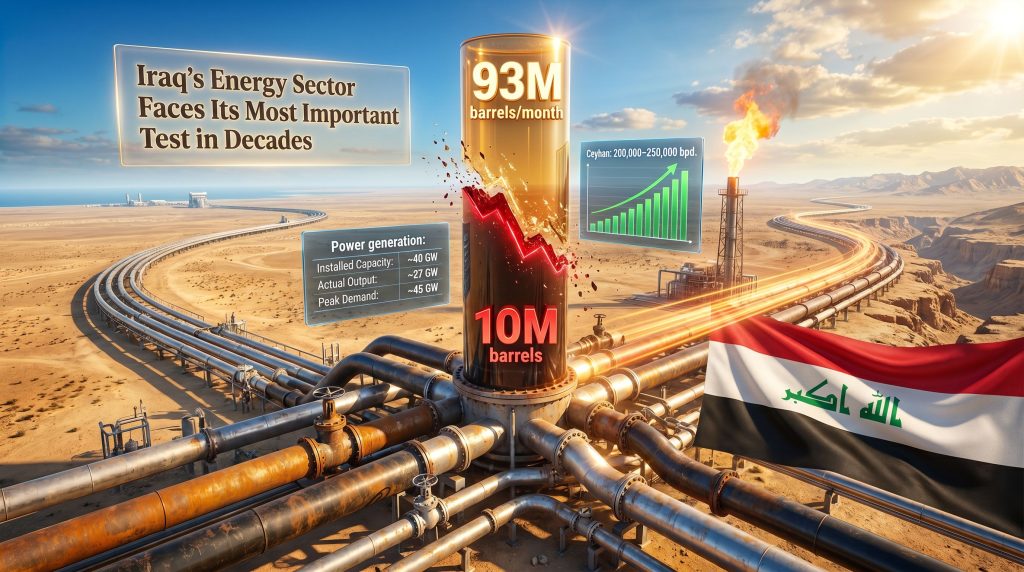
Consider the electricity system. Iraq held an installed generation capacity of approximately 40 GW as of 2023, yet maximum actual generation achieved was around 27 GW against peak demand of 45 GW. Transmission and distribution losses of 30 to 50% meant that even the power successfully generated was partially squandered before reaching consumers. This is not a fuel availability problem in any simple sense. It reflects infrastructure decay, grid architecture misalignment, and governance failures across the entire delivery chain.
| Metric | Figure |
|---|---|
| Installed generation capacity (2023) | ~40 GW |
| Maximum actual generation achieved | ~27 GW |
| Peak electricity demand | ~45 GW |
| Transmission and distribution losses | 30–50% |
Furthermore, what makes this more striking is the fuel mismatch at the heart of the system. Iraq burns crude oil to generate electricity while simultaneously flaring massive volumes of associated natural gas that could serve as a far more efficient and cost-effective generation fuel. This dual inefficiency represents a cascading economic loss: forgone gas revenues on one side, inflated generation costs on the other. Addressing this mismatch is among the most commercially impactful reforms available to Baghdad, yet it has remained unresolved across successive governments.
The IEA's roadmap for Iraq's energy sector has long outlined the structural remedies available, yet institutional barriers have repeatedly prevented their implementation.
The real cost of Iraq's energy dysfunction is not measured in missing megawatts. It is measured in the accumulated economic value of resources destroyed, imported, or left undeveloped across three decades of institutional fragmentation.
The Hormuz Shock: Forced Confrontation With a Known Vulnerability
Energy analysts had flagged Iraq's near-total dependence on southern export terminals connected to the Strait of Hormuz for years before the 2026 regional escalation. The vulnerability was structural and visible. What the crisis accomplished was to transform an acknowledged risk into an undeniable economic emergency.
How Severe Was the Export Collapse?
Before the regional conflict intensified, Iraq was exporting approximately 93 million barrels per month through the Strait of Hormuz, according to Brookings Institution analysis of Gulf export flows. By April 2026, that figure had collapsed to approximately 10 million barrels through the same corridor. The reduction of nearly 89% through that single route represented a fiscal shock of extraordinary magnitude for a government heavily dependent on hydrocarbon revenues. This episode mirrors broader patterns of oil market disruption driven by geopolitical escalation across the wider region.
The compounding factors were instructive:
- Insurance cost escalation made many southern shipments commercially unviable
- Tanker availability contracted sharply as maritime security deteriorated
- The absence of any meaningful alternative export redundancy left Baghdad with no buffer
- Revenue shortfalls immediately threatened Baghdad's ability to meet federal budget commitments, including transfers to the Kurdistan Regional Government
What the Hormuz disruption exposed was not a flaw in Iraqi planning so much as the predictable consequence of deferred infrastructure decisions across multiple political cycles. The strategic recognition now embedded in Baghdad's policymaking — that the southern terminal concentration model carries existential risk — is arguably the most consequential shift in Iraqi energy thinking in at least a generation.
The Kirkuk-Ceyhan Revival: Tactical Alignment or Durable Framework?
The March 2026 agreement between the Iraqi federal government and the Kurdistan Regional Government to resume exports through the Kirkuk-Ceyhan pipeline was the most significant energy infrastructure development to emerge from the Hormuz crisis. The pipeline provides an alternative export corridor running from northern Iraq through Turkey to the Mediterranean port of Ceyhan, entirely bypassing Gulf shipping lanes.
Exports through the Ceyhan terminal resumed at approximately 200,000 to 250,000 barrels per day, with both parties expressing ambitions to increase volumes substantially in subsequent months. Joint oversight committees were established, revenue flows were reconnected to federal structures, and Turkey's interest in restored transit income aligned with both Baghdad's and Erbil's immediate fiscal needs.
However, the underlying tensions that have defined the Baghdad-Erbil relationship for over two decades remain structurally unresolved. These dynamics echo Iraq energy governance parallels seen in other fragmented producer states, where short-term fiscal alignment frequently masks deeper constitutional disputes.
| Disputed Issue | Baghdad's Stance | KRG's Stance |
|---|---|---|
| Hydrocarbon revenue ownership | All revenues vest in the federal state | KRG holds autonomous revenue management rights |
| Budget transfer guarantees | Conditional on federal framework compliance | Unconditional constitutional entitlement |
| Security responsibility near infrastructure | Federal government's domain | Militia removal required before confidence returns |
| Investor protection framework | Governed by federal law | Separate contractual guarantees demanded |
The current cooperation is best understood as a convergence of short-term fiscal necessity rather than a resolution of the constitutional disputes that have persisted since the formation of the modern Iraqi federal structure. Kurdish leaders have consistently argued that security threats from armed factions operating near energy infrastructure represent a precondition for any durable long-term confidence.
Tactical cooperation between Baghdad and Erbil has been achieved before and subsequently collapsed. What distinguishes the current period is the external pressure from the Hormuz disruption forcing both parties to maintain alignment longer than political instinct might otherwise permit.
Iran's Embedded Influence: The Reform Constraint That Cannot Be Legislated Away
Understanding the limits of Iraq's reform capacity requires understanding the depth of Iranian penetration across Iraqi political, economic, and security structures. This is not a diplomatic relationship that can be severed by policy declaration. Iran's reach operates through electricity import dependencies, trade financing, religious institutional networks, political party funding, and the parallel security architecture built by Iran-linked militia groups over two decades.
Iraq currently imports both gas and electricity from Iran to compensate for its domestic generation shortfall. This dependency persists despite Iraq holding substantial undeveloped gas reserves of its own, creating a situation where a resource-rich nation pays a sanctioned neighbour for energy it could theoretically produce domestically. Reducing this dependency is simultaneously an economic priority, a geopolitical objective, and an institutional reform challenge. The broader geopolitical risk landscape increasingly shapes how international investors assess exposure to states caught between Washington and Tehran.
Why Does Militia Influence Persist?
The militia dimension complicates every investment calculation:
- International oil companies can model geological uncertainty and commodity price risk
- Regulatory ambiguity, while costly, can be priced into project economics
- What cannot be adequately quantified is the operational exposure created by missile and drone attacks on infrastructure, militia interference with personnel, political intimidation of local contractors, and the use of infrastructure disruption as factional leverage
Recent sanctions targeting Iraqi officials and entities connected to Iranian-linked oil networks have reinforced the difficulty of cleanly separating domestic energy reform from broader geopolitical positioning. Baghdad faces a genuinely difficult navigation challenge: Washington's pressure to reduce Iranian dependency sits in direct tension with Tehran's embedded influence over the domestic political coalitions that Baghdad's government depends on for its own survival.
The new Iraqi leadership has committed publicly to bringing weapons under state authority and reducing militia economic influence. However, institutional networks constructed across two decades of parallel governance cannot be dismantled through policy announcements, and the pace of change will inevitably be constrained by the political costs of confrontation.
Kurdistan's Gas Opportunity: From Political Liability to Strategic Asset
One of the less examined dimensions of Iraq's energy future is the role the Kurdistan Region's undeveloped gas resources could play in transforming the regional energy architecture. The KRG holds significant untapped gas reserves that carry strategic value well beyond their contribution to Iraq's domestic energy balance.
Developed at scale, Kurdish gas could deliver across multiple dimensions simultaneously:
- Reduce Iraq's Iranian energy dependency by substituting domestic gas supply for imported Iranian electricity and gas
- Support Turkey's transit ambitions by providing additional pipeline volumes through Ceyhan-connected infrastructure
- Contribute to European supply diversification by offering an eastern Mediterranean alternative to Russian pipeline supply
- Underpin KRG industrial development by providing affordable energy inputs for manufacturing and processing sectors
Western policymakers have increasingly identified Kurdish gas development as a geopolitical tool for reducing Iranian influence over Iraqi energy architecture, a framing that elevates the strategic priority of KRG gas investment beyond its standalone commercial merits. This convergence of commercial, geopolitical, and resource geopolitics interests represents an unusual alignment that could, under the right institutional conditions, attract the scale of investment the Kurdish gas sector requires.
The next major ASX story will hit our subscribers first
Iraq's Renewable Energy Ambitions and the Structural Gap Between Target and Reality
Iraq has stated an ambition to source approximately 25% of its electricity from renewable sources by 2030, targeting around 12 GW of renewable generation capacity, primarily through solar. The country's geographic position provides genuine solar resource advantages, with high irradiance levels across most of its territory making utility-scale photovoltaic development technically viable.
| Renewable Energy Metric | Status |
|---|---|
| Renewable share target by 2030 | ~25% |
| Capacity target | ~12 GW |
| Primary technology focus | Solar PV |
| Current renewable contribution | Minimal |
The barriers to achieving this target are almost entirely institutional rather than physical. In addition, energy transition pressures from the global shift toward clean power are adding urgency to Iraq's renewable ambitions, even as domestic structural constraints remain formidable.
- Heavily subsidised electricity tariffs distort investment economics and make cost-recovery models for private renewable developers extremely difficult to structure
- Regulatory frameworks lack the investor protection certainty required to underpin long-term financing
- Grid infrastructure cannot currently absorb variable renewable generation at meaningful scale without significant transmission upgrades
- Budget dependency on hydrocarbon revenues creates structural resistance to the capital allocation needed for long-term infrastructure transformation
IRENA's energy transition assessment for Iraq underscores that without subsidy reform and regulatory strengthening, the 25% by 2030 target will function as an aspiration rather than a pathway.
Three Scenarios for Iraq's Energy Sector Through 2028
Scenario 1: Managed Reform With Incremental Progress
Baghdad successfully consolidates state authority over energy infrastructure, militia influence recedes gradually from economic structures, and the Baghdad-KRG cooperation framework holds under sustained fiscal pressure. Northern export volumes through Ceyhan increase toward 400,000 to 500,000 bpd. International investor confidence improves incrementally. Production capacity advances toward the stated target of 5 million bpd.
Scenario 2: Geopolitical Escalation Reverses Momentum
Renewed Washington-Tehran confrontation transforms Iraq once again into an arena for proxy competition. Pipelines, export terminals, and foreign-operated facilities become targets. International companies reduce operational exposure. The Baghdad-KRG agreement fractures under budget pressures. Reform momentum stalls for another political cycle.
Scenario 3: Structural Breakthrough Through Institutional Alignment
A rare convergence of interests produces a durable institutional framework. Gas capture investment accelerates, flaring declines materially, Kurdish gas development attracts major project financing, and Iraq's electricity deficit begins closing through domestic fuel supply improvements.
The most probable near-term trajectory is a hybrid of Scenarios 1 and 2: reform progress accumulating during periods of reduced regional tension, periodically disrupted when geopolitical pressures from the broader Iran-U.S. dynamic intensify.
The Five Structural Barriers That Must Be Overcome
No analysis of Iraq's energy future is complete without cataloguing the obstacles that have defeated previous reform cycles:
1. The Constitutional Revenue Dispute
The Baghdad-Erbil disagreement over hydrocarbon revenue ownership has no clean legal resolution. It will require sustained political management rather than a definitive constitutional settlement.
2. Militia Economic Entrenchment
Factions with embedded interests in the current fragmented system have both the motivation and demonstrated capability to disrupt reforms that threaten their economic position.
3. Iranian Dependency Across Multiple Vectors
Electricity imports, gas supply, political financing, and security structures create an interdependency web that cannot be rapidly unwound without creating short-term instability that Iraqi governance capacity may be unable to absorb.
4. The Infrastructure Investment Deficit
The Iraq-Turkey pipeline framework faces agreement expiration uncertainty. Total infrastructure investment requirements across generation, transmission, gas capture, and export systems run to several billion dollars.
5. Subsidy and Governance Distortions
Chronically underpriced electricity, weak regulatory institutions, and budget-dependent financing structures have prevented the energy sector from developing the commercial self-sufficiency that would make it resilient to political interference.
The Institutional Question That Will Determine Iraq's Energy Future
Iraq's long-term energy trajectory will ultimately be shaped by neither commodity prices, OPEC decisions, nor the outcome of U.S.-Iran negotiations. The determining variable is whether Iraq's political leadership can construct regulatory, fiscal, and security institutions durable enough to outlast the factional pressures that have historically captured and fragmented them.
The current moment is arguably more consequential than any previous reform window. For perhaps the first time in a decade, all major stakeholders face genuine fiscal pressure to make the system function: Baghdad needs export diversification, the KRG needs revenue, Turkey needs transit income, and international energy companies need production growth opportunities in a supply-constrained global market.
Iraq retains the geological foundation to become one of the world's most consequential energy producers over the coming decade. Its undeveloped gas reserves offer extraordinary value. Its geographic position connecting the Gulf, Turkey, Europe, and the Eastern Mediterranean gives it strategic relevance that few other producers can match.
Whether that geological wealth translates into sustained economic development will be determined by one question: can Iraqi institutions be made stronger than the political forces that have historically divided them? That is the real Iraq's energy sector test in decades, and by any honest assessment, it remains the most important governance challenge the country has confronted in generations.
This article contains forward-looking assessments and scenario analysis based on publicly available information. It does not constitute investment advice. Energy sector forecasts and geopolitical projections involve material uncertainty and should not be relied upon as predictions of future outcomes.
Want To Spot the Next Major Mineral Discovery Before the Market Does?
While Iraq's energy governance challenges illustrate how institutional failures can erode even the world's most resource-rich nations, savvy investors are finding opportunity closer to home — Discovery Alert's proprietary Discovery IQ model delivers real-time alerts on significant ASX mineral discoveries, turning complex geological data into actionable insights the moment they're announced. Explore historic discoveries and their remarkable returns, then begin your 14-day free trial to position yourself ahead of the broader market.