June 12, 2026
The Infrastructure Bet Behind Mining's Biggest Equipment Cycle
Capital equipment manufacturers rarely build for the moment. When an original equipment manufacturer replaces a five-decade-old facility with a purpose-designed headquarters, it is placing a long-horizon wager on where industry demand is heading, not where it currently stands. The decision to construct rather than renovate, to consolidate rather than distribute, and to showcase rather than store reflects a calculated reading of structural forces reshaping the global mining equipment landscape.
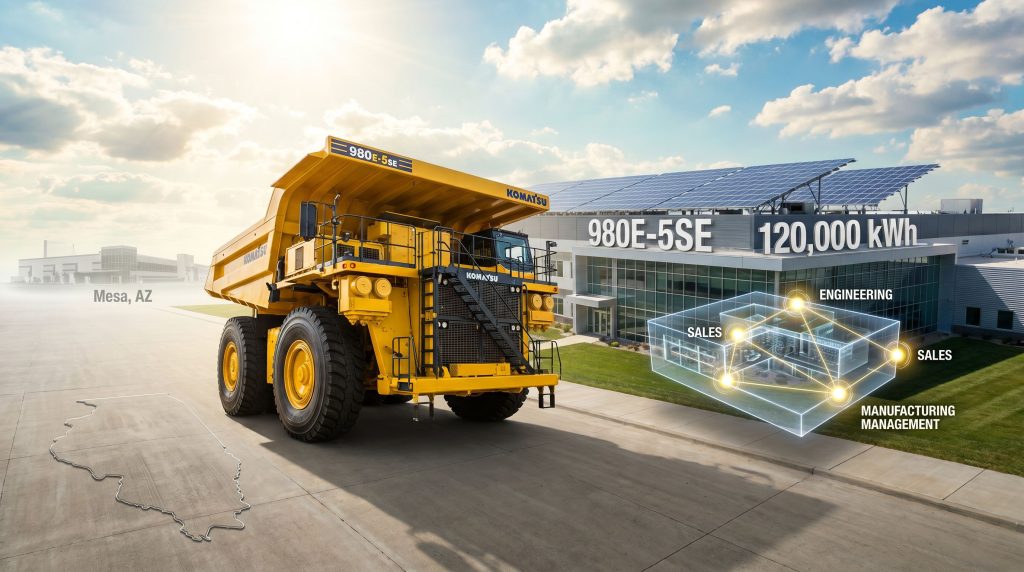
That is precisely the lens through which Komatsu opens new Peoria mining hub deserves examination. The facility, which formally opened in June 2026 following a late-2024 groundbreaking, is not a cosmetic upgrade. It is a generational infrastructure commitment that repositions Peoria as the nerve centre of Komatsu's surface haulage operations across North America, integrating engineering, sales, manufacturing management, and customer engagement functions into a single, purpose-built environment.
Understanding why this matters requires stepping back from the ribbon-cutting and examining the strategic logic embedded in every design decision.
When big ASX news breaks, our subscribers know first
What Komatsu's New Peoria Mining Hub Actually Does
From a 1970s Office Block to a Strategic Operations Centre
The facility that Komatsu's new Peoria campus replaces was constructed in the 1970s, a period when mining equipment design, manufacturing coordination, and customer engagement operated through entirely different technological and organisational paradigms. Engineering teams worked in relative isolation from commercial functions. Customer feedback filtered slowly through layers of sales intermediaries before reaching product developers.
The new facility reverses this architecture. By physically co-locating engineering, sales, manufacturing management, and customer-facing operations, Komatsu has created an environment where product development feedback loops are compressed from months to days. In an industry where equipment lead times routinely extend across multiple years, this acceleration in decision-making velocity represents a genuine competitive differentiator.
Peoria's designation as one of Komatsu's Mother plants further underscores the facility's strategic weight. This classification, reserved for manufacturing sites of critical importance within Komatsu's global network, is not assigned to facilities based on size alone. It reflects a site's role as a centre of technical excellence and operational authority within the broader manufacturing ecosystem, meaning decisions made at Peoria carry weight that cascades through Komatsu's international supply chain and product development programmes.
Consolidating Surface Haulage Leadership Under One Roof
The operational functions now housed at the Peoria facility span the full value chain of Komatsu's surface haulage business. Furthermore, data-driven mining operations are increasingly shaping how these functions interrelate:
- Engineering and product development teams responsible for advancing haul truck technology, including electric-drive systems and low-emission solutions
- Sales and commercial functions that interface directly with mine operators across North America, translating operational requirements into equipment specifications
- Manufacturing management coordinating production schedules, quality standards, and supply chain integration across Komatsu's broader facility network
- Customer experience operations providing immersive technology engagement through the facility's dedicated customer experience centre
This consolidation eliminates the internal friction that traditionally slows product development and customer responsiveness in large industrial organisations. When engineers developing next-generation haul truck powertrains sit within walking distance of sales personnel who have just returned from site visits at copper operations in Arizona or gold mines in Nevada, the knowledge transfer that would previously have required formal reporting structures happens organically and continuously.
The co-location of technical development and customer-facing functions is not merely a real estate decision. It is an organisational philosophy embedded in physical form, reflecting Komatsu's understanding that in today's mining equipment market, responsiveness is as valuable as specification performance.
How the Facility Reflects Komatsu's Surface Haulage Direction
Electric-Drive Technology as the Strategic Centrepiece
The decision to permanently install a 980E-5SE electric-drive ultra-class haul truck at the entrance of the Peoria facility is a statement of technological intent that goes well beyond marketing aesthetics. In the surface haulage segment, the choice of showcase equipment communicates product priorities to every procurement team, mine planner, and technical director who walks through the door.
The 980E-5SE sits at the apex of Komatsu's haul truck portfolio. Its electric-drive configuration represents the dominant technology direction for large-scale surface mining operations, where the combination of improved energy efficiency, lower maintenance requirements on drivetrain components, and increasingly favourable emissions profiles makes electric-drive systems the default choice for operators planning long-duration fleet deployments.
| Feature | Detail |
|---|---|
| Showcase Unit | 980E-5SE Mining Truck |
| Drive Technology | Electric-drive configuration |
| Facility Placement | Permanent installation at facility entrance |
| Strategic Purpose | Customer experience and technology demonstration |
| Market Segment | Ultra-class surface haulage |
The prominence given to this model at the Peoria hub signals that Komatsu's product development investment and commercial focus within surface haulage is firmly oriented toward electric-drive technology. Consequently, this positions the company ahead of an industry transition that is accelerating as mine operators factor scope 1 emissions reduction into fleet procurement decisions. This also connects closely to broader mining electrification trends reshaping the sector globally.
Surface Haulage Within Komatsu's Global Mining Portfolio
Surface haulage represents one of the highest-revenue segments within large-scale mining equipment supply globally. The economics are straightforward: a single ultra-class haul truck represents a multi-million dollar capital investment, and major mining operations run fleets numbering in the dozens. Fleet replacement cycles, component overhauls, and technology upgrades generate sustained revenue streams over decades.
For Komatsu, maintaining competitive positioning in this segment requires not just technically superior products but also the operational infrastructure to deliver faster customer responsiveness, more integrated technical support, and greater proximity between product development teams and the operational realities of modern mining. The Peoria hub addresses all three requirements simultaneously.
Sustainability Infrastructure Built Into the Campus
Breaking Down the Green Building Features
The sustainability specifications embedded in the new Peoria facility reflect a deliberate effort to align Komatsu's own operational footprint with the environmental standards it increasingly advocates through its mining equipment technology. In addition, the emphasis on renewable energy in mining is becoming a baseline expectation rather than a differentiator. The key features include:
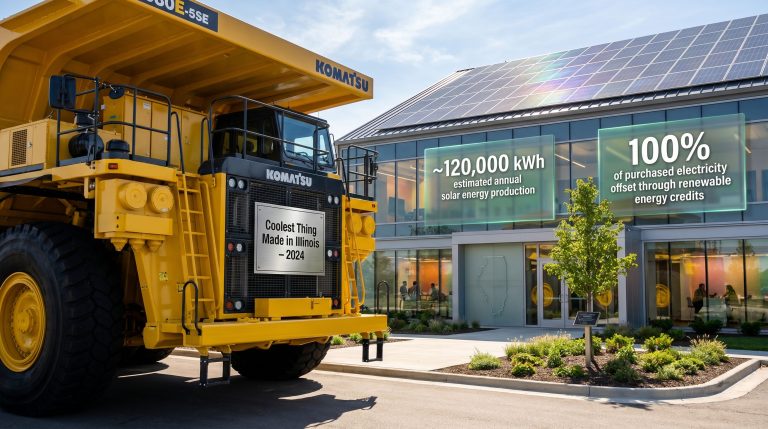
- 100-kilowatt solar array projected to generate approximately 120,000 kilowatt-hours annually, offsetting a meaningful portion of the facility's electricity consumption through on-site renewable generation
- Rainwater collection system designed to reclaim stormwater for facility use, reducing municipal water consumption and supporting environmental compliance requirements
- LED lighting throughout the facility, delivering significant energy efficiency improvements over the legacy fluorescent and halogen systems that characterised the 1970s-era building it replaces
- Renewable energy credits covering the entirety of the facility's purchased electricity, achieving a net-zero electricity procurement profile from day one of operations
To contextualise the solar output: a commercial facility of this scale typically consumes between 500,000 and 1,500,000 kilowatt-hours annually depending on operational intensity. The 120,000 kilowatt-hour solar contribution represents meaningful on-site generation while the renewable energy credits address the balance, creating a fully renewable electricity profile without dependence on grid decarbonisation timelines.
Why OEM Facility Sustainability Matters to Mining Customers
Mining equipment manufacturers are under increasing pressure from Tier 1 mining customers to demonstrate ESG alignment not just in their product specifications but in their own operational footprint. A sustainability-certified headquarters sends a direct signal to procurement teams conducting supplier sustainability assessments.
This dynamic has become materially significant in large mining equipment procurement. Major diversified miners operating under net-zero commitments increasingly require suppliers to document scope 3 emissions, which includes the manufacturing and delivery of capital equipment. When an OEM's own facilities operate on renewable electricity, it directly supports the accuracy and credibility of the scope 3 emissions data that mining operators report to investors and regulators.
The rainwater collection system addresses a separate but equally important dimension of operational sustainability. Water management has become one of the most scrutinised aspects of industrial facility operations across the United States, particularly in regions where municipal supply is under increasing pressure from population growth and climate variability. Stormwater reclamation demonstrates proactive resource stewardship that goes beyond minimum compliance requirements.
What the Investment Signals About North American Strategy
Reading the Capital Allocation Decision
Replacing a functioning 50-year-old facility is categorically different from maintaining it. The decision to invest in purpose-built infrastructure signals internal confidence in long-duration demand that cannot be justified by short-term market conditions alone. Construction groundbreaking in late 2024, completion by end of 2025, and formal opening in mid-2026 reflects an accelerated timeline that indicates strong internal prioritisation rather than a cautious infrastructure refresh.
This timeline is worth scrutinising. A project of this scale, from design finalisation through construction completion, typically requires 24-36 months for complex commercial and industrial facilities. The compressed schedule suggests Komatsu committed substantial resources to accelerate delivery, reflecting the urgency with which leadership views the strategic importance of operational consolidation in the surface haulage segment. Komatsu's new $28 million facility has drawn significant attention as a marker of long-term regional commitment.
The Dual North American Hub Strategy
The Peoria opening does not stand alone as a strategic data point. It coincides with Komatsu's separately announced development of a new facility in Mesa, Arizona, focused specifically on parts distribution and delivery time reduction for customers across western North America. Taken together, these two investments reveal a coordinated regional infrastructure build-out:
| Facility | Location | Primary Function | Status |
|---|---|---|---|
| Peoria Hub | Illinois, USA | Surface haulage HQ, engineering, sales, customer experience | Opened 2025/2026 |
| Arizona Hub | Mesa, AZ, USA | Parts distribution, delivery time reduction | Under development (2026) |
The geographic logic is deliberate. Illinois provides centralised access to eastern and midwestern mining and industrial markets, while Arizona positions Komatsu closer to the high-growth copper and critical minerals mining activity concentrated across the southwestern United States and northern Mexico. A parts distribution hub in Arizona directly addresses one of the most persistent pain points in mining equipment operations: the cost and productivity impact of extended component wait times when critical equipment is out of service.
In surface mining, an idle ultra-class haul truck can represent lost production value exceeding $10,000 per hour depending on commodity prices and operational throughput rates. Reducing parts delivery times from days to hours for high-wear components transforms the value proposition of Komatsu's after-sales support network and strengthens customer retention in a segment where long-term service relationships are as commercially significant as initial equipment sales.
How This Expansion Connects to Broader Mining Equipment Market Dynamics
Capital Equipment Cycles and OEM Infrastructure Timing
OEM facility investments of this magnitude do not occur in isolation from commodity market signals. The mining equipment sector operates on capital expenditure cycles closely tied to commodity price trajectories and mine expansion activity. When copper market trends sustain elevated levels driven by energy transition demand, and when critical mineral projects accelerate to meet battery supply chain requirements, mining operators commit to fleet expansion and replacement programmes that generate multi-year demand visibility for equipment manufacturers.
Komatsu's decision to invest in permanent North American infrastructure now reflects a reading of these signals. The critical minerals energy transition structurally drives demand for copper, lithium, cobalt, and rare earth elements, requiring large-scale open pit mining operations that depend fundamentally on high-capacity surface haulage fleets. This is not a cyclical demand spike but a structural shift in the composition of mining activity, with implications for equipment demand that extend well beyond a single commodity cycle.
The Evolution of Capital Equipment Sales Toward Experience-Led Models
The integration of a dedicated customer experience centre into the Peoria hub reflects a broader transformation in how capital equipment is sold at the OEM level. Traditional mining equipment sales operated primarily through technical specification comparison, with procurement decisions driven by performance data sheets, reference site visits, and price negotiation.
Modern large-scale equipment procurement increasingly involves:
- Immersive technology engagement where operators and engineers evaluate equipment in controlled demonstration environments before field deployment
- Co-development workshops where mine planners work directly with OEM engineering teams to optimise equipment configuration for specific geological and operational conditions
- Digital integration assessments examining how new equipment connects with existing fleet management, autonomous operation, and predictive maintenance platforms
- Total cost of ownership modelling replacing simple purchase price comparison with comprehensive lifecycle cost analysis spanning fuel consumption, maintenance intervals, component longevity, and resale value
The Peoria customer experience centre is designed to support all four of these engagement modes, transforming Komatsu's headquarters from a back-office operational facility into an active commercial asset.
Low-Emission Haulage as a Competitive Differentiator
The emphasis on electric-drive technology visible throughout the Peoria facility's design and showcase choices reflects genuine competitive urgency. Mining operators are facing mounting pressure from investors, regulators, and host communities to reduce the emissions intensity of their operations. Diesel-powered ultra-class haul trucks represent one of the largest single sources of direct emissions at open pit mining operations, making fleet electrification or hybridisation a priority target in mine decarbonisation strategies.
OEMs that can credibly demonstrate leadership in low-emission haulage technology gain procurement advantages that extend beyond individual equipment sales. They position themselves as long-term technology partners in mine operators' decarbonisation journeys, creating relationships with strategic depth that pure price competition cannot easily displace.
The global mining equipment market has been valued at over USD $100 billion in recent years, with surface haulage representing one of the single largest equipment categories by capital value. Facility investments that consolidate surface haulage leadership send a clear signal about where OEMs expect the most consequential growth and competitive battles to occur.
The next major ASX story will hit our subscribers first
Frequently Asked Questions About Komatsu's Peoria Mining Hub
What is the primary purpose of Komatsu's new Peoria facility?
The new Peoria building functions as Komatsu's surface haulage headquarters for North America, consolidating engineering, sales, manufacturing management, and customer experience functions under a single modernised campus. It replaces a 1970s-era office structure and represents a long-duration operational commitment to Peoria as a strategically critical hub within Komatsu's global mining operations network.
What sustainability features are incorporated into the Peoria hub?
The facility includes a 100-kilowatt solar array projected to generate approximately 120,000 kilowatt-hours annually, a rainwater reclamation system for stormwater management, energy-efficient LED lighting throughout the building, and renewable energy credits covering the full volume of purchased electricity, resulting in a net-zero electricity procurement profile.
What is the 980E-5SE truck on display at the Peoria facility?
The 980E-5SE is one of Komatsu's flagship electric-drive ultra-class haul trucks, permanently installed at the facility entrance as the centrepiece of the customer experience centre. Its placement communicates Komatsu's technological direction in surface haulage and provides visiting mining engineers and procurement teams with direct physical engagement with the company's leading haulage technology.
When did the new Peoria facility open?
Construction began with a groundbreaking in late 2024, with the facility completed by the end of 2025 and formally marked with an opening event in mid-2026, as reported by the Canadian Mining Journal on June 11, 2026.
Is Komatsu expanding beyond Peoria in North America?
Yes. Komatsu has announced a separate facility in Mesa, Arizona, focused on parts distribution with the specific objective of reducing component delivery times to customers across western North America, representing a coordinated dual-hub infrastructure strategy across the continent.
Key Takeaways for the Mining Equipment Sector
- Generational commitment, not incremental maintenance: Replacing a 50-year-old facility with purpose-built infrastructure signals long-horizon confidence in North American mining equipment demand
- Operational integration as competitive strategy: Co-locating engineering, sales, and customer experience functions compresses decision-making cycles in an industry where speed of response increasingly differentiates suppliers
- Sustainability at the facility level: Green building features demonstrate that Komatsu's ESG alignment extends to its own operational footprint, not just its product development targets
- Electric-drive technology as the headline narrative: The prominence of the 980E-5SE at the facility entrance reflects the strategic centrality of low-emission haulage to Komatsu's future product and commercial positioning
- Dual-hub North American strategy: Simultaneous investments in Illinois and Arizona indicate a deliberate regional infrastructure build designed to match the geographic distribution of growing mining demand across North America
Disclaimer: This article contains forward-looking observations and market analysis based on publicly available information. It does not constitute financial or investment advice. Readers should conduct independent research before making any investment or procurement decisions related to companies or equipment discussed herein.
Want to Track the Mining Discoveries Driving Demand for Equipment Like This?
Komatsu's generational infrastructure bet on North American surface haulage reflects the scale of mining activity now being planned around copper, lithium, and critical minerals — and the ASX-listed explorers and developers feeding that pipeline represent some of the most compelling opportunities in the sector. Discovery Alert's proprietary Discovery IQ model delivers real-time alerts the moment significant mineral discoveries are announced on the ASX, turning complex geological data into actionable insights — explore historic discoveries and their returns to understand the scale of opportunity, then begin a 14-day free trial to stay ahead of the market.