June 12, 2026
When Machines Replace Drivers in the World's Harshest Environments
The history of industrial automation follows a familiar arc: technologies that once seemed experimental gradually become the operational standard, reshaping entire sectors along the way. In mining, that transition has historically moved slowly, constrained by the sheer physical demands placed on equipment, the remoteness of operations, and the complexity of coordinating heavy machinery across unpredictable terrain. Yet a convergence of artificial intelligence, cloud computing, and next-generation wireless connectivity is compressing what might have taken decades into a matter of years. Nowhere is this more visible than in the coal-rich landscapes of Inner Mongolia, where Huawei autonomous electric mining trucks in China are now redefining what large-scale open-pit operations can look like.
What makes this moment particularly significant is not simply that automation has arrived in mining. It is that electrification and autonomy have arrived together, at scale, in one of the most environmentally sensitive and operationally demanding regions on the planet.
When big ASX news breaks, our subscribers know first
The Structural Problem Autonomous Electrification Is Solving
Mining's environmental footprint has long been a subject of uncomfortable scrutiny. According to McKinsey analysis, the global mining industry accounts for as much as 7% of total greenhouse gas emissions, a figure that reflects both direct operational emissions and the energy-intensive processes that underpin extraction at scale. For coal-dependent economies, this creates a compounding tension: the very resource being extracted is also powering the equipment used to extract it, locking operations into a carbon-intensive feedback loop.
Diesel-powered haulage trucks represent one of the most significant single sources of site-level emissions within open-pit mining operations. These vehicles run continuously across expansive pit floors, burning fuel at rates that compound across fleets of dozens or hundreds of units. Replacing this diesel fleet with electric alternatives fundamentally changes the economic structure of operations by shifting away from volatile fuel costs, reducing powertrain maintenance complexity, and enabling tighter integration with digital management systems. Furthermore, mining automation trends suggest this transition is accelerating across multiple regions simultaneously.
Beyond emissions, the human cost of traditional mining haulage is considerable. Drivers operating in extreme cold, dense dust, and close proximity to heavy equipment face sustained occupational health risks that accumulate over careers. Any operational model that removes personnel from those environments without reducing productivity represents a meaningful safety advance, not just an efficiency gain.
Inside the Yimin Open-Pit Mine: Why This Site Matters
Geographic and Ecological Context
The Yimin open-pit mine, situated in Inner Mongolia, China, occupies a landscape that presents challenges on multiple fronts simultaneously. The surrounding environment, characterised by wetland, grassland, and shrubland ecosystems according to research from the China University of Mining and Technology, is ecologically sensitive in ways that make conventional diesel haulage particularly problematic.
Climatically, Inner Mongolia subjects equipment to conditions that would defeat most conventional autonomous systems. Winter temperatures regularly plunge to extremes that compromise battery performance, sensor reliability, and mechanical integrity. Any vehicle platform deployed here must function not merely adequately but continuously and precisely under conditions that stress every component in the system.
A Deployment That Has No Comparable Precedent
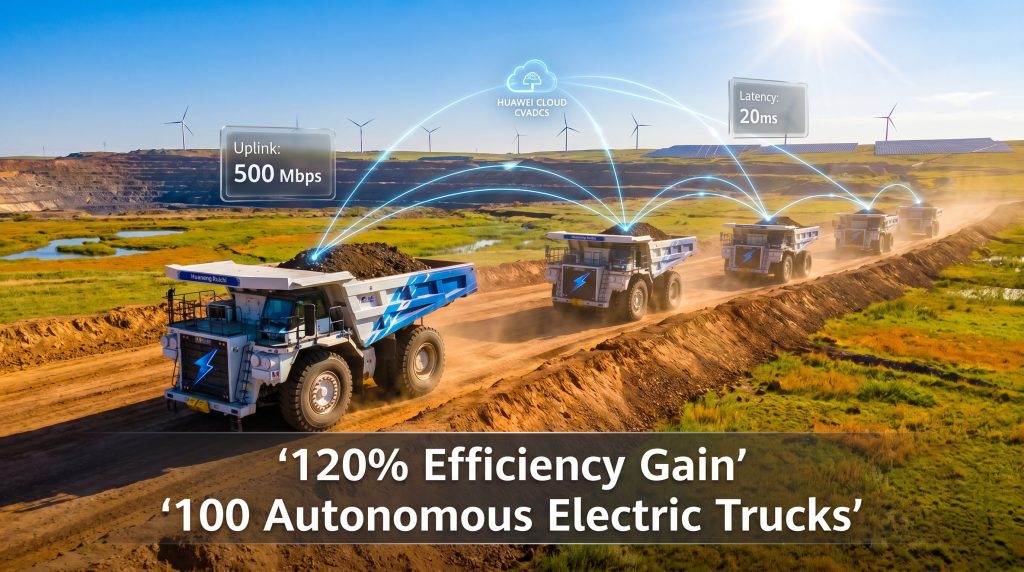
What has been established at Yimin is not a controlled pilot programme with a handful of prototype vehicles. A fully operational fleet of 100 autonomous electric trucks is conducting large-scale haulage at the site, making Yimin the first open-pit mine globally to achieve large-scale vehicle-cloud-network synergy at this magnitude. This distinction matters because it moves the conversation from theoretical capability to demonstrated operational reality — a threshold that carries enormous weight for an industry accustomed to scepticism about transformative technology claims.
The Huaneng Ruichi Trucks: Technical Architecture and World Records
Specifications That Redefine the Category
The Huaneng Ruichi autonomous electric trucks at the centre of this deployment are not adapted versions of existing manned platforms. They are purpose-engineered driverless vehicles — a distinction that carries significant implications for both structural design and operational logic. Removing the driver's cabin eliminates a major constraint on weight distribution, frees structural volume for battery and payload optimisation, and removes the single point of greatest human vulnerability in the system.
The core specifications of the fleet are summarised below:
| Specification | Performance Metric |
|---|---|
| Fleet Size | 100 autonomous electric trucks |
| Maximum Payload Capacity | 90 tonnes per vehicle |
| Operating Temperature Range | Down to -40°C |
| Efficiency Gain vs. Manual Diesel | Up to 120% improvement |
| Battery Swap Duration | Approximately 6 minutes |
| Driver Cabin | None — fully driverless design |
Three World Records in a Single Platform
The Huaneng Ruichi trucks have set three independently recognised records within the autonomous electric mining vehicle category:
- Largest payload capacity among autonomous electric mining trucks globally
- Highest operational speed classification for this vehicle category
- Lowest temperature operation threshold for autonomous electric mining equipment, certified at -40°C
The -40°C operational threshold deserves particular attention. Most battery-electric platforms, including those designed for industrial applications, experience significant capacity degradation below -20°C. Engineering a full-sized autonomous mining truck capable of sustained operation at -40°C requires advances in battery thermal management, sensor de-icing, and hydraulic system cold-weather performance that go well beyond standard commercial EV platforms. The fact that this has been achieved in a production fleet, not a laboratory prototype, signals a meaningful maturation of cold-climate EV engineering for heavy industry.
The Driverless Cabin Decision: More Than Safety
The structural choice to eliminate driver cabins from the outset carries implications beyond personnel safety, though that benefit is substantial. In a conventionally designed mining truck, the cab occupies a significant proportion of the forward mass and imposes constraints on how weight is distributed across the axle configuration. Removing it allows engineers to redistribute structural mass more efficiently, directly supporting payload optimisation.
The workforce transformation enabled by this design is equally significant. Human roles at Yimin shift away from in-cab operation toward remote monitoring, system oversight, and data management. This is not simply a reduction in headcount; it is a fundamental restructuring of what mining labour looks like in an autonomous environment, with consequences for training requirements, occupational health outcomes, and long-term labour cost trajectories as the fleet scales toward its anticipated 300-vehicle capacity. Consequently, autonomous mining trucks of this generation are setting new benchmarks for what purpose-built driverless platforms can achieve.
How Huawei's Technology Stack Operates the Fleet
Layer 1: AI Perception and Autonomous Driving Algorithms
Huawei developed proprietary AI algorithms specifically for the operational conditions of open-pit mining — a domain that presents autonomous driving challenges that differ materially from road or urban environments. Open-pit mines feature continuously changing terrain profiles as extraction progresses, unusually high concentrations of dust that degrade optical sensor performance, and the simultaneous operation of multiple categories of heavy equipment in close proximity.
Zhang Ping'an, Executive Director of Huawei and CEO of Huawei's Cloud Computing Business Unit, has described the company's AI development for this application as being uniquely designed to accelerate the coal mining industry's transition from manual to intelligent operations. Indeed, AI in mining is increasingly recognised as the foundational layer upon which all other autonomous capabilities depend. The algorithms enable precise real-time sensing for autonomous vehicles while simultaneously supporting efficient cloud-based fleet coordination.
Layer 2: Huawei Cloud CVADCS
Huawei Cloud's Commercial Vehicle Autonomous Driving Cloud Service (CVADCS) functions as the operational nervous system connecting the fleet to centralised management infrastructure. Its core functions include:
- Crowdsourced mapping that delivers real-time operational updates as site conditions change
- Dynamic route planning that optimises haulage paths continuously rather than relying on static pre-programmed routes
- Dispatch coordination that minimises vehicle idle time and eliminates scheduling bottlenecks inherent in human-managed fleet operations
- Scalable architecture designed to support more than 300 vehicles operating continuously in future expansion phases
The reduction in idle time that CVADCS delivers represents a compounding efficiency advantage. In large fleet operations, the cumulative time lost to poorly coordinated dispatch, queuing at loading and dump points, and route conflicts can erode a substantial fraction of theoretical productivity. AI-driven dispatch eliminates these inefficiencies at a granular level, contributing directly to the 120% operational efficiency improvement reported over manually operated diesel counterparts. In addition, data-driven mining operations of this sophistication are increasingly viewed as a prerequisite for competitive large-scale extraction.
Layer 3: 5G-Advanced Network Infrastructure
Yimin holds the distinction of being the first open-pit mine in China to deploy a 5G-Advanced (5G-A) network, a connectivity standard that moves beyond conventional 5G in ways directly relevant to autonomous vehicle coordination. The network delivers:
| Network Parameter | Performance Value |
|---|---|
| Uplink Speed | 500 Mbps |
| Latency | 20 milliseconds |
The significance of 20-millisecond latency in this context requires some technical unpacking. Autonomous vehicles operating in high-density environments rely on real-time data exchange between individual units and the central management system to avoid collisions, synchronise movements, and respond to unexpected events. The 20ms latency achieved by the 5G-A network at Yimin places vehicle-to-cloud communication well within the parameters required for safe, responsive autonomous coordination.
5G-A also differs from standard 5G in its capacity for precision coverage mapping along specific operational corridors. Rather than providing generalised area coverage, 5G-A infrastructure can be configured to deliver consistent, high-performance connectivity along the exact routes autonomous vehicles follow, ensuring that connectivity quality does not degrade in the sections of the pit floor where it is most critically needed.
How Yimin Compares to Global Autonomous Mining Deployments
The autonomous mining truck sector has seen significant investment across multiple continents over the past decade, but the Yimin deployment distinguishes itself from existing benchmarks in several important dimensions.
| Project | Location | Technology Provider | Fleet Type | Scale |
|---|---|---|---|---|
| Yimin Open-Pit Mine | Inner Mongolia, China | Huawei / XCMG / Huaneng | Autonomous Electric | 100 trucks (operational) |
| Caterpillar Command for Hauling | Pilbara, Australia | Caterpillar | Autonomous Diesel | Large-scale (BHP/Rio operations) |
| Komatsu FrontRunner AHS | Australia, Chile | Komatsu | Autonomous Diesel | Multi-site deployments |
| Rio Tinto AutoHaul | Pilbara, Australia | Rio Tinto / Hitachi | Autonomous Diesel (Rail) | First autonomous heavy-haul rail |
The most consequential differentiators between Yimin and existing large-scale deployments are not merely technical; they represent a different philosophy of what autonomous mining infrastructure should look like. Caterpillar's and Komatsu's systems both rely on autonomous adaptations of diesel-powered platforms originally designed for manned operation. This retrofit approach inherits structural constraints, including driver cabins and powertrain layouts designed around human operational requirements.
The Yimin fleet, by contrast, was engineered from inception for electric autonomous operation. Furthermore, the 5G-A native architecture at Yimin represents a generational leap in connectivity infrastructure compared to the Wi-Fi, LTE, and proprietary radio networks that underpin existing autonomous mining deployments globally.
The next major ASX story will hit our subscribers first
Operational and Environmental Outcomes
Productivity at Scale
The 120% operational efficiency improvement over manually operated diesel counterparts reflects the aggregate effect of multiple compounding advantages: elimination of shift rotations, removal of fatigue management constraints, AI-optimised routing that reduces empty travel distance, faster battery swap cycles, and continuous 24-hour operational capability without the welfare infrastructure that human workforces require.
"In autonomous fleet operations of this scale, the compounding nature of efficiency gains across hundreds of vehicles operating continuously represents a fundamentally different productivity paradigm than incremental improvements to manned diesel operations."
When these advantages compound across a 100-vehicle fleet operating around the clock, the productivity differential against a comparable manned fleet becomes transformative at the operational level, not merely marginal.
Environmental Consequences for a Sensitive Ecosystem
The full elimination of diesel combustion emissions from 100 heavy haulage vehicles represents a tangible environmental benefit for the biodiversity-rich wetland and grassland zones surrounding the Yimin basin. Research from the China University of Mining and Technology has documented the ecological sensitivity of this landscape, making the transition to zero-emission electric haulage directly relevant to ecosystem preservation outcomes beyond simple carbon accounting.
However, the mining electrification shift also raises important questions about grid energy sources. Site-level solar power supports the charging and battery-swap infrastructure, further reducing the carbon intensity of the operational energy supply, though the broader grid mix feeding the site will ultimately determine the full lifecycle emissions picture.
What This Signals for the Future of Smart Mining
A Replicable Technical Blueprint
The four-party consortium structure that enabled Yimin's deployment — bringing together China Huaneng as mine operator, XCMG as truck manufacturer, Huawei as technology platform provider, and State Grid Smart Internet of Vehicles as connectivity infrastructure partner — creates a replicable collaboration model for other large-scale open-pit operations. Each partner contributes a distinct layer of the technology stack without overlapping, creating a modular architecture that can theoretically be adapted to different site configurations without rebuilding the entire system.
5G-A as an Industrial Platform, Not Just a Consumer Technology
Mining has emerged as a proving ground for 5G-Advanced applications that extend well beyond the consumer telecommunications context in which 5G is most commonly discussed. The performance data accumulating from Yimin's operational fleet will inform future deployments across construction, logistics, and heavy industry sectors where the same combination of real-time coordination, high-bandwidth data transfer, and ultra-low latency is becoming a baseline operational requirement rather than a premium capability.
Global Industry Pressure Points
The demonstrated commercial viability of a fully electric autonomous mining fleet at this scale creates a new reference point against which international mining operators will increasingly be measured. As Chinese deployments like Yimin establish that large-format electric mining trucks can deliver superior productivity under extreme conditions, the operational and reputational costs of maintaining diesel-dependent fleet models will rise for operators in other regions.
The supply chain implications are equally significant. Demand signals emerging from large-scale deployments like Yimin will accelerate the development and cost reduction of large-format mining EV batteries, battery-swap infrastructure designed for industrial-scale throughput, and AI-enabled fleet management platforms capable of coordinating hundreds of autonomous vehicles simultaneously.
Disclaimer: This article contains forward-looking statements and projections regarding operational scalability, environmental outcomes, and industry adoption trends. These projections are based on currently available information and involve inherent uncertainty. Readers should not interpret any statements about future fleet expansion, efficiency improvements, or technology adoption as guaranteed outcomes.
Frequently Asked Questions: Huawei Autonomous Electric Mining Trucks
What is the Huaneng Ruichi autonomous electric mining truck?
The Huaneng Ruichi is a purpose-built, fully electric and driverless heavy haulage truck designed specifically for open-pit mining. Carrying up to 90 tonnes per load and capable of operating in temperatures as low as -40°C, it holds three world records for autonomous electric mining vehicles across payload capacity, operational speed, and cold-temperature performance.
Where are Huawei's autonomous mining trucks currently operating?
The fleet of 100 trucks is fully operational at the Yimin open-pit mine in Inner Mongolia, China — a site characterised by both high extraction volume and significant ecological sensitivity in its surrounding landscape. Huawei autonomous electric mining trucks in China represent the most advanced commercial deployment of this technology anywhere in the world.
How does Huawei's 5G-A network support the autonomous fleet?
The 5G-Advanced network deployed at Yimin delivers uplink speeds of 500 Mbps with a latency of 20 milliseconds, enabling real-time vehicle-to-cloud communication, HD video monitoring, and cloud-based dispatch coordination essential for safe and efficient high-density autonomous fleet operations.
How long does a battery swap take on these electric mining trucks?
Battery swapping takes approximately six minutes per vehicle, minimising downtime and enabling near-continuous haulage cycles across the fleet.
How much more efficient are these trucks compared to diesel-powered alternatives?
The autonomous electric trucks deliver up to 120% greater operational efficiency compared to manually operated diesel counterparts, driven by AI-optimised routing, 24-hour continuous operation, and the elimination of shift rotation constraints.
Which companies are involved in the Yimin autonomous mining project?
The project involves four partners: China Huaneng as the mine operator, XCMG as the truck manufacturer, Huawei as the AI, cloud, and 5G-A technology provider, and State Grid Smart Internet of Vehicles as the connectivity infrastructure partner.
Want to Stay Ahead of the Next Major Mining Innovation Driving ASX Discoveries?
Discovery Alert's proprietary Discovery IQ model delivers real-time alerts on significant ASX mineral discoveries the moment they are announced, turning complex data across more than 30 commodities into clear, actionable insights for traders and investors at every level — start your 14-day free trial today or explore historic discovery returns to understand the scale of opportunity that major mineral finds can generate.