July 23, 2026
The Dual Mandate Reshaping Africa's Gold Sector
Across the global commodities landscape, few dynamics are as structurally complex as the challenge facing Africa's gold-producing nations right now. The continent sits on some of the world's most significant geological endowments, yet consistently exports raw value rather than capturing the full economic benefit of its resources. At the same time, a price environment that has sustained above US$4,000 per ounce through 2026 is creating a window of opportunity that African governments and mining operators have rarely encountered at this scale. The question is no longer whether Africa can produce more gold. The real debate is whether the continent can produce it smarter.
This is precisely the strategic terrain the AMW panel on Africa's gold output is set to navigate when Africa Mining Week convenes in Cape Town from October 14 to 16, 2026.
When big ASX news breaks, our subscribers know first
Africa's Gold Sector by the Numbers: Scale, Structure, and Asymmetry
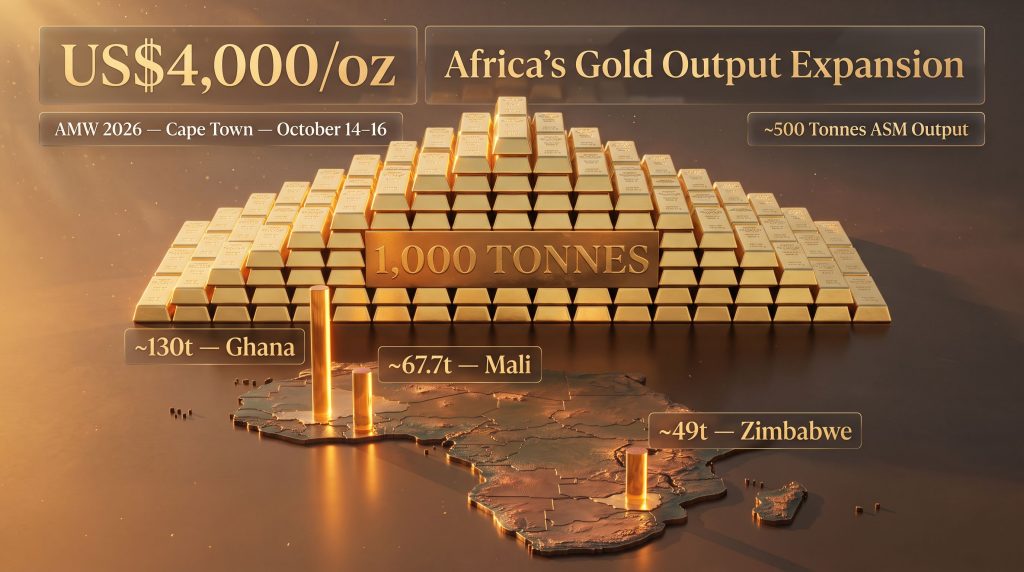
Africa produces approximately 1,000 tonnes of gold annually, a figure that positions the continent as one of the world's most important sources of new supply. What makes this number analytically interesting is its internal composition: large-scale industrial mining and artisanal and small-scale mining (ASM) each contribute roughly 500 tonnes to that total.
This near-perfect split conceals a profound asymmetry. Industrial operations attract the overwhelming majority of exploration capital, environmental compliance investment, and institutional attention. The ASM sector, which employs millions of people across the continent, operates largely outside formal regulatory frameworks, generating equivalent output volumes with a fraction of the governance infrastructure.
The ASM sector's contribution to African gold output is roughly equivalent to that of large-scale industrial mining, yet the two operate in entirely different regulatory and economic universes. Bridging that gap represents one of the most consequential optimisation opportunities in global gold supply.
Continental Production Rankings: Africa's Gold Hierarchy
Understanding where production is concentrated matters for anyone tracking African gold investment flows:
| Country | Estimated 2024 Output | Continental Rank | Notable Characteristic |
|---|---|---|---|
| Ghana | ~130 tonnes | 1st | World's 6th largest producer |
| Mali | ~67.7 tonnes | 2nd | Rapid regulatory modernisation |
| Zimbabwe | ~49 tonnes | 8th | Accelerating output trajectory |
| South Africa | Declining | Legacy leader | Deep-level, mature operations |
Ghana's position as Africa's largest producer and the world's sixth-largest gold-producing nation reflects decades of investment in geological exploration and mining infrastructure. Mali's emergence as the continent's second-largest producer is a more recent and arguably more instructive story, driven by a combination of foreign operator partnerships and active government reform rather than purely geological advantage.
What the AMW Panel on Africa's Gold Output Will Actually Examine
The AMW panel on Africa's gold output brings together a moderator and two panelists whose perspectives span the financial advisory, national policy, and major corporate operational dimensions of the sector.
Matt Banton, Head of Mining at Moore Global, will moderate the session titled Expanding Africa's Gold Output. His financial advisory background means the discussion is unlikely to remain purely technical, with investment frameworks and risk-adjusted capital allocation expected to feature prominently.
The two panelists represent distinctly different vantage points on the same challenge:
- Fousseni Togola, President of Mali's Chamber of Mines, brings the perspective of national policy design and the practical challenge of governing a gold sector where nearly 2 million people work across approximately 400 artisanal mining sites
- Benford Mokoatle, Executive Vice-President for South Africa at Gold Fields, represents the operational realities facing a major international producer navigating the complexities of deep-level mining sustainability in a mature jurisdiction
Together, these perspectives set up a panel that can move between macro policy reform and ground-level operational strategy.
Three Themes Likely to Define the Discussion
1. Regulatory Modernisation as a Capital Attractor
African governments are increasingly aware that the design of their mining codes directly influences their ability to attract long-cycle capital. Mali's establishment of the Office of Precious Substances to regulate its artisanal sector is among the more ambitious recent examples of a government attempting to bring informal production into a structured framework. Furthermore, the tension between asserting greater resource sovereignty and maintaining an investment-friendly environment is one that every African gold jurisdiction navigates differently. Understanding the gold price outlook is therefore essential context for these regulatory decisions.
2. ASM Formalization: Revenue Capture and Social Licence
Formalising artisanal mining is both an economic and a governance challenge. In Mali alone, the sector employs close to 2 million workers, making it a significant source of rural livelihoods that cannot simply be regulated out of existence. Effective formalisation must simultaneously capture tax and royalty revenue for the state, improve environmental and safety standards, and avoid destabilising communities that depend on informal mining income. No African jurisdiction has fully solved this equation, making it a live and urgent topic for the AMW panel.
3. Partnership Structures Between States and International Operators
Mali's deepening relationships with Barrick, B2Gold, Toubani Resources, and Cora Gold illustrate how producer nations are increasingly using formal partnership frameworks to unlock capital and operational expertise while retaining greater policy control. How these arrangements are structured, and what they mean for the distribution of value between state and operator, is a critical dimension of any serious discussion about expanding African gold output. In addition, the role of M&A activities in shaping these partnerships continues to grow in significance.
Ghana's Value-Addition Push and the Refining Imperative
Ghana's ambitions extend well beyond maintaining its position as Africa's largest gold producer. The country is actively pursuing a strategic shift toward domestic refining and processing, seeking to capture more of the economic value chain rather than exporting gold in raw doré form.
A dedicated AMW 2026 session, Ghana's Gold Renaissance: Refining and Innovation, Enhancing the Nation's Golden Potential, reflects how seriously the country is treating this transition. The logic is straightforward: a tonne of refined gold generates more domestic economic activity, employment, and foreign exchange retention than a tonne of unprocessed doré shipped to overseas refineries.
A separate AMW panel, Unlocking Value: Scaling Up Gold Refining and Processing in Africa, broadens this theme to a continental level. African nations that successfully build LBMA-accredited refining capacity are not just improving their economics in the current price cycle. They are repositioning themselves within global gold trade architecture in a way that compounds over decades.
The Structural Barriers That the Panel Cannot Ignore
Any honest analysis of Africa's gold output expansion must account for the constraints that moderate even optimistic production forecasts:
- Infrastructure deficits: Power reliability, road access, and port capacity remain binding constraints on mine development timelines across much of the continent. The capital cost of infrastructure provision in remote jurisdictions falls disproportionately on mining operators, compressing returns
- Geopolitical and security risk: The Sahelian region, which includes Mali, faces elevated security challenges that influence project timelines, insurance costs, and workforce management strategies for all operators active in the area
- Mercury and environmental governance in ASM: The use of mercury in artisanal gold processing remains a persistent challenge with both environmental and reputational consequences. International frameworks including the Minamata Convention create compliance expectations that many informal operators cannot currently meet
- Capital access gaps for junior producers: African-focused junior miners frequently face structural disadvantages in accessing growth capital through traditional equity markets, pushing them toward development finance institutions, royalty structures, and streaming arrangements that carry their own risk-return trade-offs
Geopolitical Risk: A Granular Assessment
| Region | Producer Examples | Geopolitical Risk Level | Primary Risk Factor |
|---|---|---|---|
| West Africa (Sahel) | Mali | Elevated | Security instability |
| West Africa (Coastal) | Ghana | Moderate | Regulatory change risk |
| Southern Africa | South Africa, Zimbabwe | Low to Moderate | Policy and currency risk |
| East Africa | Tanzania, Kenya | Moderate | Variable regulatory environments |
The US$4,000/oz Price Environment: Catalyst or Complication?
Sustained gold prices above US$4,000 per ounce through 2026 are materially altering the economics of African gold development. Deposits that were considered sub-economic at US$1,800/oz or even US$2,500/oz now sit comfortably above all-in sustaining cost thresholds for most operators, creating a pipeline of potential development decisions that would not otherwise exist.
This price environment has a compounding effect on marginal deposit economics. Lower-grade ore bodies that require significant processing infrastructure to be viable become considerably more attractive when realised prices double. Exploration budgets across the continent are expanding as companies seek to define resources that can be brought into production during a sustained high-price window. However, the influence of central bank behaviour on these price dynamics remains a critical factor that producers and investors alike must consider.
However, price-driven optimism carries its own risks:
- Extended high-price environments historically encourage over-investment in projects that become uneconomic when prices normalise
- Long-cycle mining projects approved at peak price assumptions may still be in construction or early production when the price cycle turns
- Infrastructure and workforce constraints can make rapid production expansion physically impossible regardless of financial incentives, creating a gap between planned and actual output growth
Africa's gold producers face a dual mandate: maximising production volume to capture the current price environment while simultaneously building refining and processing infrastructure for long-term value chain economics. These two objectives compete for the same capital and political bandwidth at exactly the moment when both are most urgent.
The next major ASX story will hit our subscribers first
South Africa's Operational Reinvention: Lessons for the Continent
South Africa's trajectory from the world's historically dominant gold producer to a jurisdiction focused on operational sustainability and reinvention offers a different but equally instructive model. Gold Fields' strategy in South Africa, led by Benford Mokoatle, represents a case study in how major operators adapt to the challenges of mature, deep-level mining environments where ore grades decline and extraction costs rise over time.
The lessons from South Africa's experience with deep-level mine sustainability, workforce management in technically demanding environments, and community transition planning are directly applicable to other African jurisdictions that will eventually face analogous maturity challenges. Consequently, understanding the types of mining stocks available to investors is increasingly relevant as the continent's production landscape evolves.
Scenario Analysis: Africa's Gold Output Trajectory to 2030
Forecasting African gold production involves meaningful uncertainty, but scenario framing helps investors and policymakers think through the range of plausible outcomes:
Base Case: Incremental production growth of 3 to 5 percent annually, driven by existing project pipelines, favourable price conditions, and gradual regulatory improvement across key jurisdictions.
Upside Case: Accelerated ASM formalisation adds 100 to 150 tonnes of regulated output to continental totals. Refining capacity expansion enables domestic value-addition at scale. Major new discoveries in underexplored corridors transition toward development.
Downside Case: Geopolitical disruption in Sahelian jurisdictions constrains West African output. Infrastructure bottlenecks delay project timelines. Price normalisation reduces the economic attractiveness of marginal development decisions made during the high-price window.
Frequently Asked Questions
How much gold does Africa produce annually?
Africa produces approximately 1,000 tonnes of gold per year, with industrial mining and artisanal operations each contributing roughly 500 tonnes to the continental total.
Which country is Africa's largest gold producer?
Ghana leads continental production with an estimated 130 tonnes of output in 2024, making it the world's sixth-largest gold-producing nation.
What is Mali's significance in African gold production?
Mali ranks as Africa's second-largest gold producer with approximately 67.7 tonnes produced in 2024. The Malian government has implemented significant regulatory reforms including the establishment of the Office of Precious Substances to govern roughly 400 artisanal mining sites employing close to 2 million workers.
What is Africa Mining Week 2026?
AMW 2026 is a major industry conference taking place in Cape Town, South Africa from October 14 to 16, 2026, bringing together mining executives, government representatives, financiers, and technical specialists to address strategic challenges across Africa's mining sector.
Why does the US$4,000/oz gold price matter for African producers?
Sustained prices at this level bring previously marginal deposits across the continent into economic viability, expand government royalty and tax revenues, and incentivise accelerated exploration and development investment across African gold jurisdictions. Furthermore, the relationship between undervalued mining stocks and prevailing gold prices has become a central concern for investors seeking exposure to the sector.
What are the key barriers to expanding African gold output?
Infrastructure deficits, ASM governance challenges, geopolitical risk in Sahelian jurisdictions, and capital access constraints for junior producers represent the primary structural barriers. Environmental compliance obligations, particularly around mercury use in artisanal processing, add a further layer of complexity.
What the AMW Panel Signals for African Gold's Longer-Term Trajectory
The AMW panel on Africa's gold output is more than a conference session. It reflects a broader inflection point in how African governments, mining operators, and international investors are thinking about the continent's role in global gold supply.
Several converging forces make this moment structurally different from previous high-price cycles:
- The scale of ASM employment means formalisation is now a social and political priority, not just a revenue optimisation exercise
- Major operators are increasingly engaged in co-designing regulatory environments rather than simply responding to them
- The refining and value-addition agenda has matured from aspiration to active policy across multiple jurisdictions
- Price sustainability above US$4,000/oz has fundamentally altered the development economics of the continent's geological inventory
For investors, the key variable is execution. Africa's geological endowment and price environment create the conditions for a genuine expansion of regulated, value-adding gold production. Whether that potential converts into realised output depends on the quality of the policy frameworks, partnership structures, and operational discipline that panels like AMW's gold output session are designed to advance.
This article references industry data and structural analysis intended for informational purposes. Readers should conduct independent due diligence before making any investment decisions. Production forecasts and scenario analyses involve inherent uncertainty and should not be construed as investment advice. Further coverage of AMW 2026 and African gold sector developments is available at canadianminingjournal.com.
Want to Position Yourself Ahead of the Next Major African Gold Discovery?
Discovery Alert's proprietary Discovery IQ model delivers real-time alerts on significant ASX mineral discoveries — instantly cutting through complex data to surface actionable opportunities in gold and beyond — so visit the Discovery Alert discoveries page to understand how historic finds have generated exceptional returns, and begin your 14-day free trial today to secure a genuine market-leading edge.