May 14, 2026
When Permitting Becomes a Competitive Weapon: Ontario's Gold Mining Transformation
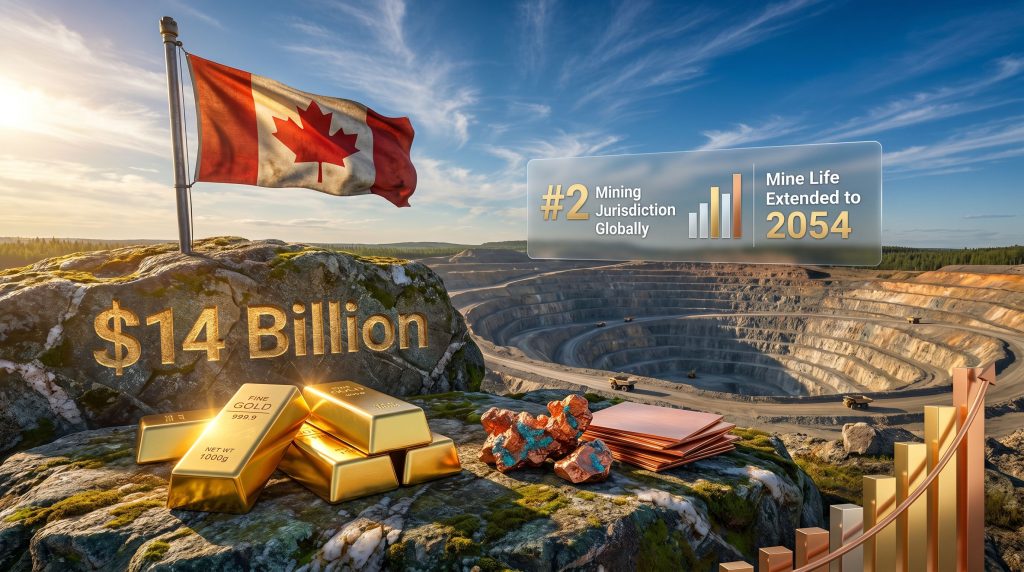
The history of mining capital allocation is, at its core, a history of risk arbitrage. Miners do not simply follow geology; they follow the combination of geology plus governance. For most of the past two decades, this calculation has been tilted by one persistent variable: regulatory uncertainty. Projects with world-class ore bodies have stalled for years under fragmented approval systems, while moderate-grade deposits in administratively efficient jurisdictions have advanced to production ahead of them. This dynamic is now shifting measurably in Ontario, and the Agnico Eagle Ontario investment 14 billion mining assets commitment sits at the centre of this transformation.
The announcement by Canada's largest gold mining company, Agnico Eagle, of a $14-billion commitment to its Ontario operating, development, and exploration assets through 2030 represents more than a capital deployment decision. It is a confidence signal embedded in a broader jurisdictional transformation, one where regulatory design has become as important as mineral endowment in attracting long-duration investment.
When big ASX news breaks, our subscribers know first
Ontario's Permitting Revolution: How Structural Reform Created a Capital Magnet
For years, Ontario's mining approval system was characterised by what industry participants described as ministry-to-ministry fragmentation: overlapping review processes, duplicated information requirements, and inter-agency coordination delays that extended project timelines without corresponding improvements in environmental or consultation outcomes. The result was capital hesitation, particularly for long-horizon projects requiring multi-decade certainty before committing hundreds of millions in development expenditure.
The introduction of the consolidated "One Project, One Process" framework fundamentally restructured this dynamic. Rather than navigating multiple agencies with separate requirements, proponents now move through a unified approval pathway that coordinates ministry input simultaneously rather than sequentially. The mechanics are straightforward, but the capital implications are significant: by eliminating redundant review stages and improving cross-ministry communication protocols, Ontario achieved a 50% reduction in mining permit timelines, a figure that directly influences the net present value calculations underpinning major investment decisions.
Furthermore, the outcomes of this reform have been measurable and internationally recognised. Ontario now holds the position of Canada's top-ranked mining investment jurisdiction, the first time in modern history it has achieved this distinction, and ranks second globally among the most competitive mining destinations worldwide. These rankings reflect assessments of jurisdictional competitiveness that weigh regulatory certainty, permitting efficiency, geological endowment, and infrastructure adequacy simultaneously.
A critical design element of the reformed framework, and one frequently overlooked in regulatory efficiency discussions, is what was preserved rather than removed. The streamlining explicitly maintained rigorous environmental standards and meaningful Indigenous consultation as non-negotiable components of the accelerated process. This distinction matters enormously for major mining companies operating under global ESG frameworks and financing conditions that require demonstrated community and environmental credibility. Speed achieved by removing safeguards creates different risk profiles than speed achieved through process rationalisation; Ontario pursued the latter.
Ontario Energy and Mines Minister Stephen Lecce has characterised the province's positioning as a deliberate strategic objective, describing Ontario as working toward becoming the mining and critical minerals capital of the G7. He frames the Agnico Eagle commitment as a direct validation of the regulatory transformation undertaken to achieve that ambition. The provincial government has also signalled further reform intentions, with an additional package of red tape reduction targeting early and advanced exploration approvals, as well as accelerated mining permits for expansions at existing mine operations.
Regulatory predictability functions as a multiplier on geological endowment. A jurisdiction with average ore grades and stable, efficient approvals will consistently attract more capital than a jurisdiction with superior geology and unpredictable governance. Ontario's reform trajectory demonstrates this principle operating in real time.
The Economics of Permitting Speed
The financial logic connecting permitting speed to capital allocation operates through several distinct mechanisms that are not always intuitive to observers outside the mining industry.
-
Discounted cash flow sensitivity: Mining projects are valued using long-dated cash flow projections. Each year of permitting delay reduces net present value by pushing production revenue further into the future, where discount rates erode its value substantially.
-
Opportunity cost of capital: Capital committed to permitting-stage projects cannot be deployed elsewhere. Faster approvals reduce this holding cost and improve portfolio return metrics for major miners allocating capital across multiple jurisdictions simultaneously.
-
Financing conditions: Project debt financing and streaming arrangements increasingly incorporate permitting risk into pricing. Jurisdictions with proven, efficient approval pathways attract more competitive financing terms, reducing overall project capital costs.
-
Exploration follow-through: When major development projects advance efficiently, junior explorers in the same jurisdiction benefit from demonstrated pathway certainty, increasing the volume of early-stage exploration activity that ultimately feeds the long-term project pipeline.
The Four Asset Pillars: How the Agnico Eagle Ontario Investment 14 Billion Is Deployed
The Agnico Eagle Ontario investment 14 billion commitment is not a single project allocation but a portfolio-level capital programme spanning operating mines, development projects, and exploration activity across one of the world's most geologically productive regions.
| Asset | Investment Scale | Key Production Metric | Projected Timeline |
|---|---|---|---|
| Detour Lake Underground | ~$1 billion | 1M+ oz/y gold (expanded) | Approval pending; mine life to 2054 |
| Upper Beaver | >$1 billion | 210,000 oz/y gold + 3,600 t/y copper | 14-year mine life |
| Macassa Mine | Ongoing capital | Operating production | Through 2030+ |
| Hammond Reef | Ongoing development capital | Under assessment | Through 2030 |
The two flagship development projects, Detour Lake Underground and Upper Beaver, together account for approximately $2 billion of the total commitment, each receiving in excess of $1 billion individually. The remaining capital is distributed across the operating Macassa Mine, Hammond Reef development activities, and exploration programmes across Ontario's broader mineral endowment.
Detour Lake Underground: Extending a Giant into the 2050s
The Detour Lake operation already ranks as one of Canada's largest gold mines by annual output. The underground expansion project moves beyond the existing open-pit configuration to develop ore resources beneath the current surface operation, creating a hybrid open-pit and underground mining system that extends the mine's productive life by multiple decades.
The capital requirement for this underground expansion component stands at approximately $1 billion, a figure that reflects the engineering complexity of developing underground infrastructure concurrent with an active open-pit operation above. This requires precision in mine planning to manage blast vibration management, underground airflow design, ore routing logistics, and workforce safety protocols that are inherently more complex in hybrid configurations than in single-method mines.
The projected outcomes justify this complexity at scale. Upon completion, Detour Lake is forecast to produce more than one million ounces of gold annually, placing it within a globally rare cohort of mines achieving this output threshold. Fewer than a handful of gold mines worldwide consistently produce at the million-ounce scale, making Detour Lake's projected output profile a genuinely exceptional asset in the global gold production landscape.
The mine life extension outcome is equally striking: operations are projected to continue through 2054, representing approximately 28 years of productive life from the announcement date. This duration requires ore reserve adequacy at depth that supports the economics of underground mining methods, which carry higher per-tonne operating costs than open-pit extraction and therefore demand sufficient grade and tonnage to generate acceptable margins over the full mine life.
Employment creation from the underground expansion alone is estimated at approximately 800 direct positions, adding to the substantial workforce already operating the existing open-pit mine.
Upper Beaver: A Dual-Commodity Asset in the Heart of the Abitibi
Located approximately 20 kilometres east of Kirkland Lake within Ontario's portion of the Abitibi Greenstone Belt, Upper Beaver occupies some of the most historically productive gold-bearing geology on the planet. The Abitibi Belt, straddling the Ontario-Quebec border, has produced more gold than any comparable geological formation in the western hemisphere over the past century, and its structural architecture continues to host economically significant deposits at depth.
Upper Beaver's development concept involves redeveloping a legacy mine site into a modern integrated operation combining underground and open-pit extraction methods with a dedicated processing facility. This brownfield development approach provides meaningful advantages: established geological knowledge from prior mining, existing infrastructure foundations that reduce greenfield development costs, and a community familiarity with mining operations that can accelerate social licence processes.
The capital commitment exceeds $1 billion, with a production profile that distinguishes Upper Beaver from a straightforward gold mine. The operation is designed to produce:
-
210,000 ounces of gold per year
-
3,600 tonnes of copper per year
This dual-commodity structure is strategically significant in the current investment environment. Consequently, the broader appeal of gold and copper exploration assets has grown considerably as gold provides the stable, precious metals revenue stream that anchors mine economics, whilst copper production introduces exposure to base metals demand driven by electrical grid expansion, electric vehicle manufacturing, and renewable energy infrastructure buildout.
The projected mine life of 14 years and employment contribution of approximately 800 positions complete a development profile that positions Upper Beaver as a material mid-tier contributor to Agnico Eagle's broader production growth architecture.
Upper Beaver's gold-copper combination is not incidental to its investment case; it is structurally significant. As capital increasingly flows toward assets with critical minerals exposure, a producing mine delivering both precious metals and a key industrial metal occupies a distinctly broadened investment relevance compared to single-commodity gold operations.
Quantifying Ontario's Economic Return: Beyond the Mining Sector
The macroeconomic implications of the Agnico Eagle Ontario investment 14 billion commitment extend well beyond the direct employment and production metrics attached to individual projects.
Direct Economic Contributions
The investment programme is projected to contribute approximately $5 billion to Ontario's gross domestic product, a figure that captures direct mine-site economic activity as well as multiplier effects through supply chain spending, contractor employment, and community economic activation in northern Ontario regions where alternative large-scale private sector investment is limited.
Employment creation follows a two-tier structure. The commitment builds on Agnico Eagle's existing Ontario workforce of more than 4,100 employees, adding up to 1,600 net new direct positions across the investment programme. Combined, this represents a total Ontario workforce exceeding 5,700 when fully deployed, making the company one of northern Ontario's largest private sector employers.
The geographic concentration of this investment in northern Ontario carries particular regional significance. Northern Ontario communities have historically experienced employment volatility tied to commodity price cycles and operational life of individual mines. Long-duration capital commitments extending to 2054 in the case of Detour Lake provide employment and economic stability across generational timeframes that fundamentally alter community planning horizons.
Ontario's Junior Mining Ecosystem: Seeding the Next Generation of Discoveries
Alongside the Agnico Eagle announcement, Ontario Premier Doug Ford revealed a $10-million government investment in a restructured Ontario Junior Exploration Program (OJEP), a programme designed to offset early-stage exploration costs for junior mining companies and licensed prospectors. This funding mechanism operates as a critical complement to major mining investment: while Agnico Eagle's capital develops known deposits, OJEP funding seeds the discovery pipeline that will sustain Ontario's mining sector beyond current project portfolios. In addition, junior exploration incentives at the federal level provide further support for companies active in the region.
The OJEP funding structure operates as follows:
-
Covers up to 50% of eligible exploration and development costs
-
Licensed Ontario prospectors can access up to $65,000 per project (inclusive of Indigenous Participation Support)
-
Junior mining companies are eligible for up to $215,000 per project (inclusive of Indigenous Participation Support)
-
Funding is allocated on a first-come, first-served basis
-
A new Advanced Exploration Stream is scheduled to launch in 2026, targeting earlier-stage project de-risking
The programme's historical track record is substantial. OJEP has committed nearly $45 million to 280 companies to date, with 201 of those companies specifically exploring for critical minerals rather than solely for gold or base metals. This critical minerals concentration reflects a deliberate policy alignment with global supply chain priorities.
The broader strategic context for junior exploration in Ontario is anchored by the Ring of Fire mineral corridor in the province's far north. Premier Ford's announcement explicitly referenced the Ring of Fire's estimated economic potential of $22 billion and up to 70,000 jobs, framing junior exploration investment as a mechanism for unlocking this long-term value through systematic geological delineation and project de-risking.
Ontario's Competitive Position Against Peer Jurisdictions
| Jurisdiction | Mining Investment Ranking | Key Competitive Strength | Notable Challenge |
|---|---|---|---|
| Ontario, Canada | #2 globally | Reformed permitting, Abitibi geology | Remote infrastructure gaps |
| Nevada, USA | Top 5 | Established gold infrastructure | Water availability constraints |
| Western Australia | Top 3 | Gold and lithium endowment | Labour cost pressures |
| Chile | Top 5 | Copper production dominance | Political and regulatory uncertainty |
| South Africa | Declining | Deep-level mining expertise | Energy and infrastructure constraints |
Agnico Eagle's Global Architecture: Ontario's Role in a Multi-Continent Growth Strategy
Understanding the Ontario commitment requires placing it within Agnico Eagle's broader production growth strategy, which targets a 20 to 30% increase in total gold output over the coming decade. The company, which holds the status of both Canada's largest gold mining company and the world's second-largest gold producer by output, operates across a portfolio deliberately concentrated in politically stable, high-rule-of-law jurisdictions. The current gold price outlook further supports this long-horizon capital strategy, as elevated prices improve project economics across the portfolio.
Ontario sits alongside Canadian Malartic expansion activities in Quebec, Hope Bay development in Nunavut, and the San Nicolas mine construction in Mexico as one of several growth anchors within this architecture. The first meaningful production increase from the Ontario development projects is expected around 2030, with the trajectory toward annual output exceeding 4 million ounces projected to materialise through the early-to-mid 2030s.
Ontario's specific advantages within this global portfolio are threefold. First, the Abitibi Greenstone Belt geological endowment provides exceptional resource density within a geologically well-characterised formation, reducing exploration risk relative to frontier geological terrains. Second, existing operational infrastructure across the Detour Lake, Macassa, and Hammond Reef assets reduces greenfield development risk and allows capital to be directed toward production enhancement rather than basic infrastructure establishment. Third, the established northern Ontario mining services ecosystem, encompassing contractors, equipment suppliers, technical specialists, and workforce training infrastructure, lowers operational execution risk compared to remote or underdeveloped mining regions.
Agnico Eagle President and CEO Ammar Al-Joundi has described the company's Ontario operations as a reflection of years of disciplined investment in people, partnerships, and communities, characterising the new commitment as building on an established foundation rather than initiating a new strategic direction. This framing is important for understanding how the $14 billion will be deployed: it flows through existing organisational and community relationships rather than requiring the establishment of entirely new operating platforms. The scale of this commitment has also attracted considerable coverage from financial media, with analysts noting the broader implications for gold M&A activity across the region.
Furthermore, the significance of this commitment extends beyond a single company. Gold M&A activity globally has been accelerating as producers seek to replenish reserves, and Ontario's improved regulatory environment positions it as an increasingly attractive destination for consolidation capital.
The next major ASX story will hit our subscribers first
Indigenous Partnership and Social Licence: The Non-Negotiable Third Pillar
Within the current mining investment paradigm, social licence has completed a transition from aspirational objective to hard capital requirement. Projects lacking demonstrated Indigenous partnership frameworks face financing constraints, permitting complications, and operational disruptions that materially affect investment returns regardless of geological quality. Ontario's regulatory reform explicitly recognises this reality by embedding meaningful Indigenous consultation as a preserved, non-negotiable element within the streamlined approval process.
The OJEP's funding structure reinforces this at the exploration stage through its Enhanced Indigenous Participation Support component, which is embedded within both the prospector and junior company funding tiers. This design signals that Indigenous participation is expected from the earliest stages of mineral exploration rather than being introduced as a requirement at the permitting or development stage, when relationships are harder to establish and project timelines are more constrained.
Agnico Eagle's stated commitment to Indigenous reconciliation and skills development as core elements of its Ontario growth strategy reflects industry recognition that long-duration operations in northern Ontario require sustained community relationships that extend across project lifecycles measured in decades. Community benefit agreements, employment and training programmes, and equity participation frameworks are increasingly standard components of project social licence architecture in the Canadian north.
The Ontario government's investment strategy has noted that the industry's momentum in the province reflects not only the regulatory improvements but also the strength and stability of its workforce and community relationships, suggesting that the human and social capital dimensions of Ontario mining competitiveness are viewed by industry participants as complementary to, rather than separate from, the regulatory improvements driving capital attraction.
Disclaimer: This article contains forward-looking statements and projections regarding mine production, economic impact, employment creation, and project timelines. These projections are based on information available at the time of reporting and are subject to change based on regulatory approvals, commodity price movements, reserve assessments, and other variables. This article does not constitute financial or investment advice. Readers should conduct independent due diligence before making any investment decisions.
Want to Capitalise on the Next Major Mining Discovery Before the Market Does?
Discovery Alert's proprietary Discovery IQ model delivers real-time alerts on significant ASX mineral discoveries — transforming complex geological data into actionable investment insights the moment announcements hit the exchange, much like the transformative projects reshaping Ontario's mining landscape today. Explore historic discoveries and their exceptional returns on Discovery Alert's dedicated discoveries page, and begin your 14-day free trial to position yourself ahead of the broader market.