
July 3, 2026
The El Indio Gold Belt: A Mineral Corridor Defined by Geology, Geopolitics, and Unresolved Risk
Few mineral provinces in the world generate as much sustained strategic interest as the high-altitude corridors of the central Andes. For decades, the intersection of geological fortune and operational adversity has shaped how major miners engage with these systems, advancing cautiously, retreating when necessary, and rarely surrendering land positions entirely. Barrick exploration near El Indio mine and Pascua-Lama sits at the centre of this tension.
Understanding what drives continued interest in this corridor requires looking well beyond any single corporate announcement and into the structural forces that make this one of the most complex, contested, and potentially rewarding mineral frontiers in Latin America. Furthermore, the broader geopolitical mining landscape adds yet another layer of complexity to strategic decision-making in the region.
When big ASX news breaks, our subscribers know first
Understanding the Geological and Commercial Significance of the El Indio Belt
The El Indio gold belt is not a project. It is a structurally continuous mineral system — a multi-hundred-kilometre corridor of epithermal and porphyry mineralisation that has produced some of the highest-grade gold and silver ore bodies ever documented in the Andes. The legacy deposits include the historic El Indio mine itself, the Tambo system, and the Pascua-Lama deposit straddling the Chilean-Argentine border.
What makes the El Indio belt particularly significant from a geological standpoint is the grade profile of its mineralisation. High-sulphidation epithermal systems of this type can generate exceptionally rich ore shoots where silica and sulphide alteration intersects with structural conduits. The El Indio mine, which operated from the late 1970s through the mid-1990s, produced gold at grades that were extraordinary even by the standards of that era, with some ore zones reporting values well above 10 grams per tonne gold equivalent.
That kind of endowment does not disappear when a mine closes. It signals that the district-scale system capable of producing such concentrations almost certainly contains additional targets that remain undrilled or incompletely evaluated.
The El Indio gold belt is not a single mine or project. It is a structurally continuous mineral corridor with multiple past-producing centres and undrilled targets, making it one of the more prospective but operationally challenging exploration frontiers in South America.
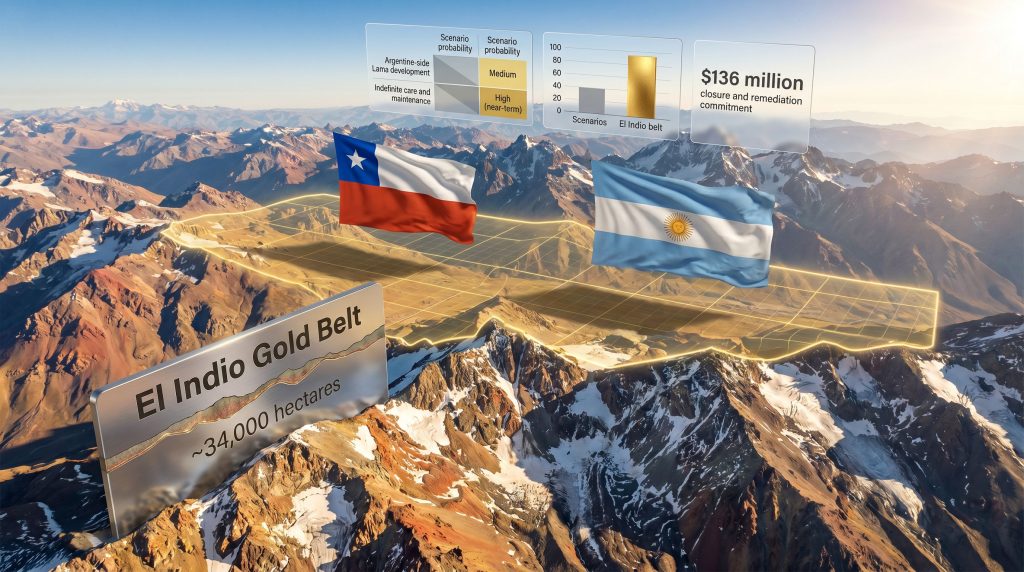
For Barrick Gold, which has maintained a significant land position across the El Indio belt, the strategic logic of continued engagement reflects a broader corporate philosophy: world-class geological systems are rare. Barrick's reported holding of approximately 34,000 hectares across the belt represents a commitment to that optionality model, maintaining exposure to district-scale discovery potential at a cost basis that remains manageable relative to the potential resource upside.
What Barrick's Renewed Exploration Activity in the El Indio Belt Actually Signals
Barrick's Land Position and the Logic of District Consolidation
In the language of major mining corporations, describing a district as holding very substantial upside for new mineral discoveries is not casual commentary. It reflects a considered assessment of geological prospectivity relative to exploration coverage — an acknowledgement that a system capable of hosting known deposits of the scale and grade found in the El Indio corridor is statistically likely to contain additional mineralisation that has not yet been systematically tested.
Barrick's renewed exploration focus in the El Indio belt operates across three distinct modes that investors and industry observers should understand separately:
- Greenfield exploration targets geological structures and geochemical anomalies in areas with limited or no previous drilling, seeking entirely new discoveries within the broader belt footprint.
- Brownfield target testing revisits geological zones adjacent to or structurally connected with known deposits, applying modern interpretation techniques to data sets that may have been incompletely evaluated in earlier exploration cycles.
- Project re-evaluation involves reassessing previously drilled or partially developed targets in light of updated resource modelling, commodity price assumptions, or metallurgical understanding.
The El Alto project, the most publicly visible current focus of Barrick's activity in the region, sits geographically proximate to the Pascua-Lama project footprint, which gives it both strategic relevance and political sensitivity. Its location within the same high-altitude belt means any meaningful exploration programme in that zone will attract scrutiny from environmental regulators, Indigenous communities, and civil society organisations.
Reading the Signals: Exploration Language and Corporate Intent
For investors attempting to interpret what Barrick's continued engagement with the El Indio belt actually means, the key distinction is between active conviction and passive optionality management. A company can maintain a large land position, conduct periodic exploration drilling, and make optimistic statements about district potential while simultaneously allocating the majority of its capital to more immediately developable assets elsewhere.
The signals worth monitoring include:
- Exploration expenditure allocated to the El Indio corridor relative to Barrick's total exploration budget
- The pace and targeting of drilling programmes, whether focused near sensitive zones or displaced toward less contested targets within the belt
- Any formal project study activity — scoping, prefeasibility, or definitive feasibility studies — which would indicate a transition from exploration optionality to development intent
- Community engagement and consultation processes, which often precede formal permitting applications by several years
The Pascua-Lama Overhang: How a Stalled Project Reshapes Every Strategic Decision in the Region
Understanding the Legal and Environmental Baseline
Any analysis of Barrick exploration near El Indio mine and Pascua-Lama that does not begin with an honest accounting of the project's current status risks misrepresenting the strategic landscape. Chile's environmental tribunal system issued orders that effectively halted construction and later required the project to move into a closure and remediation framework, citing failures in water management systems designed to protect glacier meltwater flows.
Barrick has accepted that ruling and committed approximately $136 million toward closure and remediation activities, including site stabilisation, water flow restoration, and environmental monitoring. The reclassification of Pascua-Lama from an active reserve to a closure-stage project in Barrick's financial disclosures is not a minor accounting adjustment. It represents a fundamental shift in how the company characterises the asset, from a future revenue-generating resource to a liability requiring managed expenditure.
The Argentine-Side Lama Component: Residual Optionality in a Constrained System
The binational structure of the Pascua-Lama project means that the Chilean and Argentine sides of the deposit are legally and operationally distinct, even though the ore body they collectively contain is geologically unified. The Argentine component, sometimes referred to as the Lama portion, retains a degree of development optionality that the Chilean side does not, primarily because it does not carry the same judicial closure orders.
Barrick has previously explored the concept of an underground mining approach as a potential pathway to access Argentine-side ore bodies. However, this concept introduces its own set of challenges:
- Underground development in high-altitude Andean terrain at elevations above 4,000 metres involves extreme logistical complexity and elevated capital costs
- The binational treaty framework governing Pascua-Lama creates governance complications that affect decision-making on either side of the border independently
- Water management at depth in periglacial environments requires engineering solutions that are still being developed and tested in comparable global contexts
- Financing an underground development scenario in a corridor carrying Pascua-Lama's reputational history would require demonstrating a fundamentally different risk profile to capital providers
Scenario Analysis: Pathway Probabilities for the Pascua-Lama Zone
| Scenario | Jurisdiction | Development Model | Primary Constraint | Near-Term Probability |
|---|---|---|---|---|
| Full open-pit restart | Chile | Surface mining | Environmental court orders; glacier laws | Very Low |
| Underground alternative | Chile | Underground | Permitting complexity; community opposition | Low |
| Argentine-side Lama development | Argentina | Open-pit or underground | Binational treaty; financing requirements | Medium |
| Selective greenfield drilling away from sensitive zones | Both | Exploration only | Minimal, subject to permit conditions | High |
| Indefinite care and maintenance | Both | Closure management | Capital allocation decisions | High (near-term) |
| Full closure and asset write-down | Both | Environmental remediation | Regulatory finality timeline | Medium (long-term) |
Note: Probability assessments above are analytical interpretations based on publicly available regulatory, legal, and operational context. They do not constitute investment advice or forward guidance from Barrick Gold.
Environmental and Indigenous Rights Barriers: The Structural Constraints on Exploration Outcomes
Glacier Protection Frameworks and the Water Scarcity Dynamic
Chile's legal framework for protecting glaciers and periglacial environments represents one of the most significant structural constraints on high-altitude mining development anywhere in South America. The country's environmental impact assessment system requires detailed glaciological impact studies for any project operating near or above the periglacial zone, and environmental tribunals have demonstrated a willingness to enforce these requirements against major operators.
The political salience of these frameworks has been amplified significantly by the sustained drought conditions affecting the Atacama and Central Andes regions over the past decade. When glacier and snowpack systems are visibly diminishing, any industrial activity near those systems faces an elevated level of public and regulatory scrutiny. This is not simply a legal compliance question; it is a political economy dynamic that shapes how mining proposals are received at every level.
Indigenous Community Opposition and the Post-Pascua-Lama Legal Environment
Community opposition to renewed exploration activity near the El Indio and Pascua-Lama zones carries a legal weight that should not be underestimated. Chile ratified ILO Convention 169 on Indigenous and Tribal Peoples in 2008, which establishes a framework for Free, Prior and Informed Consent processes that must be conducted before activities affecting Indigenous territories can proceed.
In the post-Pascua-Lama regulatory environment, these processes are not procedural formalities; they are substantive legal obligations that courts have upheld as grounds for suspending or blocking project advancement. Indeed, Indigenous communities in Chile have specifically framed renewed exploration activity in glacier-sensitive areas as a potential repetition of the governance failures that led to the original project's suspension.
In the post-Pascua-Lama regulatory environment, Indigenous community opposition in Chile is not merely a public relations consideration. It represents a legally actionable constraint that has previously contributed to project suspension at the highest levels of the Chilean court system.
How the El Indio Belt Compares to Other High-Altitude Andean Mining Frontiers
Regional Benchmarking: Key Comparisons Across Andean Districts
| Metric | El Indio Belt (Chile/Argentina) | Yanacocha District (Peru) | Veladero (Argentina) |
|---|---|---|---|
| Primary Metals | Gold, Silver, Copper | Gold, Silver | Gold, Silver |
| Altitude Range | ~4,000 to 5,000m+ | ~3,800 to 4,100m | ~4,000 to 4,500m |
| Regulatory Complexity | High (Chile); Moderate (Argentina) | High | Moderate to High |
| Community Conflict History | High (Pascua-Lama legacy) | High (Conga project) | Moderate |
| Major Operator | Barrick Gold | Newmont | Barrick Gold |
| Current Stage | Exploration and Closure Review | Operating and Transitioning | Operating |
| Multi-Metal Endowment | Strong (Au, Ag, Cu) | Moderate (Au, Ag) | Moderate (Au, Ag) |
The comparison reveals an important pattern: Barrick has demonstrated consistent willingness to operate in high-altitude, high-complexity Andean environments. The El Indio belt's multi-metal endowment — combining gold, silver, and copper potential within a single structural system — provides a diversification of economic drivers that purely gold-focused districts cannot offer, which strengthens the case for long-term tenure even through extended periods of regulatory constraint.
The next major ASX story will hit our subscribers first
Four Strategic Scenarios That Could Reshape Barrick's El Indio Exploration Programme
Scenario 1: Regulatory Normalisation in Chile
A shift in Chile's approach to high-altitude mining regulation — whether through legislative amendment, new geological survey frameworks, or changes in how environmental courts interpret glacier protection obligations — could meaningfully alter the development calculus for El Indio belt projects. Regulatory change of this kind typically operates on timelines measured in years to decades, making it a long-duration scenario that supports land position maintenance without near-term development commitment.
Scenario 2: Argentine-Side Acceleration
Argentina's mining policy trajectory under recent administrations has generally been more accommodating of foreign mining investment than Chile's. Furthermore, the Argentine side of the Pascua-Lama-adjacent zone does not carry the same judicial closure burden. Consequently, if commodity prices remain supportive, the Lama component could emerge as an independent development pathway, subject to resolution of binational treaty complexity and infrastructure constraints specific to the Argentine Andean zone.
Scenario 3: Community Partnership as an Enabling Framework
In several Latin American jurisdictions, structured benefit-sharing and co-governance arrangements with Indigenous and local communities have unlocked previously stalled projects. However, whether this model is applicable in the El Indio context depends on whether community opposition is primarily rooted in economic exclusion — which can often be addressed through revenue sharing — or in environmental protection, which is a fundamentally different kind of objection that benefit-sharing alone cannot resolve.
Scenario 4: Long-Term Maintenance with Selective Greenfield Drilling
The most likely near-term pathway is continued low-intensity exploration activity targeted at geological structures within the broader belt footprint that are not proximate to the most sensitive glacier and periglacial zones. This approach allows Barrick to maintain geological understanding, generate drill results that inform future development planning, and demonstrate active land stewardship without triggering the regulatory and community opposition dynamics associated with Pascua-Lama-adjacent activity.
What This Means for Investors and the Broader Gold Sector
Interpreting Exploration Signals Through an Investor Framework
For investors tracking Barrick's El Indio belt activity, the key analytical challenge is distinguishing between genuine development conviction and optionality management. A $136 million closure cost commitment on the Chilean side of Pascua-Lama establishes a sunk-cost baseline that inevitably influences how Barrick frames the economics of any future development in the corridor.
The company must generate a credible path to returns that more than offsets that expenditure base before any new development proposal will attract the capital support needed to advance. In addition, broader gold M&A activity across global markets continues to shape how major operators like Barrick allocate capital between active development and strategic land position maintenance.
The language Barrick uses in investor communications about district-scale upside and exploration potential should be assessed against three benchmarks:
- Capital allocation: Is actual exploration expenditure increasing in the El Indio corridor, or is the language outpacing the spending?
- Permitting activity: Are formal environmental or community consultation processes being initiated, which would indicate genuine development intent?
- Resource disclosure: Are exploration results being incorporated into updated resource estimates, or are they being held as qualitative data pending further work?
The ESG Dimension: High-Altitude Mining in a Changed Investment Environment
The post-ESG era has fundamentally altered how institutional capital evaluates high-altitude, glacier-adjacent mining proposals. Projects that might have attracted straightforward financing in the 1990s now face a layered due diligence process that incorporates environmental liability exposure, community consent status, regulatory risk, and reputational considerations alongside conventional project economics.
This does not make the corridor uninvestable. However, it does mean that the risk-adjusted return profile for any El Indio belt project must be proportionately stronger than for a comparable project in a lower-complexity jurisdiction. Consequently, the timeline from exploration to production decision is structurally longer than industry averages for more permissive environments. These dynamics closely mirror the broader gold sector challenges facing major operators navigating complex regulatory environments worldwide.
Frequently Asked Questions: Barrick Exploration Near El Indio Mine and Pascua-Lama
What is the current status of the Pascua-Lama project?
The Chilean side of Pascua-Lama is subject to environmental closure orders and is in an active remediation phase, with Barrick having committed approximately $136 million to closure activities including water flow restoration and site stabilisation. The Argentine-side Lama component retains a degree of optionality but faces significant governance and infrastructure constraints. No active development timeline exists for either component as of mid-2026.
How large is Barrick's land position in the El Indio gold belt?
Barrick holds approximately 34,000 hectares across the El Indio belt spanning Argentina, Chile, and Peru, representing one of the largest consolidated land packages in this high-altitude Andean mineral corridor.
What is the El Alto project and how does it relate to Pascua-Lama?
El Alto is a separate exploration target within the El Indio belt that is geographically proximate to the Pascua-Lama footprint. Its location within the same structurally sensitive zone means it attracts similar environmental and community scrutiny, making its permitting pathway subject to many of the same constraints that affected the original Pascua-Lama development.
Why did Pascua-Lama fail to advance in Chile?
The project was halted by Chile's environmental tribunal system primarily due to documented failures in water management infrastructure designed to protect glacier meltwater flows, compounded by sustained community opposition from Indigenous and local stakeholder groups and broader public concern about glacier impact.
Is Barrick still actively exploring in the El Indio belt?
Yes. Barrick is maintaining its land position and conducting selective exploration activity within the broader belt, though the pace and geographic targeting of that activity are shaped by regulatory sensitivities, community dynamics, and the reputational legacy of Pascua-Lama. Active exploration is most likely being focused on targets that are structurally disconnected from the most sensitive periglacial zones.
Key Takeaways: The El Indio Belt as a Long-Duration Strategic Challenge
Barrick exploration near El Indio mine and Pascua-Lama is not a simple story of a major miner reviving a stalled project. It is a multi-decade strategic management challenge shaped in equal measure by geological endowment, legal constraints, community rights, and the evolving ESG expectations of global capital markets. The mining industry consolidation trends currently reshaping global markets further complicate how long-duration assets like the El Indio belt are valued and repositioned within major operator portfolios.
The four scenarios outlined above span a wide range of outcomes — from near-term care and maintenance through to genuine development advancement — and each carries a different probability weighting depending on how regulatory, political, and community dynamics evolve across Chile and Argentina over the coming years.
What remains constant across all scenarios is the geological reality that underlies Barrick's continued engagement with this corridor. High-sulphidation epithermal systems of the El Indio belt's calibre are genuinely rare, and the district-scale prospectivity embedded in a 34,000-hectare land position in a proven mineral province does not diminish simply because near-term development is constrained. For patient capital and long-horizon strategic thinkers, that geological foundation is precisely why the El Indio belt will remain a closely watched, frequently contested, and strategically significant mineral corridor for decades to come.
This article is intended for informational purposes only and does not constitute investment advice. Forward-looking statements, scenario analyses, and probability assessments reflect analytical interpretation of publicly available information and should not be relied upon as predictive of actual outcomes. Readers should conduct independent due diligence before making any investment decisions related to companies or projects discussed herein.
Want to Stay Ahead of Significant ASX Mineral Discoveries Before the Broader Market?
Discovery Alert's proprietary Discovery IQ model delivers real-time alerts on high-potential ASX mineral announcements — cutting through complex geological and commodity data to surface actionable opportunities the moment they emerge. Explore how historic discoveries have generated extraordinary returns on Discovery Alert's dedicated discoveries page, and begin your 14-day free trial today to position yourself ahead of the market.