August 25, 2026
The Abitibi Gold Belt and the Economics of Strategic Proximity
Few geological formations on earth have generated as much gold wealth as the Abitibi Greenstone Belt in northern Quebec and Ontario. Stretching roughly 700 kilometres across the Canadian Shield, this Archean-era terrane hosts some of the most productive gold camps ever discovered, including Timmins, Val-d'Or, and Kirkland Lake. Within this belt, the Larder Lake-Cadillac Break functions as a crustal-scale fault corridor along which gold-bearing hydrothermal fluids have been channelled and deposited over billions of years. Understanding this structural architecture is essential context for evaluating why the Agnico investment in Radisson Mining's O'Brien mine carries significance that extends well beyond the headline dollar figure.
The Larder Lake-Cadillac Break is not simply a geological feature; it is a proven delivery mechanism for high-grade gold mineralisation. Mines distributed along its length have collectively produced hundreds of millions of ounces of gold, and the structural setting continues to attract the most sophisticated capital in the global mining industry. When a senior producer with Agnico Eagle's regional knowledge commits C$57.2 million to a junior operating along this exact structure, the geological rationale is as important as the financial one.
When big ASX news breaks, our subscribers know first
Agnico Eagle's Quebec Cluster and Why Proximity Creates Value
Agnico Eagle (TSX, NYSE: AEM) is Canada's largest gold producer by output and market capitalisation, and its operational footprint in Quebec is substantial. The company operates LaRonde, Canadian Malartic, and Goldex, all within the Abitibi region. This clustering is not coincidental. Operating multiple assets within a defined geographic area generates compounding advantages: shared infrastructure, overlapping geological databases, common workforce and contractor networks, and the ability to transfer ore processing capacity between sites when conditions allow.
For a junior developer like Radisson Mining Resources (TSXV: RDS; US-OTC: RMRDF), proximity to this cluster carries a valuation premium that is difficult to quantify through standard financial models alone. When a major producer already possesses deep familiarity with the surrounding geology, nearby processing facilities, and established community relationships, the due diligence barrier to investment is meaningfully lower. The Agnico investment in Radisson Mining's O'Brien mine reflects precisely this dynamic: a senior producer acquiring optionality on a high-grade asset that sits within its existing operational sphere.
A Century-Old Mine With Modern-Scale Potential
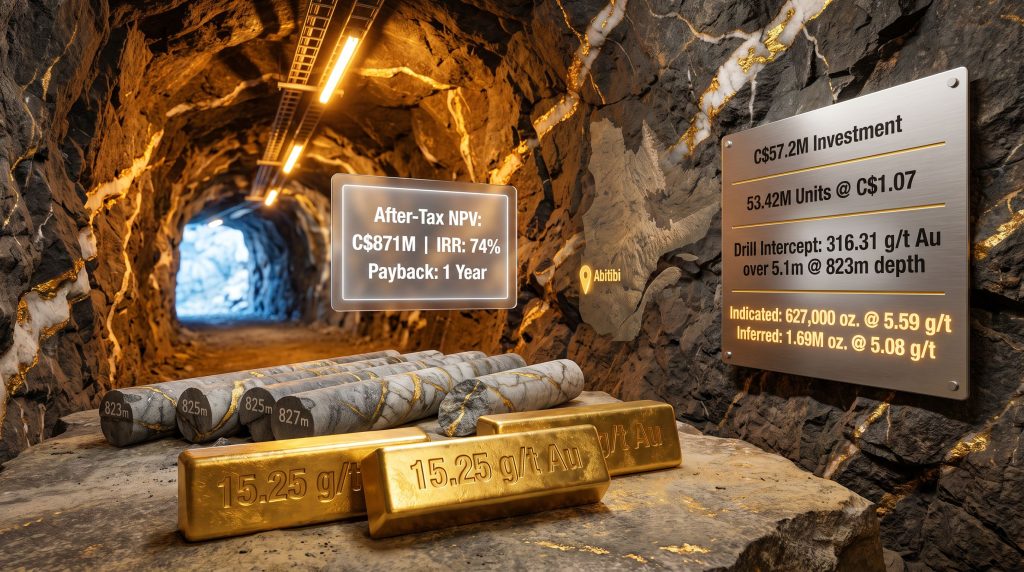
The O'Brien mine's historical production statistics remain remarkable by any contemporary benchmark. Between 1926 and 1957, the operation extracted approximately 587,000 ounces of gold from 1.2 million tonnes of ore grading an extraordinary 15.25 grams of gold per tonne. To contextualise that figure: most operating underground gold mines today consider grades above 5 g/t Au to be high-grade. A 15.25 g/t historical average places O'Brien in a category occupied by only a handful of mines globally across the entire modern era of hard rock mining.
It is worth understanding why historical mines of this calibre attract renewed attention in elevated gold price environments. When gold traded at US$300 to US$400 per ounce, projects with complex underground geometries and modest scale were often marginal or uneconomic. At US$3,300 per ounce, the economic calculus shifts dramatically. Tonnes that were once sub-economic become attractive, and high-grade historical producers become prime candidates for redevelopment using modern mining technology, improved ground control methods, and updated ventilation and water management systems. Furthermore, current gold market strategies increasingly favour assets with exceptional historical pedigree in proven geological corridors.
The O'Brien project is situated in the Bousquet-Cadillac mining camp, approximately 470 kilometres northwest of Montreal along the Larder Lake-Cadillac Break. This positioning places it squarely within a well-understood geological district with established infrastructure corridors, an experienced regional workforce, and a permitting environment that is familiar to the industry's major participants.
Breaking Down the C$57.2 Million Deal Structure
The mechanics of the Agnico investment in Radisson Mining's O'Brien mine reward careful examination, because the structure reveals as much about the strategic intent as the dollar amount does.
| Parameter | Detail |
|---|---|
| Total Investment (CAD) | C$57.2 million (C$57,159,400) |
| Total Investment (USD) | US$41.4 million |
| Units Purchased | 53.42 million units |
| Price Per Unit | C$1.07 (6% premium to prior close) |
| Unit Composition | 1 common share + ½ warrant |
| Full Warrant Exercise Price | C$1.39 per share |
| Warrant Term | 60 months post-closing |
| Agnico Stake (Non-Diluted) | ~10.45% |
| Agnico Stake (Partially Diluted) | Up to 14.90% |
The 6% premium to the prior closing price is a meaningful signal. Strategic investors do not pay premiums without conviction. The unit structure, combining a common share with a half-warrant exercisable at C$1.39 for five years, gives Agnico Eagle a long-dated right to deepen its position at a defined price if the project continues to deliver positive results. This is optionality in its purest financial form: a low-cost right to acquire more exposure as uncertainty resolves.
The governance provisions embedded in the agreement are equally significant. Agnico receives board nomination rights, participation rights in future financing rounds, and certain restrictions on property transactions, royalty grants, streaming arrangements, and secured financings that persist through December 31, 2028. These protections reflect a structured relationship designed to ensure alignment over the critical development window rather than a passive financial position that could be diluted or repositioned at the junior's discretion.
Agnico's decision to include property transaction restrictions through 2028 signals an intent to monitor and participate in the asset's development trajectory, not merely collect share price appreciation from the sidelines.
How the Capital Will Be Deployed Underground
The C$57.2 million will fund the first modern underground access programme in O'Brien's history. No underground development has been conducted at the site using contemporary methods, which means the capital unlocks an entirely new category of data and resource definition capability. The planned development sequence progresses as follows:
- Engineering and permitting initiation for underground access infrastructure, commencing immediately after closing.
- Access ramp construction, providing physical entry to the underground environment for the first time under a modern operational framework.
- Development of underground workings and associated surface facilities to support sustained underground operations.
- Water management system installation, a critical component for any underground operation in the Abitibi region, where historical mines encountered significant groundwater at depth.
- Geological and geotechnical data collection, using modern instrumentation and analysis to build a three-dimensional understanding of ore continuity, rock mechanics, and mining conditions.
- Continuation of the 140,000-metre surface drill campaign, which proceeds in parallel and remains fully funded independently of the underground programme.
The toll milling arrangement at the nearby Doyon facility is a strategically important element of the capital efficiency equation. Rather than constructing a dedicated processing plant, Radisson's preliminary economic assessment assumes ore will be processed at an existing facility, materially reducing the upfront capital requirement and compressing the timeline to cash flow generation.
The 2025 PEA: Dissecting the Economic Case
The July 2025 preliminary economic assessment (PEA) for O'Brien, conducted using a gold price assumption of US$3,300 per ounce, produced metrics that stand out even within a sector that has benefited substantially from elevated gold prices.
| Economic Metric | Value |
|---|---|
| After-Tax NPV (5% Discount Rate) | C$871 million |
| Internal Rate of Return (IRR) | 74% |
| Payback Period | 1 year |
| Planned Mine Life | 11 years |
| Initial Capital Cost | C$175 million |
| Mine Type | Underground |
| Processing Method | Toll milling (Doyon) |
A 74% after-tax IRR is an exceptional figure. For context, most underground gold development projects that advance to feasibility study stage in Canada achieve IRRs in the 20% to 40% range under their base case gold price assumptions. A 74% IRR, even at a relatively elevated gold price input, reflects a combination of genuinely high resource grades, capital-efficient processing through toll milling, and the relatively modest initial capital requirement of C$175 million for an 11-year mine life.
The one-year payback period is particularly significant for risk-conscious investors. It implies that the project recovers its entire initial capital outlay within the first year of production, leaving a decade of largely unencumbered cash flow thereafter. This compresses the timeline over which investors bear capital recovery risk, which is one of the primary reasons high-IRR projects attract major producer attention. Investors interested in a broader view of the gold miners outlook will recognise this type of project as precisely the kind that commands institutional interest at scale.
It is important to note that PEA-level economics are preliminary in nature and carry material uncertainty. The estimates are based on inferred mineral resources that are considered too speculative geologically to have economic considerations applied to them under NI 43-101 guidelines, and actual results may differ substantially. Consequently, a definitive feasibility study will be required before any production decision can be reached.
Resource Scale: The 82% Surge in Inferred Ounces
The March 2025 resource update for O'Brien represented a material inflection point in the project's development narrative. Inferred contained metal increased by 82% to reach 1.69 million ounces, a growth rate that few advanced exploration projects achieve between successive resource estimates.
| Resource Category | Tonnes | Grade (g/t Au) | Contained Gold (oz.) |
|---|---|---|---|
| Indicated | 3.49 million t | 5.59 g/t | 627,000 oz. |
| Inferred | 10.4 million t | 5.08 g/t | 1.69 million oz. |
The grade profile across both categories is notable. An indicated grade of 5.59 g/t Au and an inferred grade of 5.08 g/t Au substantially exceed the industry average for underground gold deposits globally. Most underground gold operations that advance to production carry resource grades in the 3 to 5 g/t range. O'Brien's resource grades at the high end of or above this range reflect the geological continuity of the original high-grade system that made the historical mine so productive.
For investors tracking re-rating catalysts in the junior gold sector, a near-doubling of inferred ounces in a single update is precisely the type of milestone that transforms market perception of a project's scale potential. Combined with the subsequent PEA results and the Agnico strategic investment, these sequential catalysts represent a textbook example of how high-grade junior gold projects accumulate institutional attention. In addition, the gold M&A activity seen across major markets in 2025 further underscores how senior producers are actively seeking exactly this kind of high-grade development asset.
The next major ASX story will hit our subscribers first
Record Drill Results and the Significance of Depth
The drill results that emerged during the June 17 to July 15, 2026 reporting period reinforced the project's credentials in the most direct way possible: through exceptional assay data from deep in the system.
Drill hole OB-26-385W4 intersected 5.1 metres grading 316.31 g/t Au from 823 metres downhole, including a 1-metre interval at 1,603.95 g/t Au. This interval was recorded as the highest single assay ever returned from the O'Brien mine and ranked as the top gold assay globally for the reporting period.
How Should These Results Be Interpreted?
The width-times-grade value of 1,613 for this intercept requires explanation for readers unfamiliar with how geologists assess underground drill results. Width times grade is a composite metric that captures both the physical thickness of a mineralised interval and its gold concentration simultaneously. It functions as a rough proxy for the economic significance of a single intercept. Interpreting gold drill results of this nature requires an understanding that a narrow, ultra-high-grade result and a wider, moderate-grade result can share a similar width-times-grade value, but their mining implications differ substantially depending on the minimum mining width constraints of the deposit.
For O'Brien, a 5.1-metre true width at 316 g/t from 823 metres depth is significant for two reasons. First, it confirms that the high-grade system persists at meaningful depth, well below the historical mining horizon. Second, it suggests that the transition from surface drilling to underground development will provide access to mineralisation that surface drill holes can only approximate.
Market Reaction: What the Share Price Movement Reveals
Radisson Mining's shares closed at C$1.24 on the day of the announcement, a gain of 21% from the prior close and an all-time high for the company. The implied market capitalisation at that price was approximately C$557 million.
| Share Price Data Point | Value |
|---|---|
| 52-week low | C$0.53 |
| Announcement day close | C$1.24 |
| Intraday gain on announcement day | +21% |
| Implied market cap post-announcement | ~C$557 million |
| Deal unit price | C$1.07 (6% premium to prior close) |
The move from a 52-week low of C$0.53 to C$1.24 represents a gain of approximately 134% from the year's trough. This magnitude of re-rating in a junior gold stock following a major producer strategic investment is not uncommon, but it does raise an important valuation question: how does the post-announcement market capitalisation compare to the PEA-derived NPV?
At C$557 million market capitalisation against a C$871 million after-tax NPV at a 5% discount rate, Radisson trades at approximately 64 cents on the PEA-derived NPV dollar. This is within the range that the junior gold market typically ascribes to projects at the PEA stage, where significant execution risk, resource conversion uncertainty, and financing risk remain. Furthermore, as reported by BNN Bloomberg, the deal drew immediate attention from institutional observers tracking major producer activity in the junior space.
Strategic Scenarios: From Minority Stake to Potential Operator
The Agnico investment in Radisson Mining's O'Brien mine is best understood not as a terminal position but as a structured entry point along a potential development continuum. Three plausible scenarios emerge from the deal's architecture:
| Scenario | Trigger | Probability Horizon |
|---|---|---|
| Continued minority position | Underground data gathering phase underperforms expectations | Near-term (1-2 years) |
| Increased stake post-2028 | Strong underground results confirm resource scale and mining conditions | Medium-term (2-4 years) |
| Full acquisition or joint venture | PEA upgraded to feasibility; production decision made | Long-term (4-7 years) |
The staged nature of this investment reflects a broader industry pattern among senior gold producers. Full acquisitions of junior developers carry immediate balance sheet impact and integrate all execution risk onto the acquirer's books. A structured strategic minority position with governance rights, participation rights, and option-like warrant coverage achieves many of the same strategic objectives at a fraction of the cost and risk.
Senior producers increasingly use staged strategic placements as a tool for acquiring optionality on high-grade assets while preserving balance sheet flexibility, a trend that reshapes how junior developers should think about partnership structures.
What Junior Investors Can Learn From This Deal's Architecture
The structure of the Agnico-Radisson transaction contains several instructive elements for investors who track strategic placement activity in the junior gold sector:
- Warrants with five-year terms are not standard in all private placements. A 60-month exercise window signals Agnico's expectation that value realisation at O'Brien will unfold over a multi-year development horizon rather than a near-term trading opportunity.
- Board representation rights tied to ownership thresholds create accountability mechanisms that protect the strategic investor's interests throughout the development phase, reducing the risk of management decisions that conflict with shareholder value.
- Property transaction restrictions through 2028 effectively prevent Radisson from entering into royalty or streaming agreements that would encumber the asset without Agnico's involvement, preserving the project's economics in their current form for the critical data-gathering period.
- Participation rights in future financings ensure Agnico can maintain its ownership percentage as Radisson raises additional capital, protecting against dilution of the strategic stake as the project advances.
These structural features collectively create a framework that aligns the interests of the strategic investor and the development company over an extended time horizon, which is precisely what a project of O'Brien's complexity requires.
FAQ: Agnico Eagle Investment in Radisson Mining's O'Brien Mine
What is Agnico Eagle's ownership stake in Radisson Mining after this deal?
Following closing, Agnico Eagle is expected to hold approximately 10.45% of Radisson Mining on a non-diluted basis, rising to up to 14.90% on a partially diluted basis if all warrants are exercised at C$1.39 per share within the 60-month exercise window.
What will the C$57.2 million be used for at the O'Brien project?
The capital is designated to fund the first modern underground access programme at O'Brien, covering construction of an access ramp, underground workings, surface infrastructure, and water management systems, alongside the continuation of the 140,000-metre surface drill programme already underway.
What were the historical production statistics of the O'Brien mine?
Between 1926 and 1957, the O'Brien mine produced approximately 587,000 ounces of gold from 1.2 million tonnes of ore at an average grade of 15.25 grams of gold per tonne, ranking among the highest-grade historical production records in the Abitibi region.
How does O'Brien's PEA compare to other Canadian gold development projects?
The July 2025 PEA, using a gold price of US$3,300 per ounce, returned an after-tax NPV of C$871 million, a 74% IRR, and a one-year payback on C$175 million in initial capital. These metrics compare favourably against most underground gold development projects currently advancing through the Canadian pipeline, though readers should note that PEA-stage estimates carry significant uncertainty and should not be relied upon as indicators of final project outcomes.
Does Agnico Eagle have governance rights through this investment?
Yes. The agreement grants Agnico Eagle board nomination rights contingent on maintaining required ownership thresholds, participation rights in future financing rounds, and restrictions on property transactions, royalties, and secured financings through December 31, 2028.
This article does not constitute financial advice. All investment decisions should be made in consultation with a qualified financial adviser. Preliminary economic assessments contain forward-looking statements and material uncertainties; actual results may differ substantially from those projected.
Want to Catch the Next Major ASX Gold Discovery Before the Market Does?
Discovery Alert's proprietary Discovery IQ model delivers real-time alerts the moment significant mineral discoveries hit the ASX, turning complex geological and financial data into clear, actionable insights for investors of all experience levels. Explore Discovery Alert's dedicated discoveries page to understand how early positioning in high-grade discoveries has historically generated substantial returns, and begin your 14-day free trial today to secure your market-leading edge.