August 25, 2026
Understanding AI's Exponential Energy Consumption Crisis
The intersection of artificial intelligence development and global energy infrastructure represents one of the most significant technological challenges of the 21st century. As AI and nuclear power convergence emerges as a critical solution, renewable energy sources alone are proving insufficient to meet the unprecedented electricity demands of modern computational workloads. These AI operations require consistent, high-capacity electricity that challenges current grid infrastructure capabilities.
Furthermore, nuclear power technology offers characteristics that align closely with AI infrastructure requirements: continuous baseload generation, minimal carbon emissions, and operational reliability across decades-long timeframes. This convergence has attracted substantial attention from technology companies, energy investors, and policy makers seeking sustainable solutions for exponential growth trajectories.
Quantifying Data Center Power Demands
The scale of energy consumption required for artificial intelligence operations extends far beyond traditional computing applications. Modern AI data centers consume electricity at rates that challenge existing grid planning methodologies and infrastructure capacity. Training sophisticated machine learning models requires sustained gigawatt-scale power availability, creating demand patterns unprecedented in the technology sector.
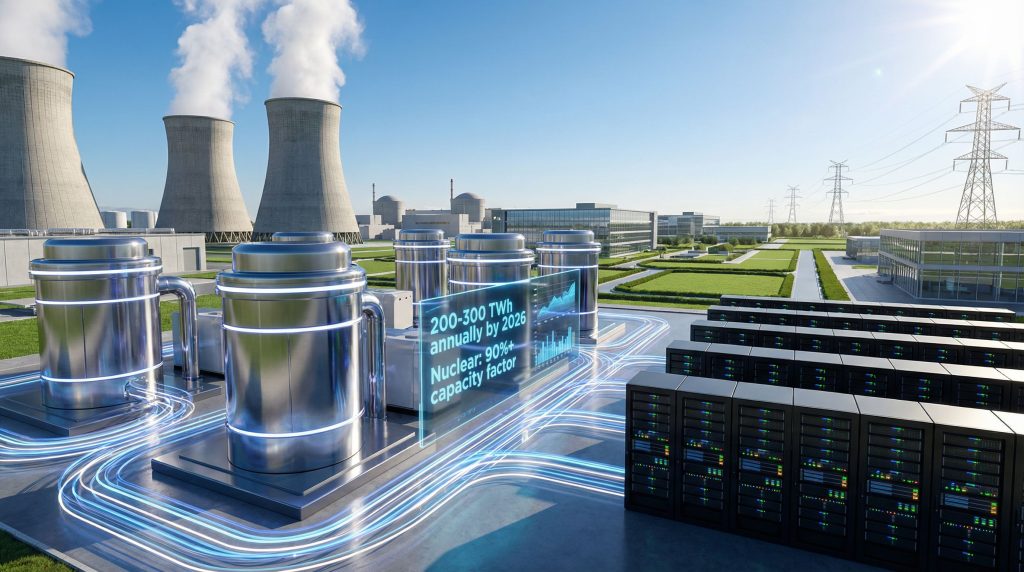
Current projections suggest AI-specific data center operations could reach 200-300 terawatt-hours annually by 2026, representing a substantial portion of global electricity demand growth. This figure reflects not just the expansion of existing facilities, but the emergence of entirely new categories of computational workloads that operate continuously rather than following traditional peak-and-valley demand cycles.
| Data Center Type | Average Capacity Factor | Power Density (MW/facility) | Operational Pattern |
|---|---|---|---|
| Traditional Cloud | 40-60% | 10-50 MW | Variable demand |
| AI Training Facilities | 85-95% | 100-500 MW | Continuous baseload |
| Hyperscale Mixed-Use | 65-75% | 50-200 MW | Predictable cycles |
Geographic clustering of these facilities creates localised grid stress points that exceed transmission infrastructure capabilities. Regions with high concentrations of AI development, including Northern Virginia, the San Francisco Bay Area, and parts of Texas, have documented transmission constraints that limit further expansion of power-intensive operations.
Why Traditional Grid Infrastructure Falls Short
Electrical grid systems were designed around predictable demand patterns that follow daily, weekly, and seasonal cycles. Traditional industrial and residential electricity use demonstrates relatively consistent peak and low-demand periods that enable effective grid management through conventional generation dispatching methods.
However, understanding uranium market dynamics becomes crucial as AI workloads fundamentally disrupt these established patterns by requiring continuous, high-level power consumption without the cyclical variations that grid operators rely upon for system balancing. Machine learning model training operates around the clock, creating baseload demand characteristics that strain grid infrastructure designed for more variable consumption profiles.
Transmission bottlenecks represent another critical constraint limiting AI expansion in high-demand regions. Existing power lines and distribution networks lack sufficient capacity to deliver the concentrated electricity supplies that large AI facilities require, particularly when multiple data centers cluster in geographically proximate areas.
The intermittent nature of renewable energy sources creates additional complexity for AI operations that cannot tolerate power interruptions or quality variations during critical computational processes.
Load balancing challenges intensify when combining AI's constant demand with grid systems that increasingly rely on variable renewable generation. Wind and solar power output fluctuations require sophisticated energy storage systems or backup generation capacity to maintain grid stability, adding infrastructure costs and complexity to AI deployment strategies.
When big ASX news breaks, our subscribers know first
What Makes Nuclear Power the Optimal Solution for AI Infrastructure?
Baseload Reliability vs. Intermittent Alternatives
Nuclear power plants achieve capacity factors exceeding 90% in most developed markets, meaning they operate at or near full output more than 330 days per year. This reliability characteristic aligns closely with AI computing requirements for uninterrupted power supply across extended operational periods.
In contrast, renewable energy sources demonstrate significantly lower capacity factors due to weather dependency and seasonal variations. Additionally, examining US uranium production insights reveals how domestic supply chains support this reliability:
- Solar power: 25-27% capacity factor in most regions
- Onshore wind: 35-37% average capacity factor
- Offshore wind: 50%+ capacity factor (limited geographic availability)
- Nuclear power: 90%+ capacity factor consistently
The technical requirements for grid frequency stability add another dimension favouring nuclear generation for AI applications. Large synchronous generators, including nuclear turbines, provide inherent inertia that helps maintain electrical frequency within acceptable operational ranges. This grid stabilisation function becomes increasingly valuable as electrical systems integrate higher percentages of inverter-based renewable generation.
Seasonal energy availability represents a fundamental challenge for renewable-dependent AI operations. Solar output varies by 30-50% between summer and winter in temperate regions, while wind resources show substantial geographic and temporal variability that cannot match AI's consistent demand profile.
Small Modular Reactor Technology for Distributed AI Operations
Small Modular Reactors represent a technological evolution specifically suited to distributed energy applications including AI data centre support. These systems offer capacity ranges from 50-300 MW, matching the scale requirements of large AI facilities while providing deployment flexibility not available with traditional nuclear plants.
Key SMR advantages for AI integration include:
- Reduced construction timelines (6-8 years vs. 12-15 years for conventional nuclear)
- Modular scalability enabling capacity expansion as AI operations grow
- Enhanced safety systems with passive cooling capabilities
- Factory fabrication reducing on-site construction complexity
- Smaller physical footprint enabling co-location with data centres
The passive safety systems incorporated in modern SMR designs eliminate requirements for external power or operator intervention during emergency conditions. These features provide additional operational security for critical AI infrastructure that cannot tolerate extended power interruptions.
Deployment timelines for SMR technology remain optimistic despite current regulatory and commercial challenges. Leading designs are progressing through licensing processes with target commercial operation dates in the late 2020s to early 2030s, coinciding with projected peak demand growth for AI infrastructure.
Which Nuclear Technologies Are Best Suited for AI Data Centers?
Generation IV Reactor Designs and AI Integration
Advanced reactor technologies offer enhanced capabilities that extend beyond traditional electricity generation, potentially providing integrated energy services for AI facilities. High-temperature gas-cooled reactors operate at 700-900°C, enabling both electricity production and industrial process heat applications that could support AI data centre cooling systems.
Molten salt reactor designs demonstrate theoretical advantages for load-following operations, potentially matching variable computational demands more effectively than conventional nuclear plants. However, these technologies remain in development phases with commercial deployment timelines extending into the 2030s or beyond.
Fast breeder reactor technology offers superior fuel efficiency characteristics that could support long-term AI operations with reduced uranium supply requirements. Current operating examples include Russia's BN-800 reactor and India's Prototype Fast Breeder Reactor, though these represent specialised deployments rather than commercial-scale technology.
Microreactor applications for edge computing facilities represent an emerging intersection between nuclear technology and distributed AI operations. These systems, rated at 1-50 MW capacity, could support smaller-scale AI applications in remote locations or provide backup power for critical computational infrastructure.
Hybrid Energy Systems: Nuclear Plus Storage Solutions
Integration of nuclear generation with energy storage technologies creates operational flexibility that can optimise both electricity costs and system reliability for AI facilities. Nuclear plants can produce electricity continuously while storage systems provide peak shaving capabilities and grid services that enhance overall economic performance.
Battery storage integration enables several operational benefits:
- Peak demand shaving to reduce electricity costs
- Grid frequency regulation services providing additional revenue
- Backup power during nuclear plant maintenance periods
- Power quality improvement for sensitive AI equipment
Hydrogen production during periods of low electricity demand represents another hybrid system opportunity. Nuclear-powered electrolysis can create hydrogen fuel for backup generation systems, transportation applications, or industrial processes, diversifying revenue streams beyond direct electricity sales.
Thermal energy storage applications leverage nuclear plants' continuous heat production for industrial processes including data centre cooling systems. These integrated approaches maximise energy utilisation efficiency while reducing overall infrastructure costs for AI operations.
How Are Major Tech Companies Implementing Nuclear-AI Strategies?
Corporate Power Purchase Agreements and Direct Investment
Microsoft's partnership with Constellation Energy represents the most significant nuclear-AI integration announced to date. Their 20-year power purchase agreement for the restart of Three Mile Island Unit 1 provides approximately 1.6 GW of dedicated nuclear capacity specifically for Microsoft's data centre operations, with expected commercial operation beginning in 2028.
This agreement establishes a precedent for corporate nuclear procurement that differs fundamentally from traditional renewable energy partnerships. The extended contract duration and dedicated capacity allocation reflect recognition that AI and nuclear power integration requires longer-term energy security than conventional cloud computing operations.
Google's investments in advanced reactor development focus on fusion energy technology rather than conventional nuclear fission. Their partnership with Commonwealth Fusion Systems targets commercial fusion deployment in the early 2030s, representing a longer-term strategic approach to nuclear-powered AI infrastructure.
Amazon's nuclear strategy remains less defined compared to other technology giants, with the company continuing to emphasise renewable energy procurement and grid electricity purchases for its expanding AI operations. However, the scale of Amazon's computational requirements suggests future nuclear partnerships are likely as AI workloads continue growing.
On-Site vs. Off-Site Nuclear Deployment Models
Co-location of nuclear generation with AI data centres offers operational advantages including reduced transmission losses, enhanced energy security, and simplified grid interconnection requirements. However, regulatory frameworks for nuclear facilities adjacent to commercial operations remain complex and vary significantly across jurisdictions.
Security considerations for nuclear-adjacent data centres include:
- Physical security coordination between nuclear and technology infrastructure
- Cybersecurity protocols protecting both nuclear control systems and AI operations
- Emergency response planning integrating both facility types
- Regulatory oversight from both nuclear and technology sector agencies
Remote nuclear plant deployment connected through dedicated transmission infrastructure provides alternative approaches for technology companies seeking nuclear-powered AI operations. This model enables nuclear development in optimal locations while serving distributed AI facilities through power purchase agreements and grid connections.
Cost-benefit analysis for proximity versus grid-connected nuclear operations varies significantly based on transmission infrastructure availability, local regulatory environments, and specific operational requirements of AI facilities.
What Are the Investment Implications for Nuclear Fuel Markets?
Uranium Supply Chain Dynamics
Global uranium production reached approximately 136.2 million pounds in 2023, concentrated among a limited number of producing countries including Kazakhstan (43% of global output), Namibia (11%), and Uzbekistan (7%). This geographic concentration creates supply chain vulnerabilities that could intensify as nuclear demand expands to support AI infrastructure.
Recent uranium price movements reflect growing recognition of supply-demand fundamentals favouring nuclear fuel producers. Market prices have fluctuated between $70-83 per pound as of late 2025, representing substantial increases from historical lows but remaining below peak levels experienced in previous uranium cycles.
Key uranium supply considerations include:
- Limited development of new uranium mines due to extended low-price periods
- Depletion of secondary uranium supplies from decommissioned weapons programmes
- Increased geopolitical focus on secure uranium supply chains
- Growing nuclear capacity globally beyond AI-specific demand
The timeline for new uranium mine development typically extends 7-12 years from initial exploration through commercial production, creating potential supply constraints as nuclear demand accelerates. Existing mines operate near capacity levels, limiting short-term production increases without substantial capital investment.
Fuel Cycle Infrastructure Requirements
Uranium enrichment capacity represents a critical bottleneck in nuclear fuel supply chains, with global enrichment services concentrated among a small number of facilities operated primarily by Russia, European countries, and the United States. Expanding nuclear deployment for AI applications will require additional enrichment capacity that currently does not exist.
Fuel fabrication capabilities must also expand to support increased nuclear capacity, particularly for advanced reactor designs that require specialised fuel forms. Small modular reactors and Generation IV technologies often utilise fuel configurations different from conventional power plant requirements, necessitating new manufacturing capabilities.
Nuclear waste management solutions become increasingly important as nuclear capacity expands to support AI infrastructure. Long-term storage facilities and potential recycling technologies will require substantial investment and regulatory development to support sustainable nuclear growth.
Current recycling technologies for nuclear fuel remain limited in most markets, though France and other countries operate commercial reprocessing facilities. Expanded nuclear deployment may justify additional investment in fuel recycling infrastructure to optimise uranium utilisation and reduce waste volumes.
Which Geographic Regions Will Lead Nuclear-AI Integration?
Regulatory Environment Assessment
The United States has implemented regulatory reforms including the ADVANCE Act, which streamlines licensing processes for advanced nuclear technologies including small modular reactors. These changes specifically target deployment timelines and regulatory predictability for private nuclear investment, creating favourable conditions for nuclear-AI integration.
European Union regulatory developments include:
- Nuclear technology classification as "green" investments under EU taxonomy rules
- Streamlined licensing procedures for Generation IV reactor demonstrations
- Increased funding for nuclear research and development programmes
- Enhanced coordination between national nuclear regulatory authorities
Asia-Pacific markets demonstrate accelerated nuclear deployment schedules, particularly in China and South Korea where government support and established nuclear industries enable faster project development. China's HTR-PM reactor achieved criticality in 2020, representing the most advanced Generation IV commercial deployment globally.
Emerging markets including the United Arab Emirates and Saudi Arabia are developing nuclear capabilities as part of broader economic diversification strategies that could support AI infrastructure development in these regions.
Infrastructure Development Timelines by Region
North American nuclear-AI integration could begin with Microsoft's Three Mile Island restart in 2028, followed by potential SMR deployments in the early 2030s as licensing processes complete and commercial technologies become available. However, this development occurs within broader energy transition challenges across the region.
European timelines focus on Generation IV reactor demonstrations through the 2028-2032 period, with commercial deployments potentially following in the subsequent decade. However, complex regulatory environments and public acceptance challenges may extend these timelines beyond current projections.
Asian markets demonstrate more aggressive deployment schedules:
- China: Multiple advanced reactor projects under construction with 2025-2030 commercial operation dates
- South Korea: SMR development programmes targeting late 2020s deployment
- India: Fast breeder reactor programme expansion supporting growing AI sector
Resource availability mapping shows uranium-rich regions including Australia, Kazakhstan, and parts of Africa positioned to benefit from increased nuclear fuel demand driven by AI infrastructure expansion.
The next major ASX story will hit our subscribers first
What Challenges Must Be Overcome for Widespread Adoption?
Technical Integration Barriers
Cybersecurity protocols for nuclear-digital infrastructure represent unprecedented technical challenges requiring coordination between nuclear security experts and AI system developers. Nuclear control systems traditionally operate in isolation from external networks, while AI operations require extensive connectivity and data exchange capabilities.
Critical cybersecurity considerations include:
- Air-gapped nuclear control systems maintaining isolation from AI networks
- Secure data transmission protocols between nuclear and AI operations
- Personnel security clearances for integrated facility operations
- Incident response procedures coordinating nuclear and cyber security teams
Skilled workforce requirements span both nuclear engineering and artificial intelligence disciplines, creating talent acquisition challenges for organisations pursuing integrated nuclear-AI strategies. Educational programmes and training initiatives must develop curricula addressing both technical domains.
Standardisation needs for modular reactor designs could accelerate deployment timelines and reduce costs through economies of scale. However, current SMR technologies represent diverse approaches with limited standardisation across designs and manufacturers.
Grid interconnection standards for distributed nuclear assets require development of technical specifications enabling safe and reliable operation of small nuclear plants connected to electrical distribution systems rather than transmission networks.
Economic and Financial Considerations
Capital cost comparisons between nuclear and renewable-plus-storage alternatives vary significantly based on project scale, location, and technology specifications. Nuclear projects typically require higher upfront investment but provide longer operational lifespans and more predictable energy costs over time.
Understanding how governments approach this challenge through their critical minerals strategy becomes essential for comprehensive planning. Key financial metrics for nuclear-AI projects include:
- Levelised cost of electricity over 60-year nuclear plant lifespans
- Financing availability for nuclear projects with extended payback periods
- Carbon pricing impact on nuclear competitiveness relative to fossil alternatives
- Technology risk allocation between nuclear vendors and AI operators
Risk allocation models for public-private partnerships must address the unique challenges of combining nuclear technology with private sector AI operations. Traditional nuclear financing often involves government ownership or substantial public sector involvement, while AI companies typically pursue private sector investment approaches.
Long-term nuclear investments require financial structures accommodating decades-long operational commitments that extend beyond typical technology sector planning horizons. Power purchase agreements, government loan guarantees, and specialised nuclear financing mechanisms may be necessary to support nuclear-AI integration.
How Will This Transformation Impact Global Energy Markets?
Fossil Fuel Displacement Scenarios
Nuclear-powered AI infrastructure could accelerate retirement of natural gas peaker plants and coal-fired power stations in regions with high concentrations of AI data centres. The baseload characteristics of nuclear generation reduce requirements for flexible fossil fuel backup capacity during periods of high AI electricity demand.
Potential fossil fuel displacement impacts include:
- Reduced natural gas consumption for electricity generation in AI-intensive regions
- Accelerated coal plant retirements as nuclear capacity expands
- Lower petroleum demand from electrification of data centre backup systems
- Carbon emissions reductions potentially reaching 2-4 gigatons CO2 annually by 2035
Oil demand implications from nuclear-powered AI operations extend beyond direct electricity generation to include reduced diesel fuel consumption for backup generators and decreased transportation fuel requirements for fuel delivery to alternative generation facilities.
Carbon emissions reduction potential represents one of the most significant environmental benefits of AI and nuclear power integration, particularly compared to scenarios where AI growth drives increased natural gas or coal consumption for electricity generation.
Investment Flow Redirections
Venture capital allocation toward nuclear technology startups has increased substantially as investors recognise the potential for nuclear-AI convergence. Companies developing advanced reactor technologies, nuclear fuel cycle innovations, and integrated energy systems have attracted significant private investment.
Traditional energy companies are pivoting toward nuclear development through partnerships with technology companies, acquisition of nuclear technology startups, and development of nuclear expertise within existing organisations. This development coincides with broader discussion around maintaining a strategic minerals reserve to support energy security.
Infrastructure investment strategies include:
- Pension funds and sovereign wealth funds increasing nuclear asset allocations
- Technology companies developing internal nuclear capabilities
- Energy utilities expanding nuclear capacity for corporate customers
- Government investment programmes supporting nuclear-AI integration
Long-term nuclear assets provide investment characteristics attractive to institutional investors seeking stable, inflation-protected returns over extended time horizons. Nuclear power plants typically operate for 60+ years with predictable cash flow patterns that match infrastructure investment requirements.
What Does the Future Hold for Nuclear-Powered AI Infrastructure?
Technology Roadmap Through 2035
Advanced manufacturing techniques for nuclear reactor components could significantly reduce construction costs and deployment timelines for nuclear-AI projects. Modular construction, factory fabrication, and standardised designs represent key technology trends supporting faster nuclear deployment.
AI is consuming more power than the grid can handle, making AI-optimised reactor control systems crucial for offering potential operational improvements including predictive maintenance, automated safety systems, and enhanced efficiency optimisation. Machine learning applications within nuclear plant operations could improve capacity factors and reduce operational costs.
Fusion energy timeline for next-generation AI facilities remains uncertain but could provide transformative energy capabilities for the largest AI operations. Commercial fusion deployment could begin in the mid-2030s if current development programmes achieve technical and economic targets.
Quantum computing integration with nuclear power systems represents a longer-term technological convergence that could enable more sophisticated reactor control systems and optimisation algorithms for nuclear-AI facility integration.
Market Size Projections and Economic Impact
Global nuclear-AI market valuation could reach $500 billion or more by 2035 based on current technology development trends and AI growth projections. This market size reflects both nuclear generation capacity and supporting infrastructure including fuel cycle services, advanced materials, and specialised equipment.
Economic impact estimates include:
- Job creation across nuclear engineering, AI development, and supporting industries
- GDP contribution in regions leading nuclear-AI integration
- Supply chain transformation requirements for nuclear component manufacturing
- Educational and training programme development supporting workforce needs
Regional economic benefits will likely concentrate in areas with favourable regulatory environments, existing nuclear expertise, and proximity to AI development centres. Countries investing early in AI and nuclear power integration may gain competitive advantages in the evolving global technology landscape.
Investment requirements for nuclear-AI infrastructure development could exceed current nuclear industry capacity, necessitating expansion of manufacturing capabilities, engineering expertise, and financial resources dedicated to nuclear technology advancement. Furthermore, as nuclear might be the answer to addressing AI's energy crisis, strategic planning becomes increasingly critical for sustainable growth.
Disclaimer: This analysis contains forward-looking projections and speculative assessments regarding nuclear technology development and AI infrastructure requirements. Actual outcomes may differ significantly from discussed scenarios due to technological, regulatory, economic, and market factors. Nuclear investments involve substantial risks including regulatory changes, construction delays, and technology performance uncertainties. Investors should conduct thorough due diligence and consult qualified professionals before making nuclear-related investment decisions.
Ready to Capitalise on the Nuclear Energy Renaissance?
Discovery Alert's proprietary Discovery IQ model delivers instant notifications on uranium and energy sector discoveries across the ASX, helping investors identify opportunities in the nuclear supply chain before broader market recognition. With major tech companies committing billions to nuclear-powered AI infrastructure, explore Discovery Alert's track record of identifying significant mineral discoveries and begin your 30-day free trial today to position yourself ahead of this transformative energy transition.